China now produces more industrial robots, installs more of them, and ships more humanoid robots than any other country. What is less visible from the outside is how the industry is actually organized: which companies make the reducers, servos and sensors that determine a robot's performance ceiling, which ones build the machines, and which ones put them to work on production lines.
This map lays out the full chain as Chinese industry analysts see it: 21 key segments across the upstream, midstream and downstream, and 128 company entries that anchor them. It is adapted from a Chinese-language industry chain survey published in October 2026, drawing on data from China's National Bureau of Statistics, the Ministry of Industry and Information Technology (MIIT), the China Robot Industry Alliance and listed-company annual reports. Where figures refer to a specific reporting period, we say so.
The big picture
China's robotics industry runs on a three-tier structure: upstream core components and materials, midstream robot manufacturing and embodied intelligence, and downstream system integration and application. It is the most complete robotics industrial system in the world, and in 2025 it hit three milestones at once.
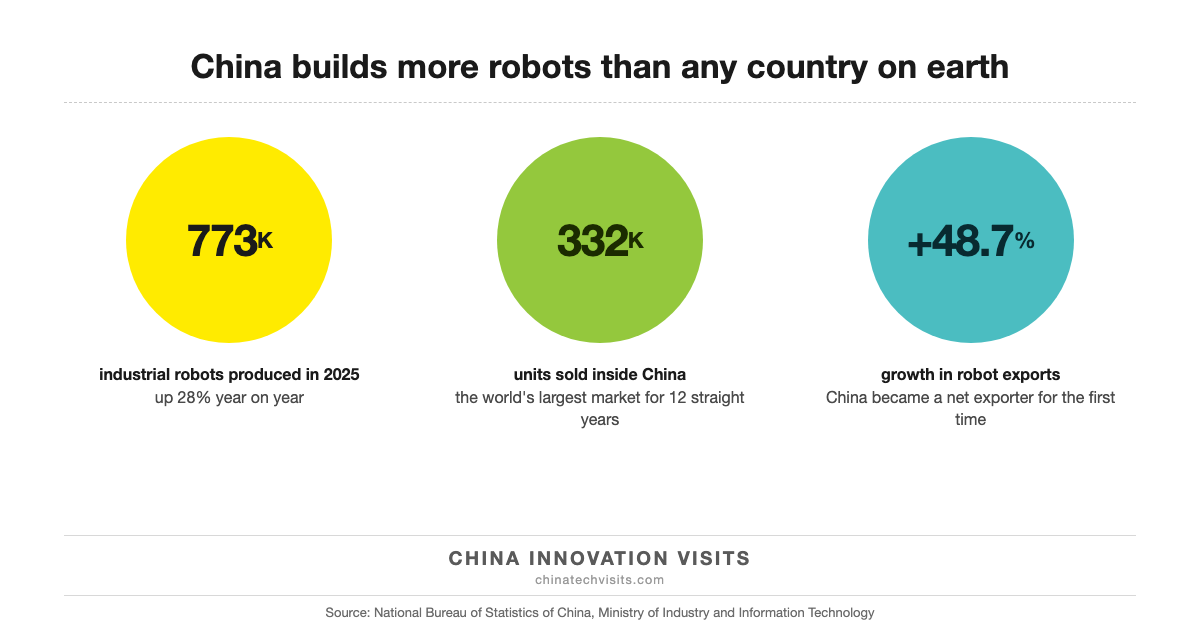
Scale. China produced 773,000 industrial robots in 2025, up 28 percent year on year, and 18.58 million service robots, up 16.1 percent and nearly double the 2022 level, according to the National Bureau of Statistics. Domestic sales of industrial robots came to roughly 332,000 units, keeping China the world's largest application market for the twelfth consecutive year. Robot density in manufacturing is expected to reach 500 units per 10,000 workers, third highest globally. For the first time, China exported more industrial robots than it imported: exports grew 48.7 percent in 2025, making the country a net exporter.
Companies. Annual revenue of robotics enterprises above designated size passed CNY 300 billion, with average growth above 20 percent over the past five years. More than 1.086 million robot-related enterprises are registered in China, including a record 261,000 newly registered in 2025 alone. In humanoid robots specifically, more than 140 whole-machine makers have released over 330 models; shipments reached about 14,400 units in 2025,84.7 percent of the global total, for a market of roughly CNY 1.55 billion. Unitree shipped more than 5,500 humanoids for a 32.4 percent global share, the world number one, and AgiBot rolled its 10,000th general-purpose embodied robot off the line.
Policy. The national framework is a three-layer system of central guidance, standards and local funds. MIIT's humanoid robot guideline (2023) set targets of mass production by 2025 and a secure, complete supply chain by 2027. At the end of 2025, MIIT's standardization technical committee for humanoid robots and embodied intelligence was established and published the first standards system covering the full chain and full lifecycle. "Embodied intelligence" has been written into the government work report as a future industry to cultivate, and Shanghai, Shenzhen and Beijing have each set up dedicated industry funds.
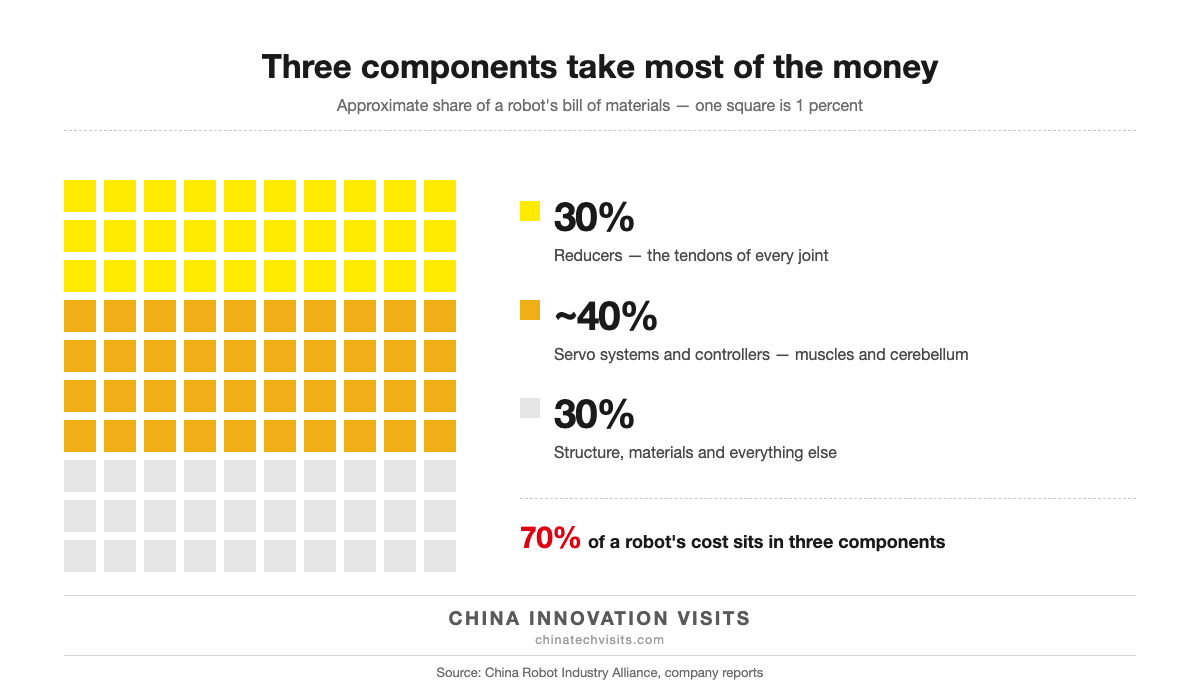
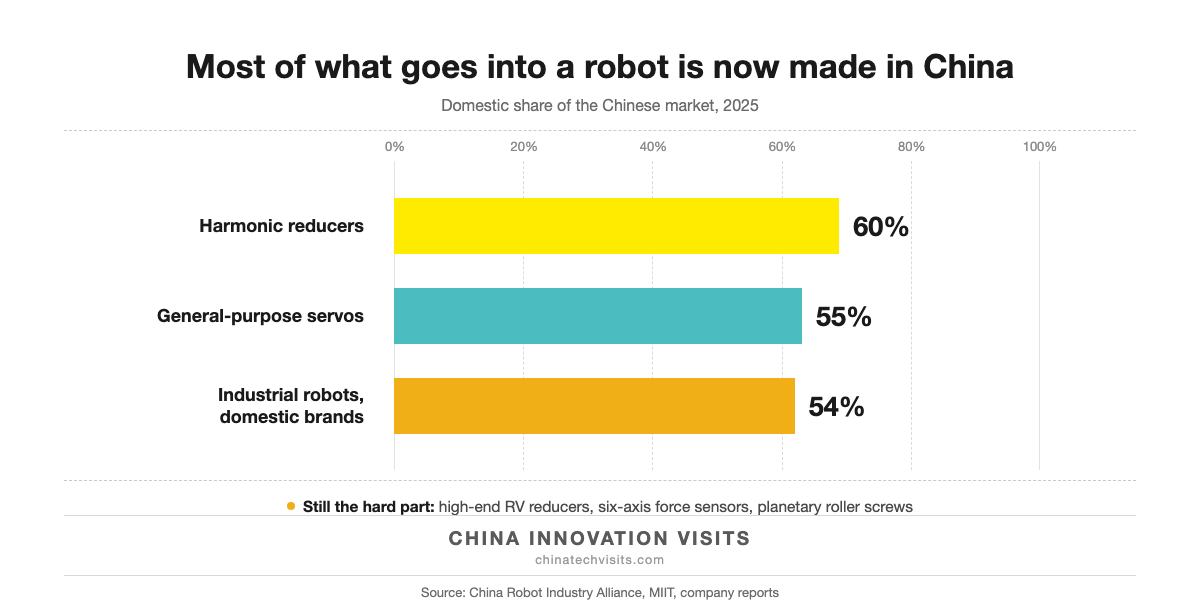
One structural fact frames everything below: the three core components — reducers, servo systems and controllers — account for roughly 70 percent of a robot's bill of materials, and they are where China's localization push is most intense. Harmonic reducers are now about 60 percent domestically supplied and general servos about 55 percent, while high-end RV reducers, six-axis force sensors and planetary roller screws are still in breakthrough stage.
Upstream: core components and materials
The upstream determines a robot's performance ceiling and cost structure. Eight segments matter.
1. Precision reducers
Reducers are the tendons of a robot joint — about 30 percent of total machine cost — and they set joint precision and service life. Domestic suppliers now hold roughly 60 percent of the harmonic reducer market, with Leaderdrive and Shuanghuan Driveline forming a two-leader duopoly at the top of the segment.
- Leaderdrive (688017.SH, Suzhou) — 2024 revenue CNY 387 million, up 8.77 percent; world's number two in harmonic reducers and China's top shipper with 27.5 percent domestic share.
- Shuanghuan Driveline (002472.SZ, Taizhou) — domestic leader in RV reducers, migrating automotive gear technology into a full harmonic + RV + planetary lineup.
- Laifual Drive (03952.HK, Suzhou) — 2025 revenue CNY 260.9 million, up 142.2 percent; China's number two harmonic shipper with 21.4 percent share.
- Zhongda Leader (002896.SZ, Ningbo) — integrated reducer + motor + driver maker, running planetary and RV lines in parallel.
- Guomao (603915.SH, Changzhou) — general gearbox leader moving into precision planetary and harmonic reducers.
- Han's Precision Transmission (unlisted, Shenzhen) — Han's Laser subsidiary building harmonic reducers and integrated joint modules.
- Qinchuan Machine Tool (000837.SZ, Baoji) — machine-tool veteran with mass-produced RV reducers and deep precision-gear process heritage.
2. Servo motors and drives
The servo system — motor, drive and encoder — is the robot's muscle. China's general servo market was about CNY 21.9 billion in 2025. Inovance holds first place with 28.3 percent share, and the domestic supply rate of roughly 55 percent is expected to reach 65 percent by 2027.
- Inovance Technology (300124.SZ, Shenzhen) — 2024 revenue CNY 37.04 billion, up 21.77 percent; China's number one in general servos with 28.3 percent share.
- HCFA (688320.SH, Quzhou) — integrated servo + PLC maker, leader of the domestic second tier.
- Estun Automation (002747.SZ, Nanjing) — 2024 revenue CNY 4.01 billion; over 80 percent self-supplied servos, with robotics and motion control as twin main businesses.
- Leadshine (002979.SZ, Shenzhen) — motion control plus stepper/servo motors, leading low-to-mid-range import substitution.
- Jiangsu Leili (300660.SZ, Changzhou) — micro-motor leader with deep positions in robot joint motors and coreless motors.
- Kinco (688160.SH, Shanghai) — low-voltage servos and frameless torque motors for mobile and collaborative robots.
- Moons' Electric (603728.SH, Shanghai) — global leader in stepper motors; coreless motors now going into humanoid dexterous hands.
3. Motion controllers and industrial control
The controller is the robot's cerebellum: trajectory planning, interpolation and real-time motion control. It determines how usable a robot is. Import substitution has moved fast in general motion control; high-end multi-axis coordinated controllers still trail foreign suppliers.
- Googol Technology (301510.SZ, Shenzhen) — 2024 revenue CNY 418 million, up 3.36 percent; domestic motion-control leader, substituting into semiconductors and high-end CNC equipment.
- Inovance Technology (300124.SZ, Shenzhen) — platform vendor across PLC and motion control with a full-stack industrial automation offering.
- STEP Electric (002527.SZ, Shanghai) — robot controllers plus elevator controls; self-developed Sigri robot brand.
- Estun Automation (002747.SZ, Nanjing) — self-developed robot controllers and motion-control algorithms as part of a fully in-house chain.
- Peitian Robotics (unlisted, Beijing) — ZTE-affiliated maker with self-developed robot bodies and controllers.
- Huazhong CNC (300161.SZ, Wuhan) — high-end CNC systems leader extending motion control into robotics.
4. Sensors and encoders
Sensors are the robot's five senses — vision, force, touch and position encoding — and they set perception and working precision. China leads in 3D vision localization; six-axis force sensors and high-precision encoders remain the hard targets.
- Orbbec (688322.SH, Shenzhen) — 2024 revenue CNY 564 million, up 56.79 percent; 3D vision perception leader with top robot 3D-vision shipments.
- Keli Sensing (603662.SH, Ningbo) — weighing-sensor leader building out six-axis force and robot torque sensing.
- OPT Machine Vision (688686.SH, Dongguan) — world number two in machine-vision lighting, with a full 3D vision and industrial camera line.
- Hanwei Electronics (300007.SZ, Zhengzhou) — gas and flexible sensor leader moving flexible tactile sensing into robotics.
- Haozhi Industrial (300503.SZ, Guangzhou) — electric spindles and precision transmission, with positions in harmonic reducers, encoders and force control.
- Yuheng Optics (unlisted, Changchun) — domestic leader in optical encoders, with a leading share of servo-motor encoder supply.
5. Robot-specific chips and compute
Chips are the compute base of the robot brain: edge AI SoCs handle visual perception, path planning and real-time control. Domestic AIoT chips have become the default main-control choice for service and humanoid robots on cost-performance and ecosystem strength.
- Rockchip (603893.SH, Fuzhou) — 2024 revenue CNY 3.14 billion, up 46.94 percent; domestic AIoT SoC leader with the leading share of robot main-control chips.
- Allwinner Technology (300458.SZ, Zhuhai) — smart application processor SoCs ramping in robot main control and vision.
- Horizon Robotics (09660.HK, Beijing) — 2024 revenue CNY 2.38 billion, up 53.6 percent; extending its Journey-series automotive compute platform into robotics.
- Cambricon (688256.SH, Beijing) — 2025 revenue CNY 6.50 billion, up 453 percent and its first profitable year; AI chips for cloud and edge intelligence.
- Intellifusion (688343.SH, Shenzhen) — edge AI chips and algorithms; DeepEdge series serving robots and city governance.
- Black Sesame Technologies (02533.HK, Wuhan) — 2024 revenue CNY 474 million, up 51.8 percent; porting automotive-grade high-compute chips to robot domain controllers.
6. Precision screws and bearings
The planetary roller screw is the core of a humanoid robot's linear joints — high load capacity and long life, but with punishing grinding-process barriers and low localization. In 2025 a wave of auto-parts and hydraulics companies crossed over into this segment, making it the most watched battleground in the chain.
- Hengli Hydraulic (601100.SH, Changzhou) — 2024 revenue CNY 9.39 billion, up 4.51 percent; hydraulics leader moving linear actuators and precision screws into humanoids.
- Best (300580.SZ, Wuxi) — precision parts maker laying out mass production of planetary roller screws and ball screws.
- XCC Group (603667.SH, Shaoxing) — bearing-ring leader entering robot transmission on both screws and bearings.
- Shuanglin (300100.SZ, Ningbo) — auto-parts company in transition, landing planetary roller screws and joint modules.
- CSB Bearing (300718.SZ, Jiaxing) — self-lubricating bearing leader building crossed-roller and robot joint bearings.
- Qinchuan Machine Tool (000837.SZ, Baoji) — precision gears and screw grinders, self-developing planetary roller screw machining equipment.
7. Lightweight materials and structural parts
Lighter robots consume less energy, run longer and respond faster. Magnesium-aluminum alloys, carbon fiber and PEEK engineering plastics are going into frames, arms and joints — demand is most urgent in humanoids.
- Baowu Magnesium (002182.SZ, Nanjing; formerly Yunhai Metal) — 2024 revenue CNY 8.98 billion, up 17.39 percent; China Baowu's sole magnesium platform with world-leading primary magnesium capacity, plus lightweight structural solutions in magnesium-aluminum alloys.
- Guangwei Composites (300699.SZ, Weihai) — carbon fiber leader supplying robot frame and arm lightweighting.
- Sinofibers Technology (300777.SZ, Changzhou) — high-performance carbon fiber specialist migrating aerospace technology to robots.
- ZYPEEK (Jilin Zhongyan) (688716.SH, Changchun) — domestic PEEK leader supplying joint and structural materials.
- Nanshan Aluminium (600219.SH, Longkou) — high-end aluminum leader bringing aviation-grade alloys into robot structural parts.
8. Coreless motors and joint modules
Coreless motors and integrated joint modules drive humanoid dexterous hands and limbs: high power density, fast response. Through 2025 domestic vendors shipped samples in volume, and mass production of dexterous hands and joint assemblies visibly accelerated.
- Zhaowei Machinery and Electronics (003021.SZ, Shenzhen) — 2024 revenue CNY 1.53 billion, up 26.42 percent; micro-transmission leader, first to mass production with a dexterous-hand solution.
- DING Technology (873593.BJ, Changzhou) — micro-motors and linear actuators, a dedicated humanoid joint-motor maker.
- Moons' Electric (603728.SH, Shanghai) — global leader in coreless motors and a core supplier of dexterous-hand joint drives.
- Jiangsu Leili (300660.SZ, Changzhou) — micro-motor leader accelerating in coreless motors and joint modules.
- Wcon Electronics (301328.SZ, Shenzhen) — industrial connector specialist with robot joint and actuator connection solutions.
- Sanhua Intelligent Controls (002050.SZ, Shaoxing) — thermal management leader bringing electromechanical actuators into humanoid joint assemblies.
Midstream: robot manufacturing and embodied intelligence
The midstream is where the industry's value concentrates: industrial robots, cobots, humanoids and mobile robots, plus vision, operating systems and end-effectors. In 2025 domestic brands took 54 percent of China's industrial robot market, and Estun's shipments passed every foreign brand for the first time to make it China's number one. Humanoids entered what the industry calls their breakout year.
9. Industrial robot bodies
The largest single segment, dominated by articulated and SCARA models. Estun shipped more than 30,000 units in 2025 for a 10.3 percent share — the first time a domestic maker out-shipped all foreign brands in China, a substantive breakthrough in import substitution.
- Estun Automation (002747.SZ, Nanjing) — 2024 revenue CNY 4.01 billion; 2025 shipments above 30,000 units, 10.3 percent share, China's number one for the first time.
- SIASUN Robot and Automation (300024.SZ, Shenyang) — 2024 revenue CNY 4.14 billion; the Chinese Academy of Sciences "national team" with the broadest industrial, mobile and special-purpose lines.
- Inovance Technology (300124.SZ, Shenzhen) — passed 20,000 industrial robot shipments in 2025; leading domestic SCARA share.
- EFORT Intelligent Equipment (688165.SH, Wuhu) — domestic articulated-robot leader with deep painting and welding process knowledge.
- STEP Electric (002527.SZ, Shanghai) — fully self-developed Sigri robot range with controller-plus-body integration.
- GSK CNC Equipment (unlisted, Guangzhou) — CNC systems and robots as twin businesses; a standard-bearer of South China robotics with a leading cumulative installed base.
- CRP Robot (unlisted, Chengdu) — welding robot specialist with self-controlled controllers and leading cost-performance.
10. Collaborative robots and flexible work
Cobots sell human-machine coexistence, safety and fast redeployment — suited to high-mix, low-volume production. Domestic makers already dominate the home market and are going global on price-performance; Dobot and JAKA have both reached the capital markets.
- JAKA Robotics (unlisted, Shanghai) — China's number one cobot maker with 21.9 percent domestic share in 2024; broad auto and electronics customer coverage.
- AUBO Robotics (unlisted, Beijing) — 2024 revenue above CNY 1 billion; a domestic cobot leader with strong exports.
- Dobot (02432.HK, Shenzhen) — the first cobot stock in Hong Kong, with over 80,000 units shipped globally.
- Han's Robot (unlisted, Shenzhen) — Han's Laser subsidiary, leading in cobots and integrated joint technology.
- FAIRINO (unlisted, Suzhou) — cobot challenger with self-developed core components and clear cost-performance advantage.
- Flexiv (unlisted, Shanghai) — originator of the adaptive robot, leading the fusion of force control and AI.
11. Humanoid robots and embodied intelligence
The hottest track of 2025. More than 140 whole-machine companies, over 330 models released, roughly 14,400 units shipped — 84.7 percent of the global total — for a market of about CNY 1.55 billion. The global top six shippers are all Chinese, and the leaders are accelerating deliveries. For context on how these machines are actually built, see our field notes on <a class="article-inline-link" href="/insights/unitree-robotics">a Unitree factory visit</a>.
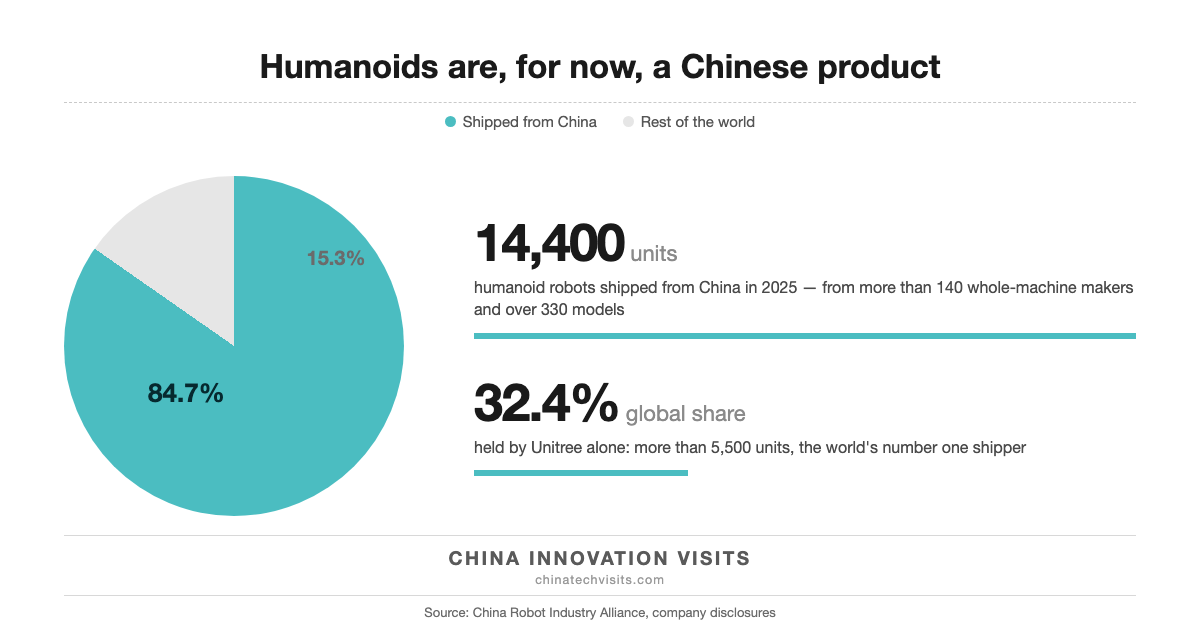
- Unitree Robotics (unlisted, Hangzhou) — 2025 revenue CNY 1.70 billion with CNY 591 million net profit (ex-non-recurring); over 5,500 humanoids shipped, world number one with 32.4 percent global share.
- UBTECH Robotics (09880.HK, Shenzhen) — 1,079 full-size humanoids sold in 2025 with orders above CNY 1.3 billion; leading industrial-scene deployment.
- AgiBot (unlisted, Shanghai) — 10,000th general-purpose embodied robot off the line; valued at CNY 40–50 billion with leading scaled orders.
- Fourier Intelligence (unlisted, Shanghai) — GR-series general humanoids, running rehabilitation and humanoid lines in parallel with a healthcare foothold.
- Leju Robotics (unlisted, Shenzhen) — 2025 revenue CNY 258 million; Kuavo sales up about 18-fold; pre-IPO valuation of CNY 9 billion.
- CloudMinds (unlisted, Shanghai) — pioneer of cloud robotics backed by SoftBank and Foxconn, leading the cloud-brain architecture.
12. Mobile robots and intelligent warehousing
AGV and AMR systems are the core equipment of smart logistics: self-navigating, flexibly dispatched, deployed across warehouses, factories and e-commerce sorting. Chinese vendors hold leading global shares — Geek+ has topped global warehouse AMR for six straight years — and exports are the main growth engine.
- Geek+ (02590.HK, Beijing) — 2024 revenue CNY 2.41 billion, up about 20 percent; world number one in warehouse AMR for six consecutive years.
- Hikrobot (unlisted, Hangzhou) — 2024 revenue CNY 5.93 billion; first tier in both machine vision and mobile robots.
- Quicktron (unlisted, Wuxi) — tote robots and intelligent warehouse systems with a leading global delivery record.
- SIASUN (300024.SZ, Shenyang) — mobile robots plus logistics system integration, with a full AGV line.
- Standard Robots (unlisted, Wuxi) — industrial mobile robot specialist with the fully self-developed SROS system.
- Guozi Robotics (unlisted, Hangzhou) — inspection and logistics robots, leading in power and railway scenarios.
13. Quadruped and special-purpose robots
Quadrupeds handle stairs, rubble and other complex terrain; special-purpose robots replace humans in hazardous power, firefighting and petrochemical work. Chinese makers hold over 80 percent of the domestic quadruped market, and applications are extending from inspection into emergency response and logistics.
- Unitree Robotics (unlisted, Hangzhou) — 33,294 cumulative quadruped units sold, the world's top seller.
- DEEP Robotics (unlisted, Hangzhou) — raised over CNY 1 billion in 2025; world number two in quadrupeds with 18.9 percent share, leading power inspection.
- Yijiahe Technology (603666.SH, Nanjing) — 2024 revenue CNY 585 million; power inspection robot leader for substation intelligent operations.
- Shenhao Technology (300853.SZ, Hangzhou) — intelligent inspection robots for power and rail transit.
- CITIC HIC Kaicheng (unlisted, Tangshan) — firefighting and emergency rescue robot leader for hazardous-duty replacement.
- Harbin Boshi Automation (002698.SZ, Harbin) — 2024 revenue CNY 2.86 billion; leader in petrochemical post-processing special robots.
14. Machine vision and perception
Machine vision gives robots eyes; combined with 3D vision and AI it moves them from fixed teaching to autonomous perception and flexible grasping. China holds advantages in core parts like lighting and lenses, and 3D-vision-guided picking is landing fast.
- OPT Machine Vision (688686.SH, Dongguan) — world number two in machine-vision lighting, with a full 3D vision and industrial camera line.
- Luster LightTech (688400.SH, Beijing) — machine vision plus optical fiber devices; leading industrial vision system integrator.
- TZTEK Technology (688003.SH, Suzhou) — industrial vision equipment leader, strongest in consumer electronics and semiconductor inspection.
- Jutze Intelligence (300802.SZ, Shanghai) — vision inspection equipment, leading in 3D inspection and dispensing systems.
- Mech-Mind Robotics (unlisted, Beijing) — leader in 3D-vision-guided robotics and AI grasping; has passed the Hong Kong exchange listing hearing.
- Percipio (unlisted, Nanjing) — dedicated 3D industrial camera maker with leading depth-vision cost-performance.
15. Robot operating systems and software
The operating system is the robot's nervous system: multi-robot scheduling, motion planning and cloud-edge coordination. Domestic robot operating systems and embodied-intelligence cloud platforms are landing faster, with platforms like Huawei CloudRobo pushing robots toward embodied intelligence.
- Huawei CloudRobo (unlisted, Shenzhen) — embodied intelligence cloud platform, empowering robots through the HarmonyOS ecosystem and Pangu foundation models.
- Standard Robots (unlisted, Wuxi) — fully self-developed SROS robot operating system with leading multi-robot scheduling.
- SLAMTEC (unlisted, Shanghai) — leader in robot navigation and localization, with leading SLAM technology and lidar products.
- UBTECH Robotics (09880.HK, Shenzhen) — self-developed robot operating system and motion-control algorithms, leading embodied software.
- Zhongke Siyi (unlisted, Suzhou) — robot software and real-time operating systems, a representative of domestic control platforms.
- Kyland Technology (300353.SZ, Beijing) — industrial internet and real-time operating systems with a robot control OS in layout.
16. End-effectors and dexterous hands
The end-effector defines what a robot can actually do — grippers, suction cups and dexterous hands. The dexterous hand is the "last centimeter" of the humanoid and the hardest to build. Domestic makers accelerated mass production through 2025, and Inspire Robots has delivered more than 10,000 dexterous hands.
- Zhaowei Machinery and Electronics (003021.SZ, Shenzhen) — 2024 revenue CNY 1.53 billion; first mover in dexterous-hand solutions with leading micro-transmission technology.
- Inspire Robots (unlisted, Beijing) — over 10,000 dexterous hands delivered in 2025; domestic leader in micro servo actuators.
- OYMotion (unlisted, Shanghai) — dexterous hands plus brain-machine interfaces; globally leading bionic hand products.
- Junduo Robotics (unlisted, Suzhou) — electric grippers and dexterous hands, leading cobot accessory supplier.
- Zhixing Robotics (unlisted, Hangzhou) — adaptive end-effectors, leading in flexible grasping and force control.
- Soft Robot Tech (unlisted, Suzhou) — soft pneumatic grippers and flexible grasping for food and irregular-part sorting.
Downstream: system integration and application
The downstream is where robot value is finally realized: automotive, 3C electronics, logistics, healthcare and services. Chinese industrial robots now operate in more than 60 national economic industry categories. Automotive and electronics remain the two anchor markets, service and special-purpose robots are scaling, and system integrators carry the last mile of delivery.
17. Automotive and new-energy production line integration
Automotive is the largest application of industrial robots at roughly 30 percent. EV lines generate heavy demand for welding, assembly, gluing and inspection robots, and giga-casting plus flexible line upgrades keep integrator order books full.
- JEE Technology (688162.SH, Hefei) — 2024 revenue CNY 3.52 billion; twin businesses in EV equipment and motor/electronic control.
- Haosen (688529.SH, Dalian) — 2024 revenue CNY 1.81 billion; leading integrator of powertrain and new-energy lines.
- Kelai Mechatronics (603960.SH, Shanghai) — flexible auto-electronics line integration, laid out in EV and intelligent-driving equipment.
- Dalian Auto (unlisted, Dalian) — leading body-in-white welding line integrator serving major joint-venture and domestic carmakers.
- Estun Automation (002747.SZ, Nanjing) — integrated robot-plus-line delivery, leading EV welding and assembly solutions.
- SIASUN (300024.SZ, Shenyang) — flexible auto assembly line integration delivering robot and logistics systems as one.
18.3C electronics and semiconductor manufacturing
3C electronics — computers, communications and consumer electronics — demands extreme precision and speed, making it the densest application scene for SCARA and cobots. Semiconductor manufacturing adds strict cleanliness and stability requirements, driving demand for cleanroom and wafer-handling robots.
- Bozhon Precision Industry (688097.SH, Suzhou) — 2024 revenue CNY 4.96 billion; 3C automation leader across consumer electronics and new-energy lines.
- Secote (603283.SH, Suzhou) — 2024 revenue CNY 4.05 billion; core Apple-chain inspection equipment supplier extending into semiconductor metrology.
- Wuxi Lead Intelligent (300450.SZ, Wuxi) — 2024 revenue CNY 11.86 billion; lithium-battery equipment leader extending into 3C and semiconductors.
- Topstar (300607.SZ, Dongguan) — industrial robots plus injection molding and automation, covering 3C and new-energy customers.
- TZTEK Technology (688003.SH, Suzhou) — industrial vision equipment for consumer electronics and semiconductor inspection.
- HYC Technology (688001.SH, Suzhou) — flat-panel and semiconductor inspection equipment; panel inspection leader.
19. Warehousing, logistics and e-commerce sorting
Smart warehousing and sorting is the largest application scene for mobile robots, fed by e-commerce promotion peaks and manufacturing logistics retrofits. Integrators must deliver hardware plus software plus scheduling as one system; project experience and industry understanding are the moat.
- Geek+ (02590.HK, Beijing) — 2024 revenue CNY 2.41 billion; world number one in warehouse AMR for six straight years.
- Hikrobot (unlisted, Hangzhou) — 2024 revenue CNY 5.93 billion; dual engines in mobile robots and machine vision.
- BlueSword Intelligent (688557.SH, Jinan) — intelligent warehouse system integration with deep e-commerce and pharma logistics projects.
- New Trend International (300532.SZ, Shenzhen) — smart logistics system integration, leading in new-energy and petrochemical projects.
- Quicktron (unlisted, Wuxi) — tote and rack robots with leading global warehouse deliveries.
- KSEC Intelligent (301311.SZ, Kunming) — intelligent logistics equipment and systems, leading in tobacco and military logistics integration.
20. Medical, surgical and rehabilitation robots
Medical robots represent the high end of medical equipment: surgical robots for orthopedic and endoscopic precision work, rehabilitation robots for stroke and motor-impairment patients. Import substitution is accelerating, and multiple domestic products won approval and entered medical-insurance pilots in 2025.
- Tinavi Medical (688277.SH, Beijing) — 2024 revenue CNY 179 million; China's number one orthopedic surgical robot maker with 39.77 percent domestic share.
- MicroPort MedBot (02252.HK, Shanghai) — 2024 revenue CNY 257 million, up 146 percent; full-line layout in endoscopic and orthopedic surgical robots.
- Remebot (Baihui Weikang) (unlisted, Beijing) — neurosurgical robot leader with multiple approved Remi-series products.
- Jianjia Robot (unlisted, Hangzhou) — joint replacement surgical robots with leading hip-and-knee navigation.
- Fourier Intelligence (unlisted, Shanghai) — rehabilitation robot leader, leading in lower-limb exoskeletons and training robots.
- Vishee Medical (688580.SH, Nanjing) — rehabilitation medical device leader steadily expanding its robot line.
21. Service robots and commercial cleaning
Service robots sit closest to the consumer. Chinese brands take all of the global top five spots in cleaning robots, and 2025 robot vacuum shipments reached 24.12 million units, up 17.1 percent. Delivery, education and commercial cleaning robots are commercializing fast — we covered the consumer end of this segment in <a class="article-inline-link" href="/insights/ecovacs-home-robotics">our Ecovacs visit report</a>.
- ECOVACS (603486.SH, Suzhou) — 2024 revenue CNY 16.54 billion; robot vacuum leader with a leading global share in cleaning robots.
- Roborock (688169.SH, Beijing) — 2024 revenue CNY 11.95 billion; the export leader among robot vacuum makers, with most revenue overseas.
- Narwal (unlisted, Dongguan) — originator of the self-cleaning robot vacuum, leading warm-water mop-washing technology.
- Keenon Robotics (unlisted, Shanghai) — commercial service robot leader with top global shipments of restaurant delivery robots.
- Pudu Robotics (unlisted, Shenzhen) — delivery and cleaning robots among the top global commercial service robot shippers.
- UBTECH Robotics (09880.HK, Shenzhen) — full line across education, commercial and home service robots, leading in AI education robots.
Where the industry sits: five clusters
China's robotics industry has settled into five coordinated clusters — the Yangtze River Delta, the Pearl River Delta, the Beijing-Tianjin-Hebei region, central China and the Northeast — with a clear gradient: the Yangtze River Delta leads across the full chain, the Pearl River Delta pairs scale with application strength, Beijing-Tianjin-Hebei breaks through on embodied intelligence, and the central and western regions are rising fast.
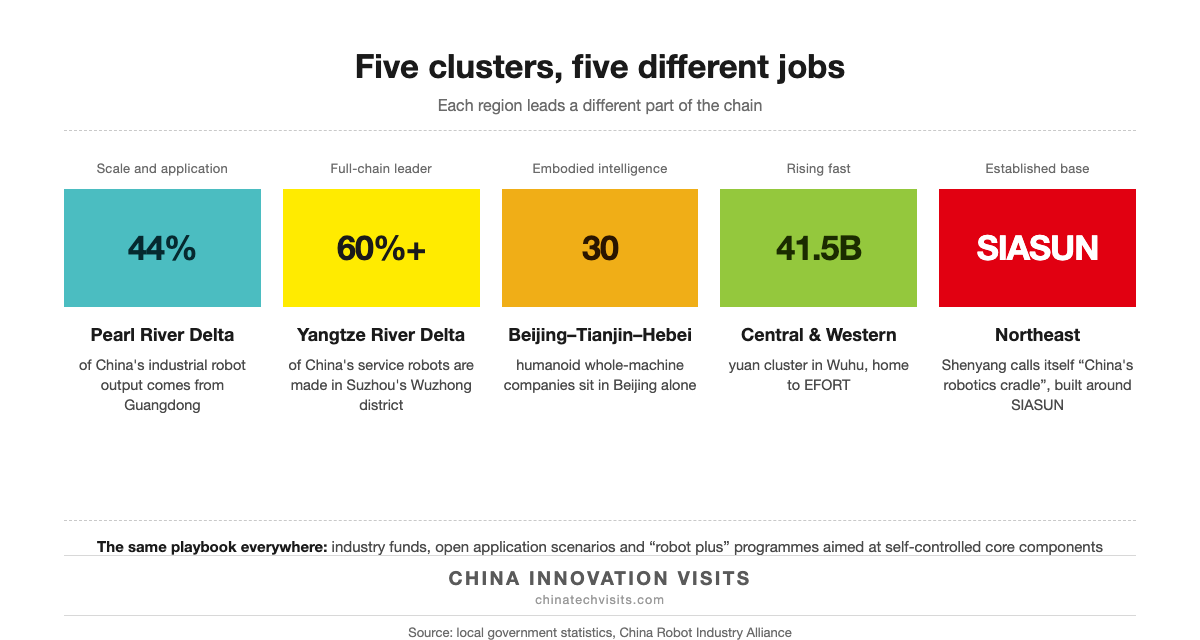
The Yangtze River Delta is the core region. Suzhou's Wuzhong district alone runs a CNY 160 billion robotics industry and produces over 60 percent of China's service robots; Changzhou makes about a quarter of the country's industrial robots; Nanjing's cluster is around CNY 40 billion. Hangzhou, at CNY 106.8 billion, holds roughly 80 percent of the domestic quadruped market and hosts Unitree and DEEP Robotics — see <a class="article-inline-link" href="/insights/hangzhou-robotics-briefing">our Hangzhou robotics briefing</a> for the city-level picture.
The Pearl River Delta leads on scale. Guangdong produces about 44 percent of China's industrial robots and has done so for years. Shenzhen's robotics output value reached CNY 242.6 billion in 2025 across nearly 60,000 enterprises, making 25.2 percent of national industrial robot output. Foshan's CNY 52.3 billion cluster is anchored by home-appliance and service robot supply chains, and Dongguan clusters component and body makers on its electronics base. For how this plays out in humanoids, read <a class="article-inline-link" href="/insights/shenzhen-robotics-valley-humanoid">our Shenzhen humanoid valley report</a>.
Beijing-Tianjin-Hebei competes through embodied intelligence. Beijing's roughly CNY 51.8 billion industry includes 30 humanoid whole-machine companies, the national humanoid robot innovation center and a bench of core component firms. Shanghai — geographically in the Yangtze River Delta but competing in the same innovation tier — runs the Zhangjiang Robot Valley with a complete humanoid and cobot innovation ecosystem and continued scale leadership in 2025.
Central, western and northeastern China are rising on distinctive strengths. Wuhu's CNY 41.5 billion cluster, home to EFORT, ranks among the national leaders. Shenyang built "China's robotics cradle" around SIASUN, and Harbin specializes in special-purpose robots.
The common playbook across cities is industry funds, open application scenarios and "robot plus" programs — and the shared direction is from assembly toward self-controlled core components. For a visitor's view of how these clusters compare on the ground, our <a class="article-inline-link" href="/insights/china-robotics-factory-tour">China robotics factory tour overview</a> maps the same industry by what you can actually walk through.
Questions
How many companies are in China's robotics industry chain? More than 1.086 million robot-related enterprises are registered in China, with a record 261,000 newly registered in 2025 alone. The map above tracks 128 company entries across the 21 segments that carry most of the industry's value, from reducers and servos to humanoids and warehouse systems.
Which parts of the chain are already localized? Harmonic reducers are about 60 percent domestically supplied, general servos about 55 percent, and domestic brands took 54 percent of China's industrial robot market in 2025. The remaining hard targets are high-end RV reducers, six-axis force sensors and planetary roller screws.
Who leads China's humanoid robot industry? More than 140 whole-machine companies have released over 330 models, and 2025 shipments of about 14,400 units represented 84.7 percent of the global total. Unitree leads with over 5,500 units shipped and a 32.4 percent global share, followed by players like UBTECH and AgiBot, which recently rolled its 10,000th robot off the line.
Where should a delegation go to see the industry? The five clusters each show a different face of it: Shenzhen and the Pearl River Delta for scale and application, Suzhou and Changzhou in the Yangtze River Delta for components and service robots, Hangzhou for quadrupeds and humanoids, Beijing for embodied intelligence research, and Wuhu or Shenyang for established industrial robot makers.
This map is updated as new data becomes available. If you are planning a robotics study tour in China and want to know which of these companies can host a delegation, tell us your dates, your delegation size and what you want to see, and we will confirm what can be arranged.
Sources: National Bureau of Statistics of China, Ministry of Industry and Information Technology, China Robot Industry Alliance, and listed-company annual reports, as compiled in a Chinese-language industry chain survey (October 2026). Revenue figures are for fiscal year 2024 unless a 2025 period is stated.