A humanoid robot programme in China is decided by the city before it is decided by the company list. Beijing, Shanghai, Shenzhen and Hangzhou hold the offices, the showrooms and the lines, but they hold different things, and a delegation that picks the city on reputation rather than on what is behind the door will spend a week looking at video walls. This page sets out what each of the four cities actually lets a visitor see, what a day in each looks like, and how to put them in an order that does not waste a flight.
Key takeaways
- The four cities are not substitutes. Beijing shows breadth in one building, Shanghai shows a production line and a government-backed test bed, Shenzhen shows shipping product and components, Hangzhou shows a showroom and an unusually well-publicised ecosystem.
- Beijing's advantage is comparison. A single exhibition hall in Yizhuang holds humanoids from many makers, so rival designs sit within a hundred metres of each other rather than across four separate appointments.
- Shanghai is where you can see a humanoid being built rather than presented. AgiBot's Zhangjiang base combines an exhibition hall, a demonstration floor and a data-collection facility of roughly 3,000 square metres.
- Shenzhen's value is not one company. It is the density: a full-size humanoid maker, a component supplier and a tactile-sensor specialist can be visited in a single afternoon, which is what makes the supply chain legible.
- Hangzhou is the most over-rated city for a first visit and the most under-rated for a second one. Read the existing report on the city before you book it, and go for the showroom, not the volume.
- Two cities is a good trip. Three is a week. Adding the fourth usually costs a day and adds a showroom you have already seen a version of.
The number that gets quoted, and what it is worth to a visitor
An unofficial tally published in October 2026 by a Chinese strategy consultancy put the number of Chinese companies working on humanoid robot bodies above 140, with more than 30 whole-machine developers in Beijing alone. Treat that as an industry count, not an audience count. The consultancy compiled it from company lists; it did not test whether any of those companies will receive a foreign delegation, and most of them will not.
What matters for planning is a much smaller number. In each city, the sites that routinely receive international business groups can be counted on one hand, and they are the sites where the engineering is far enough along to survive a technical question. The 140 figure is useful for understanding why China's humanoid sector behaves the way it does. It is not a menu.
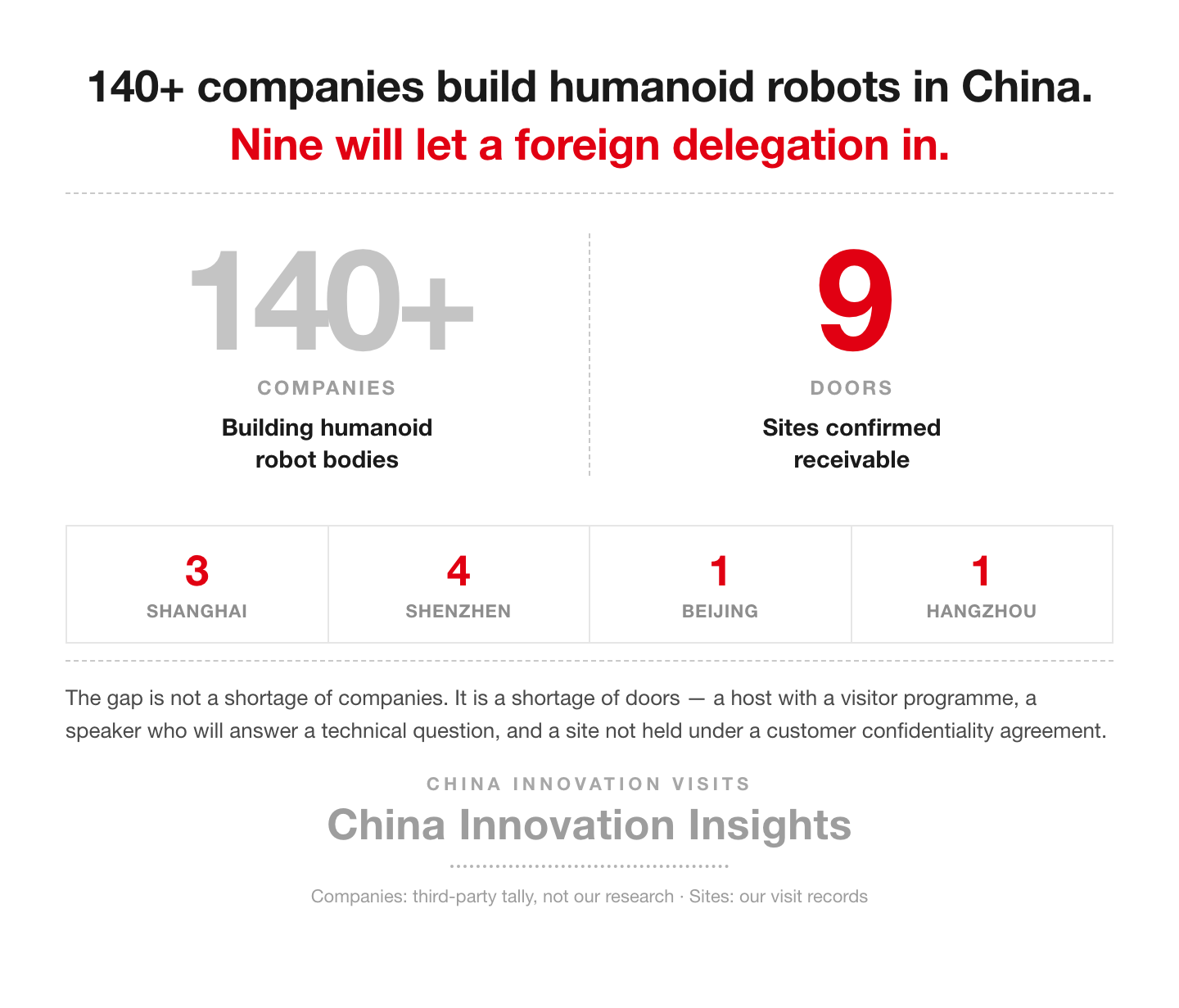
Above 140 companies build humanoid robots in China. Nine of them run a visitor programme a foreign delegation can actually book.
The other thing to fix before choosing a city is what kind of site you are going to. There are four, and the words are not interchangeable: an exhibition hall where many companies show product, a company showroom attached to an office, a production line where units are actually assembled, and a government-backed platform that assembles parts of the ecosystem under one roof. A day at each produces a completely different conversation.
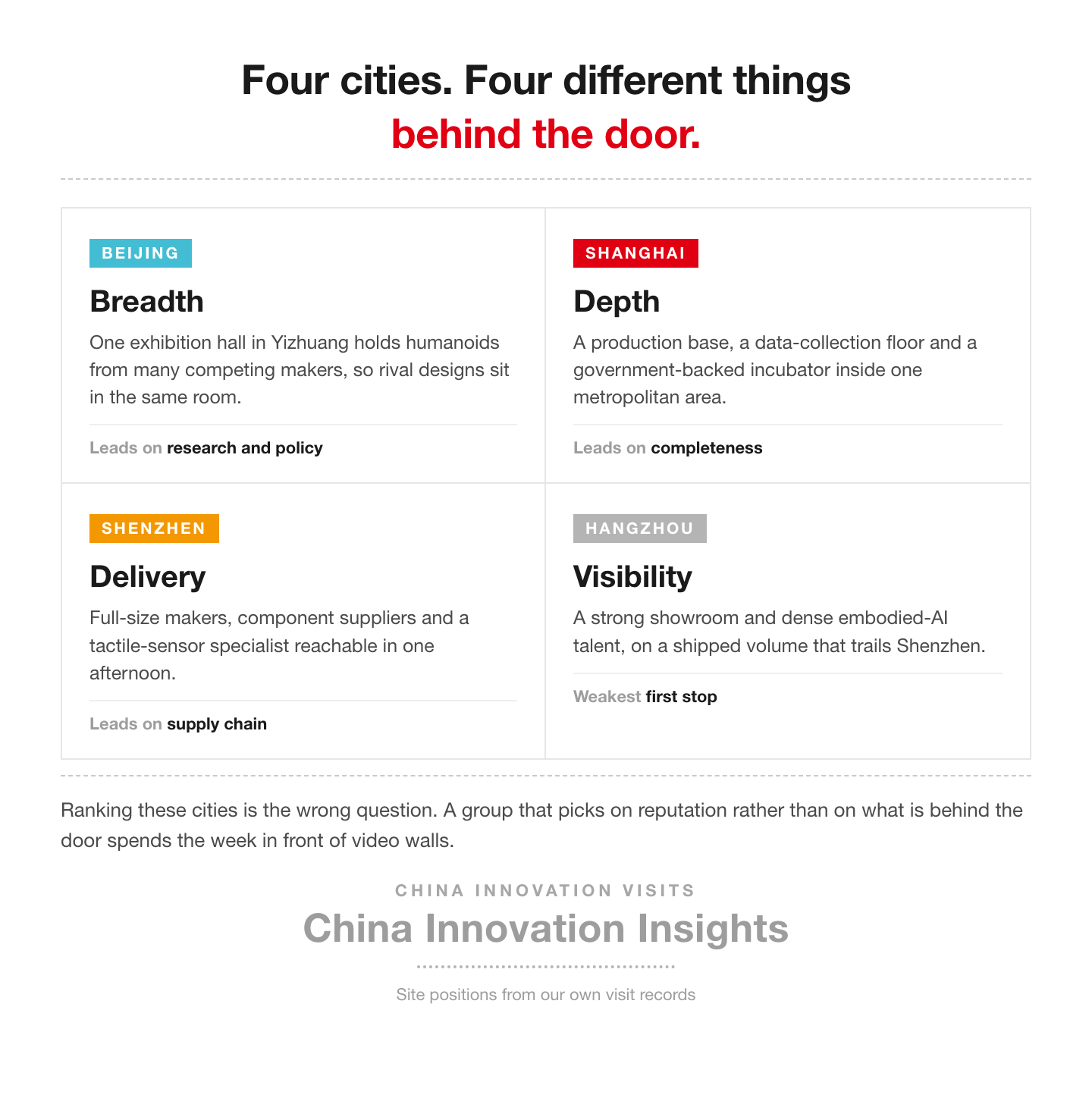
Each city leads on something the others do not have. Hangzhou is the strongest showroom and the weakest first stop.
Beijing: the building that does the comparing for you
Beijing's strongest site is not a company. It is the Yizhuang Robot World, a four-floor exhibition and experience centre of roughly 4,000 square metres inside the Yizhuang Robot Industrial Park in the south-east of the capital. Humanoids from competing makers stand in the same rooms, which means a biped, a wheeled humanoid and a torso on a mobile base can be compared within an hour instead of across three flights.
That sounds like a lesser experience than a factory, and for a group of engineers it often is not. Comparative judgements are the thing a single-company visit cannot give you. If your question is why Chinese humanoids converge on certain joint configurations, one room answers it faster than five presentations.
The programme can extend beyond the exhibition floor into an embodied-intelligence innovation centre and a pilot validation platform covering parts warehousing, a flexible line and whole-machine testing. That extension is where a group learns how much of the sector's output is field-ready and how much is still being validated, and it is the part worth requesting explicitly rather than assuming.
Beijing also holds the capital's policy machinery, which is real but hard to see. A factory gate does not show you a government fund. What a visit can show is the practical consequence: which applications are being pushed into pilot deployments and which are being left to find their own market.
Shanghai: the city where you watch a humanoid being made
Shanghai is the most complete single stop in the country for humanoid robots, because it holds three different kinds of site within one metropolitan area.
AgiBot's Zhangjiang base is the anchor. The programme runs through a product and technology exhibition hall, a live demonstration of the humanoid and quadruped range, a data-collection facility of roughly 3,000 square metres, and a closed session on where the machines are actually being deployed. The data facility is the unusual element. Most humanoid visits show hardware; this one shows the operation that generates the training data the hardware runs on, which is the bottleneck most delegations have not yet priced into their plans.
The second site is the Shanghai Humanoid Robot Innovation Incubator, a government-backed exhibition organised into four zones, from an exploded assembly through complete units to components and special-purpose machines. It is a half-day, not a day, and it is best used as the orientation before a company visit rather than as a substitute for one.
The third is Fourier Intelligence in Pudong, where humanoids and rehabilitation robotics are developed on the same site. It is the most useful stop for groups whose interest is medical, eldercare or service deployment rather than manufacturing.
The consequence for planning: Shanghai is the city where you can spend two days without repeating yourself, and it is the right first stop if the group has never seen a humanoid closer than a conference stage.
Shenzhen: the city that ships
Shenzhen's claim is not that it has the best humanoid. It is that it has the most companies in one place that are actually delivering product, and that a delegation can move between them in an afternoon.
Three sites carry a day. UBTech runs the most structured visitor programme in the city, covering an exhibition centre, an interaction zone, demonstrations and a company briefing. ENGINEAI covers a bipedal platform, full-size humanoids, a lightweight model and a heavy-duty quadruped, and its value to a group is seeing a full product ladder built in under three years. PaXini supplies tactile sensors and dexterous hands, and is the stop that explains why a humanoid that looks competent in a clip can still fail to pick up a light object.
That last visit is the one most delegations do not think to book and afterwards rate highest. Vision tells a robot where an object is. Touch tells it how hard it is gripping. The gap between a demonstration and a factory task sits exactly there, and it is easier to understand in a sensor laboratory than in an exhibition hall. For the cluster itself, the existing report on Shenzhen's robotics valley covers the supply chain and the geography in detail, and is worth reading before you choose which three companies to put on the day.
Hangzhou: read this before you book it
Hangzhou has a reputation in humanoid robotics that runs ahead of its shipped volume, and the existing analysis of the city sets out that gap with numbers rather than adjectives. The short version for planning: come for Unitree's showroom and for the concentration of embodied-AI talent, not for a production scale that beats Shenzhen.
A practical consequence follows. Hangzhou works well as a second visit for a group that has already seen Shanghai or Shenzhen and wants to understand how a listed Chinese robotics company presents itself to investors.
For the full treatment, including the comparison with other cities, read the Hangzhou robotics briefing before you commit dates.
What the map does not tell you
Three things get lost when the sector is described city by city.
The first is that demonstration quality is not deployment quality. A machine that walks convincingly across a stage may still be running scripted trajectories. The question that separates the two is boring and effective: how many units are in continuous paid operation, and in whose facility. Ask it in every city and the picture changes.
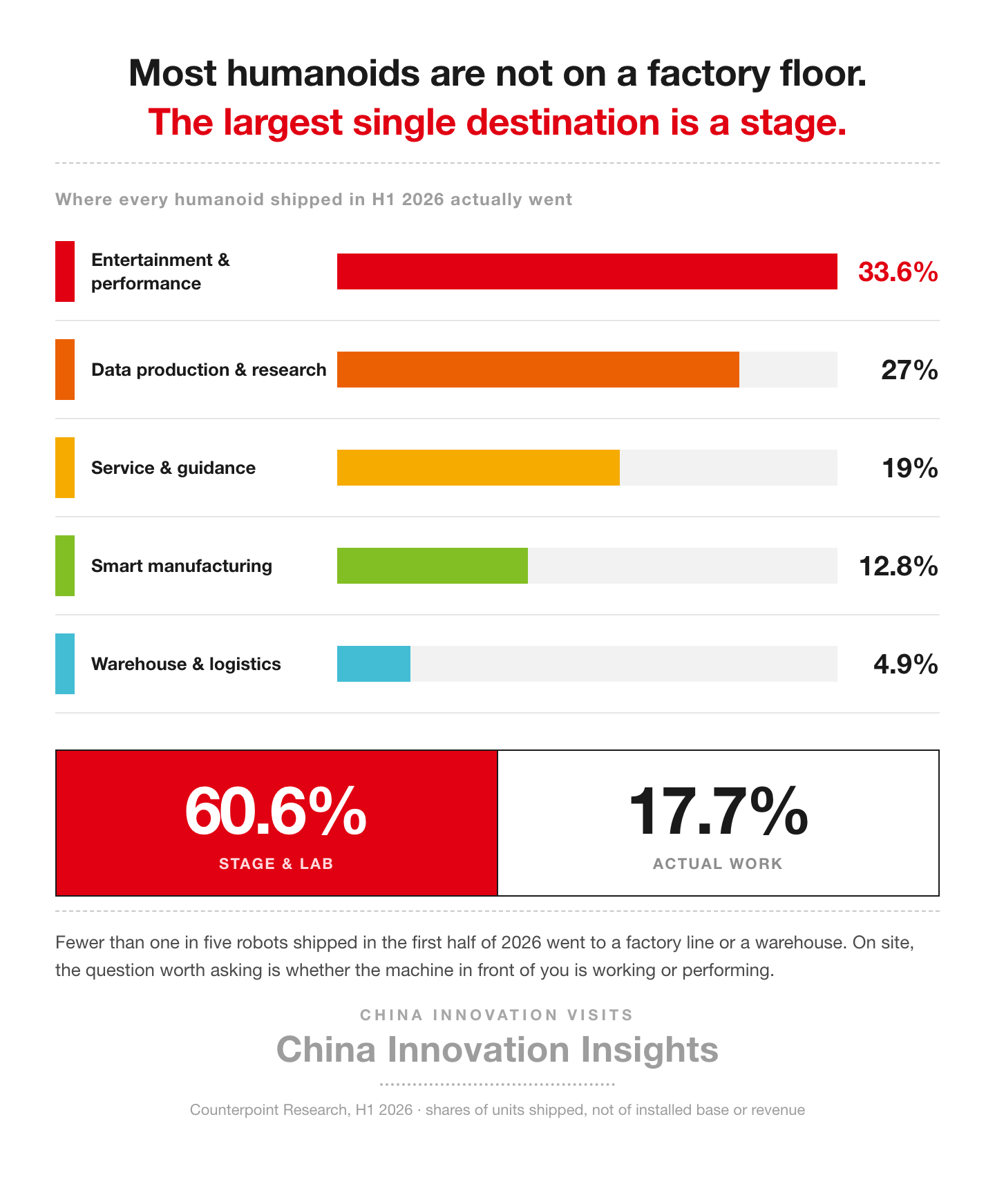
Of every humanoid shipped in the first half of 2026, fewer than one in five went to a factory line or a warehouse.
The second is that components decide the schedule. A humanoid is a harmonic reducer, a servo, a sensor stack and a battery wrapped around a policy model. The bottleneck moves between them, and which one is tight in a given year is visible in Shenzhen's component suppliers long before it shows up in a press release.
The third is that the four cities are not a league table. Beijing leads on research institutions and policy, Shanghai on the completeness of a single visit, Shenzhen on supply chain and delivery, Hangzhou on visibility. A delegation that ranks them has usually been asked the wrong question by its own board.
If the failure mode matters to your group, the arithmetic is worth seeing before you fly. A factory job is a chain of steps, not a single motion, and small per-step success rates compound into large overall failure. The clearest way to hold that in mind is to plot it.
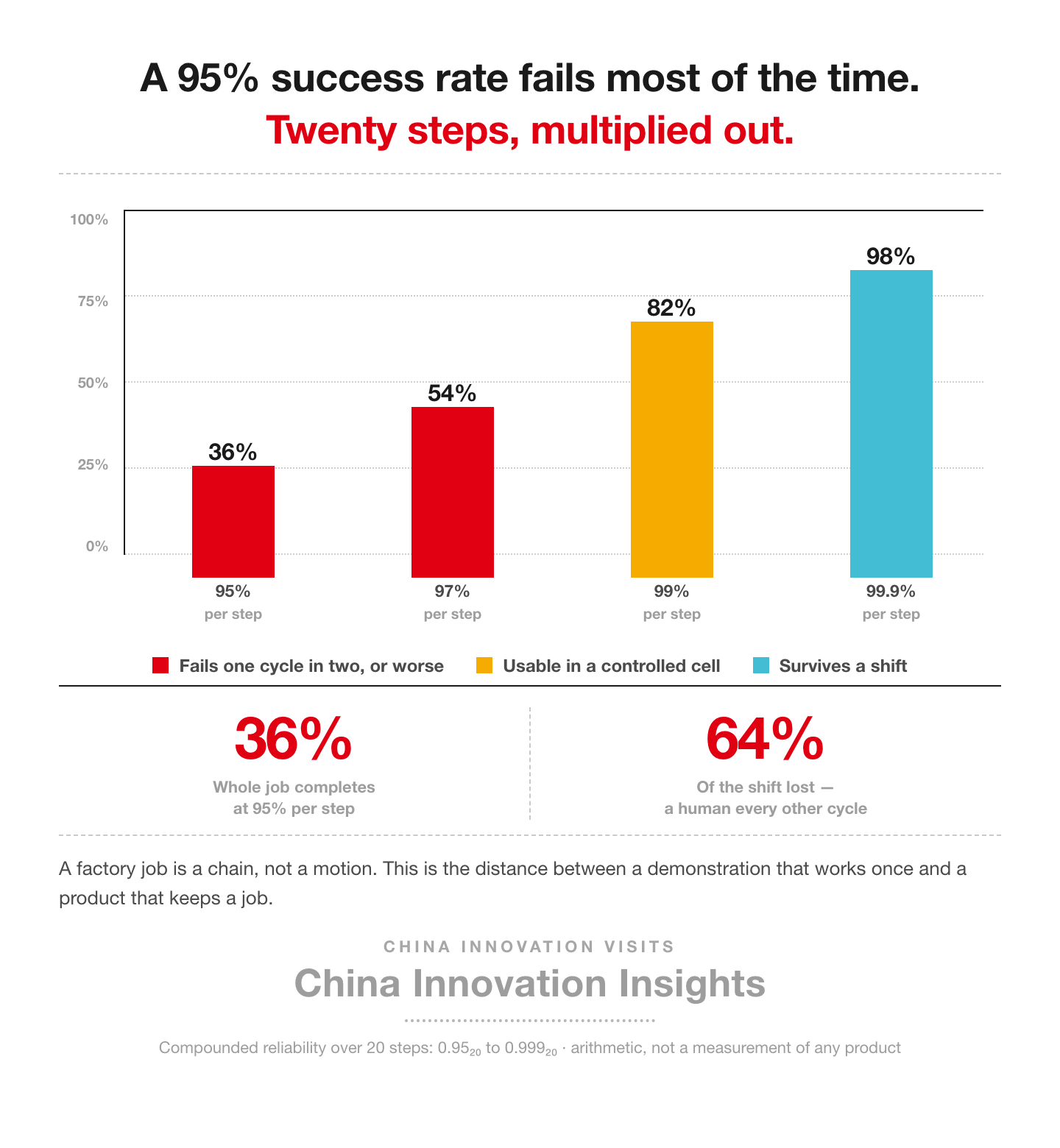
Per-step success compounds. At 95 per cent, a twenty-step job completes barely more than a third of the time.
Putting the four cities in an order
Two workable sequences, depending on the group.
For a group new to Chinese humanoids, start in Shanghai: a morning at the Zhangjiang base, an afternoon at the incubator, and if the interest is service or medical, Fourier on a second day. Then fly to Shenzhen for a day of three company visits. That is three working days including the transfer, and it covers the showroom, the line, the data operation, the components and the cluster. Beijing is added only if the group cares about policy or about seeing many makers at once.
For a group that has already seen the sector, invert it. Begin in Beijing at Yizhuang for the comparative view, move to Shenzhen for components and delivery, and treat Shanghai as the deep dive on one company. Hangzhou attaches to this second route more naturally than to the first.
Do not try to do all four in one trip unless you have five working days and a group that genuinely enjoys airports. The fourth city rarely adds a new category of insight, and it costs a day of energy that would have been better spent on a longer technical session.
Each city below is a separately bookable programme. Choose the ones that match your objectives; they are not sold as a fixed package.
Sample visit programme
Beijing: exhibition hall and business exchange
| Segment | Time | What to expect |
|---|---|---|
| Arrival and orientation | 15 min | Registration at the Yizhuang park and a short briefing on what the four floors contain and how to read the exhibits. |
| Exhibition floors | 60 min | Humanoids from multiple makers, including bipedal, wheeled and torso-on-base formats, compared side by side with exhibits of quadrupeds, industrial and medical machines. |
| Live demonstrations | 35 min | Machines running in the demonstration areas, with the opportunity to press on which behaviours are scripted and which are not. |
| Business exchange | 40 min | Closed discussion with a park or platform representative on pilot deployments and what a foreign partner can realistically take part in. |
The base programme is about two and a half hours; hotel transfers are additional and Yizhuang sits 45 to 60 minutes from the city centre. The embodied-intelligence innovation centre and the pilot validation platform described earlier are extensions that have to be requested separately, and they add time rather than sitting inside the standard walk-through.
Shanghai: production base and data collection
| Segment | Time | What to expect |
|---|---|---|
| Arrival and safety briefing | 20 min | Visitor registration at the Zhangjiang base, safety rules and the scope of what photography is allowed. |
| Product and technology hall | 40 min | The humanoid range and the component architecture explained from the body inward, with the application cases the company puts its name to. |
| Live demonstration | 30 min | Humanoid and quadruped platforms running trained tasks, with engineers on hand to answer what is scripted and what is autonomous. |
| Data-collection facility | 30 min | The roughly 3,000-square-metre operation where manipulation and locomotion data are captured and labelled — subject to separate approval. |
| Thematic session | 50 min | Closed discussion on deployment status and cost structure, framed around the questions submitted in advance by your group. |
| Questions and close | 30 min | Open Q&A with the technical lead; the session is where most groups get the specific answers they came for. |
Allow a morning. The four core modules account for the 150 minutes published on the individual company page; the arrival segment and the live demonstration sit around them, bringing on-site time to roughly three hours.
Shenzhen: three companies in one day
| Segment | Time | What to expect |
|---|---|---|
| Full-size humanoid maker (morning) | 120 min | Exhibition centre, interaction zone and demonstrations at the city's longest-running humanoid programme, plus a company briefing and Q&A. |
| Component specialist (midday) | 90 min | A younger full-stack maker covering bipedal and full-size humanoids plus quadrupeds, useful for seeing how a product ladder is built in under three years. |
| Tactile sensing and dexterous hands (afternoon) | 90 min | The sensor laboratory and hand assembly, with a briefing on force, texture and slip sensing and why vision alone cannot close the manipulation gap. |
| Synthesis session | 45 min | A chaired wrap-up comparing what the three sites claimed, what the group actually saw, and what it means for the group's own operations. |
Every programme above is a sample. The final schedule depends on your objectives, on host confirmation and on which stations are open on the day.
Practical notes
Visits are arranged for groups, and the working size is ten or more, with many industrial hosts set up to receive between ten and twenty. Smaller groups can sometimes be accommodated, but the per-person cost rises because the host arrangement, the technical speaker and the interpretation do not shrink with the headcount.
Apply at least 30 days ahead. Some elements need longer: data-collection facilities and production areas require separate approval from the host, and the approval is not always granted. We tell you at the planning stage which parts of a programme depend on it, so that nothing is promised on the day that was never confirmed.
English interpretation is provided on site throughout. Closed-toe shoes are required at every industrial site, and long trousers are expected. Photography is restricted in most production and data areas and must be agreed with the host in advance; assume it is not permitted until told otherwise.
We do not publish a fixed price. Quotes are built per group and usually cover four things: the host arrangement, the technical speaker, interpreting and on-site coordination.
How this page is verified
Site descriptions were checked against the individual company pages on this site, which are maintained from company-published material and checked on the dates shown there. The 140-company count is attributed to the consultancy that compiled it and is not presented as our own research. Claims about what a site will show are limited to what has been confirmed as receivable; where an area requires separate approval, the page says so rather than implying access. The cover and chart illustrations on this page are original graphics produced for it; the cover photograph is a commissioned illustration of a humanoid robot in a showroom, not a photograph of any specific company's site.
Questions before you plan
Which city should we choose if we can only do one? — Shanghai, if the group has never seen a humanoid up close; it is the only city where a showroom, a production base and a data operation sit inside one metropolitan area. Shenzhen if the group already knows the technology and wants the supply chain.
Can we visit more than one city in a single trip? — Yes, and the two-city combination of Shanghai and Shenzhen is the one most groups choose. Each city is a separately bookable programme rather than a fixed package, and we coordinate the transfer and the schedule across them.
Are these company visits or trade-show visits? — Company visits. Each site is a working facility with its own host, not a public exhibition, with the exception of the Beijing exhibition centre, which is a permanent multi-company venue inside an industrial park.
What will we not be allowed to see? — Data-collection facilities, active production areas and any customer line run under a confidentiality agreement are the usual exclusions, and photography inside them is normally prohibited. The programme is adjusted on site with an equivalent session wherever possible.
Do participants need a robotics background? — No. The content on cost, deployment status and the components underneath is relevant to manufacturing, logistics, investment and public-sector groups, not only to robotics teams.
Can the programme be built around a specific question? — Yes, and it should be. Tell us the question in advance and we brief the host and the technical speaker so that the closed sessions answer it rather than cover the standard ground.
Is a factory visit suitable for a mixed group of executives and engineers? — Yes, with a split. The exhibition and demonstration segments work for both audiences; the technical session is usually run separately so that the engineers can go deeper without losing the executives.
What happens if a site closes or an approval is refused? — This is a live possibility rather than an exception in this sector. We confirm what is available before you fly and substitute an equivalent visit where one exists, and we tell you at planning stage which parts of the programme are conditional.
Arrangements depend on host availability and on approval for the specific areas your brief requires, and not every element can be guaranteed in advance.
Arrange your humanoid robot visit
We arrange the programme end to end: the introduction to each host, the scheduling on the Chinese side, the internal transfers and English interpretation on site. Tell us your dates, your group size and the question your team wants answered, and we will confirm which cities and which sites can carry it. Start at chinatechvisits.com/company-visits.