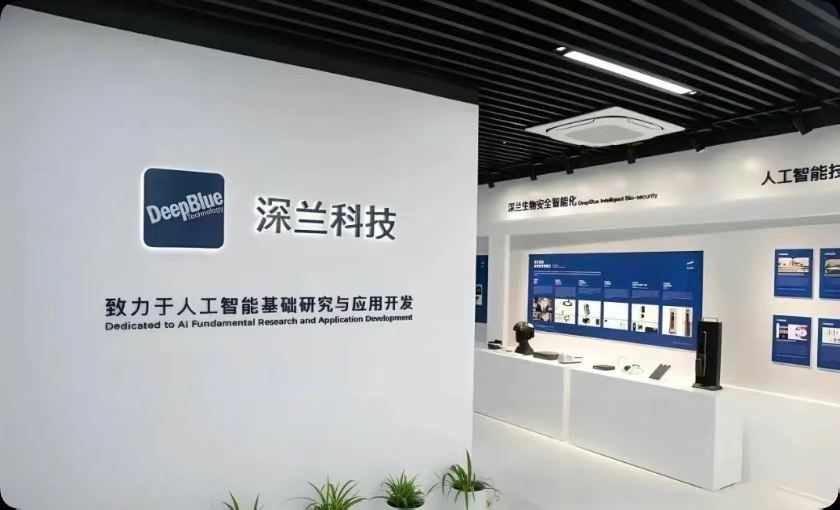
A DeepBlue Technology visit in Shanghai takes a delegation to one of the more unusual structures in Chinese AI: a company organised as an academy plus a set of businesses, claiming full-stack in-house development from algorithms through models to robot hardware. DeepBlue, in full Shenlan Artificial Intelligence Technology (Shanghai) Co Ltd, is headquartered in Shanghai and was founded by Chen Haibo. It is not listed, and that single fact shapes how a visit should be prepared.
Go because the product range is genuinely broad — cleaning robots, autonomous buses, industrial inspection equipment and AI health devices — all presented in one place. Because the company is private, it does not publish audited annual accounts, so the visit is the most direct way to see how the business is actually structured.
China Innovation Visits coordinates the Shanghai programme, including the company reception, scheduling, local transport and English interpretation.
Key takeaways
- See a broad AI product range in one place: cleaning and disinfection robots, autonomous buses, industrial inspection and health devices.
- Walk through the full-stack structure: the academy and its six research institutes, from base algorithms to finished machines.
- Discuss the Pre-IPO round backed by Pudong Venture Capital Group and the company's stated valuation target.
- Review announced orders and partnerships, from CRRC and China Communications Construction to Greenland and overseas smart city programmes.
- Ask about the research record: first places at international computer vision competitions, and more than 1,000 patent applications.
- Compare with a SenseTime headquarters visit in Shanghai on how listed Chinese AI companies disclose, or a Baidu Apollo Park visit in Shanghai on autonomous driving programmes.
Why visit DeepBlue Technology in Shanghai?
For a delegation trying to understand how Chinese AI companies commercialise, DeepBlue is a useful case. Most AI companies in China picked one layer — models, or vision software, or a single robot category — and stayed there. DeepBlue's stated strategy is to hold the whole stack, from base algorithms to finished machines, and to run it through an internal academy structure with six research institutes.
That makes the visit useful in a direct way: you see how one company moves technology between robots, vehicles, factories and clinics, and how a full-stack AI group is organised.
Shanghai is the right setting: the city has funding, procurement and talent in one place, and the visit combines easily with other programmes — including a Shanghai humanoid robot incubator visit for delegations focused on embodied AI.
Company background
2012 registration, 2014 founding
Public registration records give the entity's incorporation date as 3 August 2012, with 2023 as the year the current operating entity, Shenlan Artificial Intelligence Technology (Shanghai) Co Ltd, took over as the main vehicle. The company presents 2014 as its founding year. Legal representative and chairman is Chen Haibo, and registered capital is about 194 million yuan.
The company type is registered as a joint stock company that is not listed. That is the fact that governs everything below.
Its registered address has been in Changning district, and it announced the opening of a new headquarters in Pudong in August 2025.
The academy structure
DeepBlue describes an "academy plus company" model, with a DeepBlue Academy of Sciences and six research institutes covering artificial intelligence, intelligent vehicles, automation, brain science, life science and frontier technology. Materials describe more than 100 full-time postdoctoral and doctoral research leaders, and academic leads drawn from universities including Harvard, MIT, Tsinghua and Peking University.
It holds national specialised and sophisticated "little giant" enterprise status, has appeared on Hurun lists, and was named among the first batch of Shanghai key unicorn service enterprises.
What it sells
Cleaning and service robots
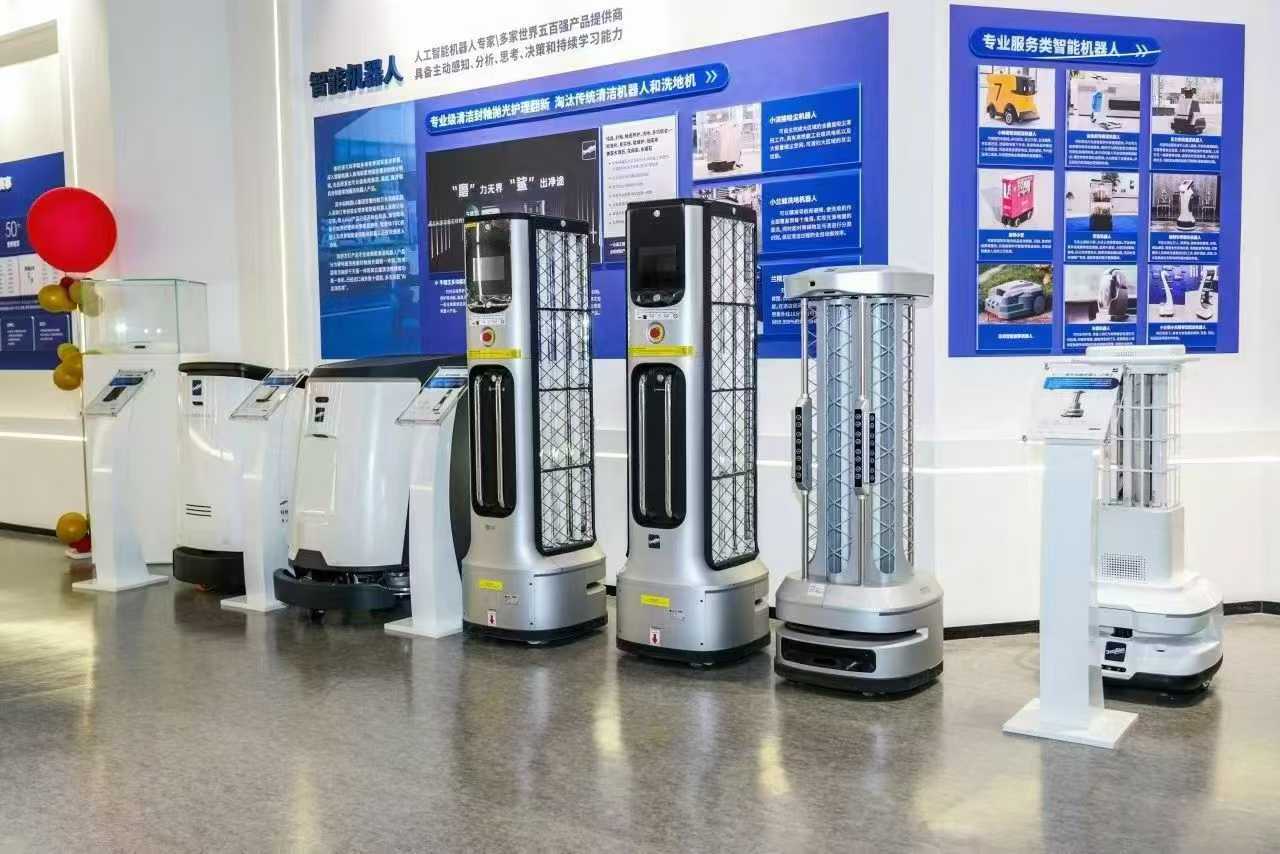
The robot range covers commercial floor cleaning, disinfection, reception and guidance, park inspection and cultural tourism guidance. Products named publicly include the Panda road sweeper, an outdoor L4 autonomous cleaning vehicle; the Xiaolanjing indoor cleaning robot; and the Lanjingling UV disinfection robot.
The company says its robots have been exported to more than ten countries including the United States, Britain, Spain, Italy, France and South Korea. In 2026 it announced volume production of commercial cleaning robots at a base in Nanchang, with a stated capacity of 200 units per shift per month and more than 100 million yuan of orders on hand.
Autonomous buses and sanitation vehicles
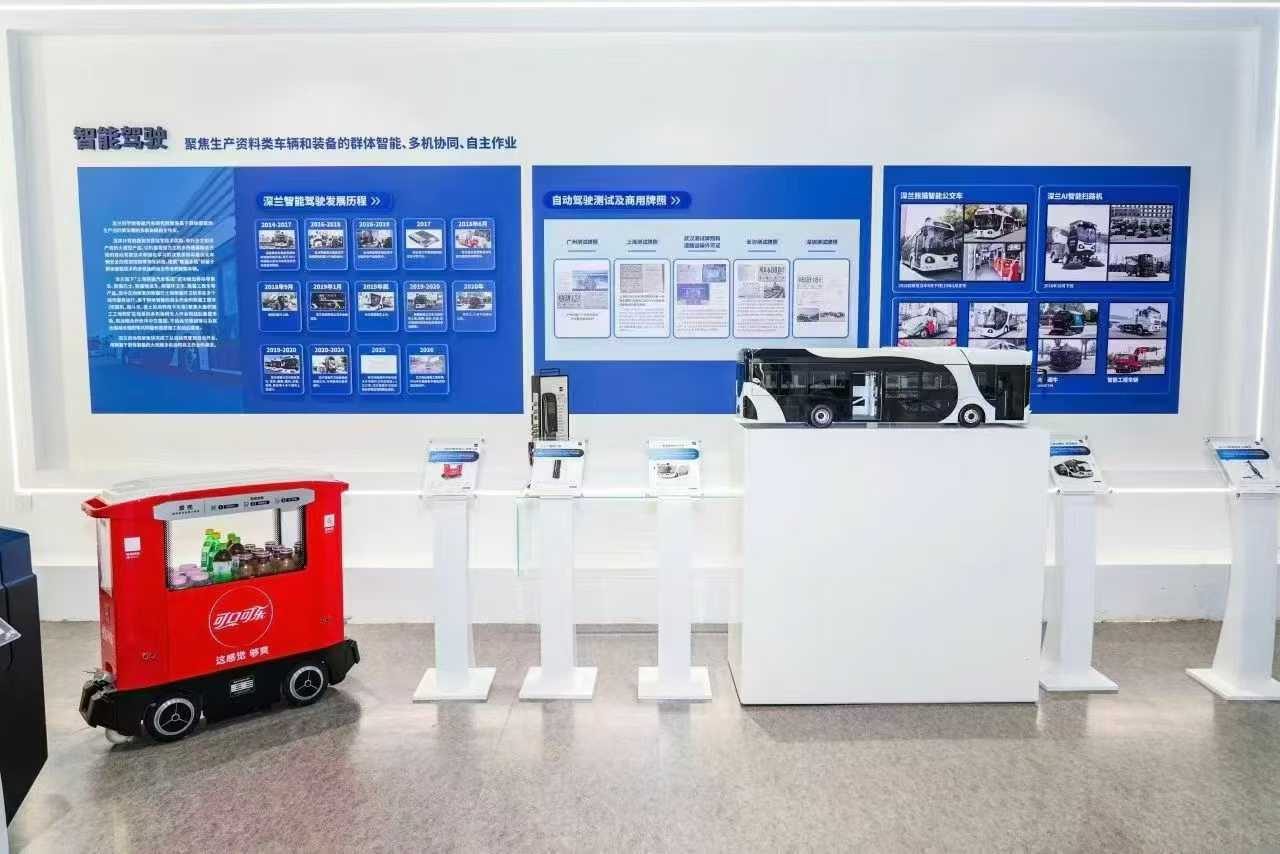
The Panda smart bus is the best-known product, with operations announced in more than ten Chinese cities including Shanghai, Shenzhen and Guangzhou. The company announced a 500-bus purchase order from CRRC Times Electric in 2024, and a sanitation service contract in Urumqi in 2025 at about 50.4 million yuan a year over three years.
This is the part of the business most relevant to a delegation working on autonomous driving in constrained, low-speed, municipal settings rather than robotaxis.
Industrial inspection and AI health
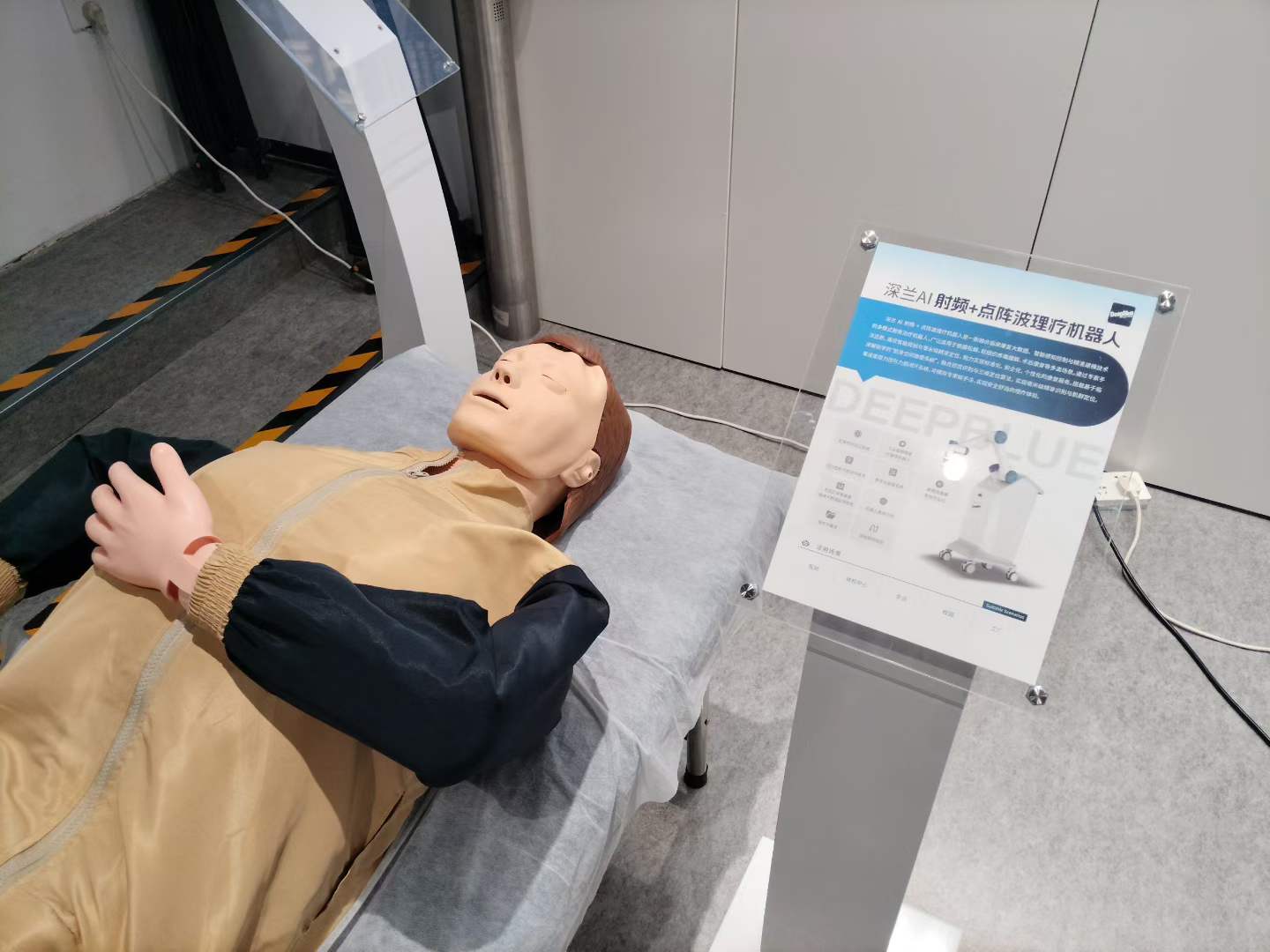
The industrial line includes inspection equipment for flat products, and the health line includes devices described as physiological health detectors and medical infrared thermal imaging systems. The company says its medical diagnostic model ranked first in an official 2025 evaluation, and that its DeepAgent product has entered China Mobile's partner ecosystem. A demonstration area shows the AI physiotherapy robot working on a treatment table, one of several health devices the company displays for visitors.
Funding, valuation and the listing attempt
Twelve rounds and the Pre-IPO round
Public records describe twelve funding rounds, with investors including Yunfeng Fund, Huaying Capital, CICC and Greenland Financial, which holds about 7.12 per cent. Disclosed amounts total more than 500 million yuan across the earlier rounds.
In April 2025 Pudong Venture Capital Group announced participation in a Pre-IPO round of several hundred million yuan. Company statements at the time put a target valuation of 23 billion yuan for late 2025 or early 2026 — a target, not a completed transaction at that number.
The listing process
Listing talk around this company dates back to 2018, when it was reported to be close to a fast-track technology IPO process. The April 2025 Pre-IPO round, with Pudong Venture Capital Group among the investors, is generally read as preparation for a listing.
Ask directly what stage the process is at and who is sponsoring it — the answer will tell you where the company is heading.
Orders and partners
Domestic
Announced domestic business includes the 500-bus order from CRRC Times Electric, the Urumqi sanitation contract, strategic cooperation with three China Communications Construction Group subsidiaries in April 2025, a 1,000-robot purchase contract with a Suzhou property company in July 2026 reported at 180 million yuan, and a joint venture with Greenland Group announced in August 2026.
Announced orders are not the same as delivered revenue, and the ratio between the two is the question worth asking in the technical session.
Overseas
Announced overseas work includes a smart city project in Uzbekistan described by the company with a total programme value of 2 billion US dollars, distribution agreements in Norway, cooperation with an Iraqi infrastructure development foundation, and a partnership covering Russia, Brazil and Argentina with a Baowu subsidiary.
The Uzbekistan figure in particular is a programme value for a city-scale project, not a contract value for this company. Read it as the size of the project the company says it joined, not as revenue.
Research and competition record
The company says it has won more than 40 first places at international computer vision and AI competitions including CVPR, ICCV and ECCV, and describes itself as the only repeat grand slam winner across the three main computer vision events in consecutive years. Some of its own materials cite more than 50 first places. It reports more than 1,000 patent applications or grants.
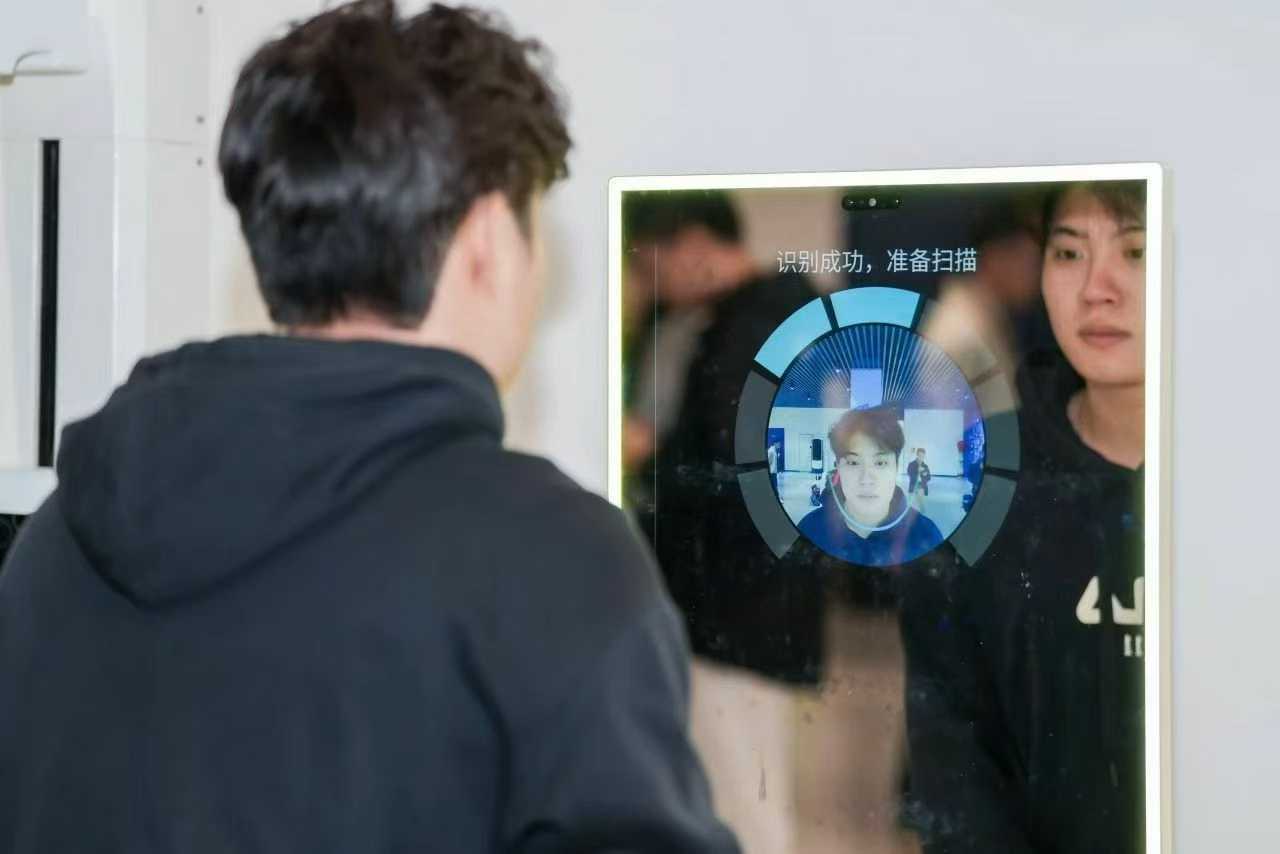
Competition results are a real signal of research capability, and they are also a research signal rather than a product one. Ask which competition work has shipped as product, and in which revenue line. In the exhibition hall the computer vision work is hands-on: a smart mirror runs face recognition on visitors in real time, the same recognition stack that sits inside the company's security and access products.
What a visit covers
The standard programme
| Time | What happens |
|---|---|
| 09:00–09:30 | Exhibition hall: company history, core technology and product range, with hands-on operation of several products |
| 09:30–10:10 | Manufacturing and campus areas: intelligent manufacturing in operation |
| 10:10–11:00 | Themed discussion with the management team on strategy, innovation management and organisational culture |
| 11:00 | Departure |
The programme is adapted to what the delegation wants to understand, and the final scope is confirmed in writing during planning, before you commit.
The exhibition hall
A standard programme includes an exhibition hall session covering company history, core technology and products, a walk through production or assembly areas, and a technical discussion with management or engineering staff. Programme materials describe a large hall with dozens of products on display and hands-on operation of several of them.
The exhibition hall is where the breadth is easiest to grasp, and the technical session is where the questions above should be asked. Delegations with a commercial agenda should allocate more time to the second than the first.
Who it suits
The visit suits delegations working on service robotics, municipal and sanitation automation, autonomous driving in constrained environments, industrial AI inspection, and AI in healthcare devices. It also suits investors and analysts who want to see a private Chinese AI company close up, with the caveats above.
Practical notes
- The visit is a business programme. Delegations are received as professional visitors and follow the host's rules.
- Booking requires approval in advance. Programme materials note that government and public institution delegations are asked to submit a formal request letter, and corporate delegations a participant list, with the booking confirmed by the host.
- Foreign participants normally need to be registered with the host ahead of time, and that process is longer than for domestic visitors; allow additional working days for the paperwork.
- Photography rules are confirmed in advance; some areas carry confidentiality requirements. Tell us during planning if you need images for internal reporting.
- Smart casual is appropriate. The programme involves walking through exhibition and technical areas.
- English interpretation can be arranged, including specialist preparation on AI and robotics terminology. Bilingual materials and an English summary can be prepared on request.
Questions before a DeepBlue Technology visit in Shanghai
Is the visit open to international business delegations? Yes, subject to advance arrangements and confirmation by the host. Registration of foreign participants takes extra time, so we recommend planning at least 30 days ahead.
Is DeepBlue a listed company? No. It is a private joint stock company and does not publish audited annual accounts.
How large is the company? The group operates through multiple subsidiaries and research institutes. Programmes are delivered by the host team; ask directly for the current scale figures during the briefing.
What is the group size? Visits are normally arranged for groups of 10 or more. We confirm the practical maximum with the host for your date.
How long does the visit take? The standard programme runs about two hours, covering the exhibition hall, production or assembly areas, and a briefing and Q&A.
Is the company close to listing? It completed a Pre-IPO funding round in April 2025 involving Pudong Venture Capital Group, and public statements target a valuation of 23 billion yuan. Ask the host for the current status of the process.
Has the company received state backing? Yes. In April 2025 Pudong Venture Capital Group participated in the Pre-IPO funding round, and the company holds national specialised and sophisticated "little giant" enterprise status.
Do participants need a technical background? No. The visit can be approached through robotics, municipal operations, procurement, investment or supply chain, and terminology is handled through interpretation.
What are the main product lines? Cleaning and disinfection robots, autonomous buses and sanitation vehicles, industrial inspection equipment, and AI health devices.
Is English interpretation provided? Yes, including preparation on AI and robotics terminology, and bilingual handouts can be arranged.
What documentation is needed in advance? A participant list with passport details for foreign visitors, submitted to the host for registration, plus the delegation's industry focus. We tell you the lead time for your specific group.
Does the programme always run as described? It is built around the elements above. Facilities and areas opened on the day are subject to what the site opens, and we confirm the final scope in writing during planning, before you commit.
Arrange your DeepBlue Technology visit
Tell us your dates, group size and what your team wants to understand: service robotics and cleaning automation, autonomous buses in municipal service, industrial AI inspection, AI health devices, or how a private full-stack Chinese AI company is structured and financed. We confirm the final programme scope with the host in writing during planning.
China Innovation Visits will coordinate the company reception, discussion priorities, transport and English interpretation.
Contact China Innovation Visits to arrange your DeepBlue Technology visit in Shanghai.