A United Imaging Healthcare(联影医疗) visit in Shanghai takes a delegation to the company that leads China's high-end medical equipment market. Shanghai United Imaging Healthcare was founded in 2011, is headquartered in Shanghai, and has been listed on the STAR Market under 688271 since 2022. In 2025 it reported revenue of about 13.8 billion yuan, up 33.98 per cent, and net profit attributable to shareholders of about 1.869 billion yuan, up 48.14 per cent.
The reason to go is that the market position is unusually specific. United Imaging ranked first in China by new-installation share across its full product line, excluding ultrasound, in 2025. Nine individual product categories ranked first in China. Its PET/CT line has held first place for ten consecutive years and its CT line for three. In 2025 both MR and radiotherapy reached first place in China for the first time.
The second reason is the part most reporting gets wrong. United Imaging is not a low-cost challenger that won on price. It runs a research programme that consumed about 2.62 billion yuan in 2025, builds its own core components, and is now selling into the United States, Europe and India against GE, Siemens and Philips. A delegation that wants to understand how a Chinese equipment maker moves from import substitution to premium export will get a better conversation here than at a consumer technology company.
China Innovation Visits coordinates the Shanghai programme, including the company reception, scheduling, local transport and English interpretation.
Key takeaways
- See the product line that now covers CT, MR, XR, molecular imaging, radiotherapy and ultrasound.
- Understand how PET/CT held first place in China for ten years and how MR reached first place in 2025.
- Discuss the 2025 result: revenue up 34 per cent, profit up 48 per cent, gross margin down.
- Examine the component localisation programme and what it saved.
- Ask about overseas: 24.86 per cent of revenue, up more than 50 per cent, across 100 countries.
- Compare with a FANUC factory tour in Shanghai on how Chinese equipment makers attack an incumbent, and a BGI visit in Shenzhen on the life-science side of the same sector.
Why visit United Imaging in Shanghai?
Medical equipment is a good subject for a delegation because it combines three things that rarely sit together: heavy engineering, regulated markets, and a customer — the hospital — that buys on clinical evidence rather than price alone. United Imaging is the clearest Chinese example of a company that has worked through all three.
The visit is also a lesson in what import substitution actually costs. Replacing a foreign component is not a purchase decision; it is a multi-year engineering programme with validation, regulatory and supply chain work behind it. United Imaging says it completed more than 50 such substitutions in 2025. Ask what the failure rate was.
Shanghai is the right place for the conversation because the company's main base, its second-phase smart manufacturing site and much of its research are here, with production also in Changzhou and Wuhan. Delegations building a wider healthcare programme usually pair it with a Fosun Pharma visit, which covers the therapeutic rather than the diagnostic side.
Company background
Founded 2011, listed 2022
United Imaging was founded in Shanghai in 2011 and listed on the STAR Market in August 2022. It makes magnetic resonance imaging systems, computed tomography systems, X-ray imaging, molecular imaging including PET/CT and PET/MR, ultrasound, and medical linear accelerator systems for radiotherapy, as well as animal MR and animal PET/CT for research.
The product line completed
The company describes completing a full-line layout in 2025 with the launch of a new ultrasound series, covering CT, MR, XR, molecular imaging, radiotherapy and ultrasound. It launched more than 80 new products globally during the year. Being one of the few domestic companies with a full line matters commercially: a hospital buying an imaging suite wants one vendor, not six.
The 2025 results
Revenue and profit
Revenue was about 13.800 billion yuan in 2025, up 33.98 per cent — a record since listing. Net profit attributable to shareholders was about 1.869 billion yuan, up 48.14 per cent, and net profit excluding non-recurring items about 1.770 billion yuan, up 75.18 per cent. Operating cash flow was about 2.679 billion yuan, a substantial improvement on the year, and the company raised its proposed dividend to 1.8 yuan per 10 shares. Basic earnings per share were 2.28 yuan and weighted average return on equity 9.00 per cent. The company proposed a dividend of 1.8 yuan per 10 shares, against 0.8 yuan the previous year.
By product
Sales of medical imaging diagnostic and radiotherapy equipment were about 11.390 billion yuan, up 34.87 per cent, or 82.53 per cent of revenue, at a gross margin of 46.56 per cent. Maintenance and service revenue was about 1.708 billion yuan, up 25.96 per cent, or 12.38 per cent, at a gross margin of 61.86 per cent. Software revenue was about 54.5 million yuan, down 34.49 per cent.
By geography
Domestic revenue was about 10.369 billion yuan, up 29.07 per cent, or 75.14 per cent. Overseas revenue was about 3.431 billion yuan, up 51.39 per cent, or 24.86 per cent — up more than 2.86 percentage points on the year — with the business now covering 100 countries and regions.
People
Headcount at the end of 2025 was 8,703, up 6.48 per cent. Revenue per employee was about 1.586 million yuan and profit per employee about 215,000 yuan.
Reading the margin
Gross down, net up
Gross margin was 47.01 per cent, down 1.53 percentage points, while net margin was 13.36 per cent, up 1.3 percentage points. The two moved in opposite directions, and that combination is the interesting part of the year.
A falling gross margin alongside rising net profit usually means operating leverage and cost control rather than pricing power. Ask which of the two it was, because the answer tells you whether the 2026 margin path is up or down.
The research number, and a correction
The company's 2025 research expense was about 1.842 billion yuan, up 4.57 per cent, equal to 13.35 per cent of revenue. Total research investment, on the company's broader definition, was about 2.621 billion yuan, or 18.99 per cent of revenue. Cumulative patent applications passed 10,000, with invention patents accounting for more than 80 per cent.
Some secondary sources circulating in Chinese training material describe annual research spending at over 10 billion yuan. That figure is not consistent with the company's own reporting on revenue of 13.8 billion yuan, and should not be repeated.
Market share: where it actually leads
The domestic position
The company reports that its full product line, excluding ultrasound, gained 4.5 percentage points of new-installation share in China in 2025, ranking first, with nine product categories ranked first in China. Specific lines named include 40-slice CT, 64–80-slice CT, 128–160-slice CT, 1.5T MR, 3.0T and above ultra-high-field MR, PET/CT, PET/MR and mammography DR.
What changed in 2025
MR gained 2.7 percentage points and radiotherapy gained more than 18 percentage points, with both reaching first place in China for the first time. PET/CT held first place for the tenth consecutive year and CT for the third.
Radiotherapy moving 18 points in a year is the single most notable number in the report, and it is worth asking what drove it — a product launch, a tender cycle, or a competitor's withdrawal.
What is on the floor
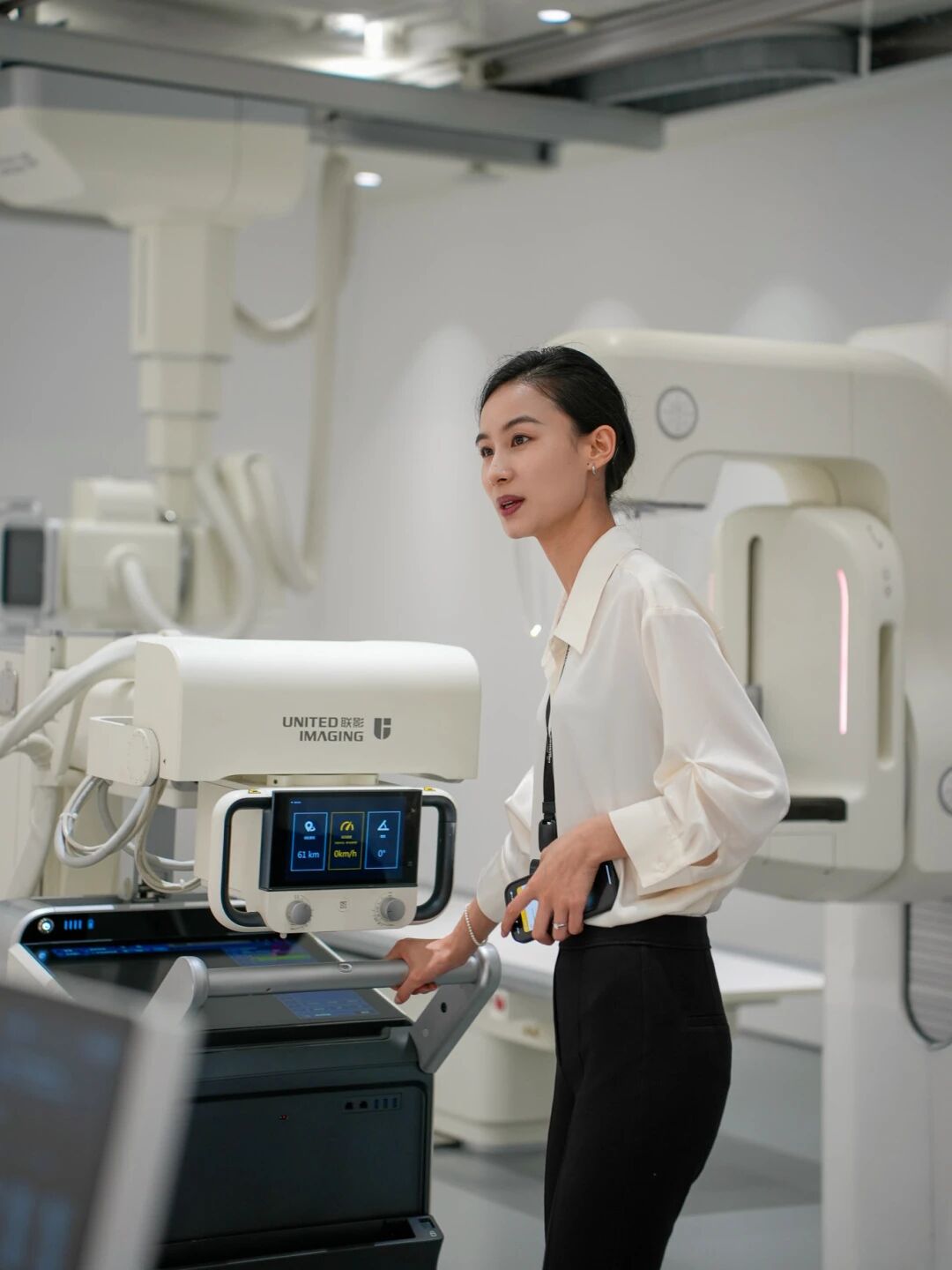
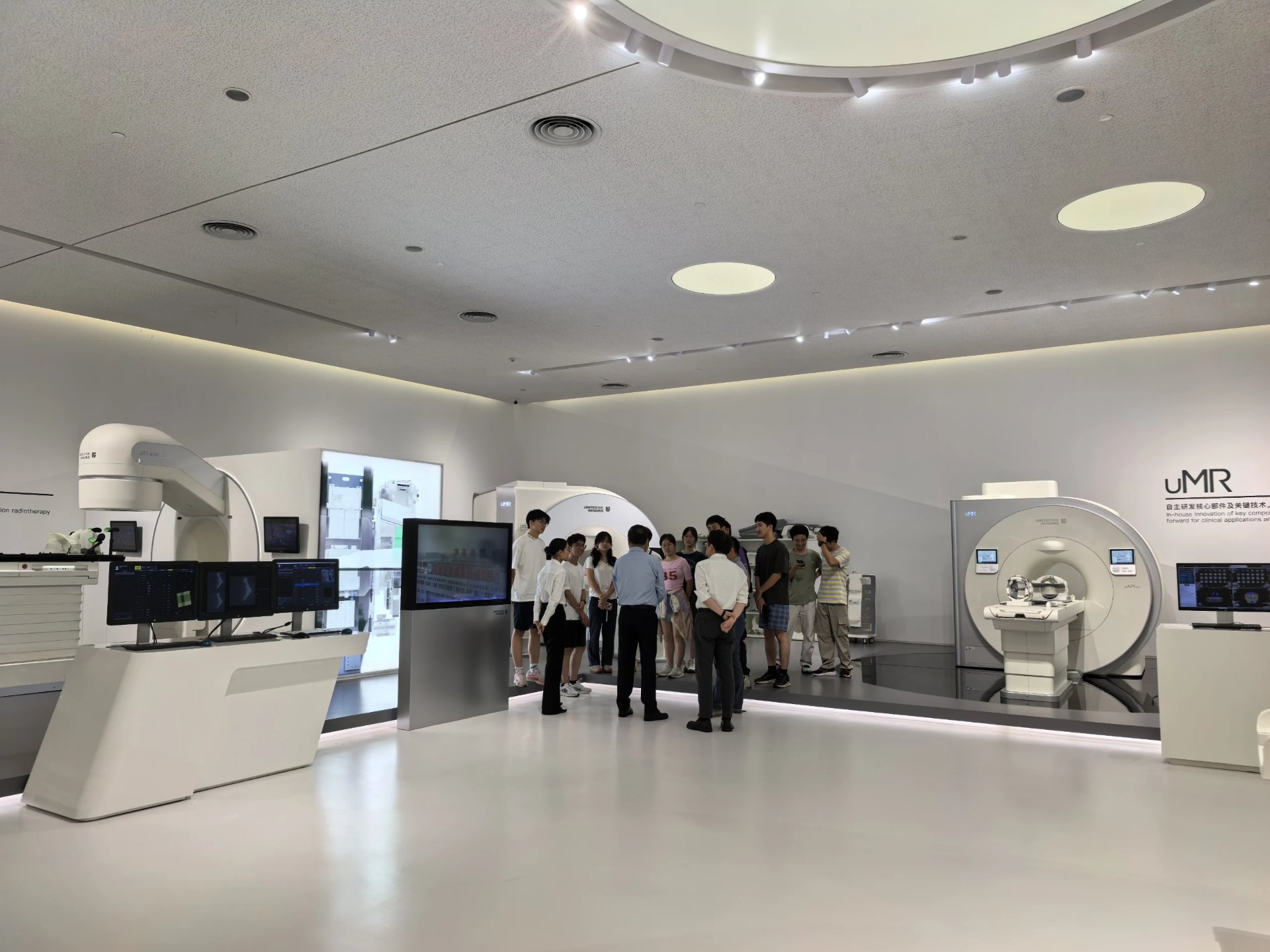
The exhibition hall lays out the full product range — CT, MR, PET/CT, interventional, radiotherapy and women's health imaging — in one continuous circuit, with staff presenting each line at the machine itself.
The firsts
Products cited by the company include the uCT Siriux, described as the world's first dual-wide-bore dual-source CT; the uCT Ultima, described as China's first photon-counting spectral CT; the uMR Jupiter, described as the world's first whole-body clinical ultra-high-field 5T MR; and the uMR Ultra, described as the world's first "camera" MR. The company also lists ten leading interventional technologies including zero-noise high-definition low-dose imaging and panoramic 3D.
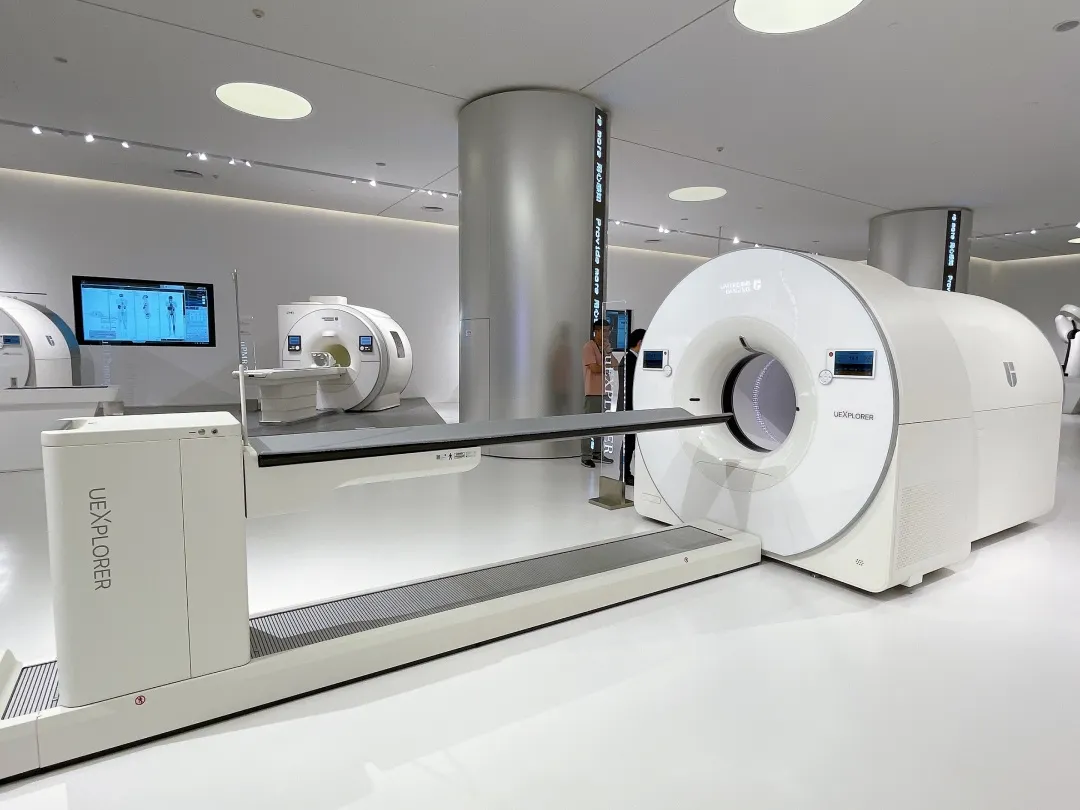
The exhibit most visitors remember is the uEXPLORER, the company's total-body PET/CT — credited as the world's first whole-body dynamic PET/CT when it launched, and still the machine that anchors the hall.
What to ask about them
"World first" claims in medical imaging are worth testing clinically. Ask what the uCT Ultima's photon-counting detector changes in dose or diagnostic confidence, and whether the 5T system has a defined clinical workflow or is still a research platform. The answers separate a product from a demonstration.
The cost programme
Component localisation
The company says it completed more than 50 core component substitutions and production switchovers in 2025, cutting direct material costs by more than 300 million yuan, and implemented more than 200 lean cost-reduction projects.
Logistics
Cold-magnet shipping now covers close to 70 countries and regions, with more than 500 MR systems delivered safely and cumulative logistics savings of more than 370 million yuan. Cross-border delivery savings were reported at more than 10 million US dollars for the year.
Why this matters
Superconducting magnets, detector crystals and X-ray tubes are the components that decide whether an imaging company is an integrator or a manufacturer. A delegation should ask which of the three United Imaging now makes itself, and which it still buys.
Overseas: a quarter of revenue and rising
North America
The company reports order and revenue growth in North America, with high-end imaging equipment now covering more than 90 per cent of US states by its account, and installations at leading clinical and research institutions. Local service revenue grew more than 50 per cent.
Europe
European revenue grew 49.61 per cent to about 585 million yuan. The company describes a local system covering research, marketing, service and operations as essentially in place, and in March 2026 announced a strategic cooperation with Bayer on medical imaging and digital health.
Asia-Pacific and emerging markets
Asia-Pacific revenue grew more than 40 per cent and emerging markets more than 80 per cent. Named developments include a strategic cooperation with IHH Healthcare and installation at Singapore General Hospital; a first public healthcare system tender win in Australia with an eighth PET/CT installed in Melbourne; work with Apollo hospitals in India; and first-unit deliveries in Turkey, Kuwait and Morocco.
How to weigh it
A quarter of revenue outside China, growing faster than the domestic business, is a genuine structural change. It is also the part most exposed to trade policy, which is why the company's localisation and logistics programmes sit in the same story.
The 2026 first quarter
The first quarter
In the first quarter of 2026 revenue was about 2.908 billion yuan, up 17.34 per cent, and net profit about 399 million yuan, up 7.78 per cent.
What to ask
Both rates are lower than the full-year 2025 rates, and the first quarter is the smallest quarter of the year for a business that delivers to hospital capital budgets. The useful question at the briefing is what is in the order book and how much of the year's delivery is already contracted, rather than reading a single quarter against an exceptional full year.
The visit programme
| Time | What happens |
|---|---|
| First 30 minutes | Exhibition hall: the company's history and core achievements, presented product line by product line |
| 30–70 minutes | Campus and manufacturing areas: intelligent manufacturing and digital management in operation |
| 70–120 minutes | Briefing and discussion with senior staff on management practice and strategy |
The standard visit runs about 120 minutes: 30 minutes in the exhibition hall, 40 minutes in the campus and manufacturing areas and 50 minutes in discussion, with the start time set with the host.
A standard visit runs through a reception and company introduction, then a guided walk of the exhibition hall with staff presenting each product line at the machine itself — the guides cover CT, MR, interventional, radiotherapy and women's health imaging, and adjust the depth to the delegation's background.
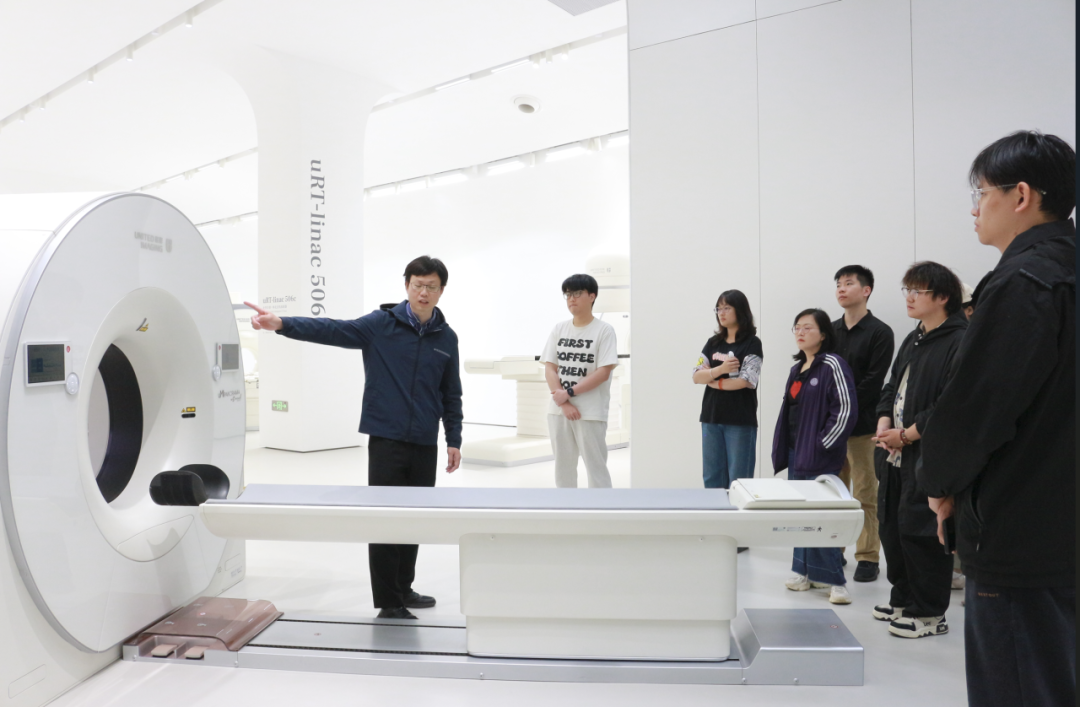
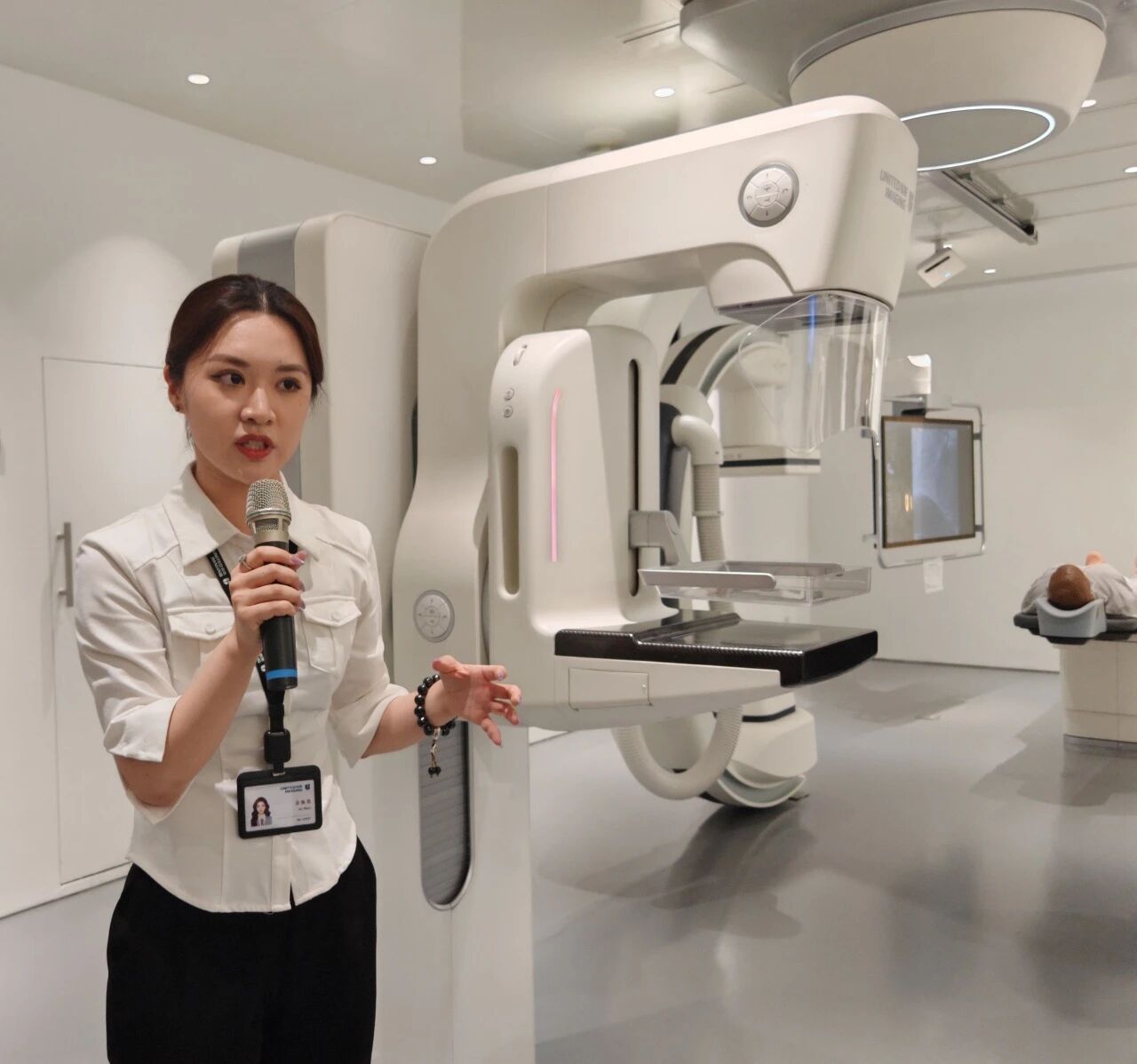
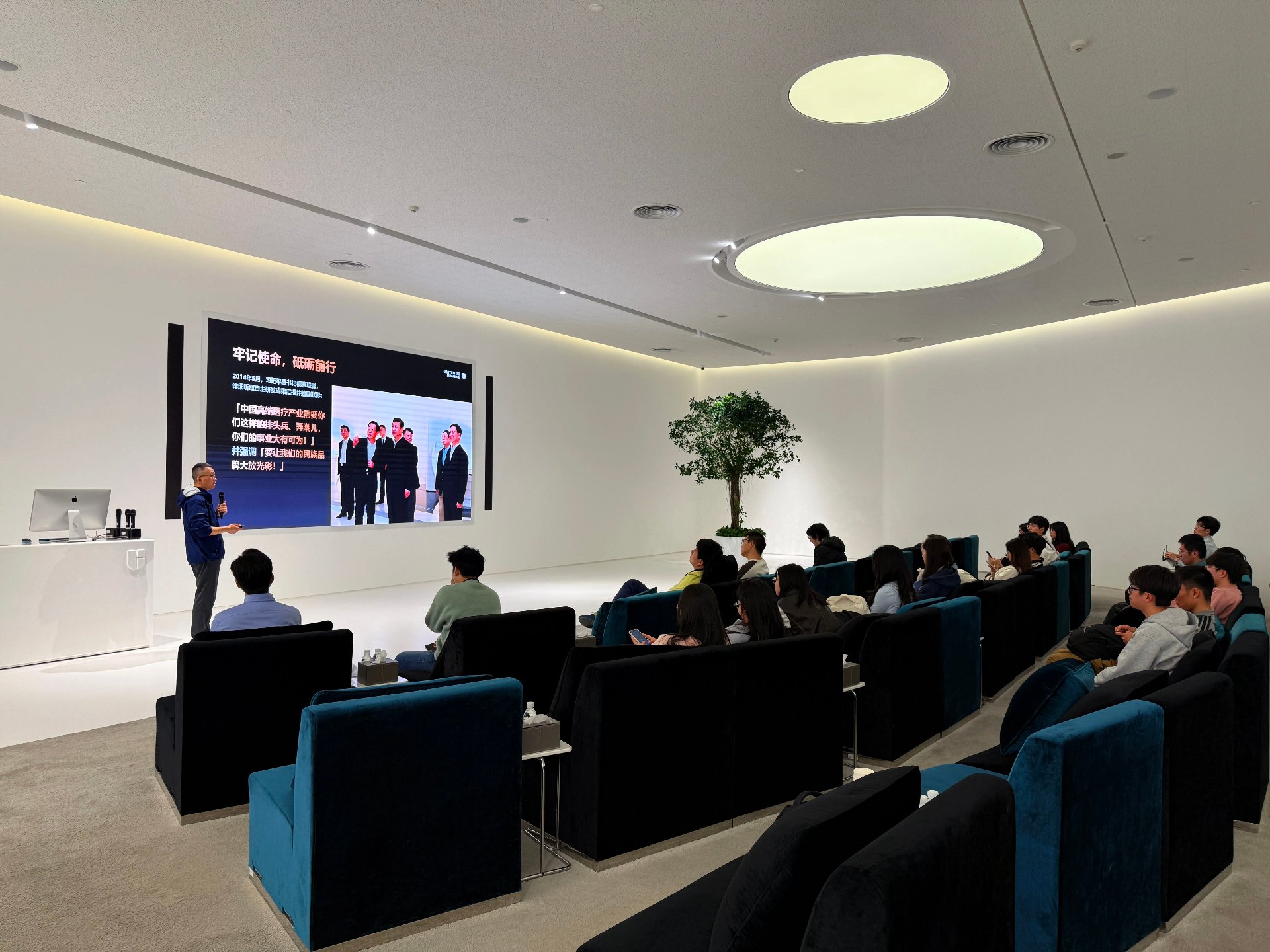
The visit closes with a briefing and discussion session in the theatre, where the company presents its history and development and the delegation's questions are answered. This is normally the most useful hour: the technical walk shows what the company builds, and the session is where the commercial and strategic questions above get answered.
Practical notes
- The visit is a business programme. Delegations are received as professional visitors and follow the host's rules.
- Booking requires approval in advance; tell us your dates early so the paperwork does not delay the visit.
- Provide the participant list, industry background and focus areas; the depth of the technical briefing is adjusted to suit.
- Photography rules are confirmed in advance; tell us during planning if you need images for internal reporting.
- Smart casual is appropriate. The programme involves walking through exhibition and technical areas.
- English interpretation can be arranged for the exhibition, technical sessions, briefing and Q&A, with preparation on imaging terminology.
Questions before a United Imaging visit in Shanghai
Is the visit open to international business delegations? Yes, subject to advance arrangements and confirmation by the host. Host approval takes time, so we recommend planning at least 30 days ahead.
What is the group size? Visits are normally arranged for groups of 10 or more. We confirm the practical maximum with the host for your date.
How long does the visit take? The standard programme runs about two hours, typically covering the exhibition hall, technical areas, and a briefing and discussion with company specialists.
Where is the visit held? At the company's base in Shanghai. We confirm the meeting point in writing after the host approves the booking.
Do participants need a technical background? No. The visit can be approached through healthcare delivery, procurement, manufacturing, investment or policy, and terminology is handled through interpretation.
Is English interpretation provided? Yes, including preparation on imaging and medical equipment terminology.
How large is the company? Revenue was about 13.8 billion yuan in 2025, up 33.98 per cent, with net profit of about 1.87 billion yuan and 8,703 employees.
How much does it spend on research? Research expense was about 1.842 billion yuan in 2025,13.35 per cent of revenue; on the company's total research investment definition, about 2.621 billion yuan, or 18.99 per cent. Figures above 10 billion yuan appearing in some training material are not consistent with the company's reporting.
Where does it lead in China? It ranked first by new-installation share across its full line excluding ultrasound in 2025, with nine categories first. PET/CT has been first for ten years and CT for three; MR and radiotherapy reached first place in 2025.
Is growth continuing? The first quarter of 2026 grew more slowly than the full year 2025: revenue up 17.34 per cent and net profit up 7.78 per cent. Ask what is in the order book.
Does the programme always run as described? It is built around the elements above. Facilities and areas opened on the day are subject to what the site opens, and we confirm the final scope in writing during planning, before you commit.
Arrange your United Imaging visit
Tell us your dates, group size and what your team wants to understand: import substitution in medical devices, how to sell imaging equipment into regulated markets, the economics of service revenue, or building a full product line rather than a single product. China Innovation Visits will coordinate the company reception, discussion priorities, transport and English interpretation.
Contact China Innovation Visits to arrange your United Imaging visit in Shanghai.