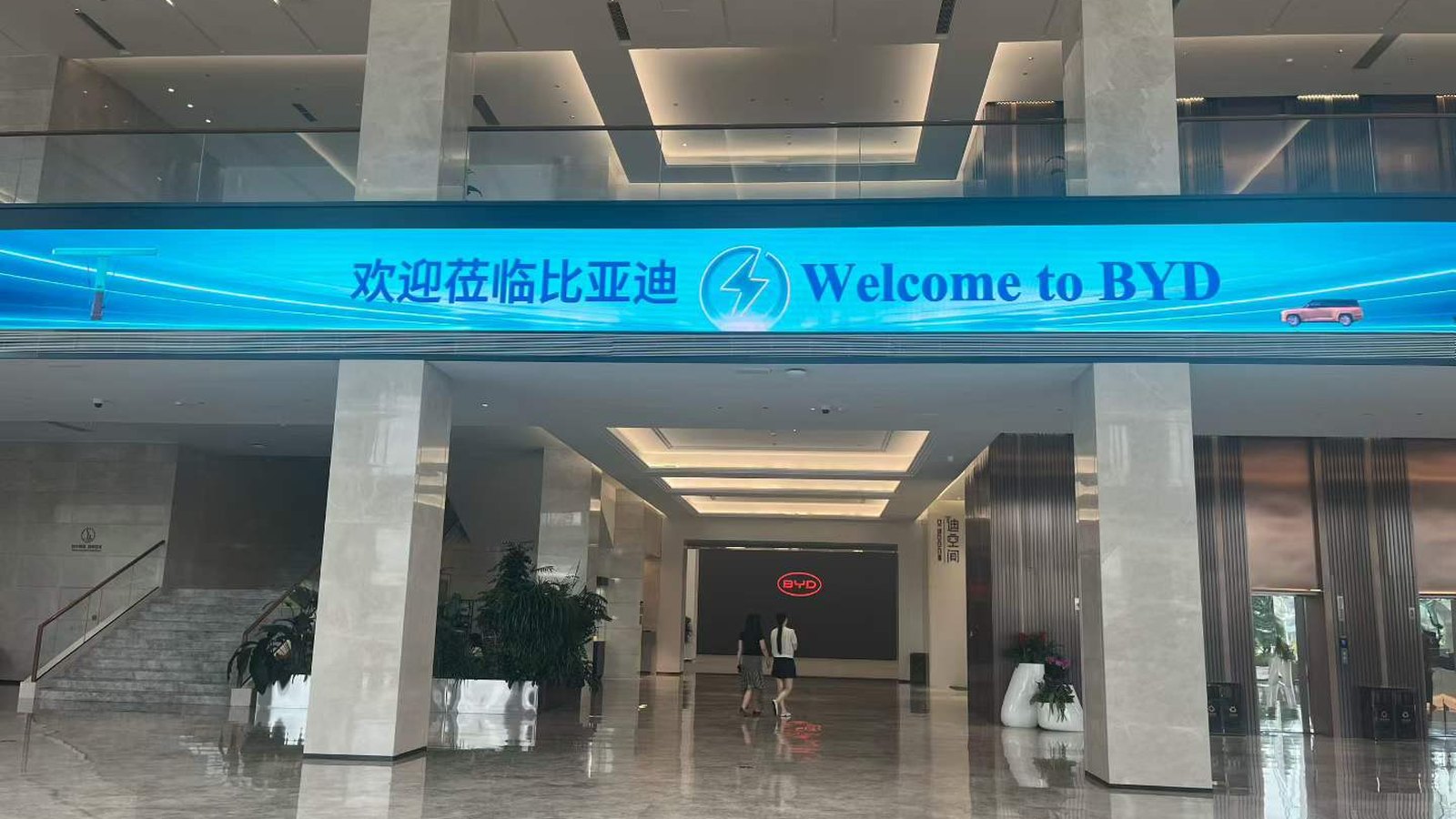
A BYD company visit puts a business delegation inside the company that turned a battery maker into the world's largest new-energy vehicle business. The programme runs at BYD's global headquarters in Pingshan, Shenzhen, and at the museum the company opened in its original 1995 workshop in Longgang — a technology hall, a museum walk, and sessions with the people who build the cars. What a team takes home is not a product tour. It is how batteries, vehicle platforms, driver assistance and manufacturing are held together inside one company, and what that means for selling into markets abroad.
Key takeaways
BYD's global headquarters and its technology exhibition hall are in Pingshan, Shenzhen, and the company's history museum is in Longgang, in the buildings of its original 1995 workshop — both inside Shenzhen and normally combined in one day.
The reason to go is vertical integration. BYD builds its own batteries, motors, electronic controls and power semiconductors, and the exhibition hall is where that claim stops being a line in an annual report and becomes a set of components standing next to each other.
The headline exhibits are the second-generation Blade Battery with megawatt flash charging — 10% to 70% in five minutes at room temperature — the kilovolt-class Super e-Platform, the God's Eye driver-assistance system and the model range across premium and volume brands.
The Longgang museum is the part delegations consistently underrate. It documents the decision to enter car making in 2003 and the years of vertical integration that answered the doubters, which is more useful to a management team planning its own hard pivot than the product hall.
We arrange the programme end to end, including site scheduling on the Chinese side, transport between the two Shenzhen sites and English interpretation on site.
Key visit details
Where the visit is held
Location — BYD's global headquarters on BYD Road, Pingshan District, Shenzhen, known locally as the Hexagon Building campus; and the BYD History Museum in the Deqing industrial park, Longgang District, Shenzhen, on the site of the company's original 1995 to 2000 workshop. Both sites are inside Shenzhen, roughly an hour apart by road.
Getting there — both sites sit well outside the central business districts, which is the detail most delegations underestimate when they build their own schedule. Pingshan is in the north-east of the city and the museum is in Longgang to the north, so a day that combines them involves real road time across Shenzhen rather than a short hop between two downtown addresses. We plan the transport as part of the programme, including pickup from your hotel.
Format and duration
Duration — Half a day at a single site, or a full day combining the Pingshan headquarters and the Longgang museum.
Format — A guided walk through the technology exhibition hall, a ride on the SkyShuttle inside the campus, the museum, and a themed session with company experts. Production-line viewing is arranged with the site and confirmed as part of planning rather than assumed.
Who the programme suits
Best suited to — Automotive and new-energy vehicle teams; battery, charging and automotive supply-chain businesses; smart-manufacturing and industrial-technology groups; business leaders studying product and technology strategy; and delegations looking at China's automotive industry and its overseas expansion.
Main themes — Battery technology and flash charging, vehicle platforms and high-voltage architecture, intelligent driving, automated manufacturing and supply chain, brand portfolio and international expansion.
Booking, group size and site rules
Booking — Around 30 days in advance is the practical lead time. The programme is best suited to groups of 10–20 participants.
Visiting requirements — Some core technology areas of the museum are closed to photography. Where a production line is included in the programme, phones, cameras and recording equipment are not permitted on the line, and any protective clothing required is arranged for you.
Why a BYD visit is worth a delegation's day
The numbers alone would justify the trip. In the first quarter of 2026 BYD recorded revenue of RMB 150.225 billion, net profit attributable to shareholders of RMB 4.085 billion, and research and development spending of RMB 11.344 billion in a single quarter. In July 2026 it sold 419,000 vehicles in one month, close to 180,000 of them outside China, with overseas sales now accounting for about 43% of the total. It has held the top position in China's monthly new-energy vehicle sales for 62 consecutive months.
The more useful object of study is the structure behind those numbers. BYD builds its own batteries, motors, electronic controls and power semiconductors. That vertical integration is what lets it cut prices into a market without cutting the product, and it is the same capability that pays for a flash-charging network or a driver-assistance system rolling out across ten million vehicles. Reading that in a filing tells you the strategy. Standing in the hall where the parts are laid out next to each other tells you how tightly it is actually held together.
It is also a company in the middle of moving from product export to capacity export, building plants abroad while it defends a domestic price war. Delegations working on their own China or overseas strategy tend to find that transition more instructive than a finished success story. The same lens applies to the battery makers up the supply chain — see the Sunwoda company visit and the CATL overseas buildout for the cell-side view, and the BYD global strategy read for the vertical-integration argument in more depth.
Inside the Pingshan headquarters
The technology hall is where the programme starts, and it is the reason the visit reads as a technology campus rather than a car plant. Four exhibits carry most of the weight.
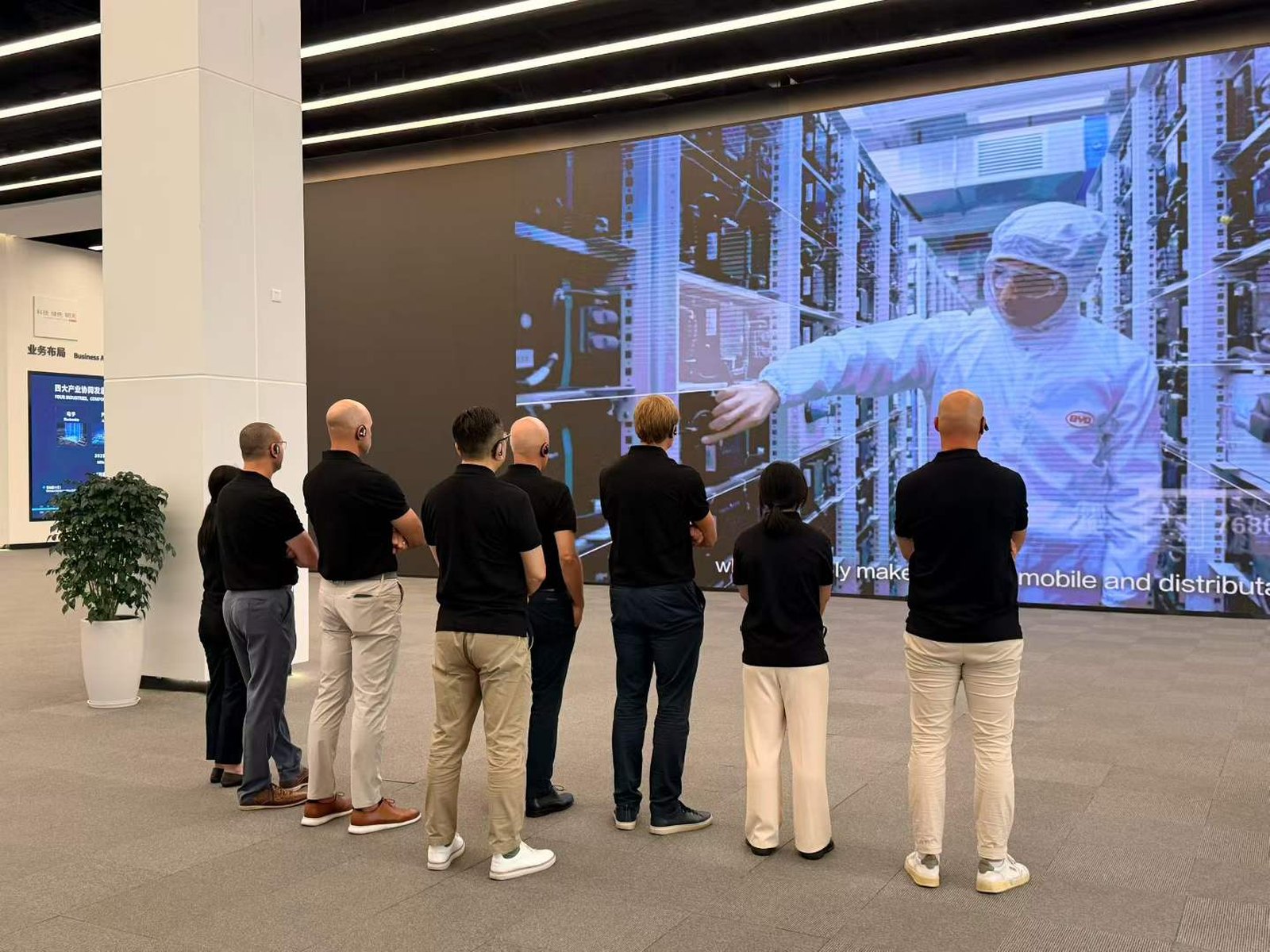
The technology exhibition hall at BYD's Pingshan headquarters, Shenzhen.
The Blade Battery and megawatt flash charging
Second-generation Blade Battery and megawatt flash charging. At room temperature the system takes a vehicle from 10% to 70% charge in five minutes and from 10% to 97% in nine. At minus 30 degrees Celsius, from 20% to 97% takes about twelve minutes — the fastest mass-production charging rate in the world today. The exhibit is worth standing in front of because it is the clearest single answer to the objection that still slows electric vehicle adoption in cold markets: that charging is slow and unreliable in winter.
The Super e-Platform and the 1,000-volt architecture
Super e-Platform and the 1,000-volt architecture. Launched in 2025, it moves the whole vehicle — battery, motor and electronic control — onto a kilovolt-class electrical system. The point a delegation should take from it is not the charging headline but what full-chain high voltage does to efficiency, thermal load and the number of parts a platform can carry across several models.
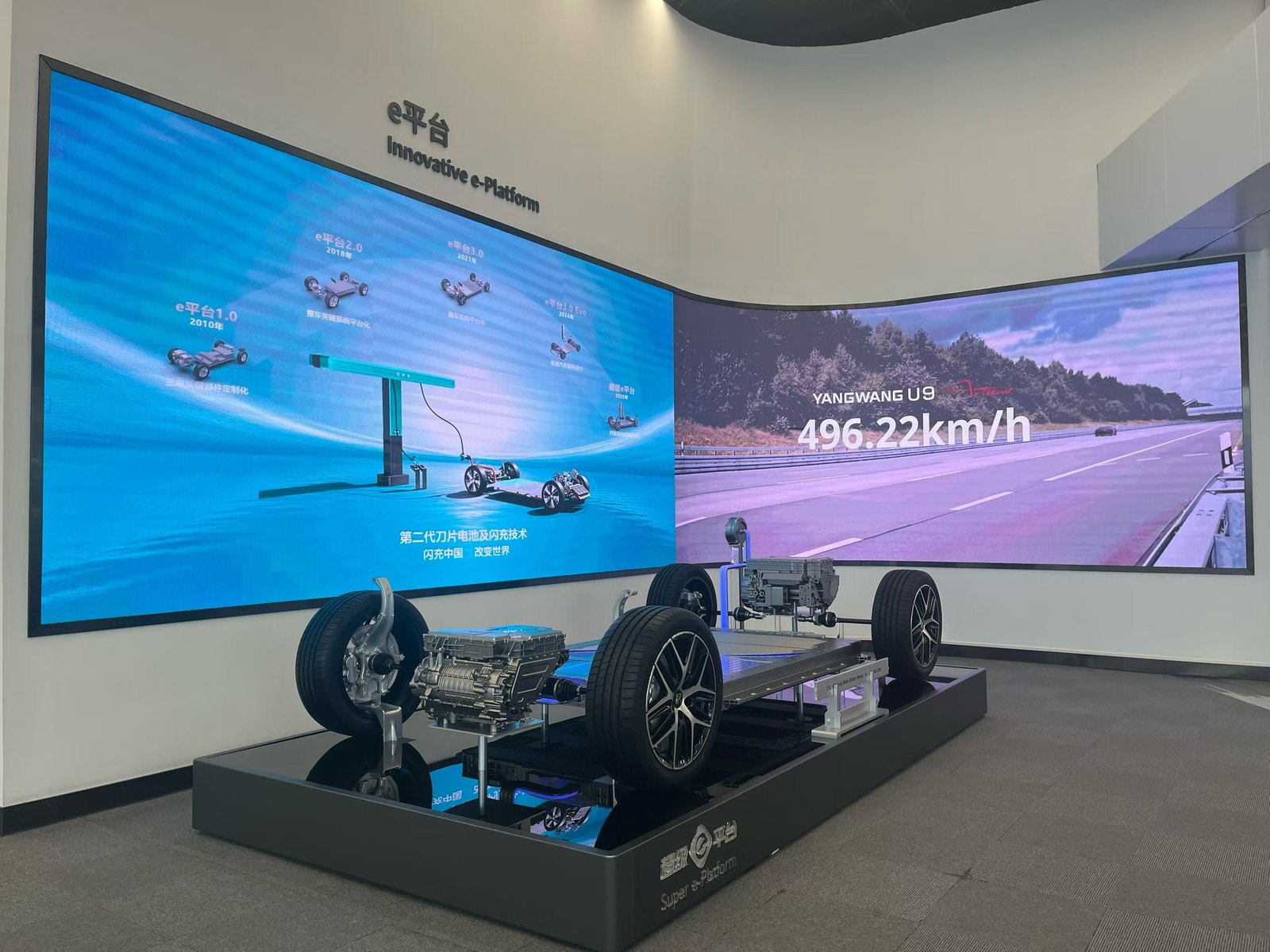
The Super e-Platform display in the exhibition hall.
God's Eye intelligent driving
God's Eye intelligent driving. BYD's approach has been to push driver assistance down into mainstream models rather than reserve it for a premium flagship. That is a different problem from the one most autonomy teams are solving: it is about cost, sensor configuration and validation at volume, and it is the version of the question most manufacturing companies will eventually face.
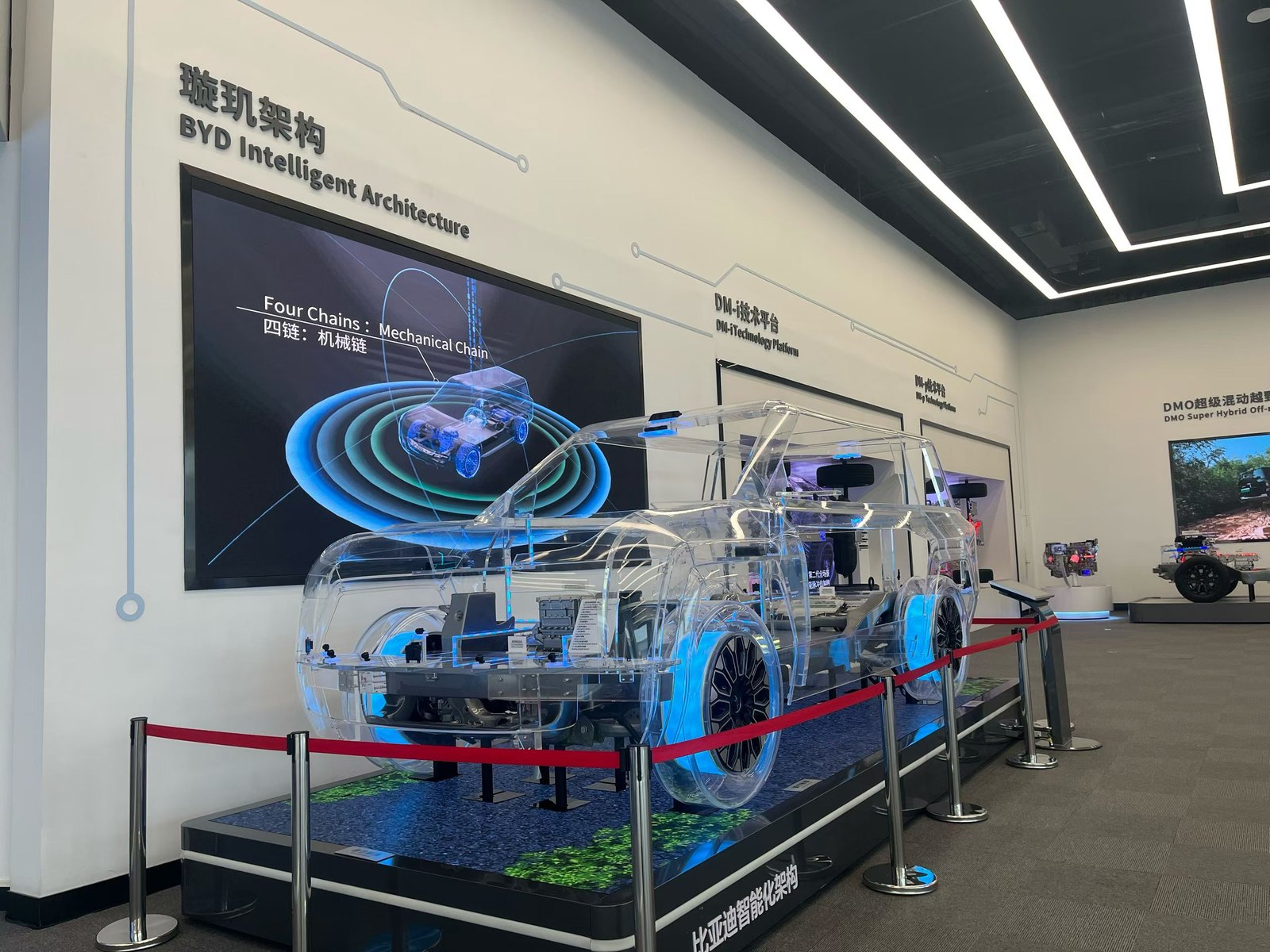
The intelligence framework displayed in the hall — where driving assistance, sensors and vehicle systems meet.
The product matrix and the patent wall
The full product matrix and the patent wall. The hall carries the model range from the premium Yangwang and Denza lines through Fangchengbao to the mainstream volume brands — the clearest illustration of how one platform and one parts base are split into several price bands. The global patent wall alongside it shows the filings behind the components, and it is the exhibit that most often changes how a visiting engineering team reads the rest of the room.
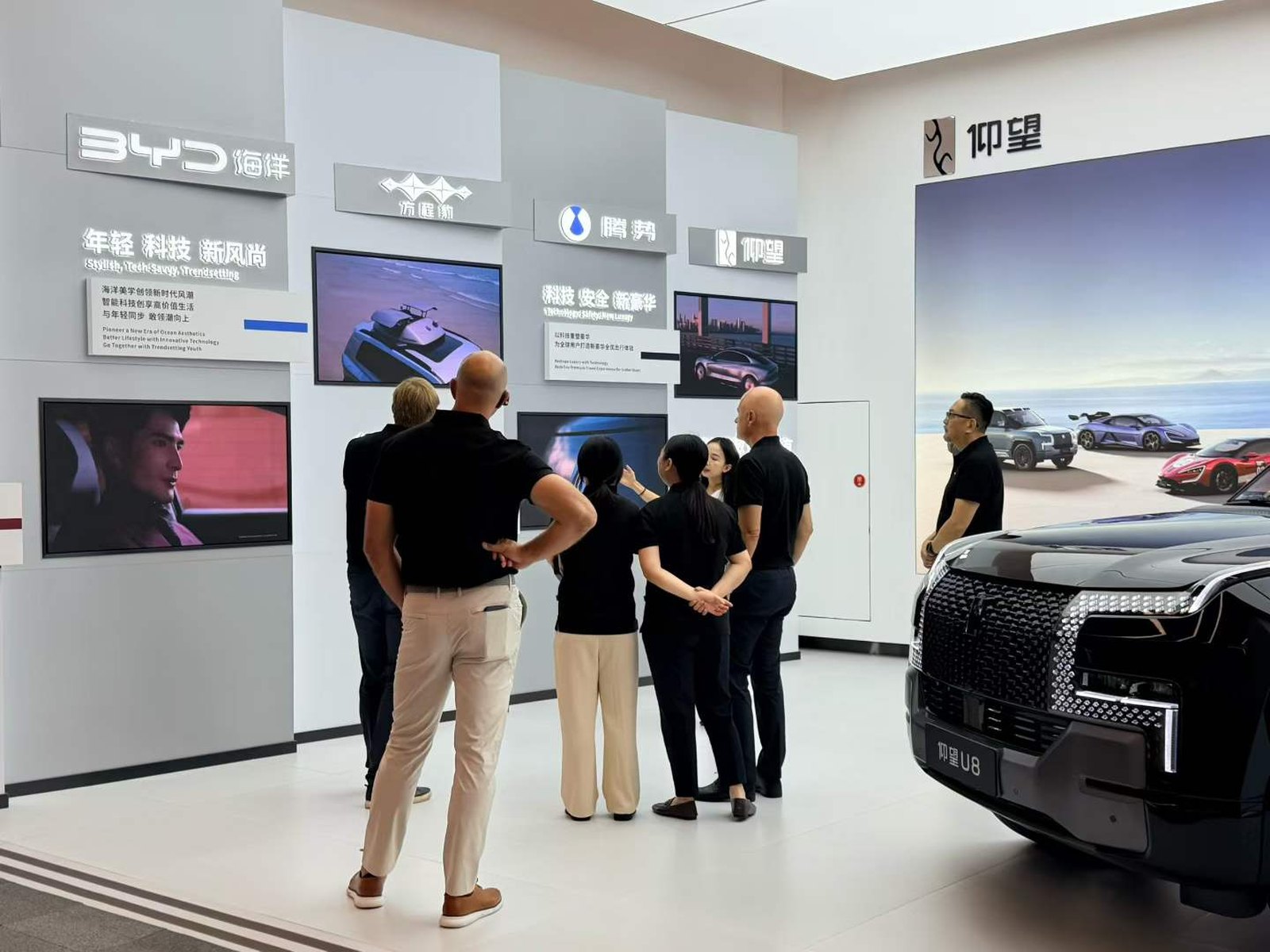
Delegations get hands-on time with the current model range in the hall.
The SkyShuttle, its control centre and the depot
The SkyShuttle. BYD builds its own elevated autonomous transit system, and a line runs through the campus. It is the clearest example on site of the company applying the same in-house engineering habit to something that is not a car: the vehicles, the signalling and the control systems are all its own.
Most programmes ride the line and stop there. The two stops that separate a good visit from a routine one are the operation control centre — the room from which the whole line is dispatched, running unattended — and the maintenance depot where the vehicles are serviced. A working transit operation has to solve dispatching, redundancy and maintenance on real constraints rather than in a demonstration, and for any delegation dealing with fleet operations, logistics or infrastructure, those two rooms raise better questions than the passenger platform does. Both are arranged with the site as part of planning.
The same segment of the programme usually includes BYD's vehicle retail and experience side, where a delegation can sit in the latest models and work through the driver-assistance features with someone who knows the system, and — in some cases, subject to how the day is scheduled — look over a partner vehicle line represented on the same campus. It is the part of the visit that answers the question engineers ask first and paperwork answers last: what is it actually like to use this.
The Longgang museum: thirty years in two old factory buildings
The second site is easy to underestimate and usually turns out to be the part of the day a delegation talks about afterwards. BYD opened its history museum on 18 November 2024, on the company's thirtieth anniversary, on the site of its original workshop in the Deqing industrial park in Longgang District — the buildings it occupied from roughly 1995 to 2000. Two former factory blocks, eight floors between them, 9,473 square metres, and more than 2,000 physical exhibits.
The two blocks divide the story. One covers the thirty-year company history and the battery business it started in. The other covers the four industries BYD now runs — automotive, electronics, rail transit and new energy — and how each of them grew out of the one before. The route runs in time order, so the arc from a rechargeable-battery manufacturer to a global vehicle maker is walked rather than summarised.
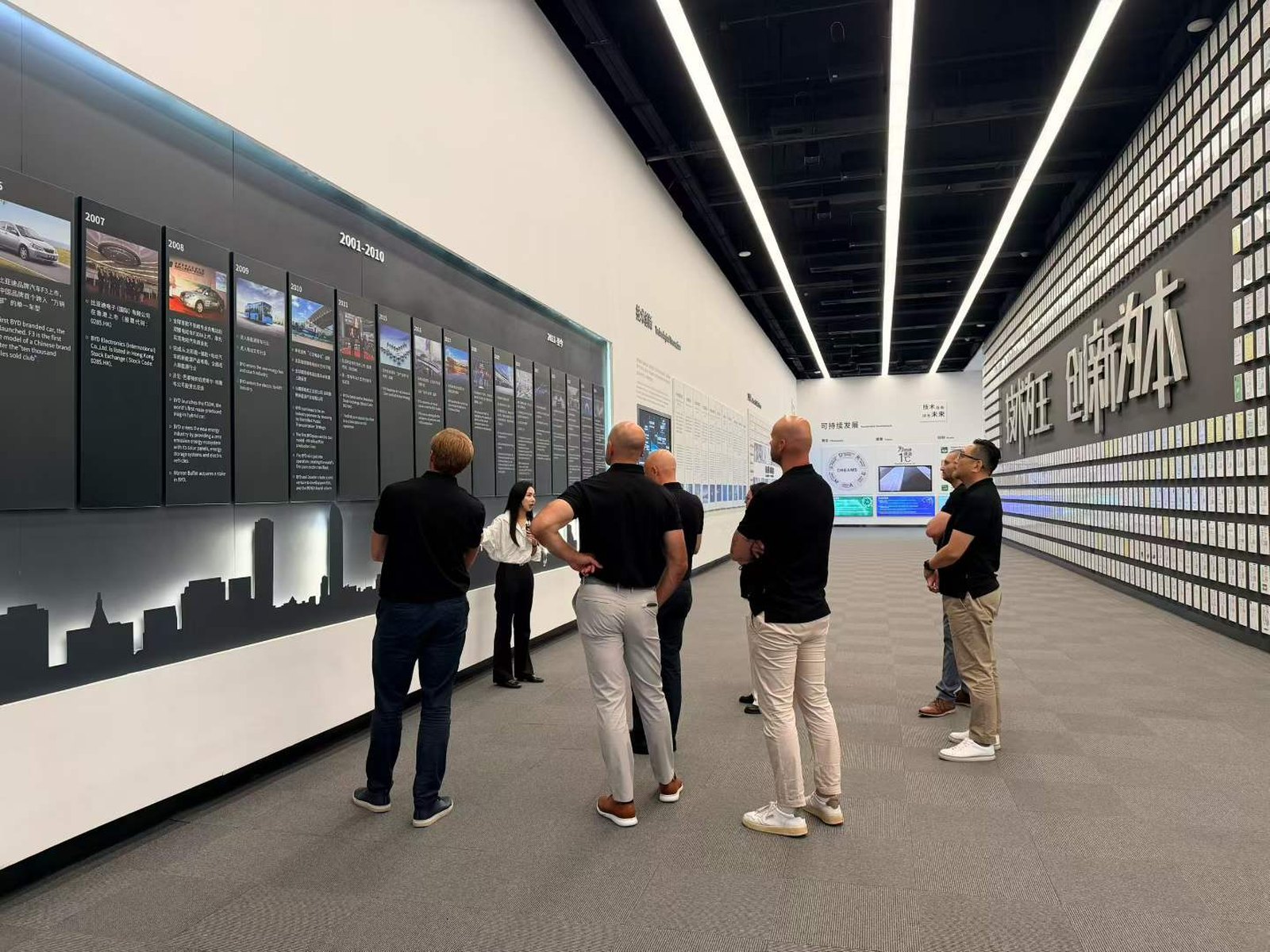
The development history walk-through at the BYD History Museum, Longgang District.
The section most relevant to a visiting management team is the one covering the decision to enter car making in 2003, when the outside view was that a battery company had no business building cars, followed by the years of vertical integration that answered it. Companies preparing their own hard pivot — a new category, a new market, a capability that does not yet exist internally — tend to find more to argue with here than in the product hall. The museum is also the stop that pairs with an expert session on BYD's own history and management method rather than on its product line, which is why we normally put the two sites on the same day when a delegation has the time.
What different teams take away
For automotive and new-energy vehicle teams — how one platform and one parts base are stretched across several brands and price bands, and what that does to development cost and time to market.
For battery, charging and supply-chain teams — what a second-generation Blade Battery and a megawatt charging system imply for cell chemistry, pack design, connector and cable standards, and the grid interface behind the station.
For manufacturing and industrial-technology teams — how automation, process and quality control are organised on a line running at very high volume, and where the trade-off between automation and people has actually landed. This is the group most likely to pair the visit with a battery line such as the Sunwoda smart-manufacturing visit on the same trip.
For business leaders and strategy teams — the export and localisation playbook: which markets BYD entered first and why, how it decided between exporting vehicles and building plants, how the brand portfolio is positioned as it moves upmarket, and how a low-cost home market is defended while an overseas one is bought. Teams reading the European side of that story will get more from the BYD Europe analysis alongside the site visit.
The same site should look different to each of those four groups, and that is the point. Tell us which one your delegation is and the expert session is shaped around it.
Sample visit programme
| Session | What to expect |
|---|---|
| Technology exhibition hall | The centrepiece of the visit: the second-generation Blade Battery and megawatt flash charging, the Super e-Platform's kilovolt-class architecture, the God's Eye intelligent driving system, the model range from the premium brands to the volume lines, and the patent wall — with a company guide and time for questions. |
| Manufacturing and supply chain | How automated vehicle production, battery manufacturing and the automotive supply chain are organised — and how a company that makes its own batteries, motors, electronic controls and semiconductors coordinates those parts into one production system. Any production-line or workshop access is arranged with the site and confirmed during planning. |
| Business and global growth session | A discussion with company experts on the multi-brand tiering strategy, building plants overseas, the charging-network buildout at home, and the operating logic behind the jump in overseas sales — connected to the markets your own team works in. |
The programme runs in that order by default, and each block is shaped around what your delegation came to find out. Tell us which of the three matters most to your team and we allocate the time accordingly.
The point of standing in the hall is not the cars. It is that the battery, the motor, the chip and the car all came out of the same company.
Where a BYD visit can be arranged
BYD's global headquarters is in Shenzhen, and that is where the programme described above runs by default — the Pingshan campus for the technology hall and the Longgang museum for the company history, on the same day if you have the time. Visits can also be arranged at BYD's manufacturing bases in other Chinese cities, including Xi'an, Hefei, Zhengzhou, Changsha, Changzhou, Jinan, Xiangyang, Fuzhou and the Shenshan Special Cooperation Zone. What each site can open differs by plant and by the day, so tell us which city fits your route and we will confirm what is available there.
Most delegations visiting Shenzhen pair BYD with one or two other stops on the same trip — a battery maker, a robotics company or an EV or autonomous-driving site. The Shenzhen tech tour page sets out the combinations that work best by day.
Practical notes for the day
Build in travel time. Pingshan and Longgang are both a long way from Shenzhen's central districts and from each other. A schedule that combines the headquarters and the museum, or that puts a morning visit on the same day as a flight, is the single most common planning error we see. We sequence the day around real road time rather than map distance.
Dress for a working site. Where a production area is part of the programme, closed-toe shoes are the sensible default and any protective clothing is provided. Photography rules are set by the site and vary by area, and phones and recording equipment stay outside wherever they apply — we confirm the specific rules for your programme before you travel, not on the day.
Bring the right people. The visit pays off most when the delegation includes someone who owns the technical question and someone who owns the commercial one. Groups that come purely to look tend to leave with photographs; groups that arrive with two or three specific questions for the expert session tend to leave with answers they can act on.
Interpreting is not a formality. The technical vocabulary of battery chemistry, high-voltage architecture and driver-assistance validation does not survive casual translation. Interpretation on site is handled by people who work on these visits, which is why sessions can go into specifics rather than staying at the level of the brochure.
What previous delegations asked us to change
Three adjustments come up repeatedly when we review a programme with the groups that have already been through it.
More time in the exhibition hall, less in the museum. Groups that booked both sites in one day and expected the museum to be the lighter half of the schedule usually find the reverse. The hall is dense enough to absorb two hours on its own, and a delegation that gives it ninety minutes ends up walking past the exhibits it came for.
Send the questions in advance. The expert session is the part of the day most sensitive to preparation. Groups that hand over their two or three real questions a week ahead get a session that engages with them directly; groups that raise them on the day get a general presentation.
Mix the delegation for the museum, split it for the hall. The museum is a narrative and works better as one group moving through it together. The technology hall rewards splitting into technical and commercial streams for part of the walk, then reconvening for the session — which is how we sequence the day when a group has the size to do it.
Questions before a BYD visit
Where is the visit held? At BYD's global headquarters in Pingshan District, Shenzhen, and at the BYD History Museum in the Deqing industrial park, Longgang District. Both are inside Shenzhen and can be combined in one day.
Can a visit be arranged in another city? Yes. BYD runs manufacturing bases in Xi'an, Hefei, Zhengzhou, Changsha, Changzhou, Jinan, Xiangyang, Fuzhou and the Shenshan Special Cooperation Zone, among others. Tell us the city and we will confirm what the site can open on your dates.
Does the programme include a production line? Production-line or workshop access is arranged with the site and confirmed during planning, so we will tell you what is available before you commit to the trip rather than after.
Can we ride the SkyShuttle? BYD's elevated autonomous transit line runs through the Pingshan campus and is the clearest example on site of the company applying the same in-house engineering habit to something that is not a car. Whether it is part of your programme is confirmed during planning, along with the operation control centre and maintenance depot.
Can we take photographs? Photography is not permitted in some core technology areas of the history museum, and where a production line is included, phones, cameras and recording equipment must stay outside. Photography elsewhere is confirmed as part of the arrangements.
Is this only for automotive companies? No. Battery, charging and supply-chain businesses, smart-manufacturing teams, investors and strategy teams all get something different from the visit. The expert sessions are shaped around the delegation's own questions.
Can the session topic be tailored to our team? Yes. Sessions can be built around technology route, platform strategy, manufacturing management, brand portfolio or overseas expansion, adjusted to your market and industry.
How far in advance should we book? Around 30 days is the practical lead time, because the sites sit inside operating facilities and need internal scheduling.
What group size works best? The programme is best suited to groups of 10–20 participants. We charge per group, so larger groups usually offer better value per person. Individuals and smaller groups are welcome to enquire at a higher per-person rate. Larger delegations can be split across the exhibition hall and the museum if that suits the schedule better.
Is English interpretation provided? Yes. English interpretation on site is part of how the programme is run, including during the expert sessions.
Arranging your BYD visit
We arrange the visit for you end to end: the introduction to the host, the scheduling on the Chinese side and English interpretation on site. Tell us your dates, your delegation size and what you want to see, and we will confirm what can be arranged. Start at chinatechvisits.com/company-visits.