A Sunwoda company visit takes a business delegation inside one of China’s largest lithium-ion battery makers — a smart-park showroom, a 3C smart-manufacturing line and expert sessions, arranged around what your team came to find out. The value is not the machinery. It is seeing how one manufacturer holds quality and efficiency steady across consumer batteries, power batteries and energy storage at the same time.
Key takeaways
Sunwoda’s group headquarters smart park is in Bao’an District, Shenzhen, and the showroom, the 3C smart-manufacturing line and the expert sessions all sit on the same site. The programme runs as a half day, or as a full day if your team continues into the afternoon sessions.
The reason to go is not the machinery. Sunwoda runs consumer batteries, power batteries and energy storage at the same time, and each of those businesses rewards something different — efficiency and cost, safety and consistency, product lifecycle. The visit is about how one manufacturer holds all three to the same standard of quality and efficiency.
The 3C smart-manufacturing line is the part most delegations come for: how a ‘digital-leading’ enterprise lays out and manages smart production, and where equipment, process, quality, people and data meet.
The part most delegations underrate is the second half — tracing what you saw back to the management method behind it: why the line is designed this way, why some steps had to be automated while others still keep a person in the loop, and where a traditional manufacturer should actually start.
We arrange the visit end to end — the introduction to the host, the scheduling on the Chinese side and English interpretation on site. Around 30 days is the practical lead time, and the programme is best suited to groups of 10–20 participants.
Key visit details
Where the visit is held
Location — Sunwoda’s group headquarters smart park in Bao’an District, Shenzhen.
Format and duration
Duration — Half a day or a full day. The morning block through 12:00 is the half-day programme; continuing into the afternoon sessions makes it a full day.
Format — Exhibition-hall visit, production-line viewing, and themed sessions with company experts.
Who the programme suits
Best suited to — Manufacturing teams working on digitalisation, lean and automation; new-energy supply-chain teams; business leaders; and government or industrial-park delegations.
Main themes — Digital transformation, smart manufacturing, industrial AI, industrial internet, lean production, production operations, workforce development, power batteries and energy storage.
Booking, group size and site rules
Booking — Around 30 days in advance is the practical lead time. The programme is best suited to groups of 10–20 participants.
Production-line requirements — Phones, communication devices and photography equipment are not allowed on the line. Visitors must wear anti-static clothing and an anti-static cap; both are arranged as part of the visit.
Why Sunwoda is worth a delegation’s time
Two factories can run the same equipment and still perform differently. Once a manufacturer grows past a certain size — more product lines, more processes, more customers, more plants — the real question stops being what the machines can do and becomes how the whole system is held together. Sunwoda (欣旺达) is an unusually clear place to study that question on site.
Sunwoda was founded in Shenzhen in 1997, listed on the Shenzhen Stock Exchange in 2011 (300207) and added a Swiss listing in 2022. It now runs six business segments — consumer batteries, power batteries, energy-storage batteries, energy services, smart hardware, and innovation and ecosystem — and its products reach phones, tablets, laptops, passenger and commercial vehicles, ships, aviation, grid-scale storage, commercial and industrial storage and home storage.
That spread is exactly what makes the visit worth the trip. Consumer electronics rewards efficiency, cost and fast delivery. Power batteries reward safety, reliability and consistency. Energy storage rewards product lifecycle and system-level capability. These are different demands on the same manufacturing organisation, and the interesting part for a visiting team is how one company keeps them all at the same standard of quality and efficiency as the number of lines, sites and customers keeps growing.
The visit is especially relevant to teams asking three questions. How does a company turn nearly thirty years of manufacturing experience into a production system that can be standardised, digitised and replicated across new plants? Why does the same digitalisation programme leave one factory still managed by people watching the floor, while another runs on data? And which steps in a process genuinely have to be automated, while others should still keep a person in the loop?
What makes this more than a plant tour is that the questions get answered by people who run the system. Sunwoda’s existing course directions map closely onto exactly these problems, including sessions on its own digital-transformation practice, industrial AI blueprints and strategy, building a new-energy battery lighthouse factory, battery process and production management, and business process and equipment sharing — alongside lean production, safety management, new-energy skills development, power batteries and energy storage. Teams bring their own questions; the experts on site are the ones who built the answers into the line. The same pattern of learning from an operator’s own account shapes the CATL overseas buildout stop.
Inside the Shenzhen smart park
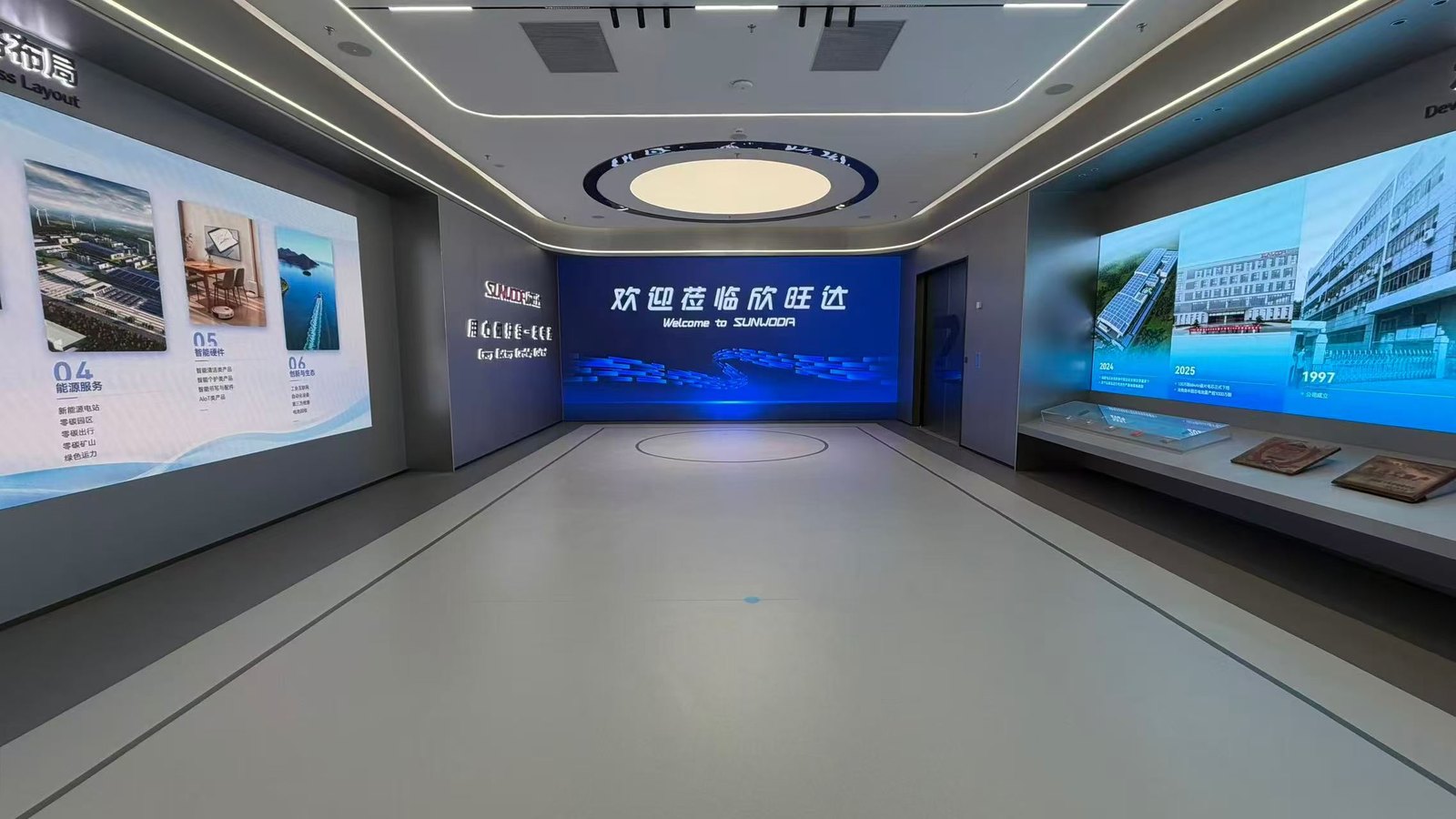
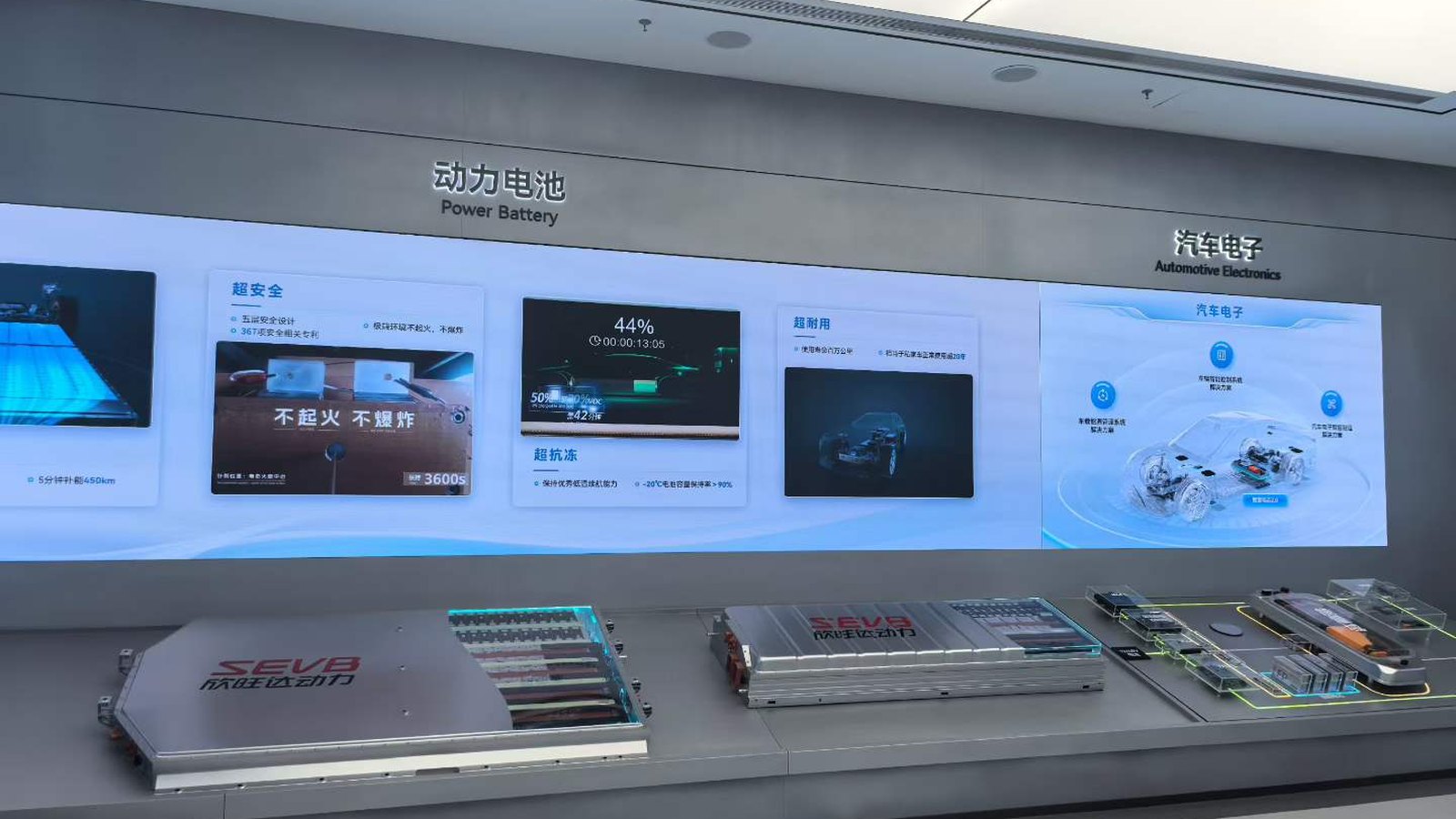
Shenzhen, group headquarters smart park. The standard programme has three parts: the smart-park technology showroom, led by a company guide; the 3C smart-manufacturing production line, where you see how a ‘digital-leading’ enterprise lays out and manages a smart line; and a themed session with company experts, whose content is adjusted to the visiting team. It is the stop most delegations pair with the hardware and EV plants on a Shenzhen tech tour.
The Sunwoda Smart Park exhibition hall, Shenzhen.
The 3C smart-manufacturing line
The 3C smart-manufacturing line. The line shows how a ‘digital-leading’ enterprise lays out and manages smart production — where equipment, process, quality, people and data meet. Line access follows the day’s production schedule, so it is confirmed as part of arranging your visit rather than assumed.
What is worth watching on the line
What is actually worth watching on the line. The easiest thing to photograph at any smart factory is a robotic arm, and the arm is usually the least useful thing to bring home — more machinery is not the same as a more advanced factory. The difficult part is connecting equipment, process, quality, people, data and management systems. So the questions that repay attention are these: how does the production plan reach the workshop? How is equipment status managed? How are production exceptions detected? How is product quality traced? How do automation and people work alongside each other? And how does efficiency keep improving? Individually they look small. Together they are the operating capability of the company.
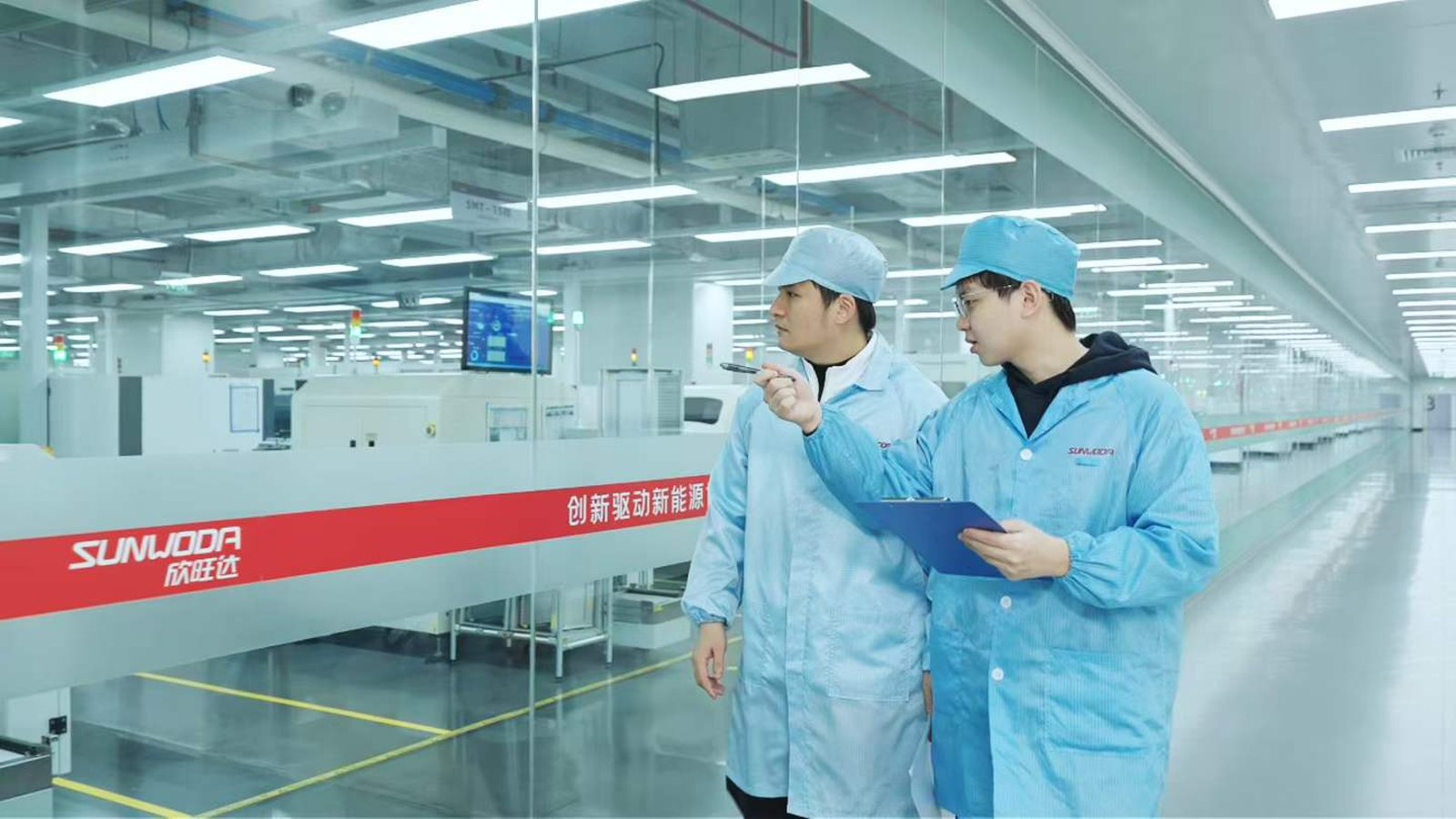
Inside a Sunwoda smart-manufacturing plant.
Reading the line back to the management method
And the second half matters as much as the first. Seeing the line only tells you what the company does; the value comes from tracing what you saw back to the management method behind it — why this line is designed this way, why the digital systems are built the way they are, why some steps had to be automated while others still need a person, what the company got wrong during its own transformation, and where a traditional manufacturer should actually start.
What your team can learn
The most useful questions depend on your team’s own work, so the visit is framed around the areas most relevant to your delegation.
For manufacturing teams — how a digitalised factory is actually built, how lean production is run day to day, and where automation genuinely lifts efficiency rather than just adding equipment. This is the group most likely to pair the visit with the BYD factory tour on the same trip.
For new-energy supply-chain teams — power-battery and energy-storage industry trends, and the manufacturing system that sits behind them, examined at the level of process and production management rather than market commentary.
For business leaders — production systems, digital transformation, workforce development, and the organisational capability questions that decide whether a growing company can hold its quality steady across more lines and more sites.
For government and industrial-park delegations — how the new-energy industry, advanced manufacturing and the digital factory behind them fit into a wider industrial-upgrade picture, which reads differently when it is seen on a live line rather than in a briefing deck.
The same company should look different to different teams, and that is the point. Tell us which of these four your delegation is, and the sessions are shaped accordingly.
Sample itinerary (Shenzhen headquarters)
| Time | Programme |
|---|---|
| 09:10–10:00 | Guided visit to the Sunwoda smart-park exhibition hall |
| 10:10–10:40 | Visit to a 3C smart-manufacturing production line |
| 10:40–12:00 | Expert-led session, topic adjusted to the delegation’s interests |
| 12:00–13:30 | Lunch break, buffet lunch self-paid |
| 13:40–16:00 | Themed session or expert discussion, tailored to the delegation and market context |
This is a reference schedule; session topics may be adjusted to the delegation’s learning objectives.
Reading the schedule. The morning block through 12:00 is the half-day programme. Continuing into the 13:40–16:00 session makes it a full day. The sessions are built around your team’s objectives, so the topics and the time at each stop can be reshaped.
Digitalisation is not more robots on the floor. It is moving from people managing the factory to systems running the process and data informing the decisions.
Questions before your visit
Do we have to be a battery or automotive company? No. The programme is built for manufacturing teams working on digitalisation, lean and automation, for new-energy supply-chain teams, for management teams, and for government or industrial-park delegations. The session content follows your questions.
Does the Shenzhen programme include a production-line visit? Yes. The sample itinerary includes a visit to Sunwoda’s 3C smart-manufacturing production line.
Is the production line always available? Line access follows the day’s production schedule at the Shenzhen smart park and is confirmed as part of arranging your visit. Where a specific line cannot be opened on your dates, we will tell you before you commit rather than after.
Can we take photographs inside? Not on the 3C smart-manufacturing line, where phones and other communication or camera equipment are not permitted. Anti-static clothing and a cap are required to enter the line, and those are arranged for you. Photography elsewhere in the programme is confirmed as part of the arrangements.
Can the discussion topic be tailored to our delegation? Yes. The expert-led sessions can be adjusted to the delegation’s needs and market context.
Can the agenda be changed? Yes. The published itinerary is a reference, not a fixed product. The themed sessions were designed to be adjusted, and we reshape the topics and the time at each stop around your team’s objectives.
Is lunch included in the programme fee? The sample itinerary lists a self-paid buffet lunch at the Sunwoda canteen.
How far in advance should we book? Around 30 days is the practical lead time, because the site sits inside an operating plant and needs internal scheduling.
What group size works best? The programme is best suited to groups of 10–20 participants. We charge per group, so larger groups usually offer better value per person. Individuals and smaller groups are welcome to enquire at a higher per-person rate. Larger delegations can be split across the exhibition hall and the line if that suits the schedule better.
Is English interpretation provided? Yes. English interpretation on site is part of how the programme is run.
Where is the visit held? At Sunwoda’s group headquarters smart park in Bao’an District, Shenzhen — the showroom, the 3C smart line and the expert sessions are all on the same site. Tell us your focus and we will advise how to shape the day around it.
Arranging your Sunwoda visit
We arrange the visit for you end to end: the introduction to the host, the scheduling on the Chinese side and English interpretation on site. Tell us your dates, your delegation size and what you want to see, and we will confirm what can be arranged. Start at chinatechvisits.com/company-visits.