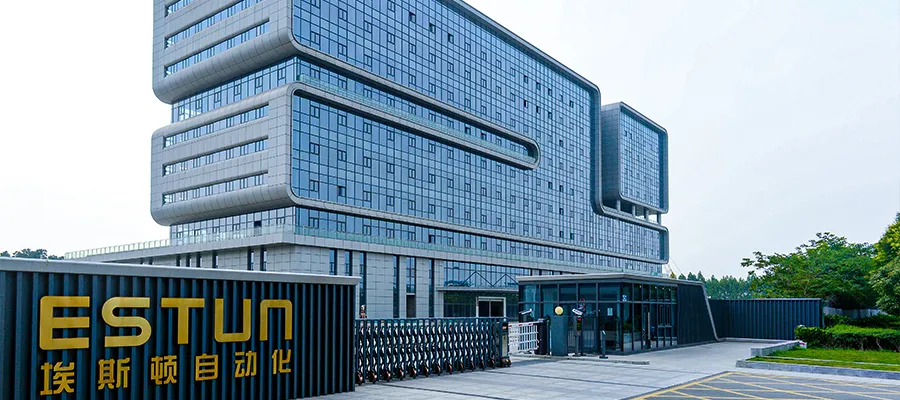
An Estun(埃斯顿) Robot visit in Nanjing takes a delegation to the company that displaced the foreign incumbents at the top of the Chinese industrial robot market. Estun Automation was founded in 1993, lists in Shenzhen under 002747 and, since March 2026, in Hong Kong under 02715. Its headquarters is in Jiangning district, Nanjing.
The number that makes the visit worth the trip is this: in 2025, according to MIR Databank, Estun's industrial robot shipments in China passed Fanuc, Yaskawa, Kuka and ABB — the first time a Chinese brand has topped the Chinese industrial robot market. Its share reached 10.6 per cent.
The second reason to go is the way the company is built. Estun makes its own servos, drives and controllers rather than buying them in, it sells into more than 75 overseas service points, and in 2025 it returned to profit with revenue up 21.93 per cent and operating cash flow up 788 per cent. A delegation that wants to understand how a Chinese industrial manufacturer is actually put together, rather than what it ships, will get a more useful conversation here than at a company that only assembles.
A visit runs to a fixed morning timetable at the Jiangning headquarters, covering the exhibition hall, the intelligent manufacturing demonstration area, and a briefing and Q&A with company specialists. The timetable is set out below.
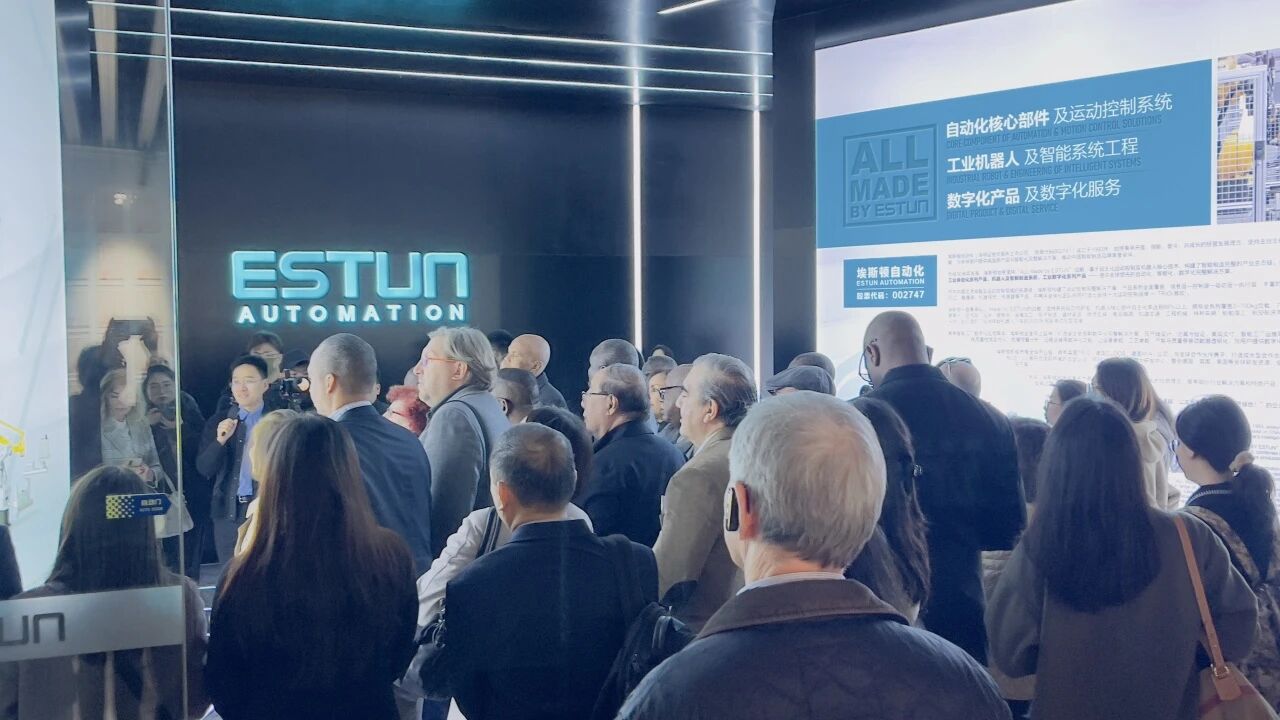
China Innovation Visits coordinates the Estun tour, including the company reception, scheduling, Nanjing transport and English interpretation.
Key takeaways
- See the full product range, from 3 kg collaborative robots to 1,200 kg heavy-payload machines.
- Understand how a Chinese brand passed the four foreign incumbents, and what it still buys from abroad.
- Discuss what building your own servos, drives and controllers costs in capital and returns in margin and resilience.
- Examine AI-free teaching welding and the company's robot operating system.
- Compare the approach with a Fanuc factory tour in Shanghai, one of the incumbents Estun overtook.
Why visit Estun in Nanjing?
Industrial robots are a good subject for a delegation because the market is measurable and the competitive story is clear. For decades the Chinese market was dominated by four foreign manufacturers. That changed, and Estun is the Chinese brand that led the change.
The visit is also a working lesson in vertical integration. Estun builds its own servos, drives and controllers rather than assembling bought-in components, which is unusual and is the reason its margins behave differently from an assembler's. Ask what that costs in capital and what it buys in resilience.
Nanjing is not a city most delegations visit for robotics, which is part of the value: the company is not performing for an audience.
Company background
Thirty years from servos to robots
Estun was founded in 1993 in Jiangning, Nanjing, starting with automation systems for metal-forming machine tools. In 1998 the team built its own high-precision AC servo system with positioning accuracy of plus or minus 0.01 mm, and in 2003 it released a fully self-developed AC servo system that broke the long-standing dominance of Japanese suppliers and brought domestic servo prices down to roughly one third of imported units. It entered complete robots in 2011 and launched seven domestic robot models within three years. It listed on the Shenzhen Stock Exchange in 2015. Revenue grew from about 487 million yuan in 2015 to more than 4 billion yuan by 2024, a compound rate above 25 per cent, and reached about 4.888 billion yuan in 2025, the highest annual total in the company's history. How a business compounds at that rate while building its own core components, rather than assembling bought-in parts, is the question worth putting to it on site.
What it sells
The company operates two main businesses. Industrial robots and intelligent manufacturing systems produced about 3.997 billion yuan in 2025, up 31.8 per cent. Automation core components and motion control produced about 891 million yuan.
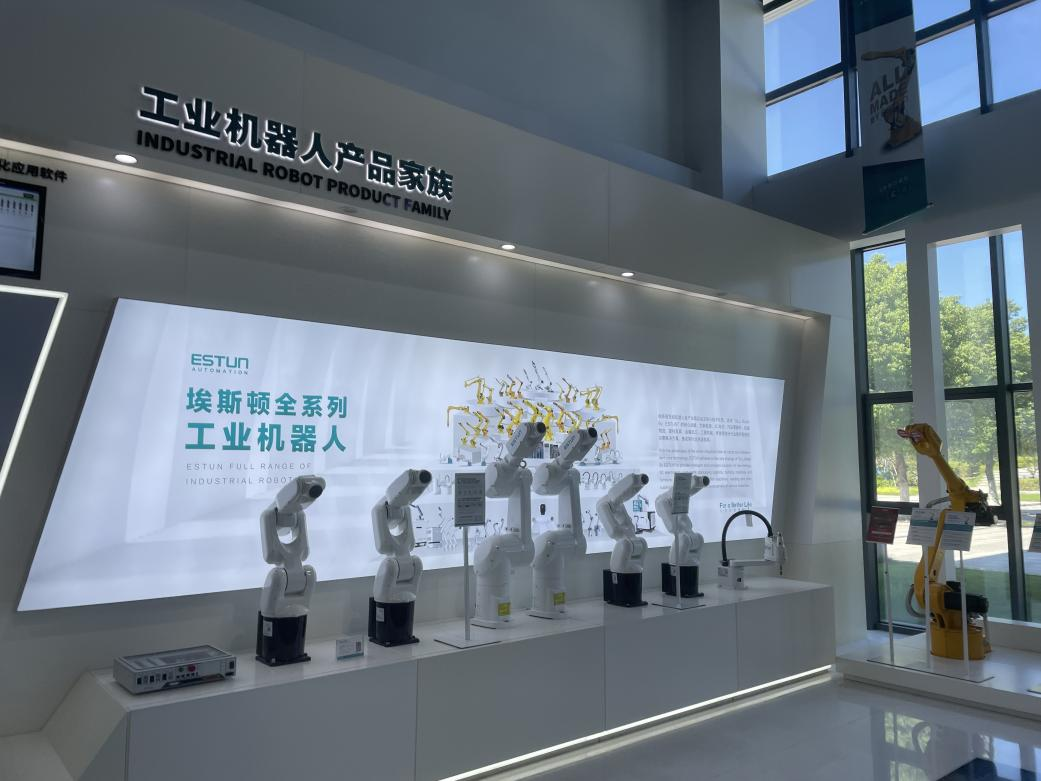
The product range covers 96 robot models from 3 kg to 1,200 kg payload. The company describes its motion control and servo systems as fully self-developed, and states that core components are independently controllable; promotional material often cites an autonomy rate above 95 per cent.
The group also operates four brands — Estun, Cloos, Trio and M.A.i — covering different markets and technologies, several acquired rather than built. The acquisitions began in 2017, brought full ownership of the German welding specialist Cloos by 2020 and established a European research centre in Milan.
The 2025 results
Revenue and the return to profit
For 2025 Estun reported revenue of about 4.888 billion yuan, up 21.93 per cent. Net profit attributable to shareholders was about 44.97 million yuan, up 105.55 per cent.
The two figures together describe the model: revenue grew by more than a fifth in a year when the company also took share from the four foreign incumbents. Volume leadership is being converted into scale, and the operating cash flow figure below is where that shows up most clearly.
Gross margin was 29.23 per cent for robots and intelligent manufacturing systems, and 30.43 per cent for core components. Overseas gross margin was 36.75 per cent, up 4.09 points on the previous year, and gross margin on core components reached 30.43 per cent. Selling overseas is the more profitable part of the business, which is why the international build-out matters and why the company completed a plant in Poland in 2025.
Cash and investment
Operating cash flow reached about 507 million yuan, up 788 per cent, and the company reported its gearing ratio falling by 2.78 points.
Research and development spending was about 476 million yuan, 9.74 per cent of revenue, with R&D and engineering staff at 29.68 per cent of headcount. By the end of 2025 the company held 634 granted patents, including 279 invention patents, and 441 software copyrights.
Overseas
Overseas revenue was about 1.463 billion yuan, up 6.8 per cent, roughly 30 per cent of the total. The group runs 75 service points globally and completed a plant in Poland in 2025, using a "local for global" model that pairs Chinese supply chain efficiency with local service.
The Hong Kong listing
On 9 March 2026 Estun listed H shares in Hong Kong under code 02715, becoming the first company in China's industrial robot sector to hold both an A-share and an H-share listing. The offering raised about 1.486 billion Hong Kong dollars, or about 1.412 billion net.
Taking the top of the market
How the lead was taken
According to MIR Databank, Estun ranked first in China by industrial robot shipments in 2025, including foreign brands, with shipments up about 25 per cent year on year and share at 10.6 per cent. The same reporting credits it with pushing Chinese brands past 56 per cent of the domestic market. Estun brand robot revenue grew close to 50 per cent.
This is a genuine turning point and worth marking as one. It is also worth asking where the next increment comes from: the company's own targets are around 20 per cent domestic share and 80,000 to 100,000 units a year within three years, and overseas is the faster-growing, higher-margin part of the business.
Where it leads in niches
Frost & Sullivan data cited by the company puts Estun first globally in sheet metal bending robots and in photovoltaic industry robots as of 2024, first in China and second globally in power battery robots, and fifth globally and fourth in China in arc welding robots.
Niche leadership is more defensible than overall share, because it rests on process knowledge rather than price. Ask which niches the company expects to hold.
Technology on the floor
Heavy payload
The ER1200, a 1,200 kg six-axis robot, is presented as the first domestically produced machine at that payload to reach volume application. The engineering problems are not conceptual: synchronising two motors and two reducers, and keeping the structure light enough to be usable. Ask what the duty cycle looks like in a real plant.
AI-free teaching welding
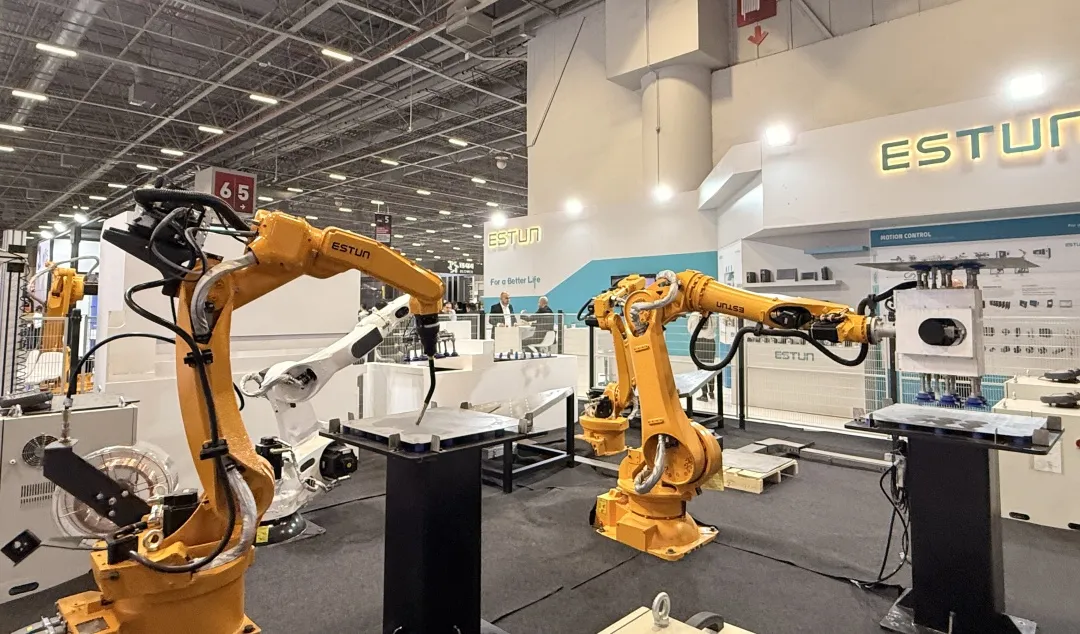
The welding demonstration is the most transferable part of the visit. Conventional welding robots require a programmer to teach each seam, which costs hours per part. The vision-based system the company demonstrates identifies the seam and generates the path, cutting setup from hours to minutes.
For any delegation with welding, fabrication or low-volume high-mix production, this is the concrete answer to why robots are suddenly viable for smaller batches.
The operating system
In early 2026 the company released iER.OS, a robot control system with its own robot language, Juliet. Demonstrations show programming through higher-level languages including Python, with an architecture the company describes as allowing multiple robots to be coordinated as a flexible workstation.
The strategic question is whether an open system grows the ecosystem or locks customers in. Ask what runs on third-party hardware.
Humanoid work
Estun established Cuizhuo Technology in 2022 for embodied intelligence and humanoid robots, and released a wheeled humanoid, Panshi C05-L, aimed at industrial settings in November 2025. Cuizhuo's collaborative robot shipments grew more than 270 per cent. Management has said embodied robotics is an important future direction while noting that how it is structured relative to the listed company is still under discussion.
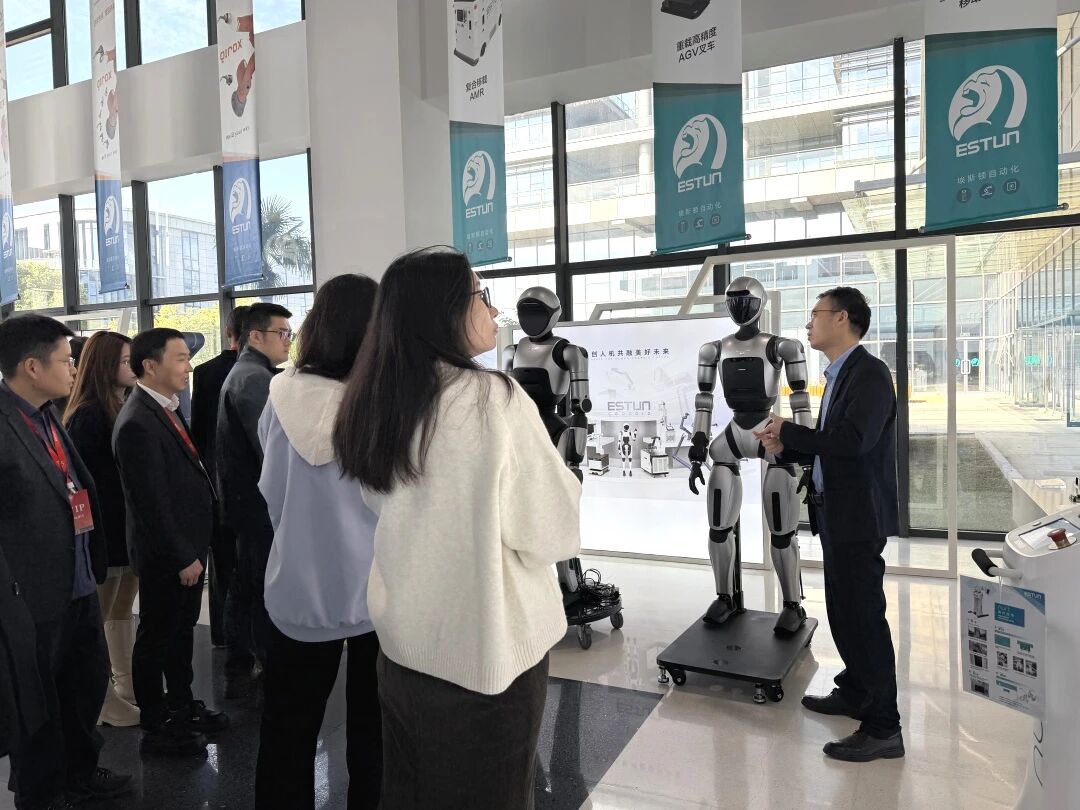
What a visit covers
The standard programme
| Time | What happens |
|---|---|
| 09:30–10:30 | Guided programme: exhibition hall on the company's history, core businesses and industry position; automated storage and materials-handling system; digital platform showing output progress and equipment status in real time |
| 10:30–12:00 | Briefing and discussion: the decisions that took Estun from a servo supplier to the top of the Chinese industrial robot market |
| 12:00 | Departure |
The programme is adapted to what the delegation wants to understand, and the final scope is confirmed in writing during planning, before you commit.
Practical notes
- The visit is a business programme. Delegations are received as professional visitors and follow the host's rules.
- Booking requires approval in advance. Companies normally submit a participant list; government and public institutions usually need a formal letter. Tell us early so the paperwork does not delay the date.
- Photography rules are confirmed in advance; tell us during planning if you need images for internal reporting.
- Smart casual is appropriate. The programme involves walking through the demonstration areas.
- English interpretation can be arranged for the exhibition, the demonstration areas, the briefing and Q&A.
Questions before an Estun visit in Nanjing
Is the visit open to international business delegations? Yes, subject to advance arrangements and confirmation by the host. Host approval takes time, so we recommend planning at least 30 days ahead.
What is the group size? Visits are normally arranged for groups of 10 or more and fewer than 20 participants. Smaller groups can sometimes be accommodated.
How long does the visit take? The standard programme runs about two hours, covering the exhibition hall, the demonstration areas and the briefing and Q&A.
Where is the visit held? At the company's headquarters in Jiangning district, Nanjing. We confirm the building and meeting point in writing after the host approves the booking.
Do participants need a technical background? No. The visit can be approached through manufacturing, operations, investment or procurement, and terminology is handled through interpretation.
Is English interpretation provided? Yes, interpretation can be arranged for the exhibition, the demonstration areas, the briefing and Q&A.
What does the 2025 financial record look like? Revenue was about 4.888 billion yuan, up 21.93 per cent, net profit attributable to shareholders about 44.97 million yuan, up 105.55 per cent, and operating cash flow about 507 million yuan, up 788 per cent.
Is Estun the largest robot maker in China? By shipments in 2025, according to MIR Databank, yes, including foreign brands, with 10.6 per cent share. The comparison is on shipments; the four foreign incumbents remain the larger businesses by global revenue.
How should the company's own targets be read? Management has stated ambitions of around 20 per cent domestic share and 80,000 to 100,000 units annually within three years, and 50 per cent share overseas. Treat these as stated goals, not forecasts.
How self-sufficient is the supply chain? Estun develops its own motion control and servo systems and states that core components are independently controllable; promotional material commonly cites an autonomy rate above 95 per cent. Ask on site which items are still sourced externally.
Does the programme always run as described? It is built around the elements above. Facilities and areas opened on the day are subject to what the site opens, and we confirm the final scope in writing during planning, before you commit.
Arrange your Estun Robot visit
Tell us your dates, group size and what your team wants to understand: vertical integration, domestic substitution, the financial turn, or applying robots to your own processes. China Innovation Visits will coordinate the company reception, discussion priorities, transport and English interpretation.
Contact China Innovation Visits to arrange your Estun visit in Nanjing.