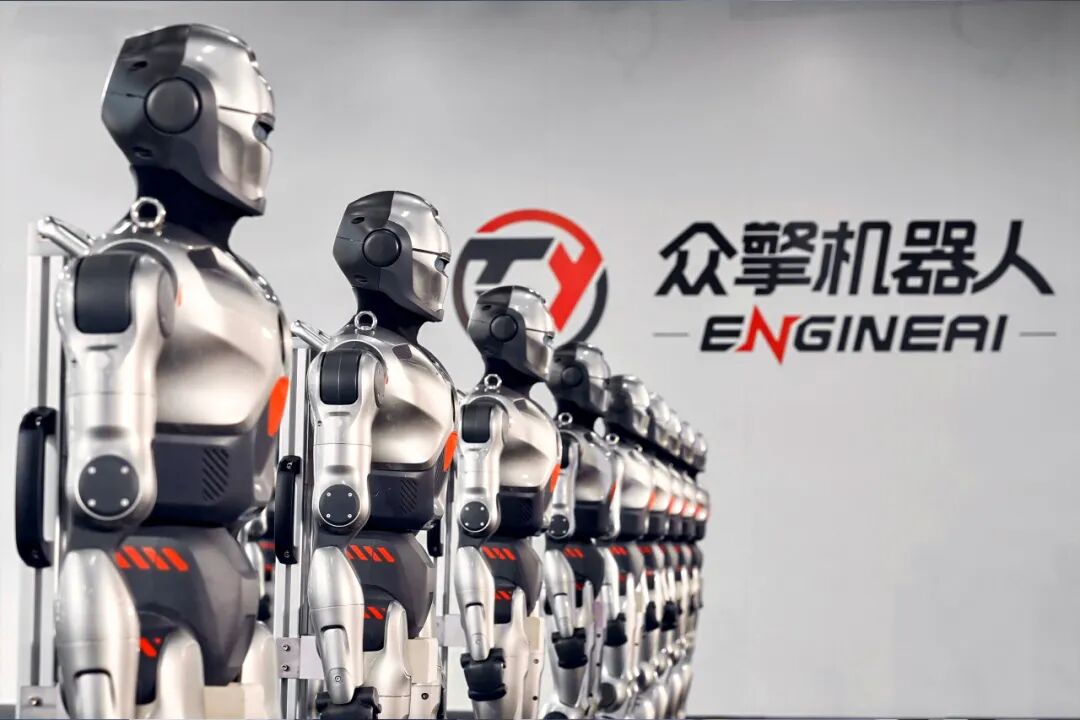
An ENGINEAI company visit in Shenzhen introduces international business delegations to a humanoid robot maker founded in October 2023 and headquartered in Nanshan district. The company develops general-purpose humanoid robots together with the motion control, core components and embodied intelligence behind them. A visit is organised around a product and technology showcase, live demonstrations and a company briefing with Q&A.
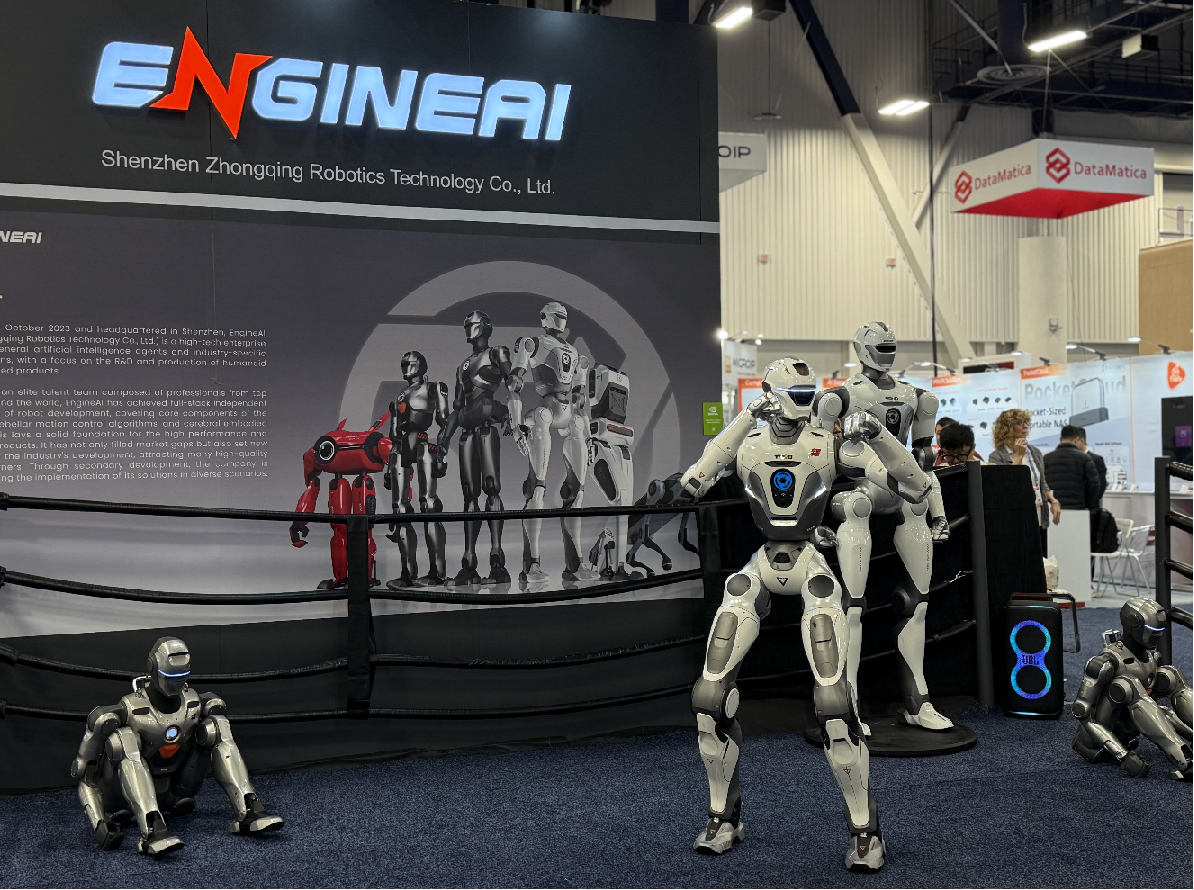
ENGINEAI's product line covers the SA01 bipedal platform, the full-size SE01 and T800 humanoid robots, the lightweight PM01, and the JS01 heavy-duty quadruped. The company describes its approach as full-stack, in-house development across body design, key components, motion control and embodied intelligence, with applications discussed across industrial manufacturing, research and education, commercial services and cultural tourism.
China Innovation Visits coordinates the EngineAI tour, including the company reception, scheduling, Shenzhen transport and English interpretation.
Key takeaways
- See the ENGINEAI product line, including the SA01, SE01, PM01, T800 and JS01.
- Understand how a young company links full-stack hardware, motion control and embodied intelligence.
- Compare the SE01, PM01 and T800 as three answers to different engineering problems.
- Examine how robot capabilities are being adapted for industrial and service settings.
- Discuss the gap between private-market valuation and current delivery scale in an honest, evidence-based way.
Why ENGINEAI stands out
ENGINEAI is a useful case study because its story differs from a conventional manufacturing company in several ways. The founder, Zhao Tongyang, is a serial entrepreneur who began working on legged robots well before this company was formed. He started a quadruped robotics business in 2016; that team was acquired by XPeng in 2020 and became Pengxing Intelligence, where he led development of XPeng's first humanoid robot, the PX5. He left in 2023 and founded ENGINEAI with part of that engineering team.
That background helps explain how a company founded in late 2023 was able to release several products in its first two years. The visit therefore offers more than a look at individual robots. It is an opportunity to discuss how prior engineering experience, a carried-over team and a focused technology route shape the speed at which a robotics start-up can move.
A seven-year head start
The engineering foundation behind ENGINEAI predates the company itself. Zhao Tongyang began investing in legged robot development in 2016, at a time when high-end imported humanoid robots in China were priced at the level of tens of millions of yuan and the domestic industry was still sparse. Early work focused on basic algorithms because imported machines were too expensive to buy and dismantle for reference.
The direction moved toward quadruped robots in 2018, and the business was acquired by XPeng in 2020. When ENGINEAI was founded in 2023, it inherited an experienced team and years of accumulated work in motion control and robot hardware. This continuity is the clearest explanation for its rapid product cadence, and it is worth examining during the briefing rather than treating the company as a two-year-old start-up with no history.
Choosing the harder technology route
Much of the industry first works on making a robot stand and walk, then improves dynamic performance over time. ENGINEAI instead put early resources into the upper limits of movement. SE01 was presented as a humanoid robot using a human-like, straight-knee walking gait, rather than the bent-knee gait common in the industry. PM01 is a lightweight, highly dynamic robot, and the company has shown it completing a front somersault. T800 uses high-torque joints, with maximum joint torque described as reaching 450 newton-metres.
This route is capital-intensive and has a long cycle. Its appeal is that once the underlying body and motion capabilities are established, they can be reused across the product line. During the visit, the three machines can be compared directly: SE01 addresses walking naturally, PM01 addresses the ceiling of dynamic movement, and T800 addresses sustained, full-size work.
From prototype to production machine
The three full-size and lightweight machines illustrate different engineering trade-offs. T800 stands 1.73 metres tall, weighs about 75 kilograms, uses an aviation-grade magnesium-aluminium alloy body, and has 29 degrees of freedom before a dexterous hand. It is described as using a solid-state battery developed for humanoid robots, with a stated runtime of four to five hours. The base version is listed from 180,000 yuan, and the company says it opens the robot body and low-level code to buyers.
Looking at SE01, PM01 and T800 together makes the trade-offs visible. A hardware company has to balance performance, cost and manufacturability at the same time, and decisions that look small on a specification sheet become meaningful when the machines are placed side by side.
The valuation and shipments gap
Financing trajectory
ENGINEAI's financing has moved roughly in step with its product iterations. Reports describe angel and angel-plus rounds in August 2024 totalling close to 100 million yuan, a pre-A round in April 2025, and pre-A-plus and A1 rounds in July 2025 approaching 1 billion yuan, with JD.com leading the A1 round. In April 2026 the company completed a 200 million US dollar Series B led by a Henan Investment Group fund together with Luxshare Precision, after which reports put its post-money valuation above 10 billion yuan. Figures for the total number of rounds vary across sources, so the cumulative amounts are better treated as reported figures than as a single fixed count.
Reported Hong Kong listing plans
In June 2026, media reports citing people familiar with the matter said ENGINEAI had filed confidentially for a Hong Kong IPO, working with CICC and CITIC Securities. The size and timing had not been finalised, and the company had not publicly confirmed the filing at the time.
Shipments in 2025
The delivery picture comes from a different source. Omdia data cited in the Unitree Robotics prospectus put ENGINEAI's 2025 humanoid robot shipments at about 400 units. The same data placed other Chinese makers well ahead in volume.
| Company | 2025 humanoid robot shipments |
|---|---|
| AgiBot (Zhiyuan) | about 5,168 units |
| Unitree | about 4,200 units, over 5,500 after adjustment |
| UBTech | about 1,000 units |
| Leju | about 500 units |
| ENGINEAI | about 400 units |
| Fourier Intelligence | about 300 units |
These figures carry different meanings. Private-market valuation is based heavily on team and technology validation, while the long-term test for a manufacturer is delivery at scale. ENGINEAI is therefore best understood as a company with strong motion capabilities whose commercialisation is still being proven. Treating it as a finished success story misses the more useful question: how technical ability is converted into reliable delivery.
What the company is building
A layered product system
ENGINEAI describes its work as a layered product system rather than a single robot. The SA01 is a highly extensible bipedal robot, SE01 is a full-size humanoid robot presented around a human-like gait, PM01 is a lightweight and highly dynamic machine, T800 is a full-size high-mobility general-purpose robot, and JS01 is a heavy-duty quadruped. The company says it develops its own motors and other key components.
This portfolio approach is deliberate. Different products are aimed at different customers, price levels and functional needs, from research platforms and developers to full-size robots intended for industrial and service scenarios. The briefing can be used to discuss how a single underlying capability base is adapted across these products.
Production capacity and pace
Production pace is one of the clearest indicators of engineering maturity in humanoid robotics, where assembly still depends heavily on manual work and accumulated process knowledge. In May 2026 the company said its intelligent manufacturing base at Honghualing in Shenzhen had begun operating, with the first T800 units coming off the line, and described the line as able to produce one humanoid robot every 15 minutes. Reports also described a base in Zhengzhou, in Henan province, intended to support larger-scale manufacturing.
These are stated capacities and plans rather than proof of steady output. During the discussion they can be examined as a manufacturing question: what has to be solved to move from hundreds of units toward volume measured in thousands.
Where robots are being put to work
Industrial handling
The closest reported example of larger-scale industrial work came in August 2026, when the company said T800 had begun material loading, unloading and handling work at a Luxshare Precision plant in Suzhou, connected to the factory management system and able to receive an order, navigate, pick material, deliver it and place it. The company has also described robots providing reception and guidance at a Shenzhen science and technology venue and product guidance in a Decathlon store.
From movement to steady work
These examples show how one body platform can be adapted across industrial and commercial service settings. They also point to the difference between a robot that can perform a difficult movement and one that can complete a job steadily within a real operating environment.
Research through competition
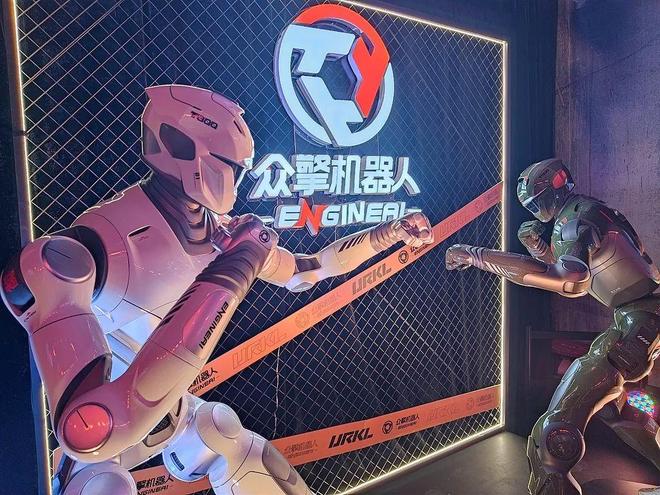
ENGINEAI initiated and hosts the Universal Robot Kombat League, or URKL, a humanoid robot free-fighting competition for which T800 is the designated machine. The value of the league is not limited to publicity. In a contest, a robot has to move, attack, defend, absorb impacts, fall and get back up autonomously, generating body and motion-control data that can feed back into development.
For teams focused on research and development management, this is an organisational design worth discussing. Extreme conditions are turned into a testing ground, and the data produced under stress becomes an input to engineering rather than merely a public demonstration.
How to arrange an ENGINEAI visit
Visits are arranged in advance through China Innovation Visits and confirmed by the host. We recommend planning at least 30 days ahead.
Visits are normally organised for groups of 10 or more and fewer than 20 participants. Smaller groups can sometimes be accommodated.
Please provide your preferred dates, group size, business background, learning objectives and language requirements. A short list of questions helps coordinate the company briefing and the relevant terminology for interpretation.
Sample visit programme
09:30–10:30 — Product and technology showcase. See the ENGINEAI product line, observe demonstrations arranged by the host and compare the SE01, PM01 and T800.
10:30–12:00 — Company briefing and Q&A. Discuss the company's background, technology route, production plans and deployment work, with priorities adjusted to the delegation's interests.
The timings and programme are subject to final confirmation with the host.
Combine with other Shenzhen visits
An ENGINEAI visit can form part of a wider Shenzhen technology tour, connecting humanoid robotics with the city's component suppliers, precision manufacturing and electronics ecosystem.
For delegations comparing humanoid robot approaches, a UBTech visit offers another Shenzhen perspective through the Walker series, while a Unitree visit provides comparison with a company built first on quadruped robots. An Agibot visit adds a further point of comparison on humanoid development.
Combinations are coordinated around the delegation's objectives, travel schedule and host availability.
Practical notes
- Comfortable casual shoes are recommended for walking and standing during the showcase.
- Follow the guided route and staff instructions during demonstrations.
- Photography rules are confirmed in advance; tell us during planning if your organisation needs images for internal reporting.
- Demonstrations may change according to equipment availability and reception arrangements.
- English interpretation can be arranged for the showcase, briefing and Q&A.
Questions before an ENGINEAI visit
Is the visit open to international business delegations? Yes, subject to advance arrangements and confirmation by the host. We recommend planning at least 30 days ahead.
What is the group size? Visits are normally arranged for groups of 10 or more and fewer than 20 participants. Smaller groups can sometimes be accommodated.
How long does the visit take? The standard programme is about two and a half hours, typically from 09:30 to 12:00, including a product and technology showcase and a company briefing with Q&A.
Do participants need a technical background? No. The visit can be approached through business development, industry applications, innovation or the wider robotics ecosystem, and terminology is handled through interpretation.
What preparation is useful? Please share your business background and key questions in advance, and wear comfortable casual shoes for walking and standing.
Is English interpretation provided? Yes, interpretation can be arranged for the showcase, briefing and Q&A, with relevant terminology prepared around the delegation's interests.
What can be understood about the company's capabilities? ENGINEAI describes itself as full-stack, spanning body design, self-developed key components, motion control and embodied intelligence, which can be discussed through the product line and briefing.
Why is the gap between 400 shipments and a reported 10 billion yuan valuation important? The Omdia shipments figure and the private-market valuation answer different questions. Valuation reflects team and technology expectations, while delivery scale reflects current commercial execution.
Why did ENGINEAI prioritise dynamic movement first? The company put early resources into a human-like gait and high-dynamic movements on the basis that strong body and motion capabilities can later be reused across its machines.
Where are the robots already being used? The company has reported T800 handling material at a Luxshare plant in Suzhou, along with reception and guidance work at a Shenzhen venue and product guidance in a retail store.
Does the programme always run as described? It is built around the elements above. Facilities and areas opened on the day are subject to what the site opens, and we confirm the final scope in writing during planning, before you commit.
Arrange your ENGINEAI visit
Tell us your dates, group size and what your team wants to understand about humanoid robotics. China Innovation Visits will coordinate the company reception, discussion priorities, transport and English interpretation.
Contact China Innovation Visits to arrange your ENGINEAI company visit in Shenzhen.