Start with a paradox. No city on earth is more closely associated with humanoid robots than Hangzhou: its machines performed at China's Spring Festival Gala — watched by hundreds of millions — two years running. Yet in 2024, according to the city's own industry bureau, Hangzhou's seven humanoid makers produced roughly 500 units between them.
This is the briefing we give executives before we take them inside Hangzhou's robotics companies — compiled from the sources we check before any delegation visit: FY2024 annual reports, Unitree's final IPO prospectus filed with the Shanghai Stock Exchange, Hangzhou municipal statistics, and published tender results. Where sources use different definitions, both figures are shown and the difference is stated. All companies covered are headquartered in Hangzhou, unless a comparison with Shenzhen says otherwise.
The explanation for the paradox: Hangzhou is not running Shenzhen's playbook. Shenzhen industrialised robotics through supply-chain density. Hangzhou is attempting something different — an ecosystem model built on a university, two platform giants, an AI laboratory the whole world has heard of, patient state capital, and the first robot law in China. Whether that model can also manufacture at scale is the question of the next three years. This briefing lays out both operating systems, and what each produces.
1. The gap: fame first, volume later
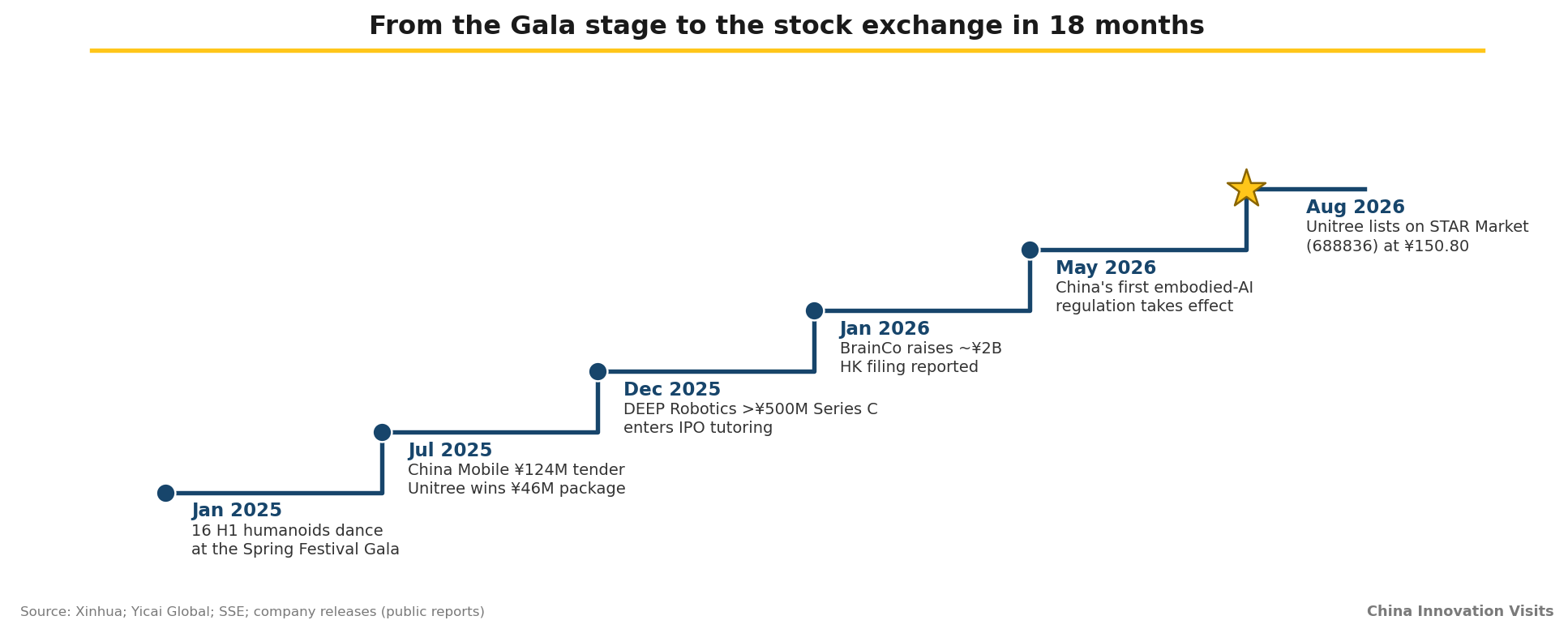
The fame is real, and unusually durable. In January 2025, sixteen Unitree H1 humanoids performed a folk dance at the CCTV Spring Festival Gala. In February 2026 they returned — performing martial arts. A robot act has become a recurring feature of China's biggest television night, the way a returning pop star would be. Foreign executives usually arrive having seen the first performance. Few know there was a sequel, and fewer still know the production numbers behind it.
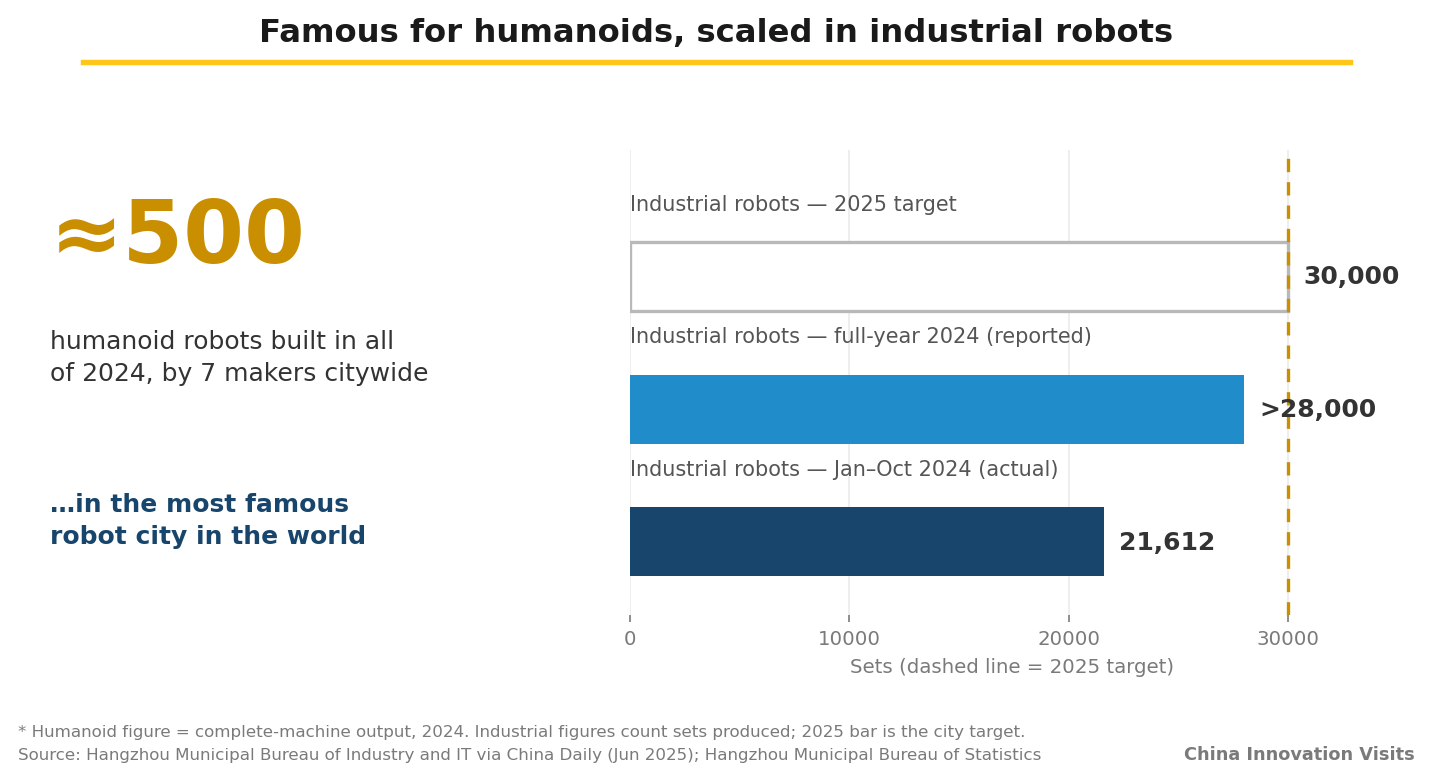
The city's volume, so far, sits in less glamorous machines. Hangzhou produced 21,612 industrial robots in the first ten months of 2024, up 37.7% year on year, according to the Municipal Bureau of Statistics. Hikrobot, the city's mobile-robot maker, passed its 200,000th unit in July 2026 — warehouse robots, shipped at genuine scale, largely invisible to television audiences. The robotics chain as a whole recorded revenue of ¥103.78 billion (about USD14.6 billion) in 2023, according to the city's World Robot Conference profile; a broader 2025 cluster figure of ¥106.8 billion uses a different definition and is not a growth reading.
The catch-up machinery, however, is fully engaged. Unitree listed on the STAR Market in August 2026, raising about ¥6.1 billion. Its Binjiang production base, under construction, is planned for 75,000 humanoids a year at full build-out, according to city reporting — 150 times the city's entire 2024 humanoid output, in a single plant. Prices are being cut into the market: Unitree's R1 humanoid launched at ¥39,900 in July 2025 and was reduced to ¥29,900 within a year. The city counted 269 embodied-intelligence companies in the first half of 2025.
2. Two cities, two operating systems
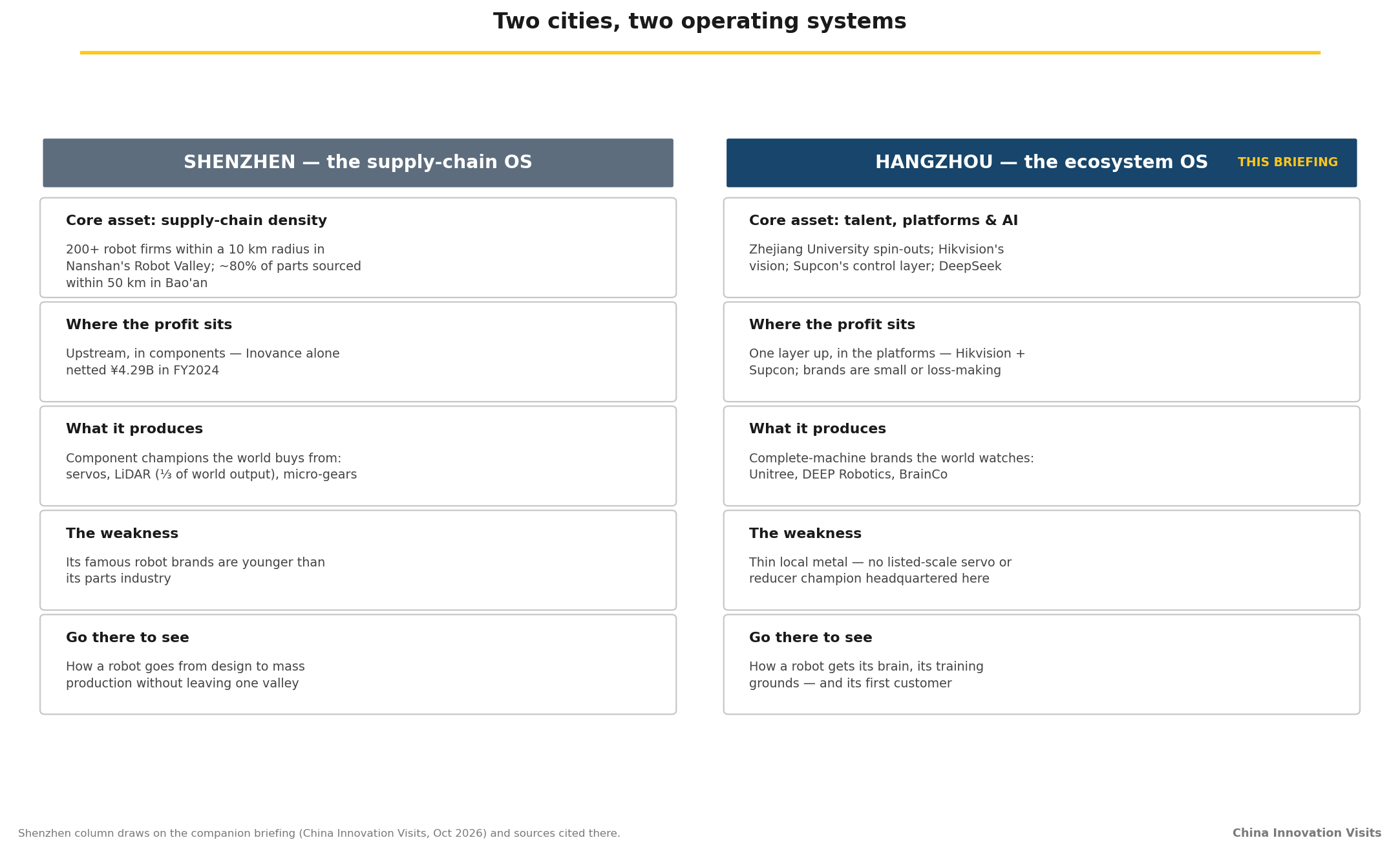
Shenzhen's system can be summarised in one statistic: in Nanshan's Robot Valley, more than 200 robotics firms sit within a 10-kilometre radius, and a robot can move from design to mass production without leaving it. Around 80% of components are sourced within 50 kilometres in Bao'an's industrial parks. The city produces about a third of the world's LiDAR units. Its robotics chain recorded output of ¥242.6 billion in 2025. The system's output is a particular kind of company: the profitable component champion. Inovance, its servo and drive leader, earned ¥4.29 billion in net profit in FY2024 — more than most robot brands in China earn in revenue. (Figures from the Shenzhen Robotics Industry Development White Paper 2025; see our companion Shenzhen briefing.)
Hangzhou's system has no equivalent density of parts. Its assets are of a different kind: a top engineering university spinning out founders; the world's largest video-surveillance company, whose vision technology became a robotics arm; the national leader in factory control systems; and the AI laboratory behind DeepSeek. Around those anchors, the state has built scaffolding other cities do not have — a ¥100 billion-plus fund complex, subsidies of up to ¥50 million for pilot-test platforms, computing-power vouchers, and, from May 2026, China's first local regulation for embodied-AI robots.
Different systems produce different companies. Shenzhen's champions sell parts to everyone and appear in no headlines. Hangzhou's sell complete machines and appear in all of them — while its profits, as Section 5 shows, sit one layer above the famous names.
3. Inside the ecosystem: what visitors usually miss
Four features of the Hangzhou system are largely invisible from outside China. Each changes how the industry should be read.
The talent crossed over from the rival city. Unitree's founder, Wang Xingxing, worked at DJI — Shenzhen's drone champion — before leaving in 2016 to found his company in Hangzhou. Shenzhen's supply chain trained the man who built Hangzhou's flagship. The pattern repeats at the university gate: DEEP Robotics was founded by Zhu Qiuguo, a Zhejiang University professor, and the university's spin-outs populate the Xihu–Yuhang corridor. BrainCo's founder, Han Bicheng, began the company as a Harvard neuroscience doctoral candidate; it remains incorporated in the United States with research in Boston — and its headquarters, and its market, are in Hangzhou.
The state runs schools for robots. Before a Hangzhou humanoid can be sold into a hospital or a warehouse, it can be sent to train. A national embodied-AI pilot-test base in Binjiang hosts more than 130 resident robots working through over 30 training scenarios, according to city reporting; Yuhang district opened a dedicated "robot school" for product maturation in June 2026. No equivalent institution exists in Shenzhen's system, because Shenzhen's robots are validated by the market's purchase orders. Hangzhou is building validation as public infrastructure.
The state is also the first customer — and it does not always buy local. The grid is the industry's anchor buyer: Shenhao won a ¥49.75 million contract in State Grid's 2024 centralised procurement, according to its exchange announcement. When China Mobile's Hangzhou arm ran a ¥124 million humanoid tender in July 2025, Unitree won the ¥46.05 million small-humanoid package — and the larger ¥78 million full-size package went to AgiBot, of Shanghai. Ecosystem pride stops at the tender document. A third city is competing for the same role, and it wins some of the rounds.
The biggest robot business in the city cannot get listed. Hikrobot's robotics revenue — ¥5.93 billion in 2024, up 20.0% according to Hikvision's annual report — exceeds the combined revenue of every pure-play robot brand in this briefing. Its mobile robots already work abroad: cumulative output passed 200,000 units in July 2026, and the Mobile Robot Industry Alliance ranked it first globally in its segment for 2025. Yet Hikrobot's ChiNext IPO application, accepted in March 2023, has been suspended seven times for expired financial materials and has never reached a listing hearing. Meanwhile its smaller neighbour listed in under two years from founding fame to exchange bell: Unitree's application was accepted in March 2026 and trading began that August. In Hangzhou's system, the platform is the profit — and the startup is the story.
One more export deserves noting: DEEP Robotics' X30 quadrupeds patrol the underground power tunnels of Singapore's SP Group, where staff have nicknamed the robot "SPock." Chinese robots are already inside foreign critical infrastructure; they simply arrived without a gala.
4. Who builds the robots
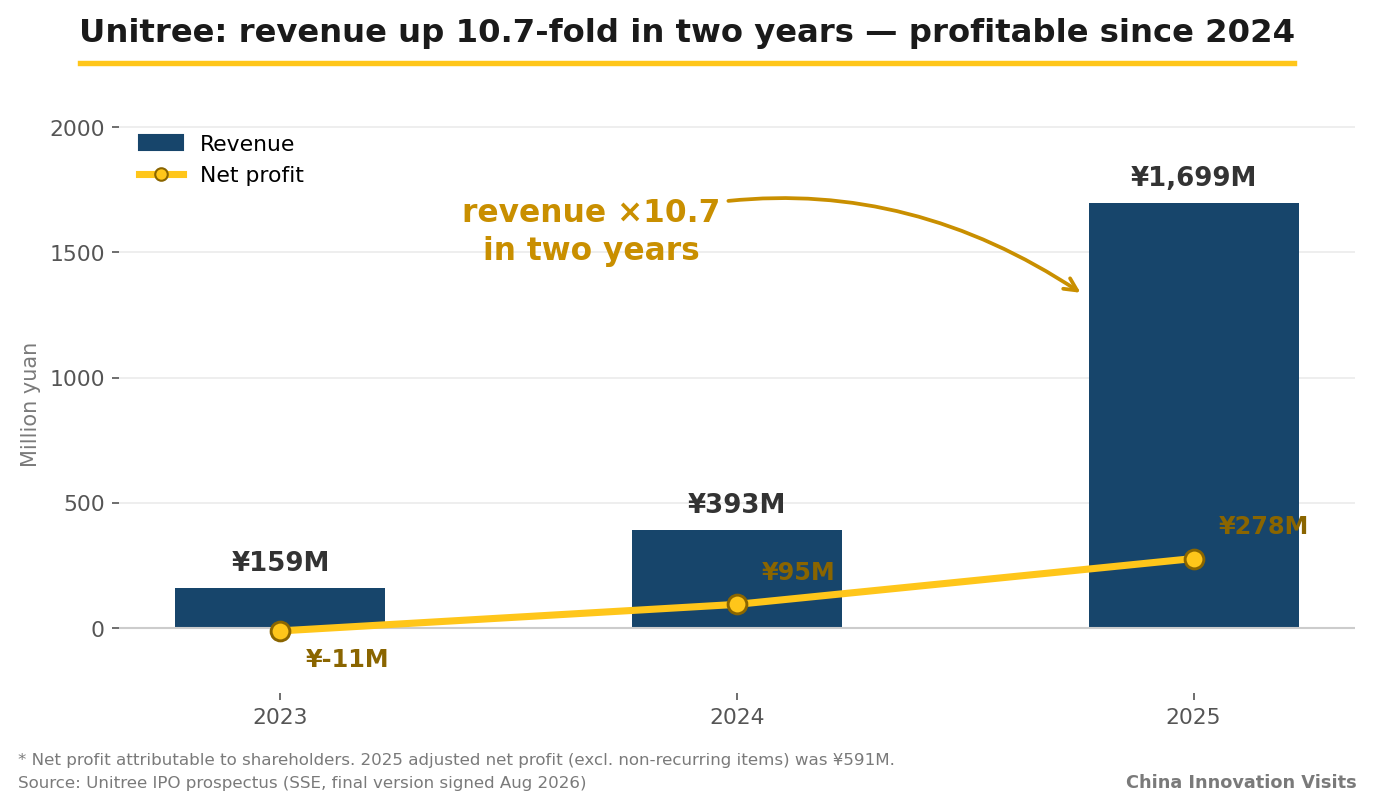
Humanoid and embodied AI. Unitree's prospectus corrects the popular picture of the company. Its profits were built on quadrupeds — robot dogs sold to universities and laboratories — not on the dancing humanoids. Revenue rose from ¥159 million in 2023 to ¥393 million in 2024 and ¥1,699 million in 2025, when humanoids became the larger business for the first time; the main-business gross margin in 2024 was 56.7%. According to the prospectus, about 80% of quadrupeds go to research, education and consumer users, and the customer roster includes Amazon, BASF, State Grid and PetroChina. Its 2025 humanoid volume is counted differently by different firms: Omdia recorded 4,200 units, the company states more than 5,500 "pure" bipedal humanoids. The definitions differ; the ranking — top two worldwide — does not.
DEEP Robotics sells inspection before entertainment: X30 quadrupeds in substations and tunnels, the wheeled-leg Lynx M20 (¥178,000, May 2025), and the IP66-rated DR02 humanoid. Coverage of its STAR Market filing reports revenue of ¥103 million in 2024 and ¥337 million in 2025, with a first profit in 2025; a Series C above ¥500 million closed in December 2025.
BrainCo turns brain-computer interfaces into bionic hands and legs: hand revenue grew from ¥62 million in 2022 to ¥185 million in 2025, according to documents reported from its Hong Kong filing, and a funding round of about ¥2 billion closed in January 2026. Its most public deployment remains the 2023 Asian Para Games in its home city, where para swimmer Xu Jialing lit the main cauldron with a BrainCo bionic hand. Spirit AI, founded in 2024, builds embodied foundation models and the Moz1 humanoid.
Vision, logistics, industrial and specialty. Hikrobot (vision and mobile robots) and iRAYPLE (Dahua's vision and AMR arm) form the volume layer described above. Guozi Robotics, in Xiaoshan, builds automated forklifts for plant logistics. Kelda, also Xiaoshan, makes welding robots — FY2024 revenue ¥557 million, net profit ¥31 million. Shenhao Technology, in Yuhang, builds grid and rail inspection robots. Xiaoshan also hosts Robot Town, a development zone that is exactly what its name says, where ABB's small-robot plant — described when it opened in 2019 as ABB Robotics' only super factory for small robots in China — has operated since 2019.
5. Where the money is
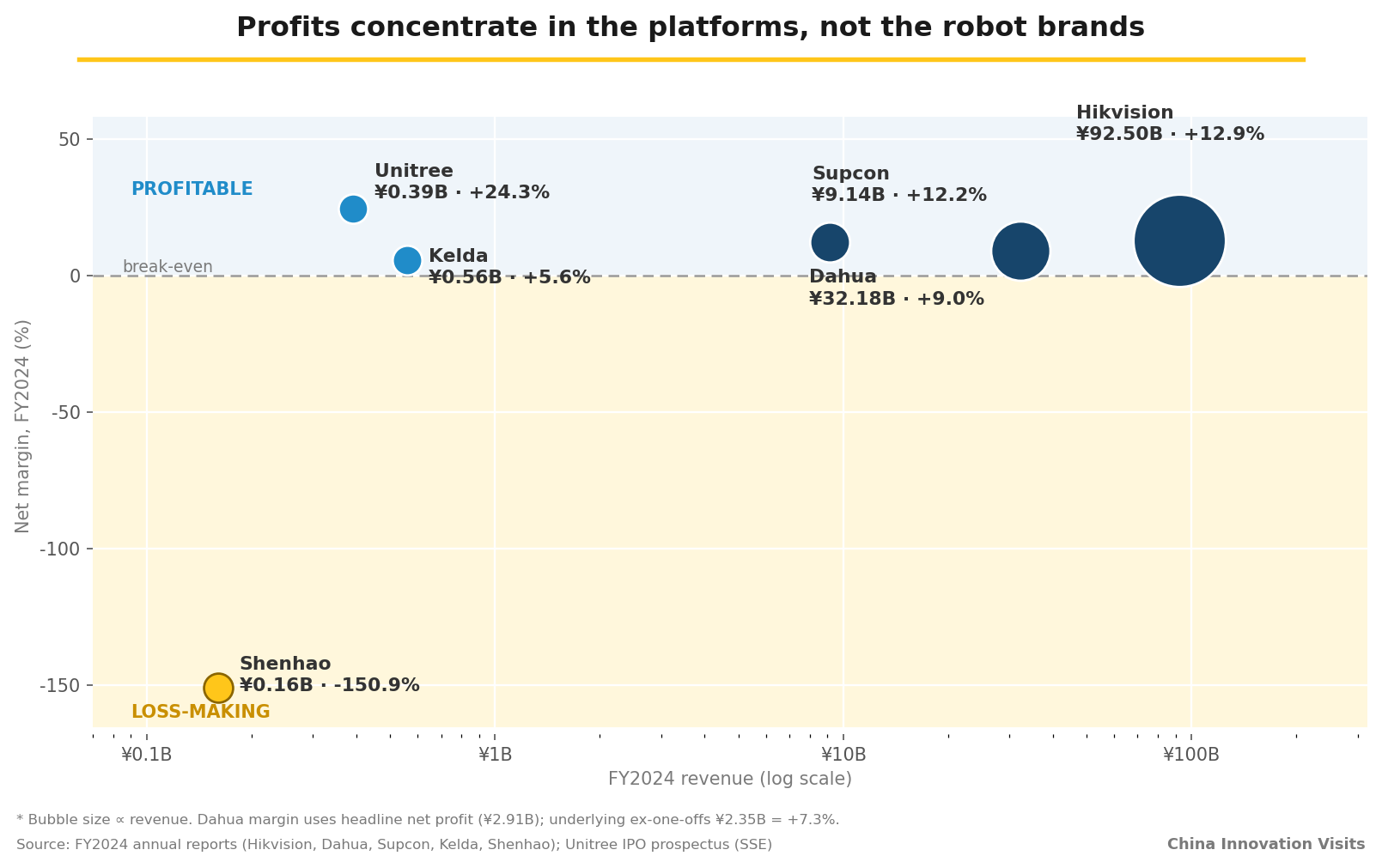
The scatter makes the system's profit geography visible. At the top right sit the platforms. Hikvision reported FY2024 revenue of ¥92.50 billion (about USD13.0 billion) and net profit of ¥11.98 billion, down 15.1% — a down cycle even for the giant. Dahua reported ¥32.18 billion in revenue and ¥2.91 billion in headline net profit; excluding one-offs, ¥2.35 billion, down 20.7%. Supcon, the control-layer company, earned ¥1.12 billion on ¥9.14 billion of revenue, a 12.2% margin, with R&D steady at 10.7% of revenue.
The brands cluster at the left: real, growing, and small. Kelda earned ¥31 million. Unitree is the exception that tests the pattern — the highest net margin on the chart, 24.3%, at the second-smallest revenue. Its margin was earned in the research market, at laboratory prices. Whether it survives consumer prices — the R1 has already been cut by a quarter — is the company's central question.
Shenhao sits alone at the bottom. It leads a genuine niche and wins State Grid tenders, and it lost ¥238 million on revenue of ¥158 million in FY2024, a third consecutive loss year, with a fourth in 2025; R&D absorbed ¥106 million, 67% of revenue.
Winning tenders and making money are different disciplines.
6. Our take: if you come, see this
1. Choose the city by the question. Go to Shenzhen to understand how robots get built — parts, prototyping, cost. Come to Hangzhou to understand how robots get smart, get trained, and get their first customers. The two systems are complements, and the strongest study-visit programs we run now pair them.
2. Walk the Binjiang corridor. Hikvision and Hikrobot, Supcon, and Unitree's rising production base in one district: the platform layer and the flagship brand in a single afternoon — the two halves of the Hangzhou system side by side.
3. Ask for the training grounds. The pilot-test base in Binjiang and the robot school in Yuhang are the institutions no other city has built. A morning watching robots being schooled explains Hangzhou's bet better than any showroom.
4. Go west for the startups, and ask the volume question. DEEP Robotics and BrainCo in the Xihu–Yuhang corridor; three of the "Six Little Dragons" are robotics companies, and DeepSeek's ¥141 million stake in Unitree's IPO ties the AI story to the robot story in one shareholding. At every humanoid maker, ask who is buying, how many, and for what task — the distance between 500 units and a 75,000-unit plant is the whole story, and each company answers it differently.
5. If you have one day: Binjiang platforms in the morning, the west corridor at midday, Xiaoshan's Robot Town in the afternoon. Brains, training grounds, and the attempt to build the missing factory layer.
We design private study-visit programs across both cities' chains — from Shenzhen component workshops to Hangzhou humanoid labs. If you are planning an executive study visit to China, talk to us before you fix the program.
chinatechvisits.com{blank}
Sources & methodology
- Industry scale and policy: World Robot Conference Hangzhou city profile (Apr 2024); Hangzhou Municipal Bureau of Statistics via Securities Times (Oct 2025); Hangzhou Municipal Bureau of Industry and IT via China Daily (Jun 2025); Hangzhou humanoid-robot development plan 2024–2029 and funding measures, Hangzhou Municipal Government Office document [2024] No. 66 (Dec 2024); Hangzhou embodied-AI regulation, in force 1 May 2026 (Sina Finance; People's Daily Overseas Edition, Oct 2026).
- Shenzhen comparison: Shenzhen Robotics Industry Development White Paper 2025, as compiled in the companion briefing "Shenzhen's Robotics Chain" (China Innovation Visits, Oct 2026).
- Financials: FY2024 annual reports of Hikvision, Dahua, Supcon, Kelda and Shenhao; Unitree final IPO prospectus (SSE, signed Aug 2026); DEEP Robotics figures from coverage of its STAR Market filing (Oct 2026), labelled as such in the text.
- Deployment and tender records: Unitree prospectus disclosures; China Mobile tender results via Yicai Global (Jul 2025); SP Group deployment via Robotics & Automation News and TechNode (Jan 2025); Shenhao State Grid contract via its exchange announcement (Aug 2024); Gala performances via Xinhua (Jan 2025, Feb 2026); pilot-test base and robot school via Hangzhou city reporting (2026).
- Calibre notes: the 2023 chain-revenue figure (¥103.78B) and the 2025 embodied-AI/smart-terminal cluster figure (¥106.8B) use different definitions and are never chained in this briefing. Hikrobot's revenue is Hikvision's disclosed robotics product line (¥5.93B, FY2024); a ¥6.32B subsidiary-calibre split in secondary summaries could not be reconciled to the filing and is not used.
- Companies are included only where headquarters are verified in Hangzhou; subsidiaries of out-of-town groups (e.g., SIASUN Hangzhou, Qianjiang Robot) are excluded. USD conversions use approximately CNY7.1 per dollar.