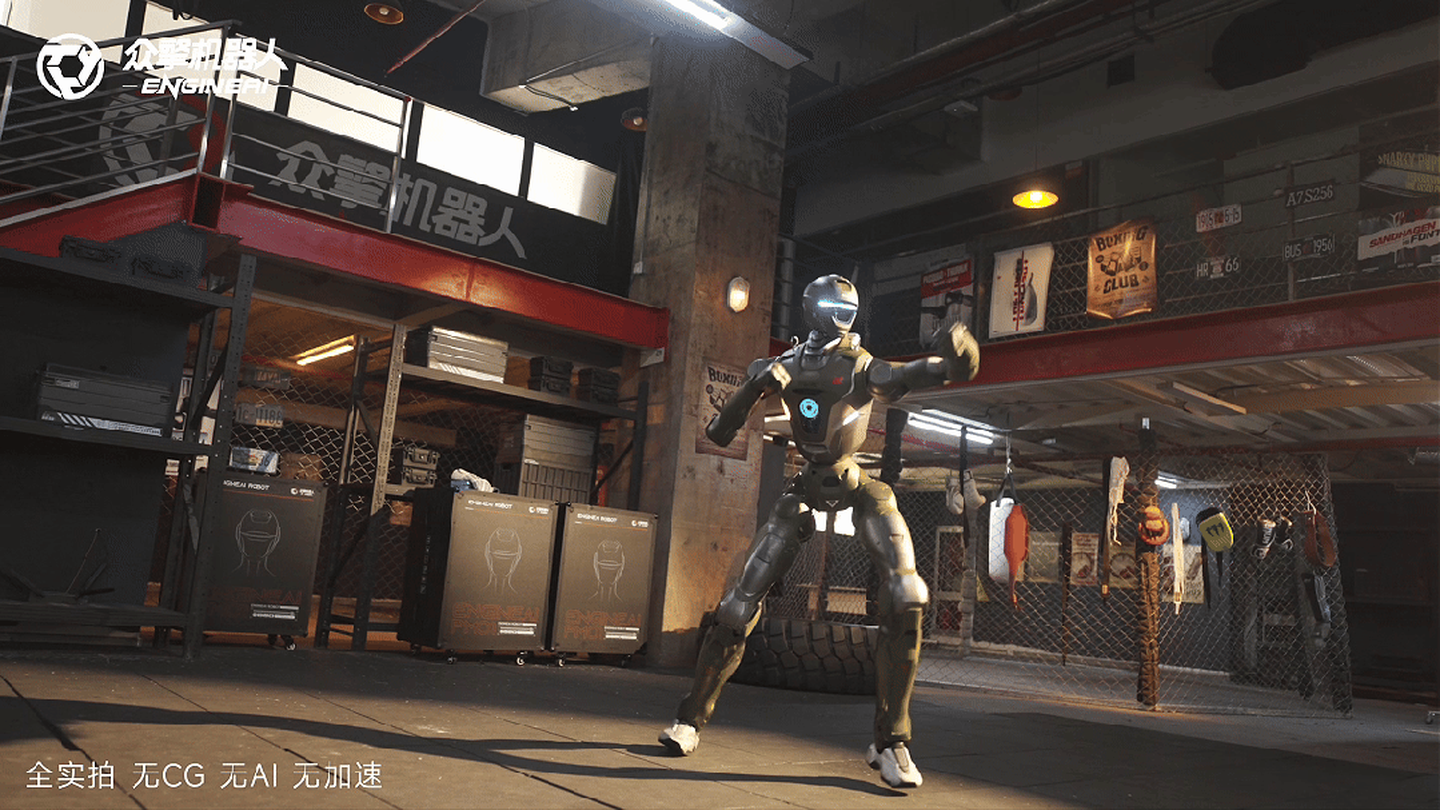
What a cage match actually demonstrates
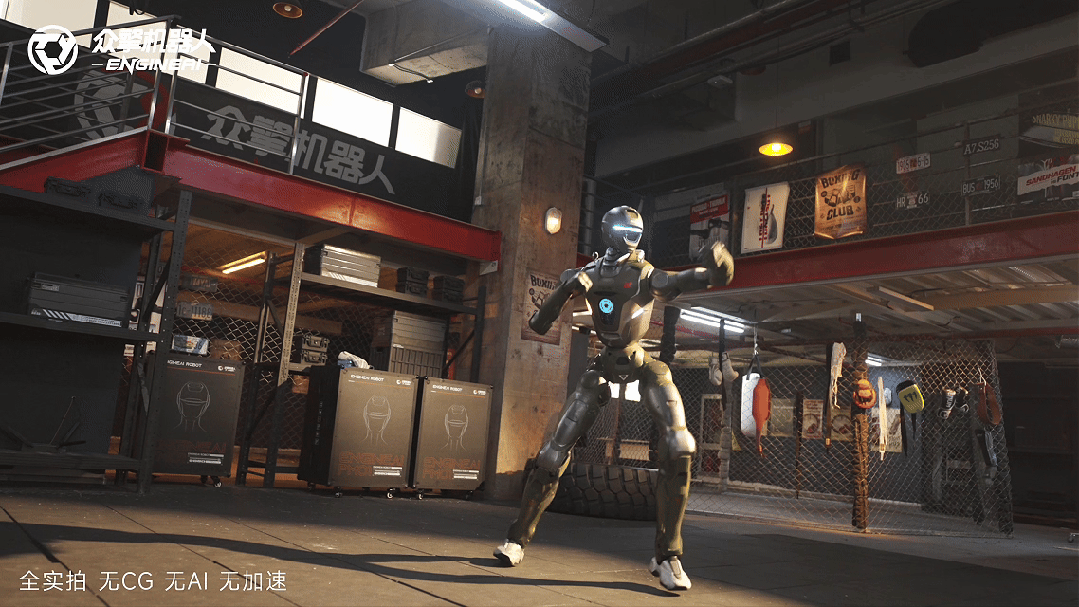 EngineAI's T800, built in Shenzhen, during remotely operated combat trials. The footage was released as unedited, with no CGI or speed adjustment.
Something unusual happened in a cage in San Francisco this year. A Chinese-made humanoid robot — the T800, built by Shenzhen company EngineAI — was brought in by a local operator for robot combat events. In footage that circulated widely, it traded blows with a human fighter and threw kicks.
For anyone who has followed robotics for a while, the reaction is understandable. For decades, the reflex was to look to Japan, Germany or the United States when the conversation turned to advanced robots. Watching a Chinese humanoid hold its own in a public arena complicates that reflex.
What makes this one a new kind of datapoint is not the fight itself, but where it happened and who paid for it.
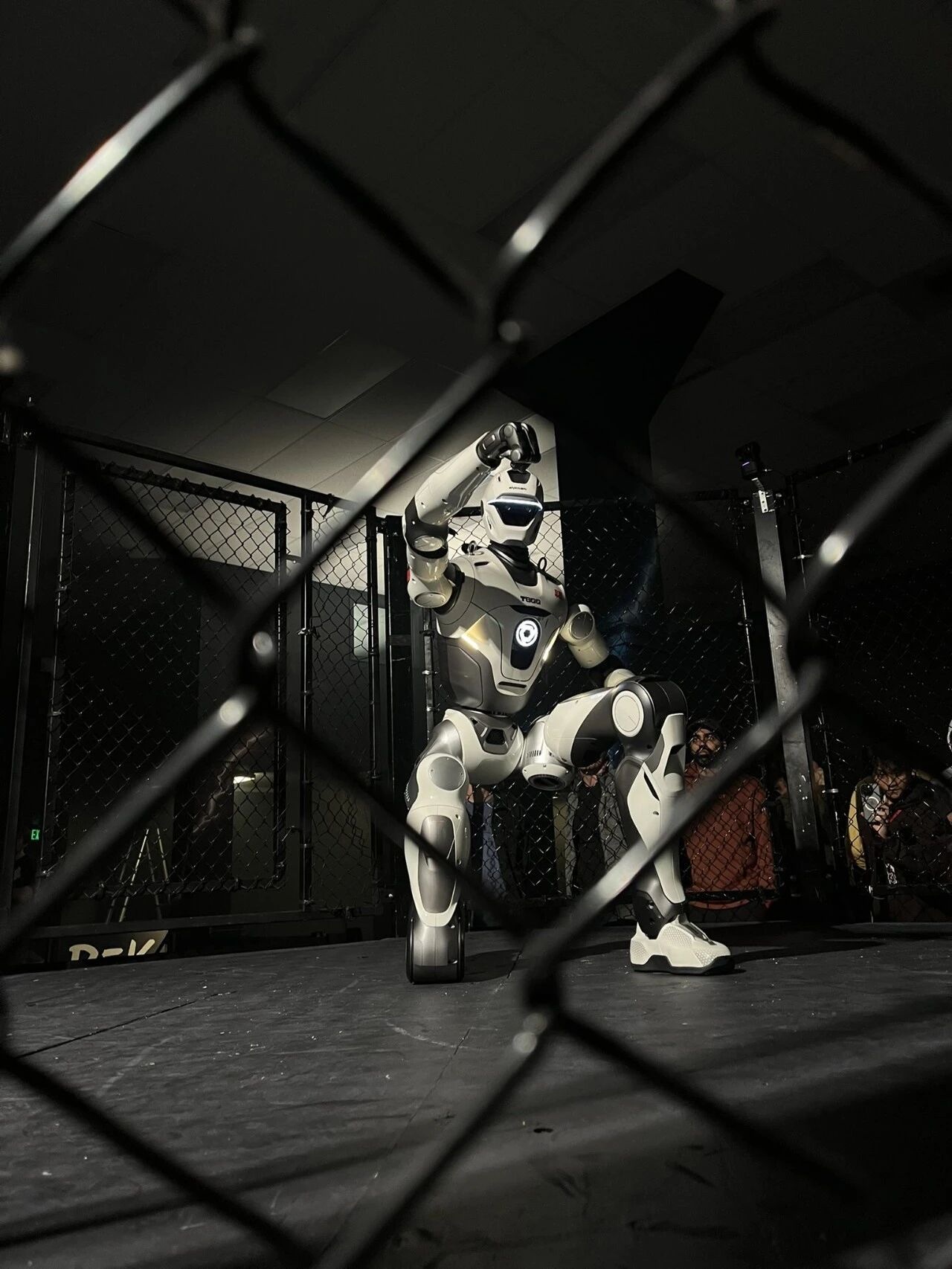 EngineAI's T800 in the combat cage.
The combat events involve remote operation. A human operator drives the machine. What the T800 showed was real, but it was a demonstration of power systems, mechanical structure and motion control — not of perception, judgement, decision-making and real-time reaction, which is what autonomous combat would require. Those are different technical problems, at different levels of difficulty.
That distinction gets lost in most of the coverage. A robot that can absorb a kick and stay upright is demonstrating torque density, joint durability and balance recovery. It is not demonstrating that the same machine can find a part on a cluttered shelf, identify it, pick it up without crushing it, and repeat that ten thousand times without a human stepping in. The first problem was solved years ago by industrial arms. The second is still open.
What the case does establish is commercial rather than technical. A Chinese humanoid robot appeared in a paid public event in the United States. Alongside factories and laboratories, entertainment, technology experiences and commercial showcases are becoming markets that robot companies actively explore.
A single overseas appearance is not evidence of large-scale American procurement of Chinese robots. It is not evidence of comprehensive technological leadership. It is evidence that Chinese companies are now capable of selling into overseas commercial settings — and that is worth watching on its own terms.
The transition underway is from can it be built to can it reach the market. What still has to be proven is whether it can be delivered consistently, and whether it creates real value.
The reason this matters to anyone evaluating the sector is that the T800 is not an isolated stunt. It is the visible tip of a supply chain that most foreign buyers have never walked through. For a structural map of that chain — who the champions are, where the blue ocean sits, and which suppliers nobody visits — see our three-layer guide to China's robotics supply chain. This article stays on the narrower question: what the cage fight does and does not prove.
The number that matters more than the fight
To judge where Chinese robotics actually stands, industrial robots matter more than humanoids.
According to the International Federation of Robotics' World Robotics 2025, China installed roughly 295,000 new industrial robots in 2024 — about 54% of the global total. The United States installed approximately 34,200 in the same period. IFR data also shows Chinese manufacturers held about 57% of their own domestic market in 2024.
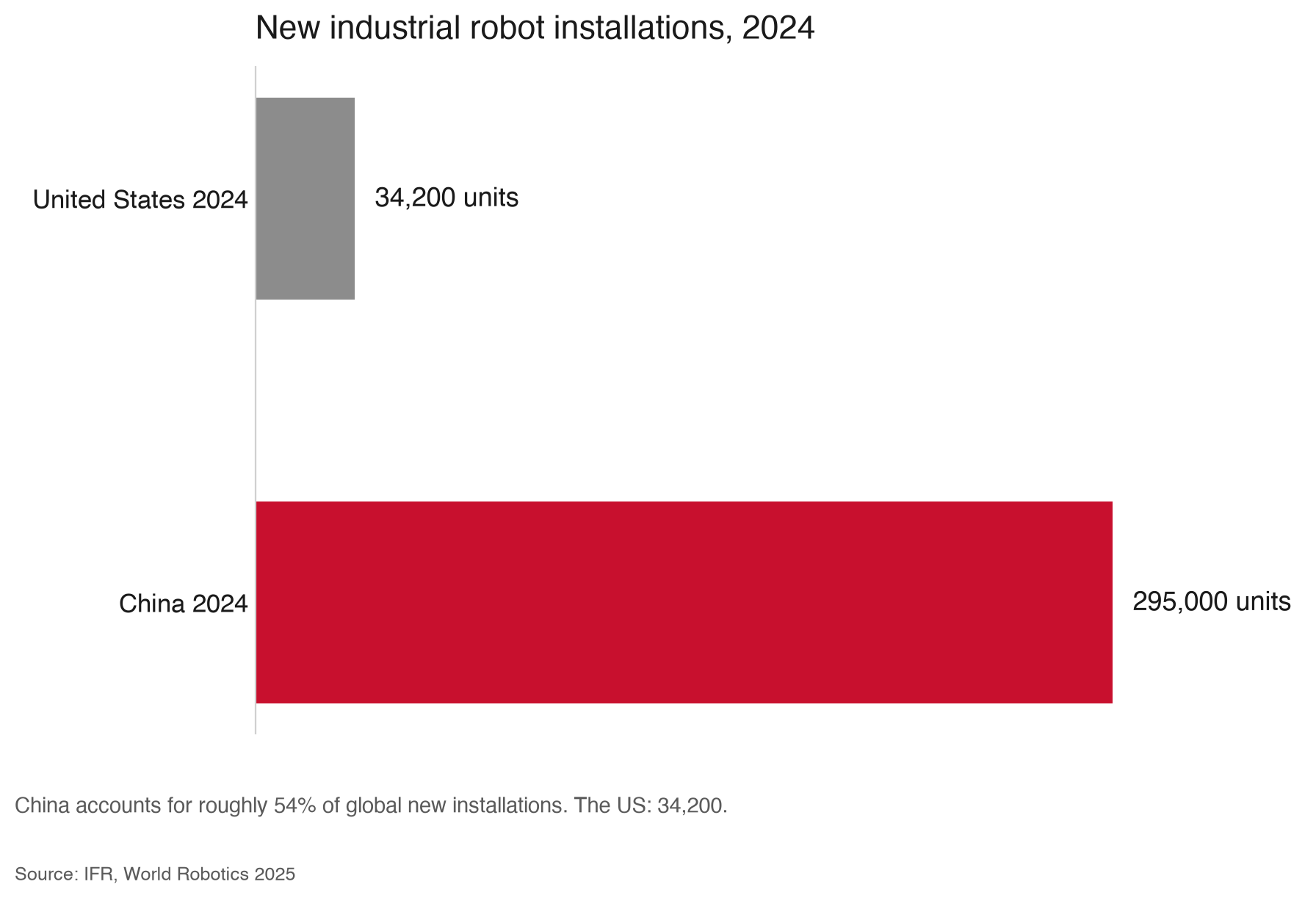
Read together, those figures say two things. China is not only the world's largest market for industrial robots; its domestic manufacturers are gaining share inside that market. The second number is the more consequential one over time.
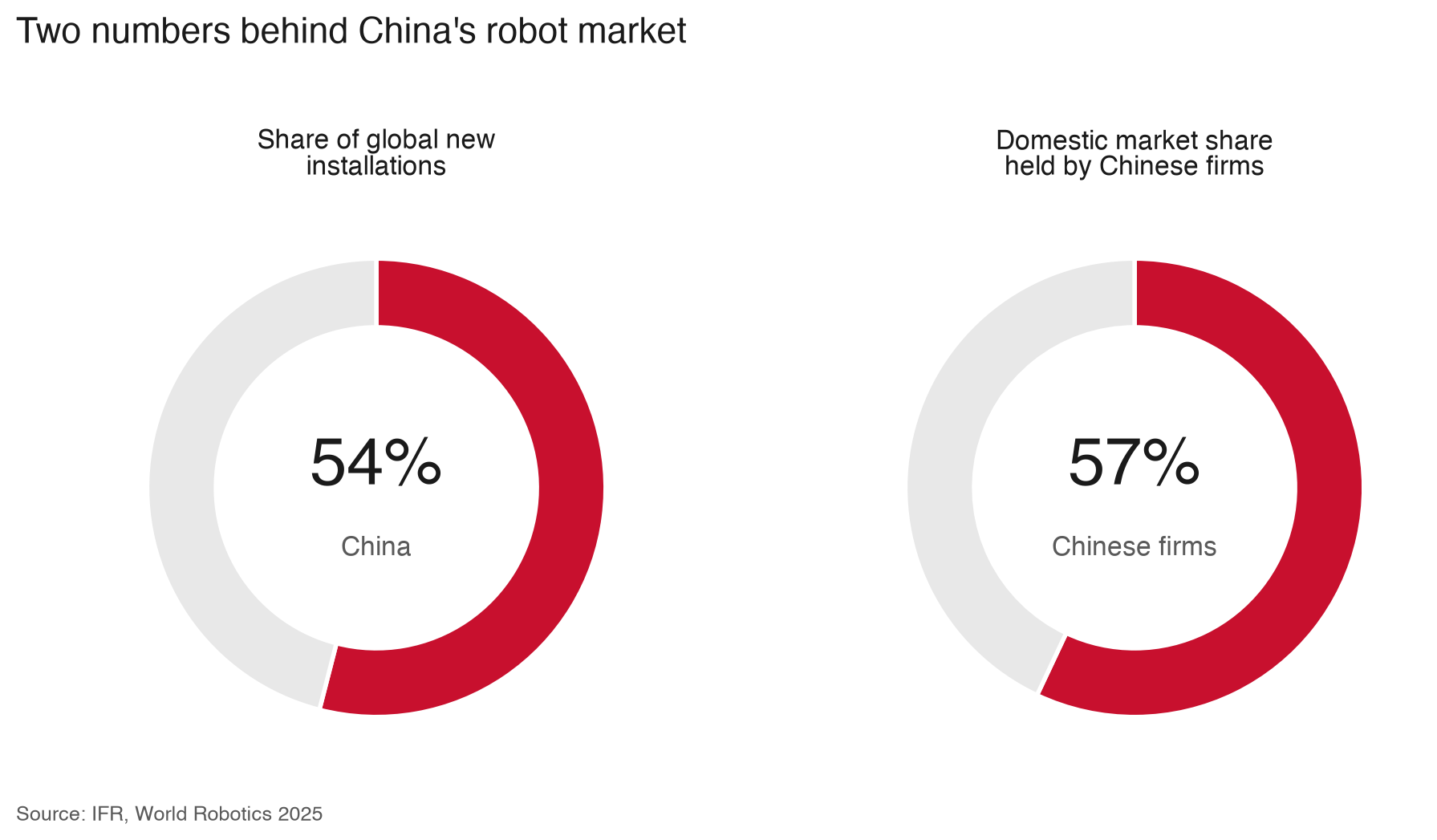
The 57 percent figure is the one that tends to get skimmed past. A country can be the largest buyer of robots while buying them all from abroad — that is a demand story, not a capability story. Domestic share is the capability story. It means the machine on the floor was designed, integrated and serviced by a company competing inside its own market against Fanuc, ABB, KUKA and Yaskawa, and winning roughly half of it.
The reasons are structural rather than mysterious. New energy vehicles, consumer electronics, lithium batteries and photovoltaics gave Chinese robot makers a large volume of real deployment scenarios. Research and development, production testing, supply-chain support and volume manufacturing sit close together. That industrial base is a significant part of why the sector has moved as fast as it has.
The proximity is the part that does not travel well in a report. A robot maker in Shenzhen can have a new fixture machined, tested and back on the line within a working day. The same change in a European supply chain involves a purchase order, a shipping interval and a customs step. That is not a technology gap. It is a feedback loop speed gap, and it compounds.
In humanoids specifically, Unitree, AgiBot, EngineAI, UBTECH and Fourier are advancing along visibly different technical routes — some strong in motion control and hardware productisation, some focused on industrial applications, some working to combine the robot body with embodied intelligence. The sector has entered a phase where dense research and development, rapid iteration and commercialisation attempts run in parallel.
But a large industrial robot market is not the same as humanoid leadership. For humanoids to genuinely enter factories, several problems remain: executing complex tasks, running stably over long periods, dexterous manipulation, and autonomous decision-making.
China's advantages are already substantial. There is still distance between a robot that can move and a robot that can work reliably.
Where the American comparison actually bites
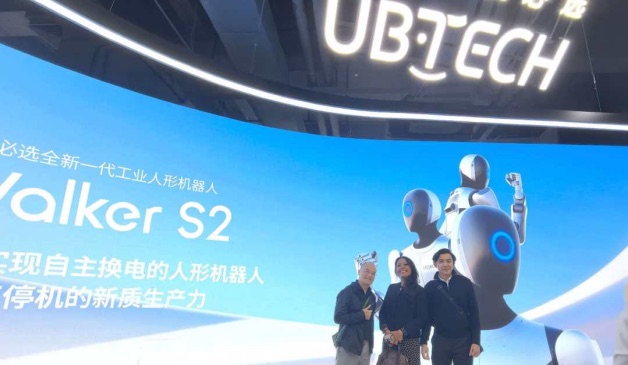 UBTECH's Walker S2 industrial humanoid on display during a company visit in China.
The most useful comparison between Chinese and American robotics is not which machine jumps higher. It is which company can convert technology into working capability.
On motion control and robot hardware, Unitree built strong product recognition in quadruped robots before extending into humanoids. EngineAI has demonstrated dynamic motion capability through products like the T800. Boston Dynamics has spent decades on complex robotic systems and holds deep accumulated expertise in dynamic balance and motion control.
Motion ability cannot be ranked by a single video, though. A robot that can run, jump and flip is not automatically a robot that can work a continuous shift in a factory.
What factories care about is more prosaic: can it move material reliably, can it run continuously, what is the failure rate, what does maintenance cost. Those determine whether a robot creates economic value.
There is an asymmetry worth naming here. Boston Dynamics has been publishing dynamic-motion footage for over a decade and remains, for most industrial buyers, a research organisation before it is a supplier. EngineAI went from a standing start to a paid commercial appearance on foreign soil in a fraction of that time. Neither fact settles the capability comparison — but together they show that the speed of commercialisation and the depth of accumulated expertise are two different axes, and Chinese and American companies sit differently on each.
The second competition line: intelligence
The more consequential contest may be in artificial intelligence.
Tesla is developing Optimus. Figure AI is exploring how AI can improve a robot's task understanding and execution. Both aim at machines that do not merely execute preset programs but understand tasks and adapt to some degree when conditions change. Chinese companies including AgiBot are pursuing embodied intelligence along parallel lines, working to connect robot bodies, intelligence models and real scenarios.
The gap here is not a simple division of labour where China does hardware and America does software.
Chinese companies are developing embodied intelligence models. American companies are working to reduce hardware costs and improve manufacturing efficiency. The technical routes are crossing.
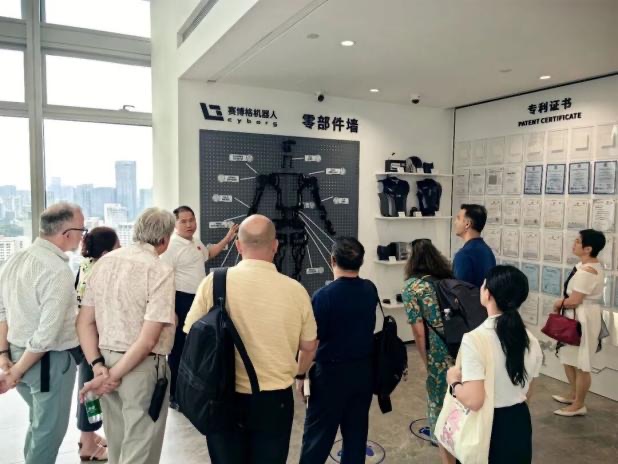 A component and certification display at a robotics exhibition — where much of the industry's real engineering sits.
The genuinely hard problem is whether a robot can read its environment, understand an instruction, plan a motion, and adjust when something unexpected happens. Put an object on a table and ask the robot to place it in a box. Straightforward. Now: what if the object has moved? What if the grasp fails? What if the shape is different? Can the robot diagnose the situation and retry on its own?
These are the problems embodied intelligence has to solve to move from demonstration to practical use. From public information, there is still no unified, repeatable benchmark that would show any single leading company — Chinese or American — has comprehensive leadership across all key capabilities.
The absence of that benchmark is itself the finding. Every vendor claims a lead on the axis it chose. Without a shared task suite run under identical conditions, those claims are not comparable, and any ranking you read — including the four dimensions below — is a judgement about weights, not a measurement.
Three gates a demonstration cannot pass
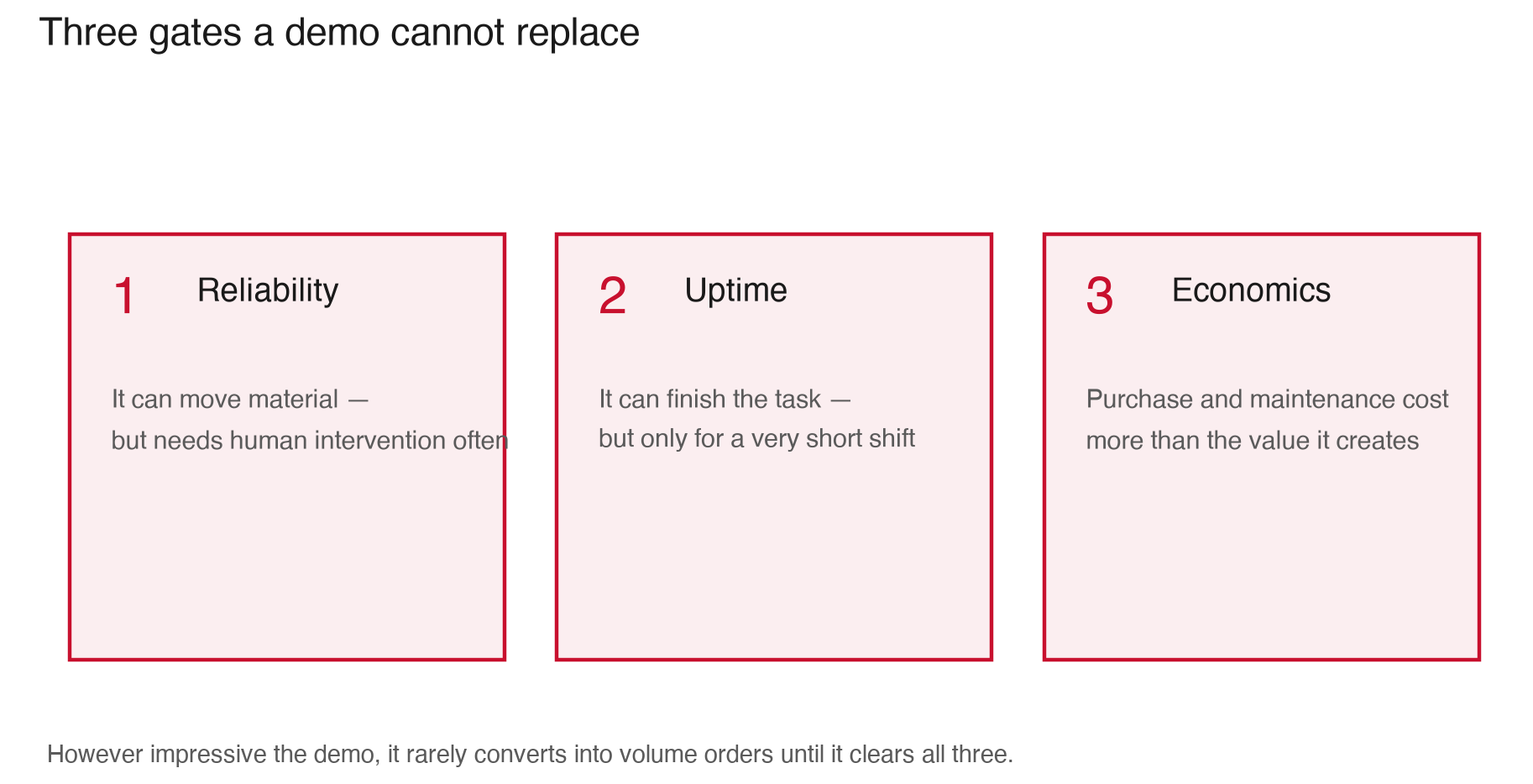
Combat footage carries strong visual impact. Industrial production is judged by a different standard. On a stage, one well-executed move can win applause. In a factory, one well-executed move may not improve throughput at all.
Enterprises need work that is stable, accurate, continuous and predictable. Three things a demonstration cannot substitute for:
Reliability. A robot that can move material but frequently requires human intervention is not yet a solution.
Uptime. A robot that can complete a task but only operates for very short periods is not yet a solution.
Economics. A robot whose purchase and maintenance costs exceed the value it creates is not yet a solution.
This is why Tesla, Figure and China's humanoid makers all need to prove themselves in real scenarios. In the near term, robots are more likely to enter factories through relatively well-defined tasks: material handling, machine loading and unloading, and internal transfer. Not every job suits a humanoid. A fixed workstation may still be better served by a conventional robotic arm, and warehouse transfer may be cheaper with a mobile robot.
The value of a humanoid is that it has a chance to adapt to environments designed for people, and to take on a wider variety of tasks under the right conditions. Whether that advantage can be realised depends on cost, efficiency and reliability.
Four dimensions — and an honest verdict
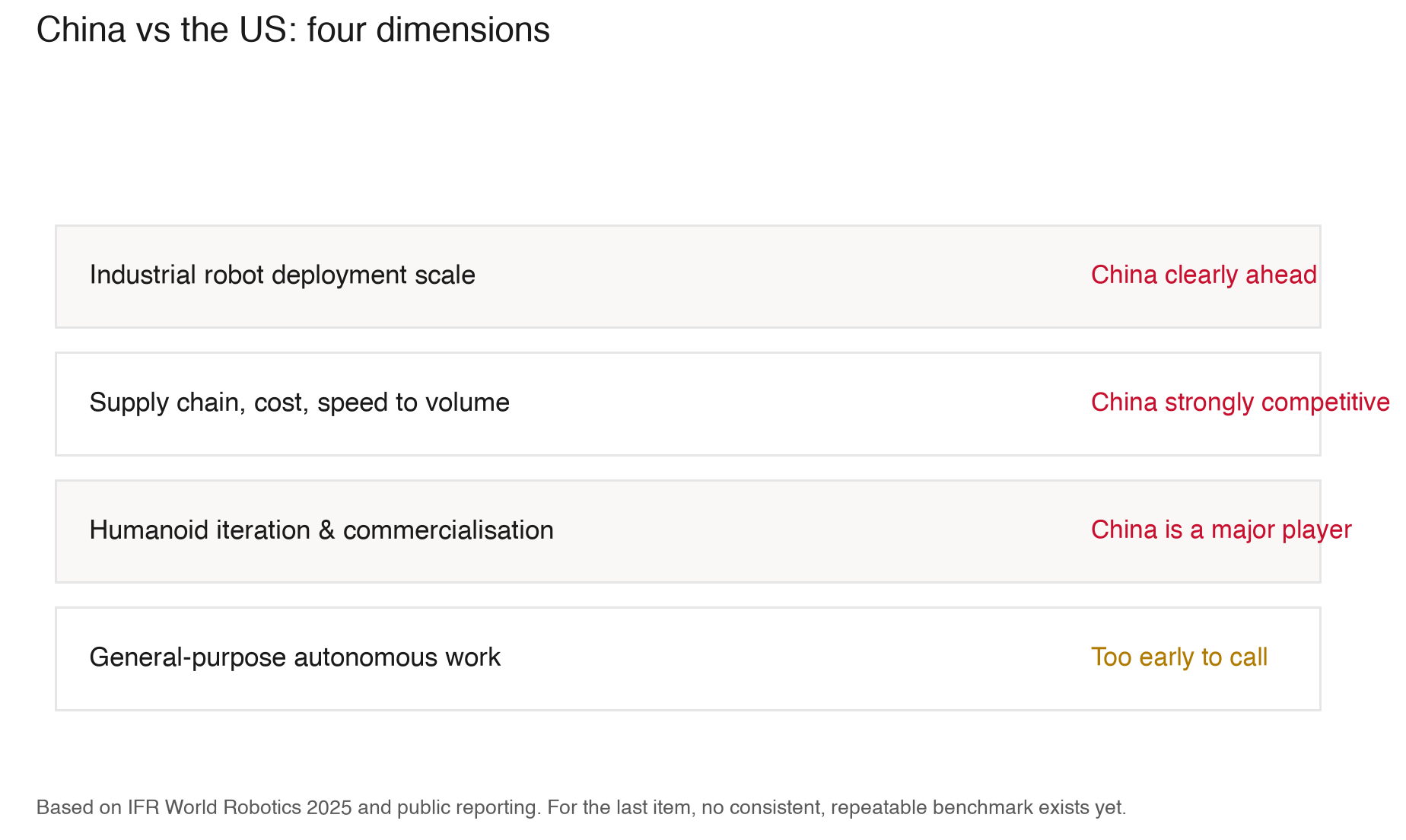
Industrial robot deployment scale. China is clearly ahead.
Supply chain, manufacturing cost and speed to industrialisation. China is strongly competitive.
Humanoid product iteration and commercialisation exploration. Chinese companies are now significant players in global competition.
General-purpose task capability, autonomous work in complex environments, and long-duration stable operation. No side can be declared comprehensively ahead. Several American companies hold deep accumulated expertise in AI and advanced robotic systems; Chinese companies hold manufacturing scenarios, supply chain depth and fast engineering iteration.
Read as a scorecard, that is two wins for China, one draw, and one category where the honest answer is that the evidence is not public. Note what is not on the list: nothing about who has the better robot. The four dimensions are deliberately about deployment, cost, iteration speed and general-purpose capability, because those are the things that decide whether a machine ships in volume. A fifth dimension — raw dynamic performance in a controlled demonstration — would favour different companies, and would also be the least predictive of commercial outcomes.
The competition ahead is about who can combine those capabilities. A robot needs an intelligent "brain," a dependable "body," and the ability to do real work at a reasonable cost. Pursuing motion difficulty alone, or judging by model demonstrations alone, is not enough to assess a company's long-term competitiveness.
If you want to see it rather than read about it
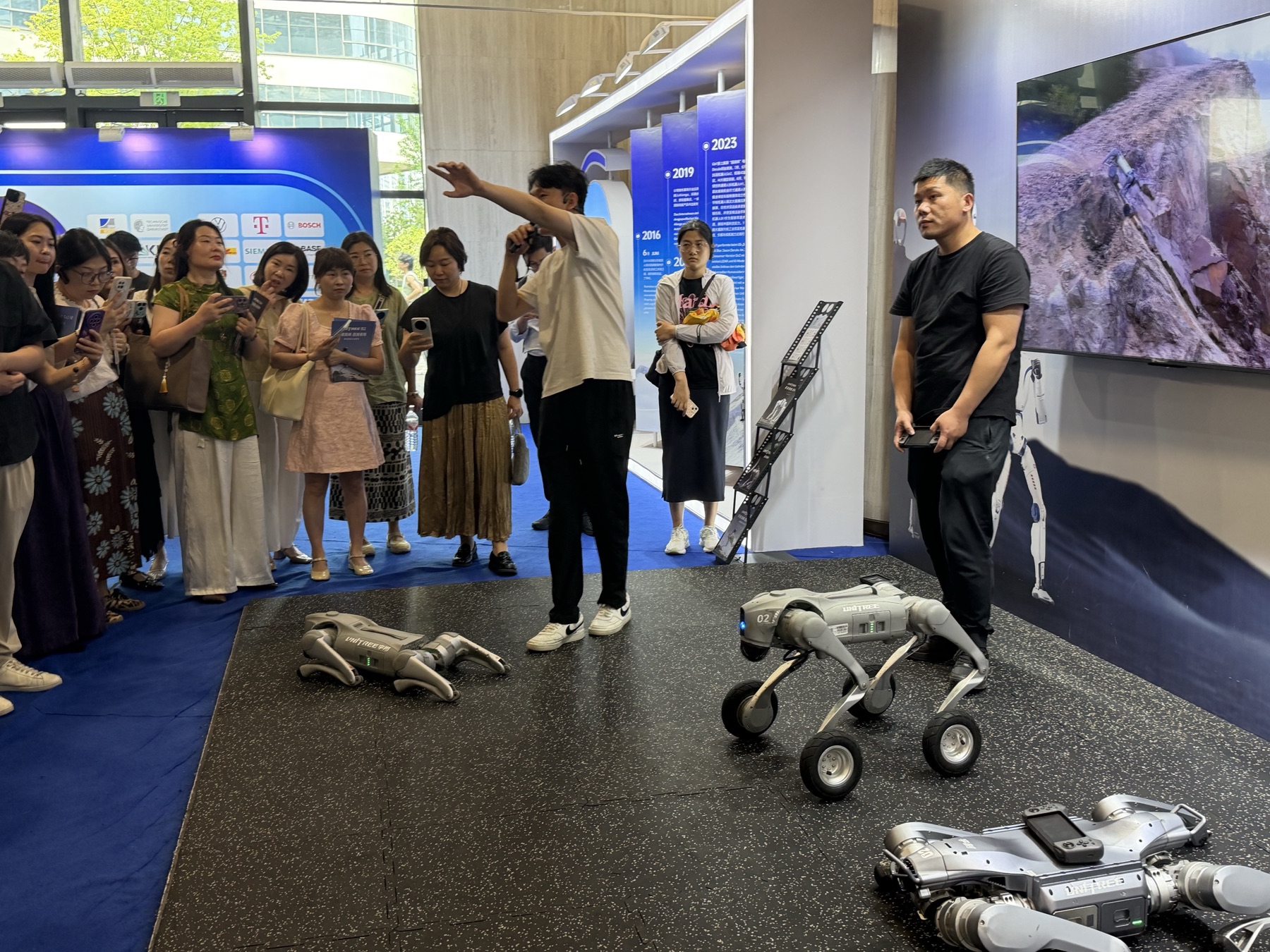 Inside a humanoid robotics showroom in Hangzhou, where visitor groups see hardware and demonstrations at close range.
Most of the judgments above come from public data, filings and reporting. They change quickly, and the useful version of the picture is the one you can update on site.
A cage fight in San Francisco tells you a Chinese humanoid can be sold abroad. It does not tell you what the factory behind it looks like, how many units actually leave the line, or what happens when the buyer asks for a service contract. Those answers sit in Shenzhen, Hangzhou and Shanghai, in showrooms and integration halls that do not appear in any report.
We arrange company visits across China's robotics and advanced manufacturing sectors for executive, investor and institutional groups — component makers, robot developers and end users. Groups we host routinely spend the technical session on the questions that a chart cannot answer: what integration actually requires, where reliability breaks down, and at what point the unit economics start to work.
If you are planning a visit, the useful conversation happens before the itinerary is fixed. Tell us what you need to evaluate and we will map the sites that can actually answer it.
For a closer look at individual companies rather than the sector, our visit write-ups on EngineAI in Shenzhen and UBTECH go into what a group actually sees on site.
Data sources: International Federation of Robotics, World Robotics 2025. Figures are attributed to the source and are not restated as our own measurements.