Key takeaways
- Trace the four-layer architecture end to end: perception, transmission, platform, application — and see where the boundary between vendor-supplied and client-supplied sits at each layer.
- Examine the transmission layer as the cost and siting decision: a self-developed full-duplex LoRa protocol with microamp sleep current, short air-time frames and threshold-triggered reporting, specified at 3.5 km base-station range.
- Work through the contactless front end: a 0.3 mm laser settlement meter, a 10 m to 1,000 m visual tracking instrument using oblique-axis digital image correlation, and a 0.1 mm laser deflection meter — and the measurement envelopes each one does and does not cover.
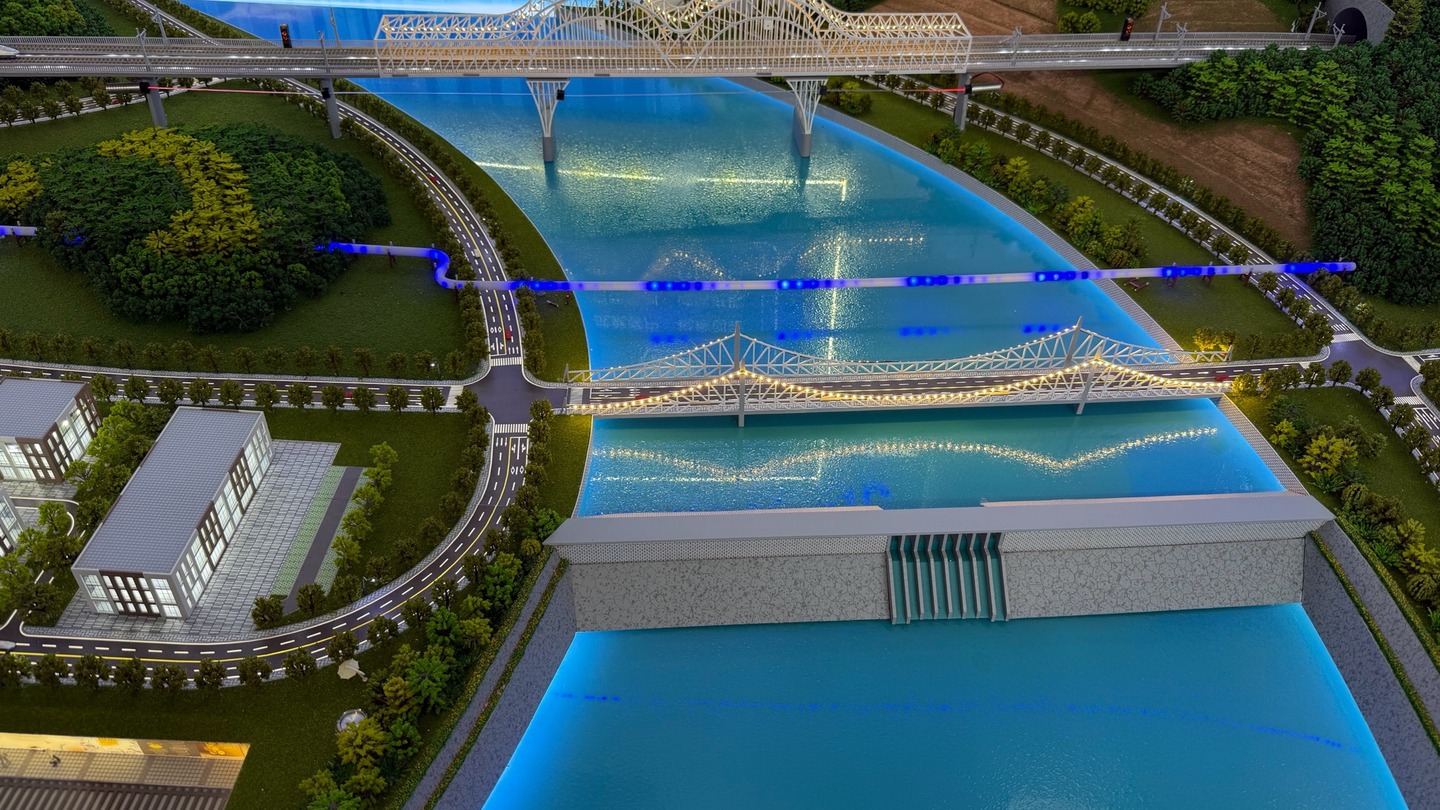
- Take apart three reference schemes at group scale: 29 bridges across about 69 km of the Shenyang–Haikou expressway, the Jiaxing G525 mixed bridge group, and a tunnel cluster on the Jiumian expressway.
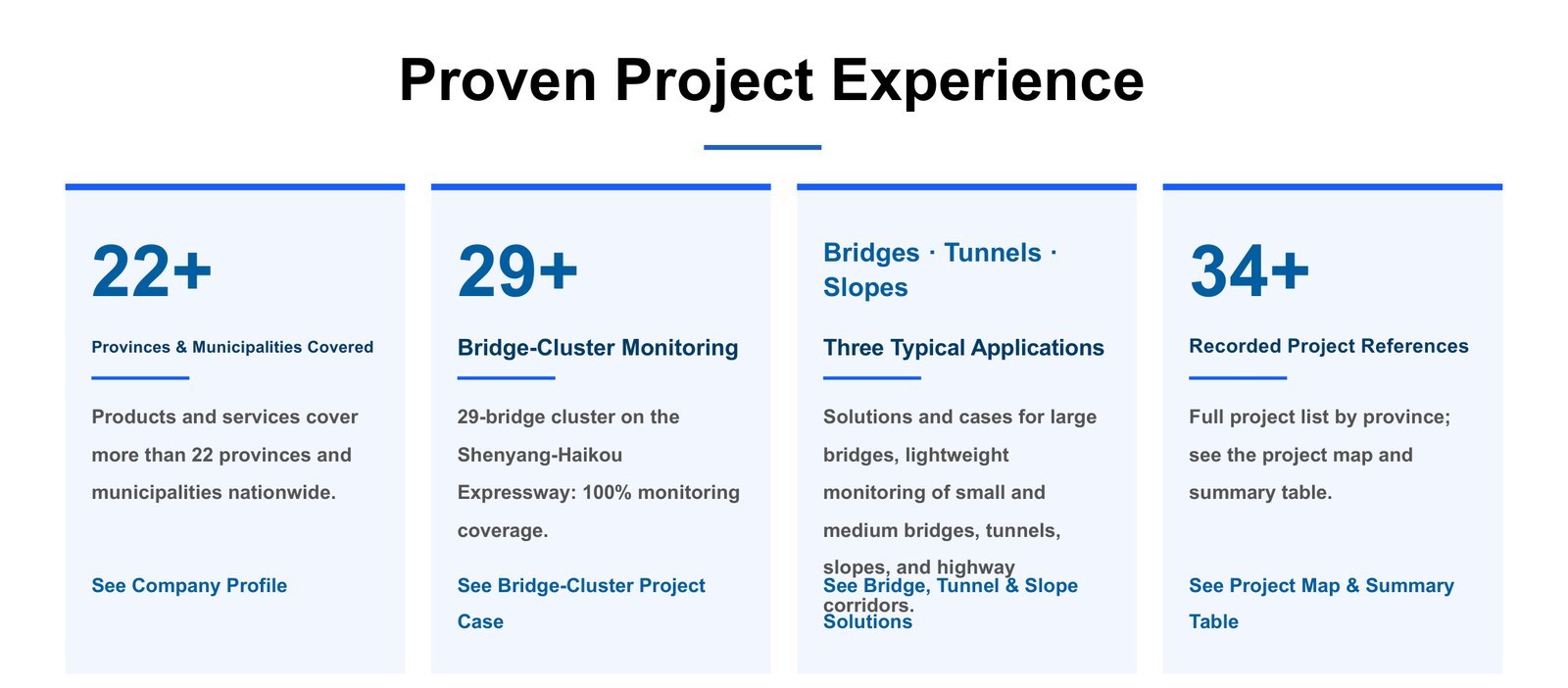
- Understand the position: a hidden champion in infrastructure monitoring — known to the institutions that own bridges, tunnels and slopes across more than twenty provincial-level regions, and invisible outside its segment.
- Meet the company's chief executive and chief technical expert, who host the programme, and put the calibration, drift and long-term stability questions to the engineers who developed the method.
- Compare with a Han's Laser visit in Shenzhen on how a Chinese industrial equipment group structures vertical integration, and with a Huawei headquarters visit on the Shenzhen hardware supply base these products draw on.
A Junlei Optoelectronics visit in Shenzhen is a technical programme for people who specify, procure or operate structural monitoring. Junlei builds and sells the full chain — sensing front ends, its own LoRa transmission network, its own monitoring platform — for bridge, tunnel, slope, subgrade, foundation pit and building monitoring, and it holds a reference portfolio of roughly 34 named projects across more than twenty provincial-level regions. Delegations that come here are usually dealing with the same three problems their Chinese counterparts solved in a hurry over the last fifteen years: a structure population too large for manual inspection, power and cabling that cannot be brought to the points that matter, and an alarm that has to work when the network does not.
The technical value of the programme is that the products are on the floor and running. Precision, range, consumption and latency are stated as numbers, demonstrated in front of you, and open to the questions a structural engineer would actually put to a supplier.
A hidden champion in infrastructure monitoring
This is a hidden champion in infrastructure monitoring — a supplier whose installed base spans more than twenty provincial-level regions, whose customers are institutions rather than consumers, and whose brand is invisible outside its segment. The pattern is worth understanding before you arrive: the public does not know the company, and the organisations that own bridges, tunnels and slopes do. A delegation from a mature infrastructure market will find the shape familiar, because this is how specialist monitoring suppliers grow — by being known to owners and invisible to everyone else.
The position rests on a specific kind of depth rather than on scale. Junlei develops its own full-duplex LoRa transmission protocol, its own sensor front ends including three contactless optical instruments, and its own monitoring platform, and it resells the conventional sensors as well so a client can mix the two on one network. The practical effect is a specialist that can answer a buyer's entire monitoring question rather than a single instrument vendor. That is also why the procurement conversation in China flows through the design institute rather than the marketing brochure — the specification is written by engineers, and a supplier that can meet it end to end holds a different position from one that can supply a part.
The engineering provenance is public and verifiable. Junlei operates a Shenzhen academician workstation and publishes with two members of the Chinese Academy of Engineering: a laser and optoelectronics specialist, and a rail transit specialist in intelligent monitoring and safety control whose awards include a national science and technology progress first prize. The company holds a joint laboratory with a Shenzhen university established in 2021 and a strategic research agreement with a city smart-transport and safety-operation institute signed in 2025 — so the methods on show have a research lineage you can trace, not just a product sheet.
This matters to a technical delegation for a specific reason: the instruments in this sector are usually sold on a specification and defended on a warranty. Here the specification has a provenance — a national railway research programme, a joint laboratory, an academician workstation — and the questions about calibration, drift and long-term stability can be put to the engineers who developed the method rather than to a sales team.
What each type of delegate should take away
For owners and asset managers. Three questions decide whether this system is procurable in your organisation: what the total cost of ownership looks like once instruments, transmission, platform and the annual service obligation are separated; who holds the alarm liability when the system escalates; and how the asset register is enriched by what the system produces, rather than by the system itself. The reference schemes are worth reading as service contracts, not as installations.
For engineering and technical experts. The measurement envelope is the conversation. Ask how the visual tracking instrument is calibrated over a 1,000 m baseline, how target stability is maintained over years, how occlusion and low visibility are handled in the resolution algorithm, and what the false-alarm rate is once a group of structures is running on tiered thresholds. The instruments are on the floor, so these questions can be answered against hardware rather than in principle.
For contractors and system integrators. The interesting layer is the transmission network and the platform's access model, because that is what you would be integrating into an existing asset management environment. Ask what a third-party sensor onboarding actually requires, what the OpenAPI exposes, and what the division of responsibility looks like between the supplier, the integrator and the owner.
For those assessing a partnership or a supply relationship. The vertical integration — protocol, front ends, platform — is the thing to weigh. It can mean faster iteration and a coherent stack, or it can mean a company spread across too many layers for its size. The certification portfolio, the reference list and the product specification all bear on that judgement, and the engineers in the room can speak to the technical half of it.
China Innovation Visits coordinates the Shenzhen programme, including the company reception, scheduling, local transport and English interpretation.
Why this visit is relevant to a monitoring practitioner
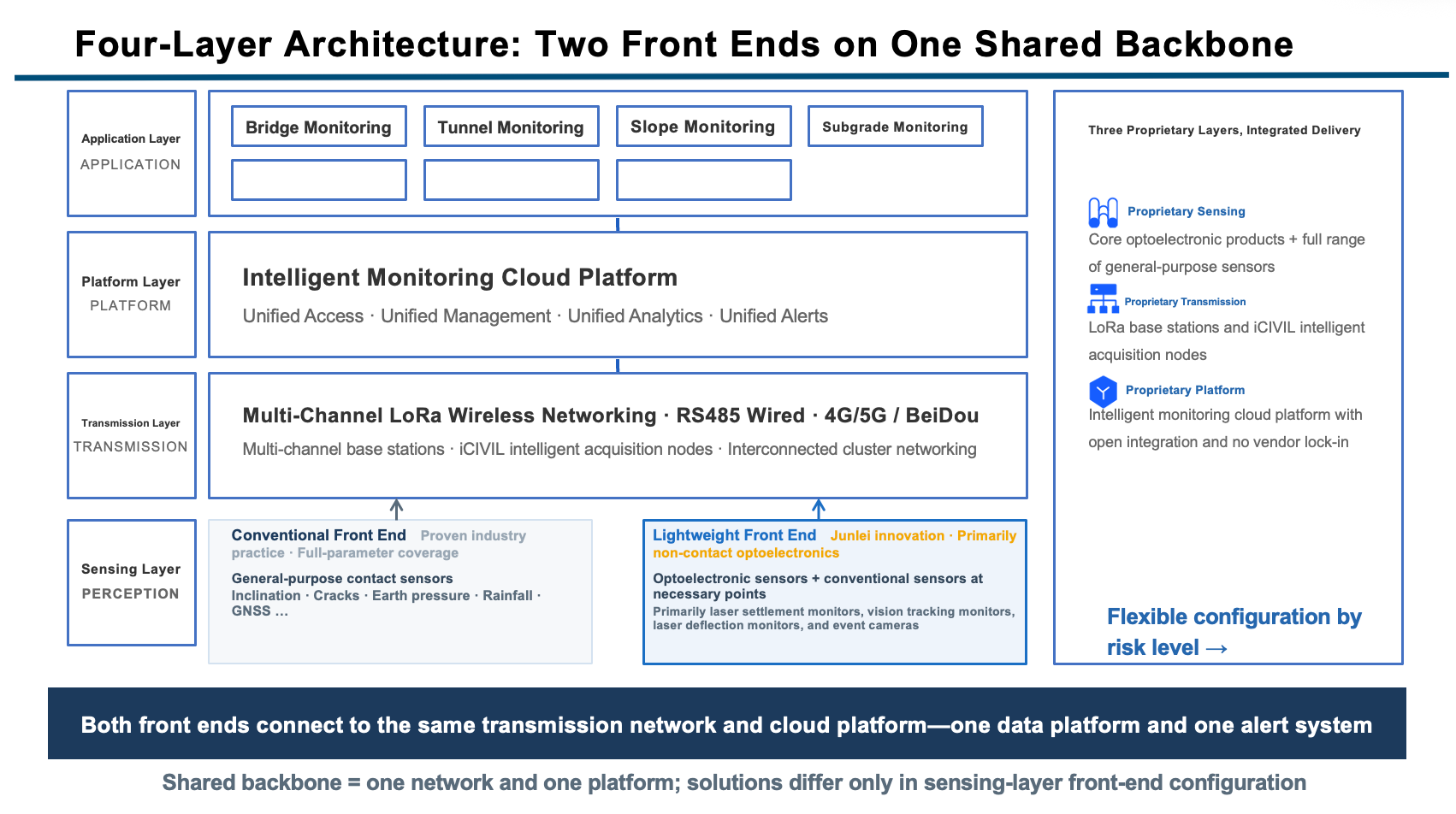
The architecture is the offer, not the sensor. Most vendors in this market sell an instrument. Junlei's commercial structure is a shared base layer — one transmission network and one platform — with the sensing front end chosen per site. For an owner or consultant, that changes the procurement question: you are evaluating a network and a data model that will outlive the instruments, and you can add either a conventional contact sensor or a contactless optical instrument to the same infrastructure later. Reading that architecture against your own asset register is the most efficient use of the hour.
The design position is a specific engineering claim. The conventional response to structural monitoring is to instrument the structure. Junlei's position is to move the measurement instrument out of the failure envelope: on the bank rather than the deck, outside the collapse footprint rather than on the slope, outside the traffic envelope rather than in the tunnel. The engineering consequence is directly testable — a station outside the failure zone keeps recording through the event, which is exactly when the data has value. What it costs you is that every measurement is now a remote measurement, which puts the burden on line of sight, target stability and atmospheric correction. That trade is what the demonstration session should be used to probe.
Two front ends on one base is a procurement instrument. Because both the conventional and the lightweight front end report into the same network and platform, an owner can start with standard contact instrumentation on critical points and add contactless coverage where cabling is impossible, without running two systems. Whether that works in practice depends on how genuinely protocol-neutral the platform's access layer is, which is a fair question to put to the engineers.
The scale of the reference projects is transferable. Chinese practice groups structures: 29 bridges treated as one monitored population across a 69 km section, a tunnel cluster treated as one system. Most foreign owners are now facing the same arithmetic — an ageing bridge population that cannot be inspected at the old frequency — and the way a supplier organises group-level monitoring, from point selection rules to alarm tiering, is the part that transfers.
The solution, layer by layer
Junlei describes its architecture as four layers with two front-end options. The base layers — transmission and platform — are developed in-house; the sensing layer offers the industry-standard contact sensor range as one option and a contactless optical family as the other. Robot and drone inspection lines are offered as independent systems that report into the same platform.
Perception layer
Two families.
The conventional front end covers the parameters a design institute would write into a specification: environment (water level, rainfall, temperature and humidity, atmospheric pressure, wind speed and direction), force (axial force, earth pressure, cable force, structural vibration), and deformation (displacement, settlement, crack width, inclination). These are the standard contact instruments, supplied and integrated across the same network.
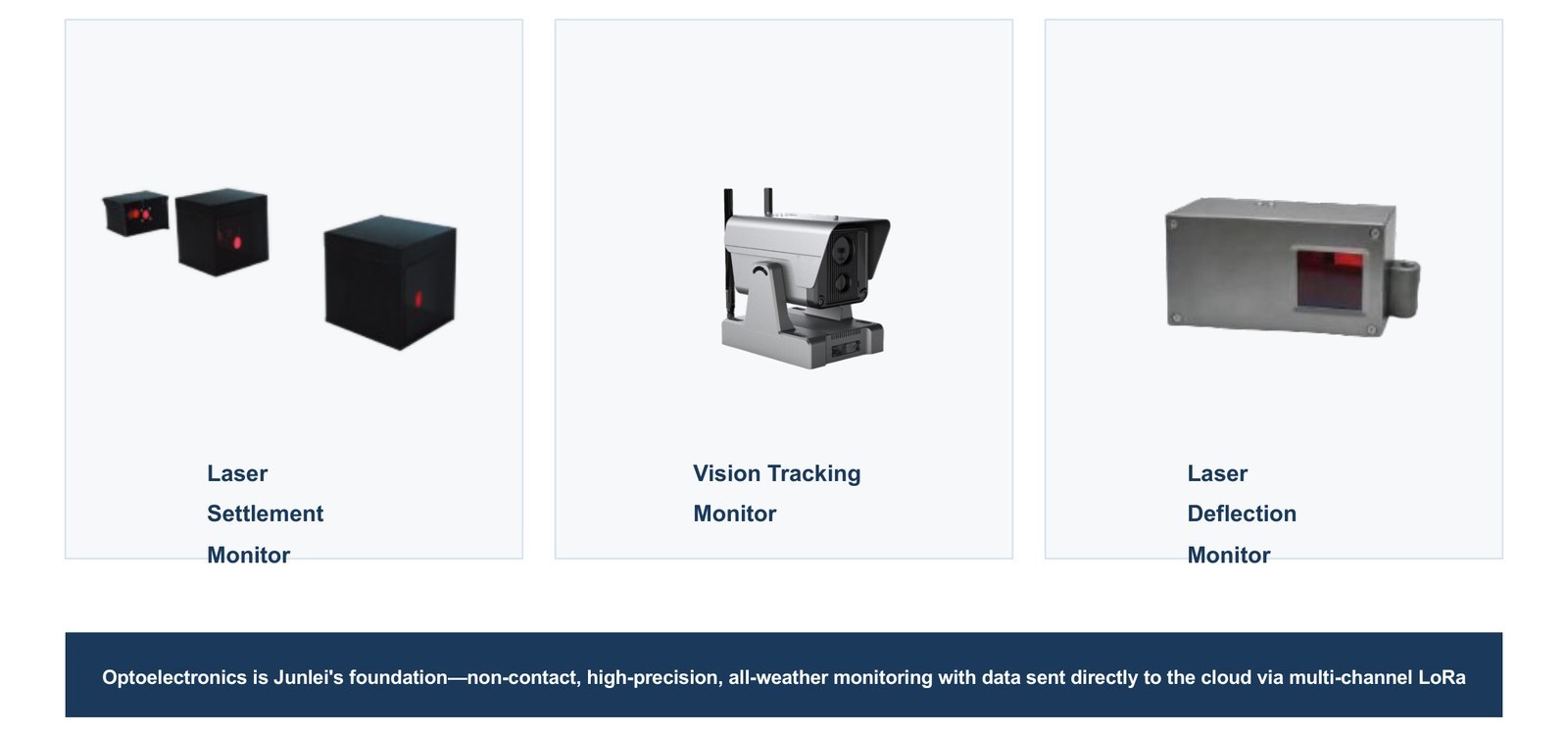
The lightweight front end is built mainly on Junlei's own optical instruments, with conventional sensors added at points that need them: a laser settlement meter, a visual tracking instrument, a laser deflection meter, and — in the slope and tunnel work — a laser event camera. The company's stated position is that this front end covers deformation at the points that matter most while removing the cabling and the installation exposure.
Transmission layer
This is where the company spends its argument, and it is the layer a technical delegation should examine hardest.
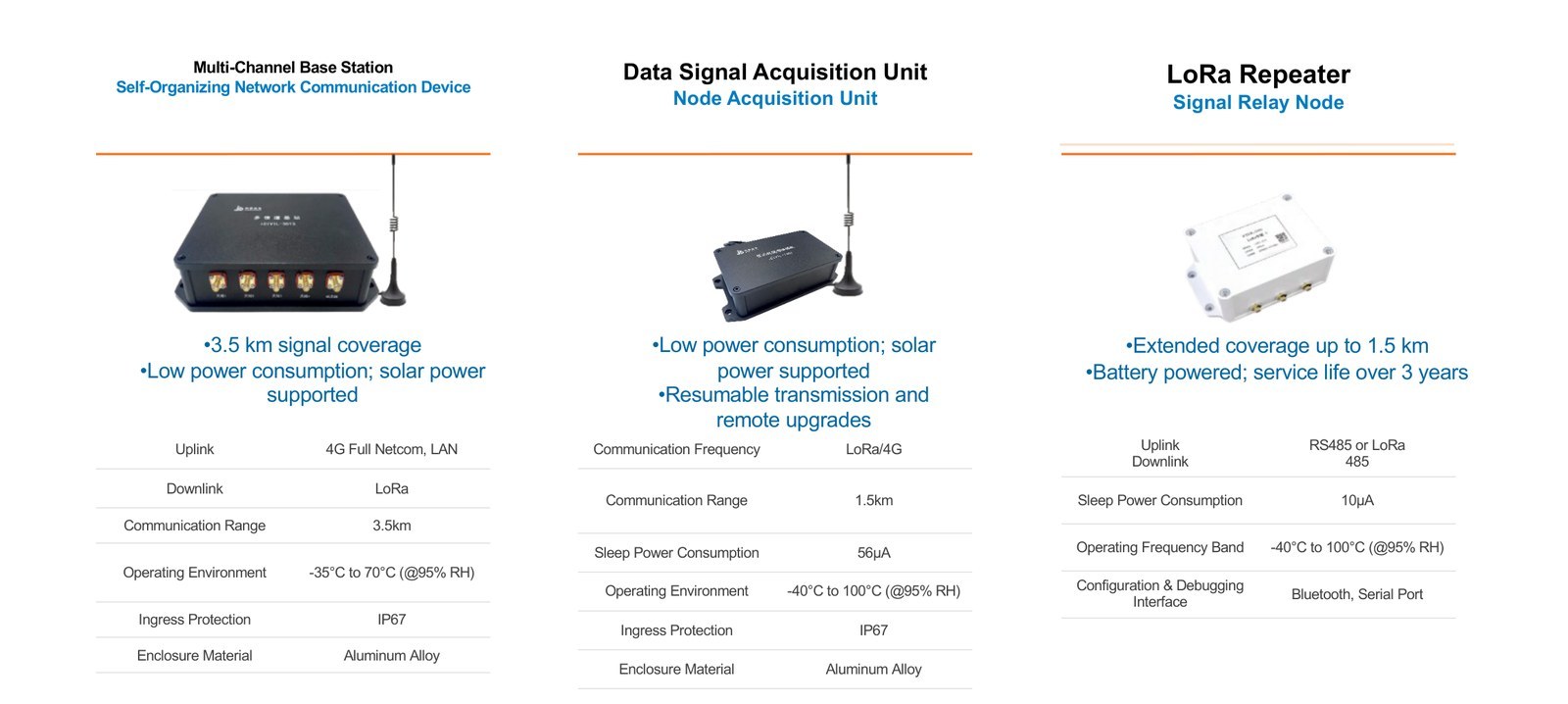
The protocol is designed around energy. Nodes sit at microamp-level sleep current, transmit short frames with air time measured in tens to hundreds of milliseconds, return to sleep immediately after transmitting rather than staying in receive, and support scheduled, fixed-interval and threshold-triggered reporting, with the reporting rate stepping up when readings move. A whitelist removes the join handshake on every transmission. The product specification for the multi-channel base station gives 4G or LAN upstream, LoRa downstream, a 3.5 km communication range, IP67 protection, an aluminium enclosure and an operating range of -35 °C to 70 °C at 95 per cent relative humidity. The data acquisition node is specified at 56 μA sleep current, 1.5 km range, -40 °C to 100 °C and IP67; the repeater at 10 μA sleep current over RS485 or LoRa, with a 1.5 km extension.
The engineering consequence is siting. A small photovoltaic panel and a lithium battery are sufficient, so a monitoring point no longer requires a mains connection, a cable route, a trench or a lane closure. On a mountain slope, in a tunnel without power, on a deck where the operator will not accept a closure, that is the difference between a monitored point and an unmonitored one. The company's own worked example is three site types: remote terrain with no grid supply, sites where solar charging is slow through the wet season, and retrofit work on existing bridges and tunnels where nothing may be disturbed. Storage is sized per site against local irradiance and reporting frequency, with the design case taken as seven to fifteen days of continuous overcast.
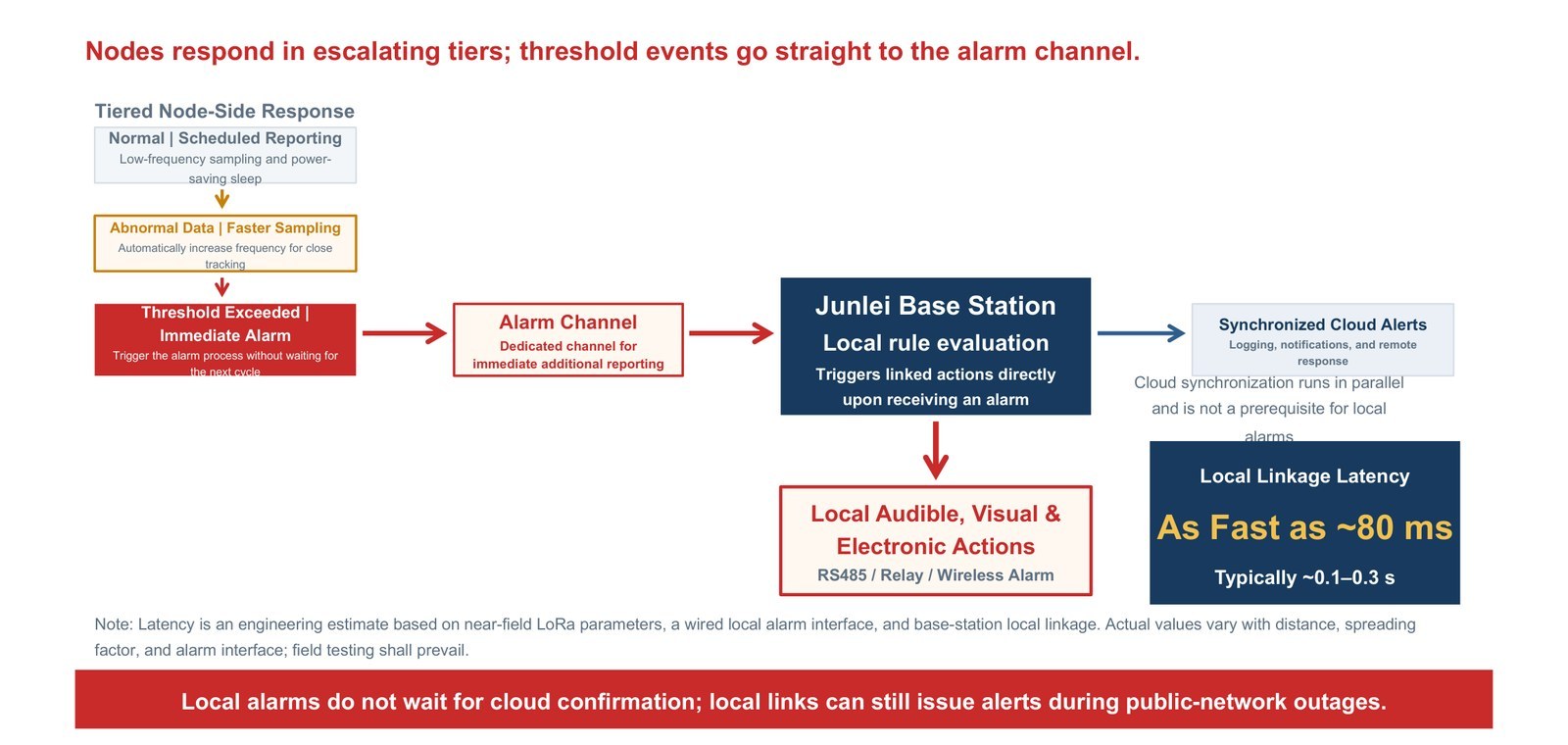
The second mechanism is escalation. A node reports on schedule when readings are normal, increases its own collection rate when readings trend abnormally, and on a threshold breach sends immediately onto an alarm channel rather than waiting for the next cycle. The base station then makes a local rule decision and drives local output over RS485, relay or a wireless alarm device, with the company quoting local linkage of roughly 0.1 to 0.3 seconds under near-field LoRa conditions with a wired local alarm interface. Cloud synchronisation is described as a parallel path, not a precondition. The design intent — that a public-network outage does not silence the alarm — is the single most important claim to verify, because it determines whether the system is a monitoring system or a reporting system. Those latency figures are the company's engineering estimate for near-field conditions and depend on distance, spreading factor and the alarm device; ask for site test data.
Range figures deserve the same scrutiny: 3.5 km is a specification for the base station under stated conditions, and the practical cell in an obstructed tunnel or a folded slope is decided by the survey, not the datasheet. Ask how the network plan is produced for a site like yours.
Platform layer
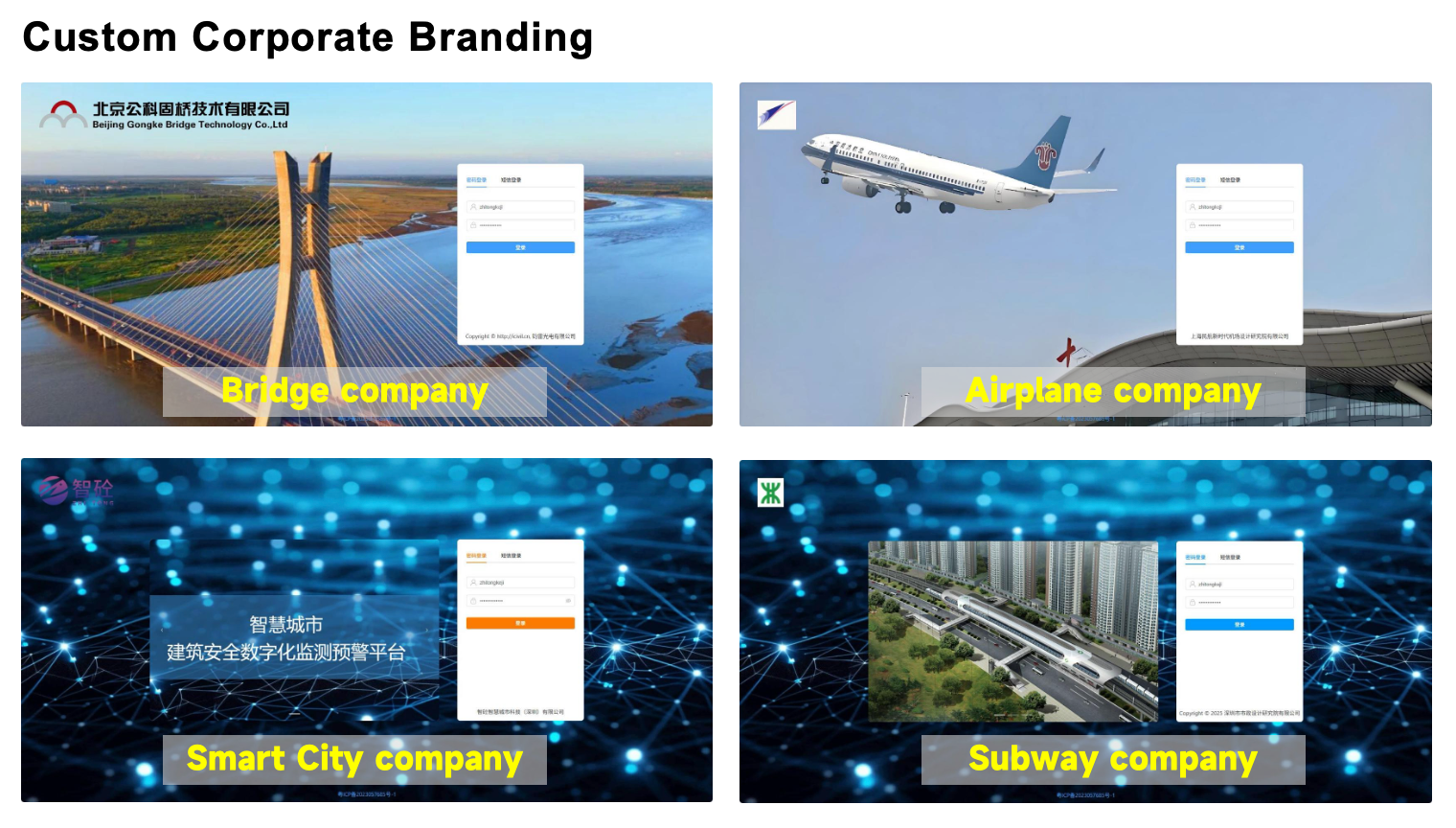
The platform is presented as the layer that converts readings into decisions: unified device access across protocols and brands; unified presentation and scheduled report generation; multi-level thresholds with SMS, email and application alerts plus linked snapshot capture; private deployment so data remains inside the client's network; remote configuration, over-the-air upgrade and online diagnosis; and an OpenAPI with brand customisation so the platform can report upward to a provincial regulator or an existing asset management system.
For a practitioner, three questions decide whether this is real or a slide. First, how a third-party sensor is onboarded — whether there is a documented device profile and a driver model, or a bespoke integration per device. Second, what the threshold engine supports — static values only, or rate-of-change, multi-parameter correlation and per-season variation. Third, what happens to the data at contract end, including the export format and whether the raw time series leaves with the client.
Application layer
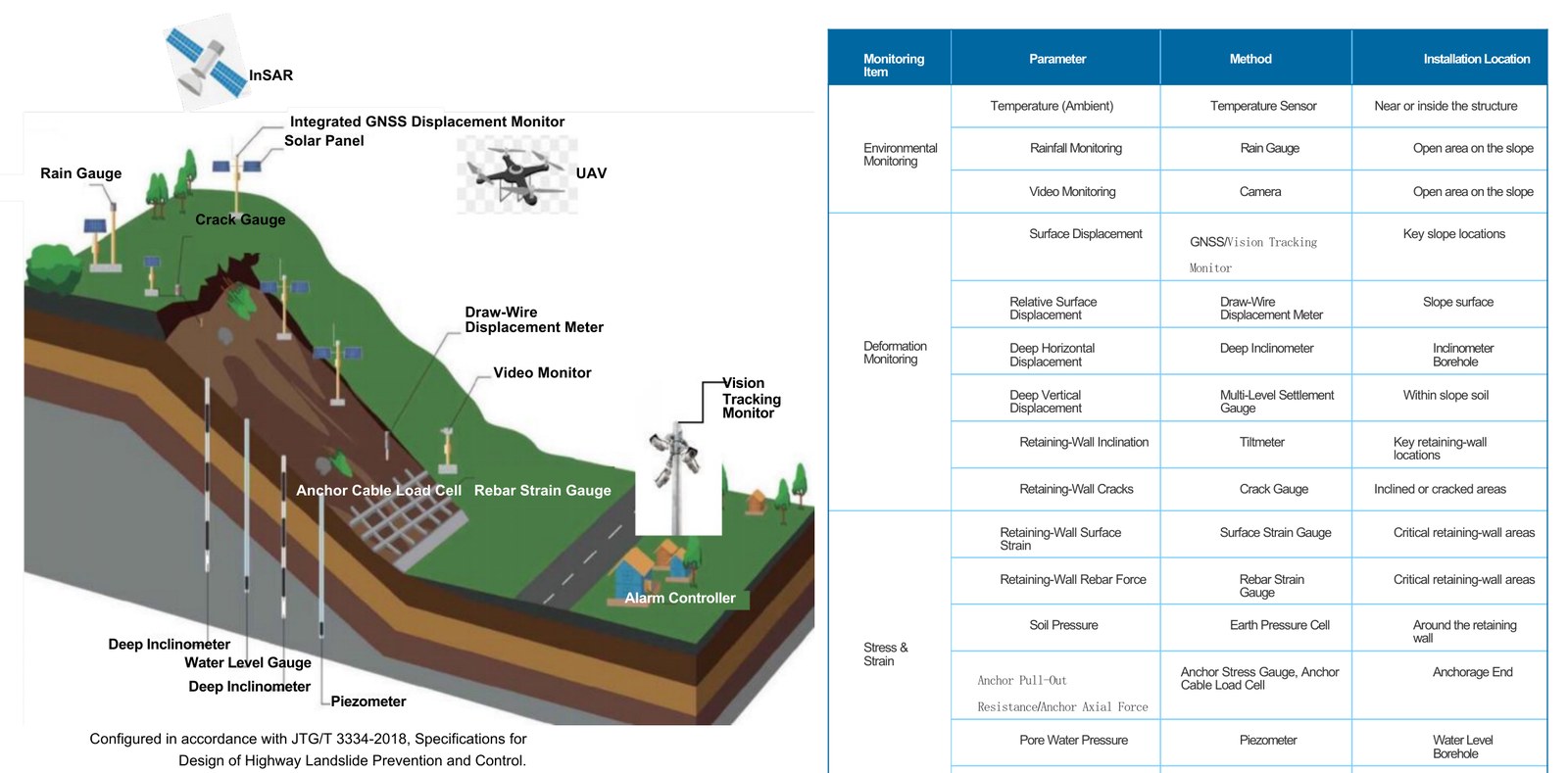
The platform is deployed across bridge, tunnel, slope, subgrade, foundation pit, reservoir and dam, and urban infrastructure monitoring. The parameter lists per asset class are the conventional ones, and the company publishes a slope scheme mapped to monitoring content, parameter, method and point location under the national highway landslide design specification — a useful artefact to compare against your own specification.
The contactless front end in detail
Three instruments carry the lightweight argument, and each has a measurement envelope that should be discussed on site rather than read from a brochure.
Laser settlement meter. Measures vertical settlement, horizontal displacement and inclination; specified at 0.3 mm precision; IP67; operating range -40 °C to 85 °C at 95 per cent relative humidity; communicates over 4G, BeiDou or LoRa. The company associates its development with a research programme of the national railway group, developed jointly with the operating company of the Beijing–Shanghai high-speed line, the railway design group and the railway research institute, and describes it as the first sub-millimetre settlement instrument in China. Note that the claims of primacy and of programme association are the company's own; the specified 0.3 mm precision is the number to design against.
Visual tracking instrument. Measures at 10 m to 1,000 m with precision between 0.1 mm and 5 mm depending on range; tracks more than a hundred passive targets simultaneously; IP67; -40 °C to 85 °C; 4G or 5G. The stated method is oblique-axis digital image correlation, which is what allows it to operate without a coaxial line of sight and to correct for environmental disturbance instead of assuming a clean measurement path. For a bridge or slope application the useful questions are how the camera network is calibrated, how target stability is maintained over years, what happens to the measurement when visibility drops or a vehicle obstructs a target, and how many targets can be lost before the configuration has to be re-surveyed.
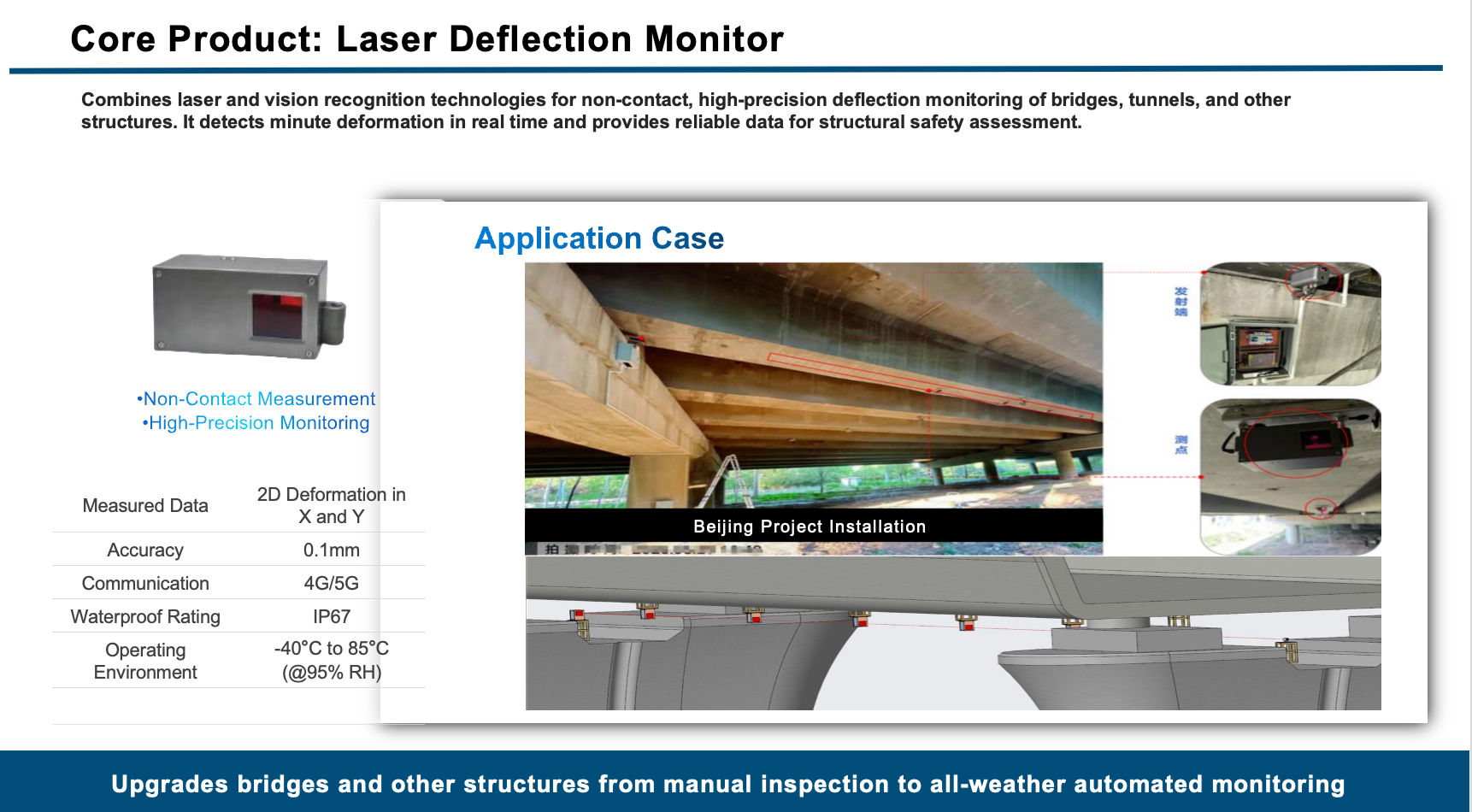
Laser deflection meter. Combines a laser with visual recognition to measure deflection of bridges and tunnels without contact, specified at 0.1 mm, IP67, -40 °C to 85 °C, 4G or 5G. The company's published framing is the shift from periodic manual inspection to continuous automatic measurement of the same quantity.
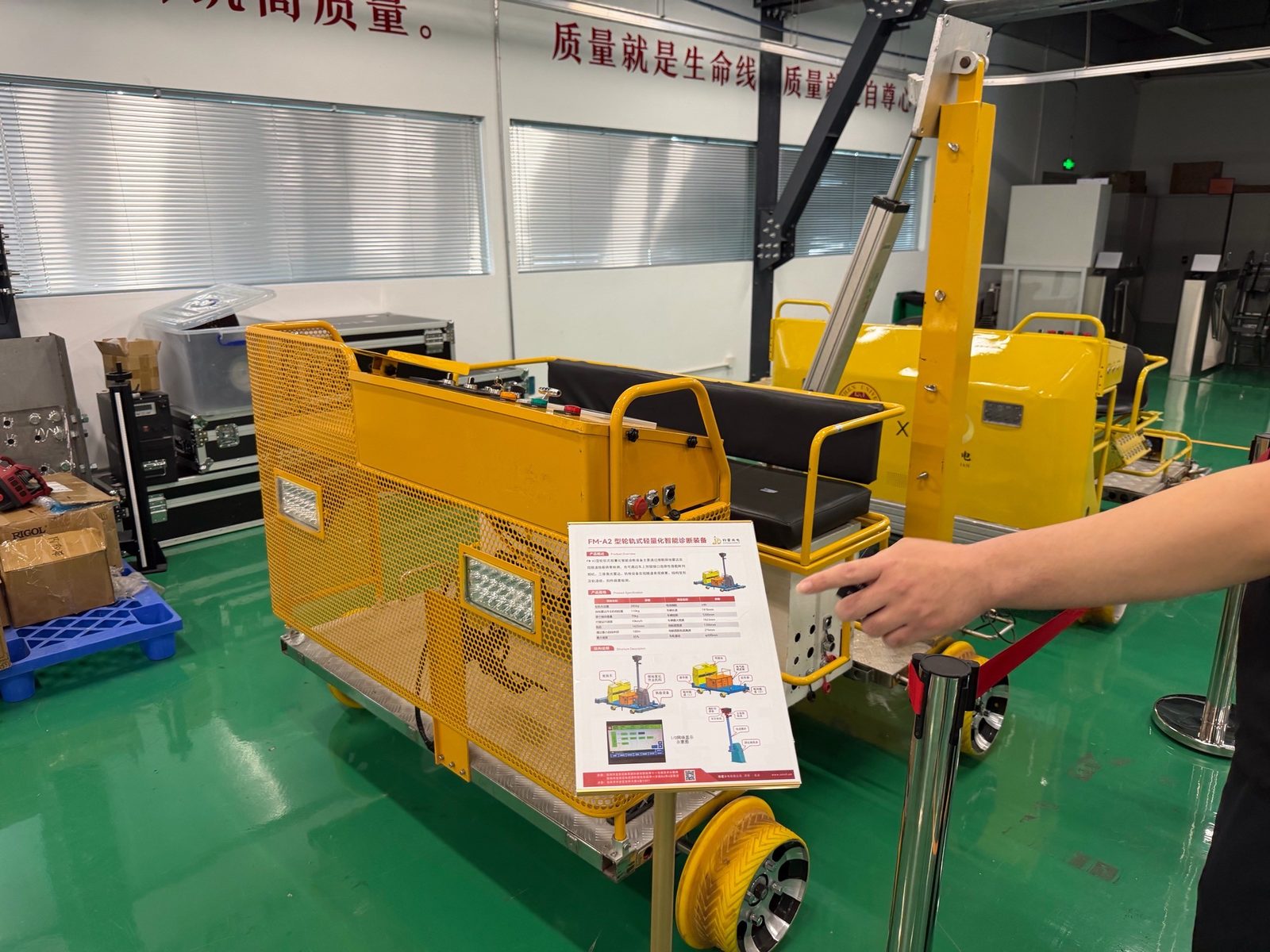
Two further devices complete the picture. The laser event camera is described as dormant at effectively zero standby power, triggering a high-resolution capture on an event and returning the deformation data alongside — the design case being a slope where continuous video is neither power-feasible nor useful, but the moment of failure is. The tunnel inspection vehicle integrates optical, acoustic and ground-penetrating radar equipment in a modular container to detect lining deformation, voids, cracks, water ingress and spalling, together with lining thickness and reinforcement cover; the published performance is 1 million points per second of point cloud at 2 mm ranging accuracy at 80 m for the laser module, better than 90 per cent recognition for the camera array, and 0.05 m vertical and 0.1 m horizontal resolution at more than 3 m depth for the array radar. The company presents it as a project under the 14th Five-Year Plan's competitive research programme.
Who specifies, who buys, who operates
Junlei's customer base is public infrastructure owners and their consultants: metro operating companies, expressway and highway maintenance units, high-speed railway bureaus, survey and design institutes, and municipal authorities for housing and construction, emergency management, transport and water. Stated sector coverage is railway, highway, municipal, metro and emergency response.
The procurement structure matters more than the list. A bridge group is bought by the road maintenance unit under a monitoring or safety programme, with a design institute specifying the scheme and the parameter list. A tunnel cluster is bought twice — by the construction project company during works, and by the operator afterwards. A slope is bought by whoever owns the road, sometimes triggered by an incident rather than a budget cycle. Because the design institute sets the parameter list, the specification relationship matters as much as the owner relationship, which is why the company publishes schemes mapped to national design specifications rather than to product families.
Two structural differences from most Western markets are worth stating plainly. In China this is predominantly a compliance and safety-accountability market rather than an insurance-driven one, so the requirement is written by engineers against standards. And because the buyer is a public body, the certification portfolio is part of the qualification rather than marketing: national high-tech enterprise status, a surveying and mapping qualification, GJB 9001C and ISO 9001 quality management certification, and a weapons-industry quality management certificate. For a foreign supplier or partner evaluating Junlei, that portfolio tells you which procurement regimes it is already able to enter.
Reference schemes
The portfolio covers bridge, tunnel, slope and building monitoring across more than twenty provincial-level regions, with 34 named entries in the company's performance table. Five are worth studying before arrival, because each addresses a different monitoring problem.
Bridge group, Shenyang–Haikou expressway: 29 bridges over about 69 km
The asset: about 69 km of expressway carrying 29 bridges of mixed type — continuous girder, steel box girder and others — selected for operational risk, heavy-cargo routing and impact exposure. The stated problems were mixed structural types across dispersed sites that manual inspection cannot cover at frequency, bearing displacement and vibration as hidden defects that are difficult to capture in real time, and the cost of inspection labour. The scheme combined video domes and snapshot cameras with visual displacement meters and inclinometers, added water level gauges for the flooding and impact cases, and reported into a visual warning platform with tiered alarm. Stated outcomes are full monitoring coverage of the group, alarm response inside five minutes, and annual labour cost reduction of about 400,000 yuan from reduced inspection frequency, with the stated purpose being a digital bridge file for the operating phase.
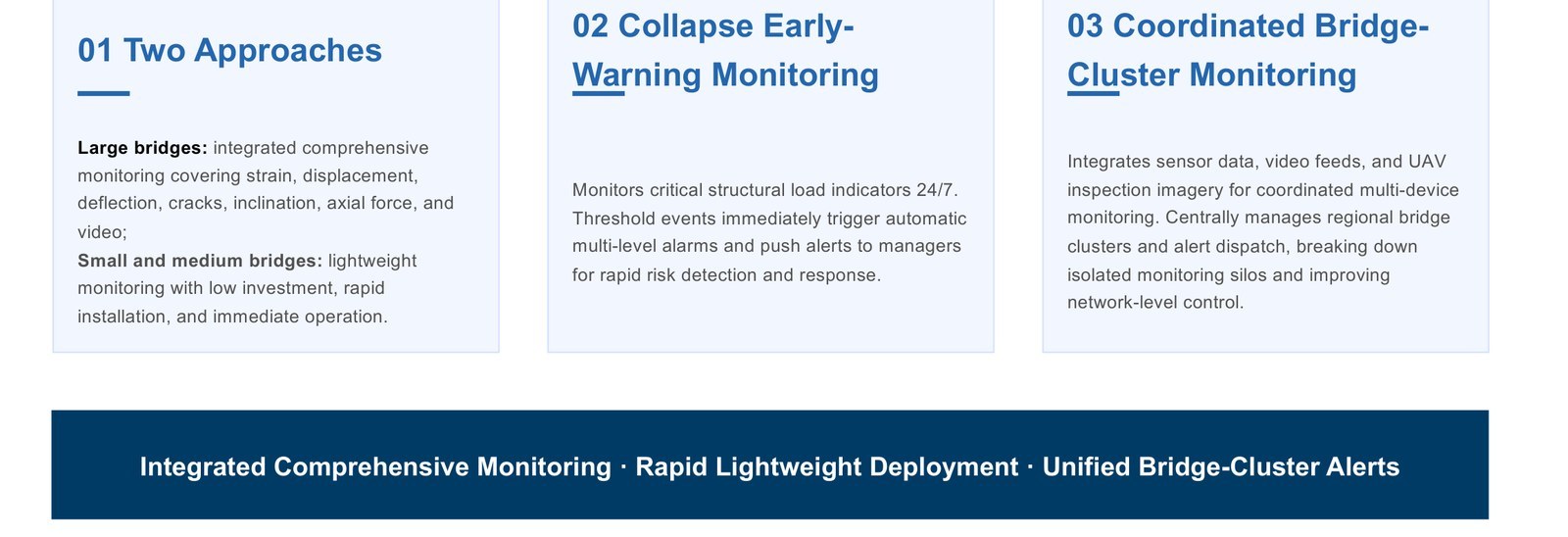
For a practitioner, the transferable element is the point-selection logic across 29 dissimilar structures — which parameters on which bridge type — more than the device list.
Bridge group, Jiaxing G525: contactless on a live national highway
About 3 km of mixed bridge types — arch, continuous girder, small box girder — on a national highway where contact installation was the specific obstacle: installation complexity and interference with running traffic. The scheme used visual tracking instruments and static level gauges on the sensing-transmission-platform build. Stated outcomes are a threefold efficiency gain and an 80 per cent cost reduction.
This is the case that makes the contactless argument concrete, because the objection it answers is operational rather than technical: you cannot close a live lane repeatedly to install and maintain instruments.
Bridge group, Ningbo section of the Yongtaiwen expressway: rapid deployment
Mixed bridge types including continuous girder and steel box girder on a mountain expressway section. The reference is presented as a rapid-deployment case with a ten-minute emergency response target, using video, water level and inclinometer devices with cloud warning and a linked sound-and-light alarm. Stated outcomes: 50 per cent faster deployment, response within ten minutes, 70 per cent lower labour cost, against conventional monitoring response measured in hours.
Tunnel cluster, Jiumian expressway: convergence without cabling
Tunnels along the Jiumian expressway in poor geological conditions with weak surrounding rock, where the risk is lining deformation and section convergence. The constraint that decides the scheme is the tunnel itself: long, enclosed, and hostile to cabling. The solution is contactless visual three-dimensional deformation monitoring, with targets surveyed and installed, data collected continuously, and deformation resolved to sub-millimetre level without instrumenting the lining at density. The stated effect is the shift from reactive to preventive management and a reduction in manual tunnel walk frequency.
Slope work: a note on siting
The slope references are of two kinds. The Wudangshan airport slope and the high slope on a Beijing national highway are presented as large-deformation, mm-level capture problems on terrain where manual inspection is itself hazardous. The Shenzhen Longgang Nanwan and Bao'an Rentian slope schemes are presented as device-linked, automatic hazard identification cases. The engineering point in all of them is the same one made earlier: the instrument sits outside the collapse footprint, in the stable zone, on a pole or an existing structure, so the station keeps reporting during the event. The company's slope scheme is mapped to the national highway landslide design specification, and the parameter set — surface and deep displacement, anchor force, earth pressure, groundwater level, rainfall, soil moisture — is the standard one.
What a visit covers
The programme is built around three things: the exhibition hall and production floor with the equipment running, a live demonstration of the instruments, and a working session with the engineers who deploy them.
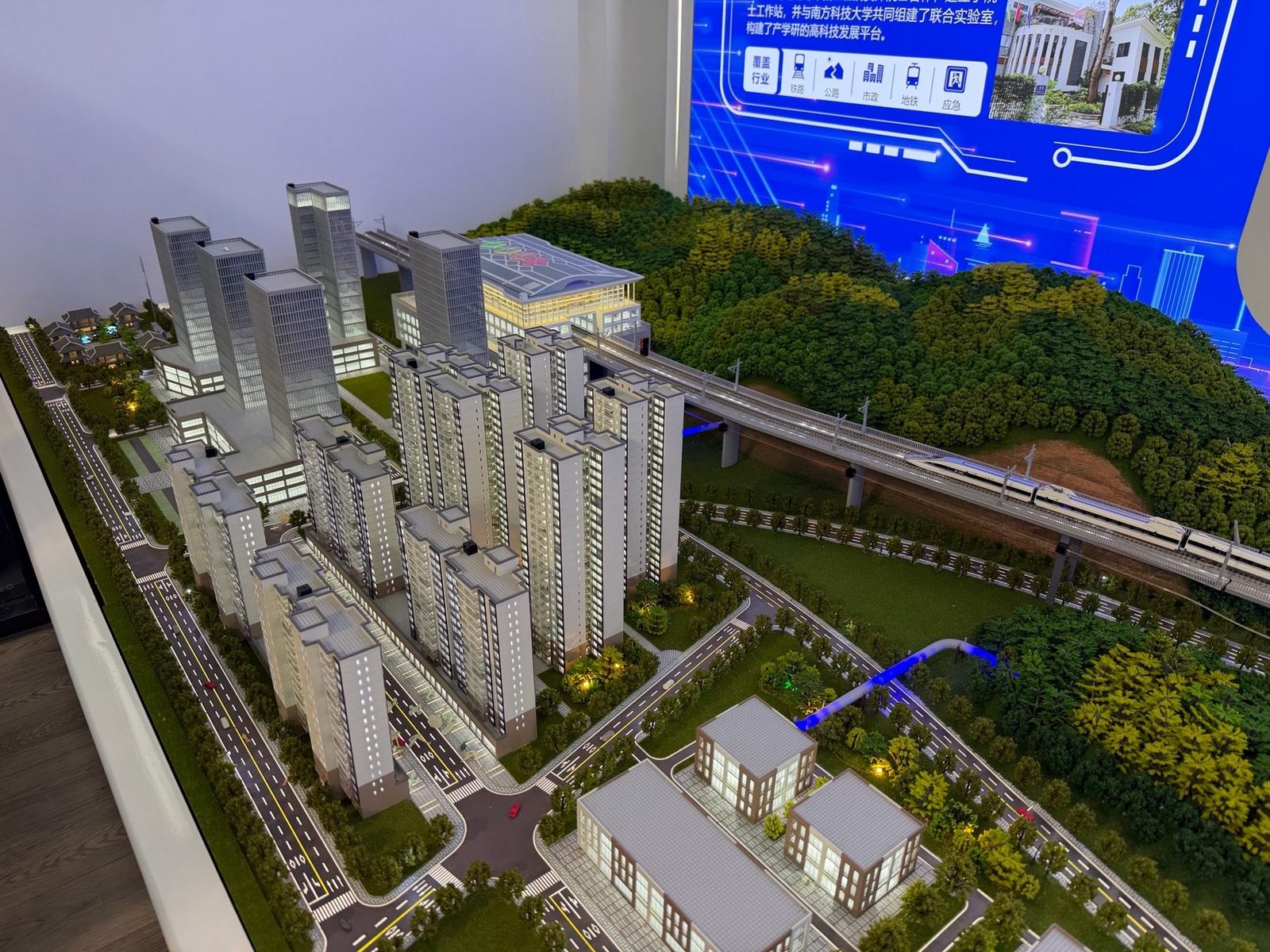
Sample visit programme
This is an indicative half-day engineering programme. The final arrangement depends on the group's technical objectives, the host's confirmation and the day's schedule.
| Segment | Time | What to expect |
|---|---|---|
| Arrival and executive welcome | 09:30–09:40 | Reception led by the chief executive and the chief technical expert, introductions of both teams, and confirmation of the technical agenda the group submitted in advance |
| Exhibition hall: architecture and product wall | 09:40–10:10 | The four-layer architecture read against your own asset classes, the full sensor range including both front ends, and the base station, node and repeater hardware with specifications |
| Production floor and live measurement demonstrations | 10:10–10:40 | Assembly and test areas, then the optical instruments running: settlement, visual tracking and deflection measurement, with readings live on the platform and the alarm chain triggered on request |
| Industry application session | 10:40–11:30 | Specification, procurement and operation of structural monitoring in China, worked through the reference schemes — point selection, parameter set, alarm tiering, inspection substitution and reporting obligations — led by the chief technical expert with the project team |
| Close and technical follow-up | 11:30–11:40 | Open questions with the chief executive and the technical team, and agreement on which documents and site data will be exchanged afterwards |
The programme runs about two hours. Timing within the segments flexes with the group; the sequence and the total are confirmed in writing during planning, before you commit.
Making the demonstration session count
The demonstrations are the reason to come rather than request a datasheet. Three things are worth arranging in advance.
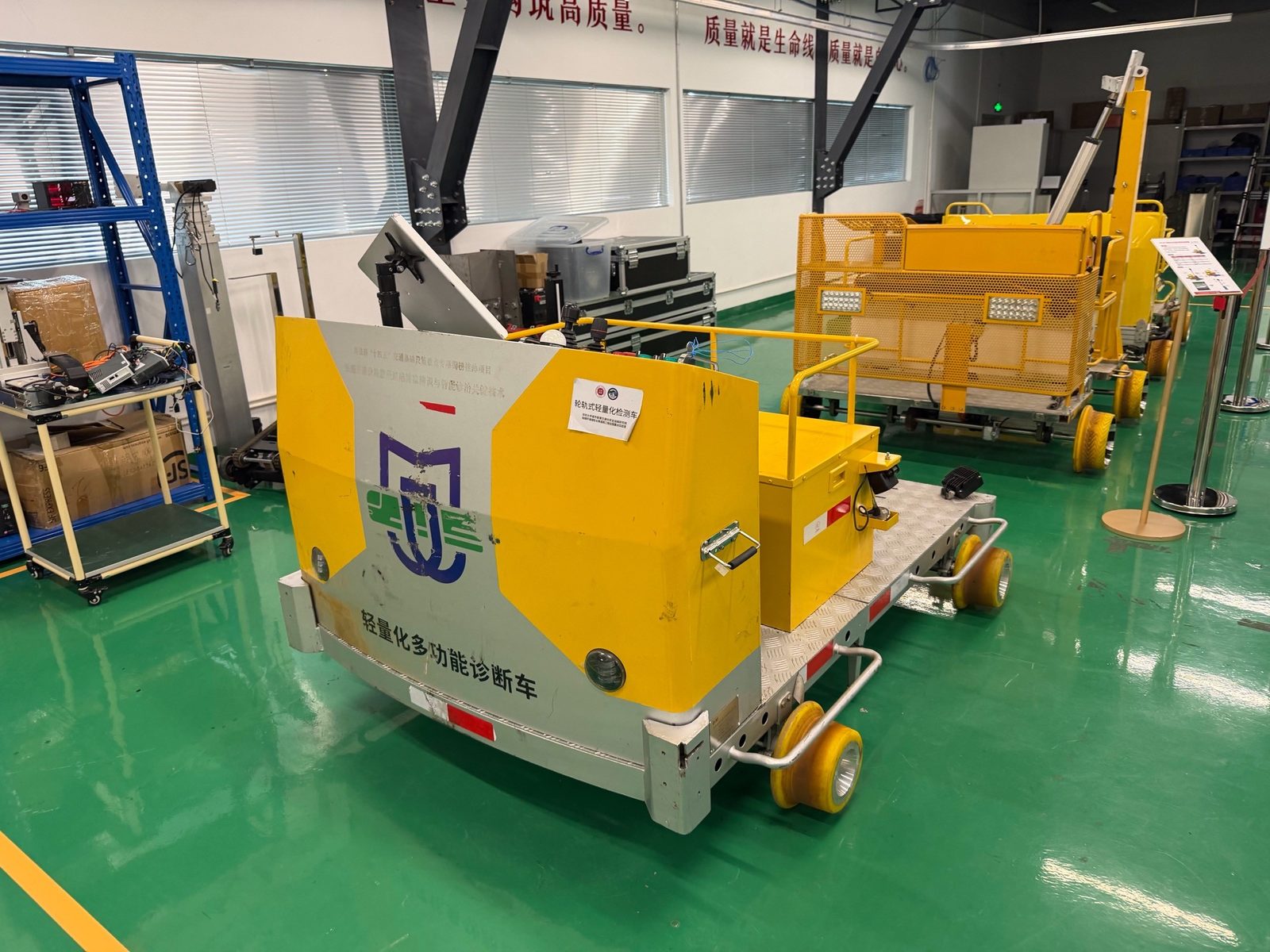
Ask for the alarm chain to be triggered in front of you, not described — a threshold breach driven through to the local sound-and-light output, with the cloud path shown alongside. The question to settle is what the station does when the public network is down, which is the difference between a monitoring system and a reporting system.
Ask for a target to be obstructed and for the reading to be watched while it is. Contactless measurement earns or loses its credibility in that minute, and the answer reveals how the algorithm handles occlusion, and whether the lost-data policy is documented.
Ask for the network plan for a site you nominate — a tunnel with a bend, a slope with a fold, a deck with a known obstruction — and how the 3.5 km figure survives it.
Making the application session count
The industry session is where the specification content sits. Lines of questioning that produce useful answers: which parameters a Chinese design institute writes into a specification for a given bridge type, and which are optional; the cost split between instruments, transmission and platform across a typical group-level scheme; how a monitoring service contract is structured, its term, and what the deliverable obligation is during that term; how the client's existing systems are integrated through the OpenAPI in practice; and what proportion of alarms are genuine against false, which is the number that decides whether an operator keeps trusting the system.
If the interest is partnership or market entry rather than procurement, ask where the company loses tenders and against whom. A supplier's account of its losses is the most efficient map of the market available.
Practical notes
The visit is a technical business programme and delegations are received as professional visitors under the host's rules. The site is a working research and production facility, so the route and the areas opened on the day are set by the host.
The delegation is received by the company's chief executive and chief technical expert. Both are named in the written programme issued before travel, and both attend the opening and closing sessions. The chief technical expert leads the technical segments; the project team joins the application session. If either is unavoidably absent on a confirmed date, we tell you before you travel rather than on arrival, and the replacement is confirmed to you in writing.
Foreign participants normally need to be registered with the host in advance, and the paperwork takes longer than for domestic visitors, so allow additional working days.
Provide the participant list, nationalities and technical focus early. The engineering depth of the session is adjusted to the group, and a delegation of bridge engineers will get a different session from one of asset owners or procurement leads. If the group has a specific structure in mind, send the structure type, span arrangement, known defects and monitoring objective in advance; the team can prepare a worked example.
Photography rules are confirmed in advance. Exhibition and production areas can carry client project material, so treat images as something to be agreed rather than assumed.
The site is in Bao'an district, in western Shenzhen, which pairs more naturally with other industrial visits in the same part of the city than with a Nanshan or Pingshan programme.
Smart casual is appropriate, and the programme involves walking through the exhibition hall and production areas with extended standing during the demonstrations.
English interpretation is provided, with preparation on structural monitoring terminology — settlement, deflection, convergence, inclinometer, extensometer, earth pressure cell, anchor load cell, digital image correlation, threshold tiering. Bilingual handouts and an English technical summary can be prepared on request.
Questions before a Junlei Optoelectronics visit in Shenzhen
Who receives the delegation? The programme is hosted by the chief executive and the chief technical expert, with the project team joining the application session. They are named in the written programme issued before travel.
Is the visit suitable for a technical delegation rather than a general business group? Yes, and it is better suited to one. The programme is built around the architecture, the instruments and the reference schemes, and the chief technical expert leads the technical segments.
Is the visit open to international business delegations? Yes, subject to advance arrangements and confirmation by the host. Registration of foreign participants takes extra time, so we recommend planning at least 30 days ahead.
What is the group size? Visits are normally arranged for groups of 10 or more. We confirm the practical maximum with the host for your date.
How long does the visit take? About two hours, split between the exhibition hall, the production floor with live demonstrations, and an application session with the chief technical expert and the engineering team. Technical discussion can be extended on request.
Where is the visit held? At the company's base in Bao'an district, Shenzhen. We confirm the meeting point and the exact building in writing after the host approves the booking.
What exactly does the system comprise? Two base layers and two front ends. The base layers are a self-developed full-duplex LoRa transmission network — multi-channel base station, data acquisition node, repeater — and a self-developed monitoring platform with private deployment and an OpenAPI. The front ends are a full range of conventional contact sensors covering environment, force and deformation, and a contactless optical family of laser settlement meter, visual tracking instrument and laser deflection meter. Robot and drone inspection systems are offered as independent lines reporting into the same platform.
What are the specified accuracies? The laser settlement meter is specified at 0.3 mm; the visual tracking instrument between 0.1 mm and 5 mm depending on distance over a 10 m to 1,000 m range; the laser deflection meter at 0.1 mm. Ask for the measurement conditions attached to each figure, and test them against your own site.
What is the transmission range and power budget? The base station is specified at 3.5 km range with 4G or LAN upstream and LoRa downstream, IP67, -35 °C to 70 °C at 95 per cent relative humidity; the data acquisition node at 56 μA sleep current and 1.5 km range; the repeater at 10 μA sleep current with a 1.5 km extension. Practical coverage is decided by the network plan for the site.
Can the alarm work without the cloud? The design routes a threshold breach to a local alarm channel and drives local output over RS485, relay or a wireless alarm device, with cloud synchronisation as a parallel path. The company quotes local linkage of about 0.1 to 0.3 seconds under near-field conditions. Ask to see it demonstrated with the network disconnected.
Who are the customers? Public infrastructure owners and their consultants: metro operating companies, expressway maintenance units, high-speed railway bureaus, survey and design institutes, and municipal housing, transport, water and emergency authorities.
Which reference schemes will be discussed? Among others, 29 bridges across about 69 km of the Shenyang–Haikou expressway, the Jiaxing G525 mixed bridge group, the bridge group on the Ningbo section of the Yongtaiwen expressway, a tunnel cluster on the Jiumian expressway, and slope work including an airport slope in Wudangshan and a high slope on a Beijing national highway.
Can we bring our own case? Yes, and it materially improves the session. Send the structure type, the monitoring objective and any known defects in advance so the team can prepare an analogous scheme.
Does the programme always run as described? It is built around the elements above. The areas opened on the day are subject to what the site opens, and we confirm the final scope in writing during planning, before you commit.
This visit is arranged on request and is subject to the host's confirmation. Itineraries, opening areas and the availability of specific equipment can change as a result of site operations, and the final programme is confirmed in writing before travel.
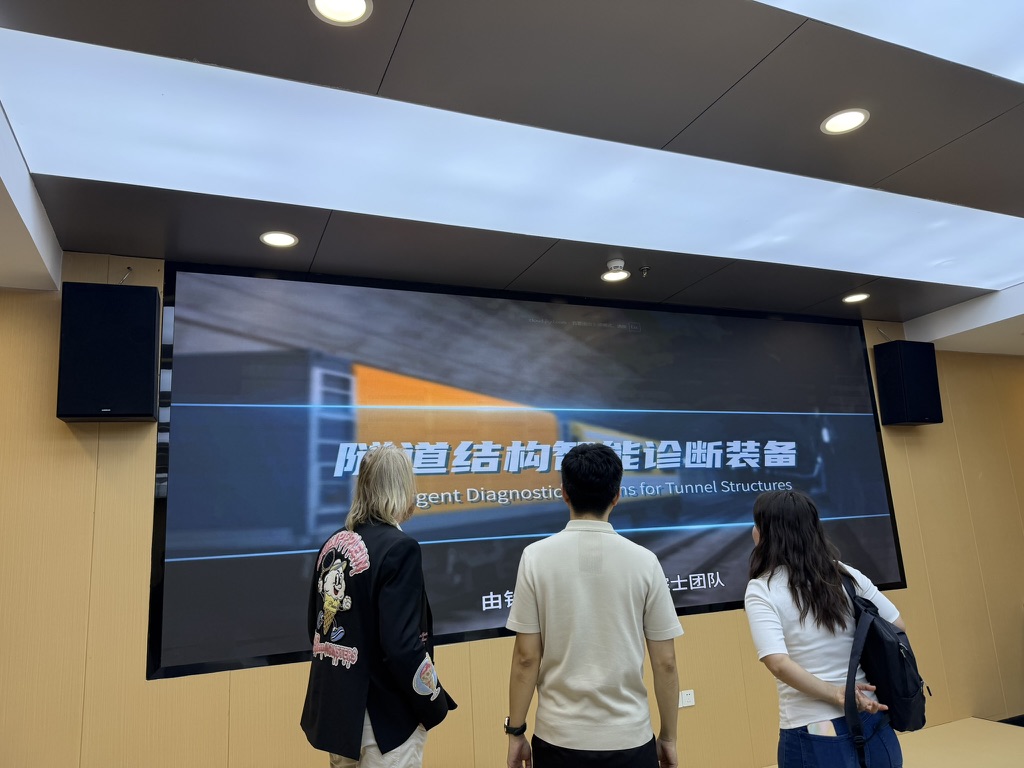
Arrange your Junlei Optoelectronics visit
Tell us your dates, group size and the technical questions the delegation is bringing: the transmission and platform architecture, the contactless measurement envelope and its limits, point selection and alarm tiering for a structure population, the specification and procurement route in China, or a partnership assessment. The programme is hosted by the company's chief executive and chief technical expert. China Innovation Visits will coordinate the company reception, the technical agenda, transport and English interpretation.
Contact China Innovation Visits to arrange your Junlei Optoelectronics visit in Shenzhen.