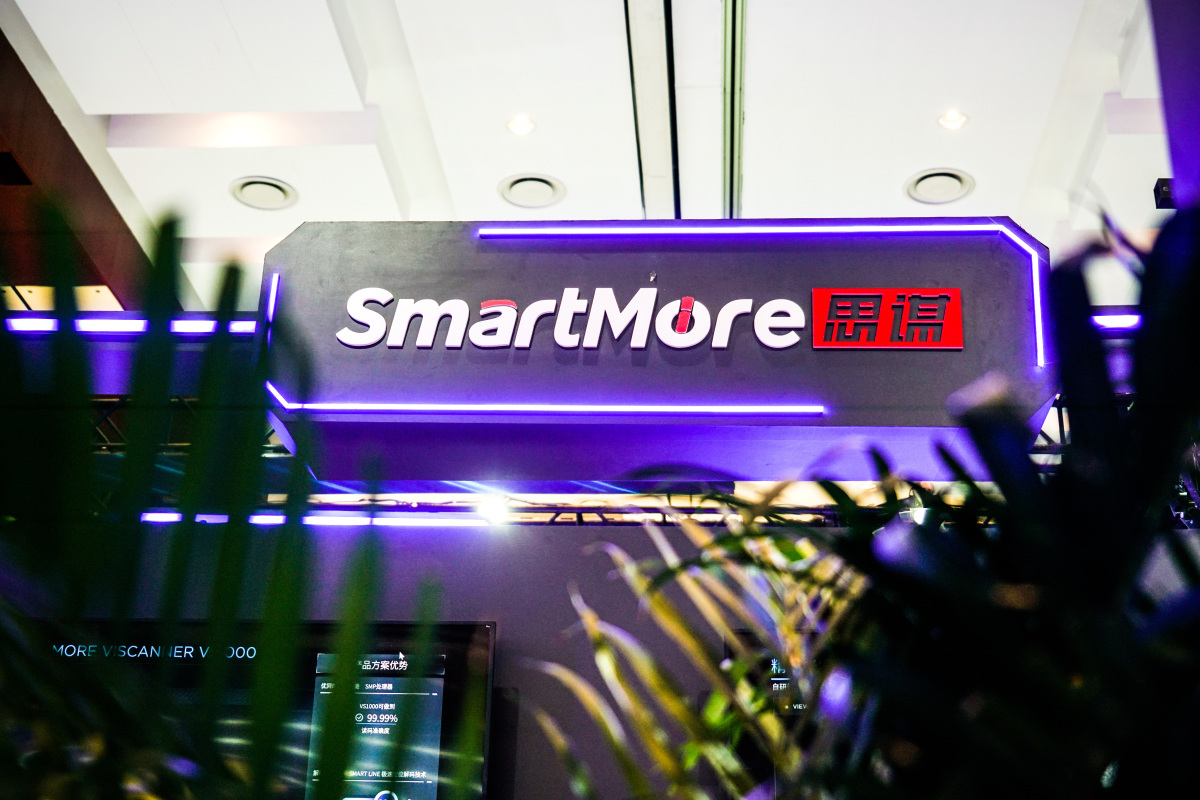
China Innovation Visits arranges showroom visits to SmartMore, the Shenzhen industrial-AI company, for organised business and institutional groups. The ideal group size is 10–20. Programmes are priced for groups, and larger groups are usually more cost-effective; individuals and smaller groups are welcome to inquire, and their per-person rate is higher than the group rate. The visit is based in the company's front-of-house exhibition space in Qianhai, where the multi-axis optical inspection machine and the IndustryGPT-driven robotic arm run live demonstrations. It does not include a production floor or a manufacturing site. Access, dates and the seated session depend on the host's approval. Contact us with your group size, dates and learning goals to check feasibility and receive a proposed itinerary.
Key takeaways
SmartMore builds industrial AI agents rather than general-purpose software. Its business is the equipment and models that let a machine inspect a part, read a code or move an object on a production line without a person deciding each action.
The visit is a demonstration-centre programme. Groups see the hardware and the models working in a showroom setting, then sit down with the company to discuss what deployment actually involves. There is no factory tour and no line walk.
The commercial case is large and recent: the company reported revenue of RMB 1.086 billion for 2025, with 78.5 percent of it from industrial AI agents, and about 140,000 agents delivered by the end of that year.
SmartMore filed with the Hong Kong Stock Exchange in March 2026. As of October 2026 the application is still being processed, so any delegation preparing a supplier case should read the prospectus figures as filed disclosure rather than as an audited listed-company record.
We arrange the programme end to end, including host introduction, scheduling on the Chinese side and English interpretation on site.
Key visit details
Where the visit is held
Location — the company's Shenzhen base in the Qianhai Shenzhen-Hong Kong Modern Service Industry Cooperation Zone. SmartMore's registered Shenzhen address is in the Qianhai Kerry Centre complex, and the visit is hosted in the exhibition area there. The host confirms the exact floor and the meeting room when a date is agreed.
Getting there — Qianhai sits on the western edge of Shenzhen, roughly 30 to 45 minutes by road from Futian and about 45 to 60 minutes from Shenzhen Bao'an International Airport. We plan transport as part of the programme, including hotel pickup.
What it is not — this is not the company's manufacturing site. SmartMore operates production and laboratory facilities elsewhere in Shenzhen; those are not part of this programme, and we do not offer a line walk. Groups that need to see equipment being built should say so before we quote, because the answer is no rather than a later upgrade.
Format and duration
Duration — half a day is the standard format: roughly two hours on site, split between the demonstration walk and a seated session. A shorter 90-minute version is possible for groups with a tight schedule.
Format — a guided walk through the exhibition area with live equipment demonstrations, followed by a presentation and open discussion with SmartMore staff. The seated session is where most of the value sits for senior groups, so we do not compress it unless asked.
Who the programme suits
Best suited to — manufacturing and quality leaders from consumer electronics, automotive, new energy and precision engineering; automation and machine-vision integrators; industrial software and AI product teams; investors and analysts covering industrial AI; and delegations studying how Chinese AI companies convert research into paid industrial deployment.
Main themes — industrial multimodal models, defect detection and optical metrology, barcode and traceability, the gap between a demonstration and a paid line installation, and what a customer has to change internally for the technology to hold.
Booking, group size and site rules
Booking — around 21 to 30 days in advance is the practical lead time. Corporate visits normally need a participant list submitted ahead of time, and the host decides what is confirmed. Dates and the composition of the session are confirmed case by case.
Visiting requirements — the exhibition area is a normal commercial space, so there are no protective-equipment requirements. Photography is subject to the host's rules on the day, and we confirm what is and is not permitted before you travel. Some demonstration equipment is brought in for the visit rather than permanently installed, so the exact line-up is confirmed with the host rather than promised in advance.
What SmartMore is, and what it builds
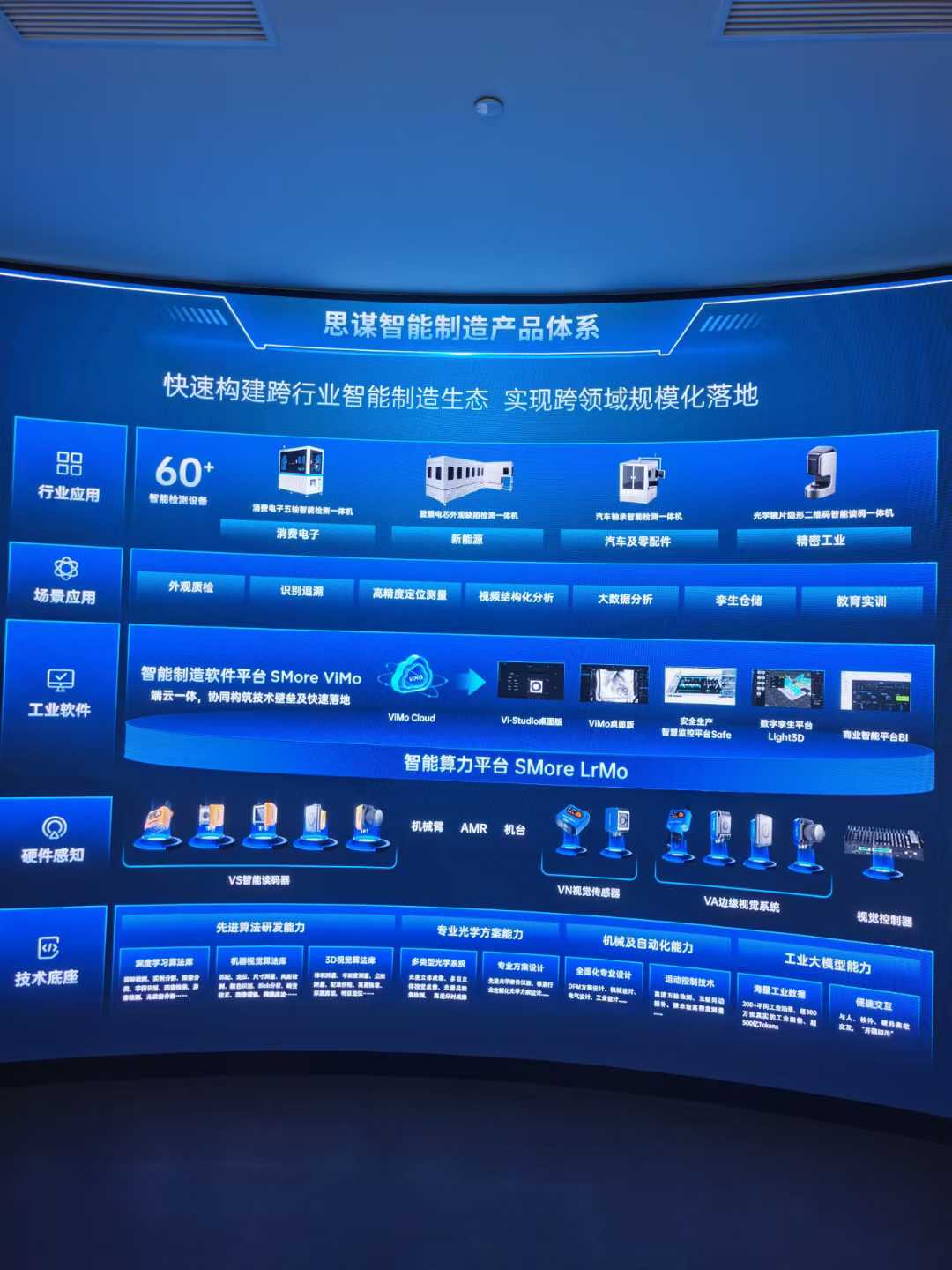
SmartMore was founded in December 2019 by Jia Jiaya, a professor at the Chinese University of Hong Kong and an IEEE Fellow working in computer vision. The company describes itself as an industrial AI agent company and builds three product lines: robots and inspection equipment, edge AI sensors, and agent software systems.
The core asset is IndustryGPT, which the company describes as the first proprietary industrial multimodal model. The claim that matters for a visiting delegation is narrower than the marketing line: the model is trained and tuned for industrial inspection and manipulation tasks, and it is paired with SmartMore's own optical, mechanical and software engineering rather than sold as a standalone API.
The hardware line-up is concrete enough to inspect. The company sells fixed-mount and handheld barcode readers, vision sensors and vision controllers, and integrated inspection equipment built around a five-axis platform; its published engineering materials describe non-standard automation equipment on a 45 to 60 day delivery cycle and standard equipment at about 30 days. On the software side it sells ViMo, which it describes as an industrial AI vision agent platform, together with a cloud service, a deep-learning training tool and a precision measurement package.
On scale, the company's published figures are that it serves more than 730 customers worldwide and had delivered about 140,000 industrial AI agents by the end of 2025, with its robots having completed more than 1.7 billion product or component inspections. It reports more than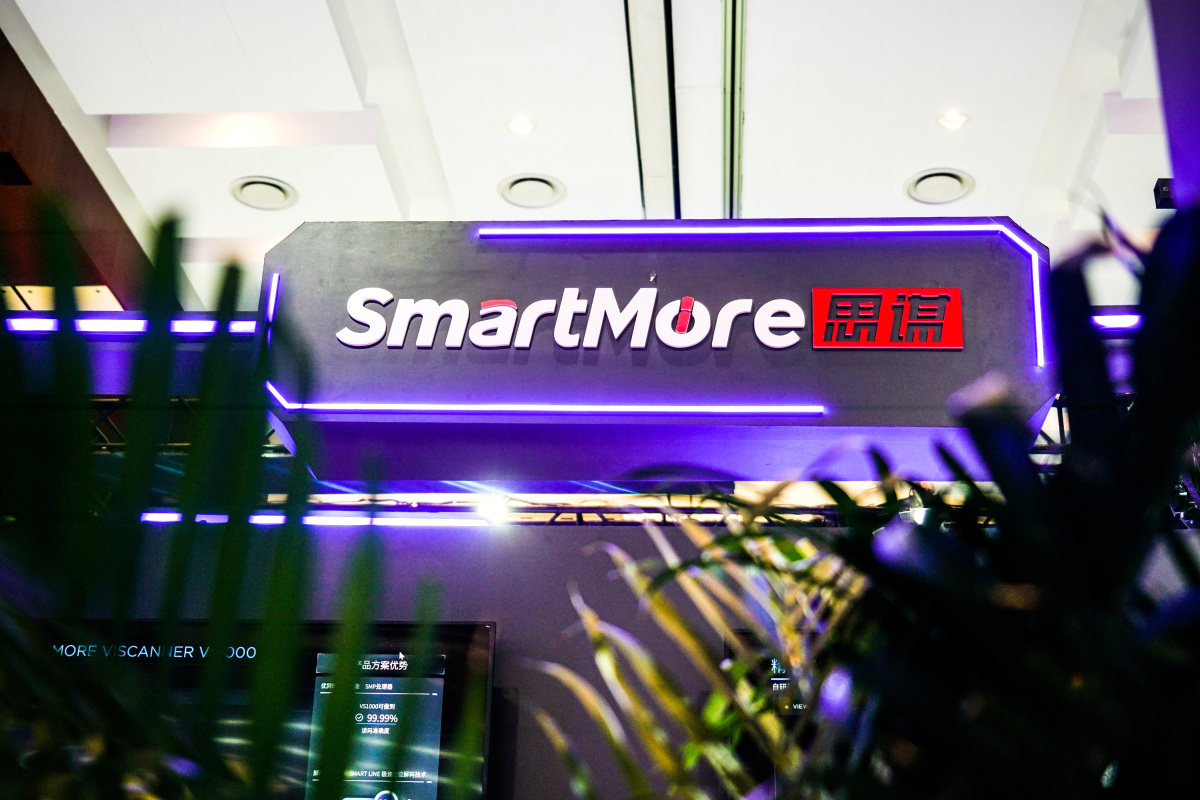 700 patent applications worldwide and more than 365 granted patents, including around 20 PCT filings.
The financial picture is the part a procurement or investment delegation should read carefully. Revenue was RMB 484.9 million in 2023, RMB 755.8 million in 2024 and RMB 1,086.3 million in 2025, growth of 55.9 percent then 43.7 percent. Agent revenue took 62.4 percent of the total in 2023, rising to 73.8 percent in 2024 and 78.5 percent in 2025, with AI infrastructure and other services making up the balance. In 2025 that agent revenue split into roughly RMB 436 million from robots, RMB 342 million from agent software systems and RMB 75 million from edge AI sensors. The company has been loss-making throughout: net losses were RMB 546 million, RMB 735 million and RMB 991 million across the same period.
Those figures come from the listing application SmartMore filed with the Hong Kong Stock Exchange on 16 March 2026, with China International Capital Corporation, Morgan Stanley and Deutsche Bank as joint sponsors. The application was still shown as being processed on the exchange's disclosure site in mid-October 2026. It had not been through a hearing and the company was not listed. Treat the numbers as filed disclosure from an applicant, and check the latest filing before you rely on them in a paper.
Customers named in the filing include Tesla, Carl Zeiss, Luxshare Precision, Goertek, BOE, CRRC, CALB and Kedali. Earlier company materials, from 2021 to 2024, named a different set including Airbus, Bosch, Canon, Continental, Schaeffler, Procter & Gamble and Unilever. Both lists are the company's own; we have not independently verified either, and the older list reflects a period when the stated customer count was 100 to 200 rather than 730.
Inside the exhibition area
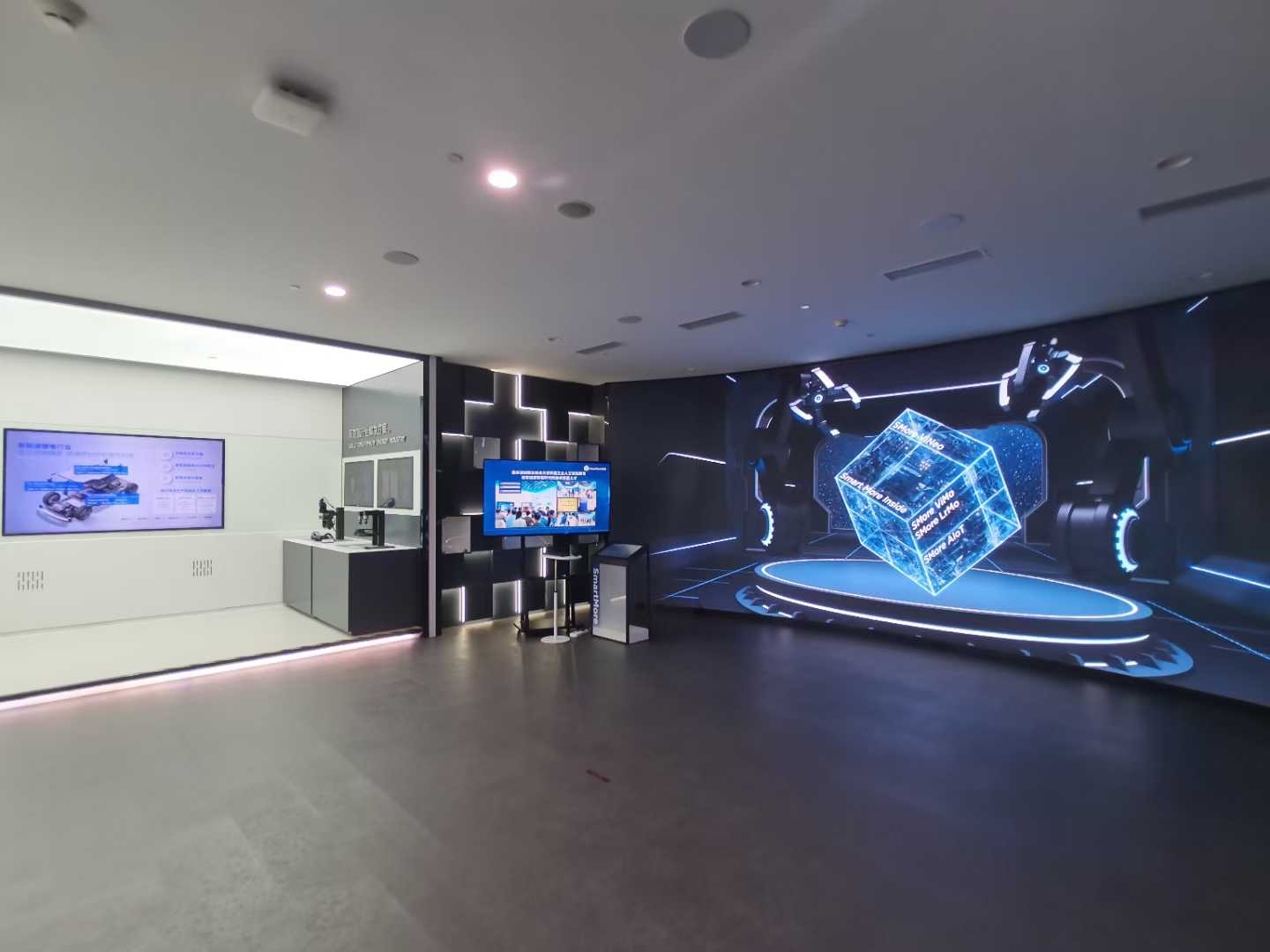
SmartMore's public materials and the accounts of previous visiting delegations describe a front-of-house exhibition space organised around four demonstration zones. The route below follows the order hosts have used. It is a showroom sequence, not a production sequence, and the specific machines on show are confirmed with the host before a visit.
The first zone is the industrial AI "super-brain" display, which is where the company explains IndustryGPT. The useful part for a technical group is not the model card but the demonstration of the loop: a camera captures an image, the model reasons about what is wrong with it, and an actuator acts. SmartMore frames this as machines moving from seeing to deciding to doing, and the display is built to show those three steps as one motion rather than three products.
The second zone is the sensor display. Fixed barcode readers, handheld readers, vision sensors and controllers are laid out by application rather than by part number, which is the practical way to read the line-up: what reads a code on a curved reflective surface, what survives a fast moving line, and where a controller is still needed at all.
The third zone is the multi-axis inspection machine, which is the demonstration most groups remember. The company's five-axis all-inspection platform rotates and tilts a part through a full optical pass, and SmartMore's published figures claim a complete 360-degree surface check of multiple small parts within a couple of seconds. The engineering behind it is described in the company's own technical pages: high-speed five-axis motion control with simultaneous interpolation, and a micron-level measurement platform. For a quality team, the question worth asking on site is not the cycle time but the false-call rate and how a new part is taught.
The fourth zone is the industrial reference-application display, which walks through deployments by sector. SmartMore publishes work across consumer electronics, semiconductors, new energy, automotive and rail transit. One case the company describes in detail is the optical one: identifying a concealed code on an ophthalmic lens for traceability, which it says it solved with a faceted micro-diamond reflective film and matching algorithms. Another is a vision inference platform running multiple inspection tasks across a large appliance manufacturer's plants.
The seated session follows the walk. In previous visits the company has presented its full-stack position, its product system and its industry coverage, then taken questions. For most delegations that discussion is the reason to come: a showroom shows that the technology works, and the discussion is where a buyer finds out what it costs to make it work in their own plant.
What different teams take away
Manufacturing and quality leaders tend to leave with three questions sharpened rather than answered: what the defect taxonomy has to look like before a model can be trained, how much of the inspection knowledge sits with the supplier versus their own process engineers, and what the real cost per inspection is once teaching, re-tuning and line integration are counted.
Technical and automation teams focus on the machine and the model together — the five-axis platform, the sensor line-up, and the question of where the model ends and conventional machine vision begins. It is a good room for that argument because both halves are on the floor.
Investors and analysts get an unusual combination: a demonstration centre and a filed prospectus. The interesting question is not whether the technology works, but what the 78.5 percent agent-revenue share and the persistent losses say about how much of the business is recurring software and how much is equipment.
Teams studying industrial AI translation — from research group to paid line — use the visit to look at the commercial mechanism rather than the technology: how a vision lab's output becomes a product with a delivery cycle, and how a company with a 2019 founding date got to 730 named customers.
Groups from outside manufacturing — retail, logistics, public sector — find less here. The demonstrations are production-line problems, and a delegation without an inspection or manipulation problem will spend the seated session on questions the host cannot make concrete.
Sample visit programme
This is an indicative half-day programme. The final arrangement depends on the group's objectives, the host's confirmation and the day's schedule.
| Segment | Time | What to expect |
|---|---|---|
| Arrival, check-in and pre-visit briefing | 09:00–09:15 | Meet at the Qianhai building's lobby and enter as a group. A short orientation on SmartMore and on what the group will see, with photography rules for the exhibition area confirmed. |
| Guided visit to the exhibition area — models and sensors | 09:15–09:50 | The industrial AI display explaining IndustryGPT and the see–decide–act loop, then the sensor zone: barcode readers, vision sensors and controllers laid out by application. |
| Guided visit to the exhibition area — inspection equipment and reference applications | 09:50–10:30 | The multi-axis inspection platform running a full-surface optical pass on small parts, and the reference-application display covering consumer electronics, semiconductors, new energy, automotive and rail transit deployments. |
| Themed session and open discussion | 10:30–11:45 | "Industrial AI from demonstration to paid line" — the model and hardware stack, the delivery model, and what a customer has to change internally — presented by SmartMore staff, followed by Q&A. |
| Close and departure | 11:45–12:00 | Wrap-up, and a short window for individual follow-up questions before the group leaves. |
The timings and programme are subject to final confirmation with the host.
Practical notes for the day
The visit is indoors and largely standing, with a seated session at the end. It is a normal commercial building, so the practical burden is light compared with a plant visit.
The exhibition area is used for customer demonstrations and internal meetings, which means the equipment on show can change between one group and the next. We confirm the demonstration line-up with the host before you travel and tell you if something you specifically asked for will not be available, rather than let you find out on the day.
Cameras and recording follow the host's rules. Parts of the display may include customer product samples or unreleased equipment, and the rules are set by SmartMore rather than by us.
The morning finishes before midday, which leaves the afternoon free. Qianhai is close to the wider Shenzhen technology corridor, so the visit pairs naturally with a second half-day programme — see the Shenzhen tech tour page for what else we run in the city.
Questions before a SmartMore visit
Is this a factory visit? No. This is a showroom and demonstration-centre programme in Qianhai. The company's production and laboratory facilities elsewhere in Shenzhen are not part of the visit, and we do not offer a line walk for this company. If your group's purpose is to see equipment being manufactured, tell us and we will point you to programmes where that is what actually happens.
What do we actually see? The industrial AI display explaining IndustryGPT and the see–decide–act loop, the sensor zone with barcode readers, vision sensors and controllers, the multi-axis inspection platform running a full-surface optical pass, and the industrial reference-application display. The route follows the product logic rather than a production flow.
How far in advance should we arrange it? We recommend planning at least 21 to 30 days ahead, and our arrangements are normally built around groups of 10 or more, which is the size most corporate hosts are set up to receive. Smaller groups can sometimes be accommodated — tell us your numbers and we will confirm what is possible.
Do we need to work in manufacturing? It helps. The demonstrations are inspection and manipulation problems, and groups without a production or quality function usually get more from a different programme in the city.
Is English interpretation provided? Yes. English interpretation on site is part of how the programme is run, including during the demonstration walk and the seated session.
Can we talk to a technical person rather than a sales person? That is the request worth making early. The host decides who presents, and for a technical delegation we ask for engineering rather than commercial staff. We confirm who will be in the room before the date is locked.
Is the company listed? Not yet. SmartMore filed a listing application with the Hong Kong Stock Exchange on 16 March 2026 and the application was still being processed in October 2026. Financial figures on this page come from that filing and should be treated as applicant disclosure.
The programme is built around the host's availability and the exhibition schedule, and the visiting terms above reflect how the company normally receives groups. Where a delegation's requirements fall outside that, we will tell you so before you commit rather than after.
Arranging your SmartMore visit in Shenzhen
We arrange the visit for you end to end: the introduction to the host, the scheduling on the Chinese side and English interpretation on site. Tell us your dates, your delegation size and what you want to see, and we will confirm what can be arranged. Start at chinatechvisits.com/company-visits, or browse the full company visit directory for the rest of the network.
Visits are arranged for organised business, institutional and association groups. The programme is not open to the public and is not a substitute for SmartMore's own customer demonstration process, which runs on the company's terms and for its own commercial purposes.