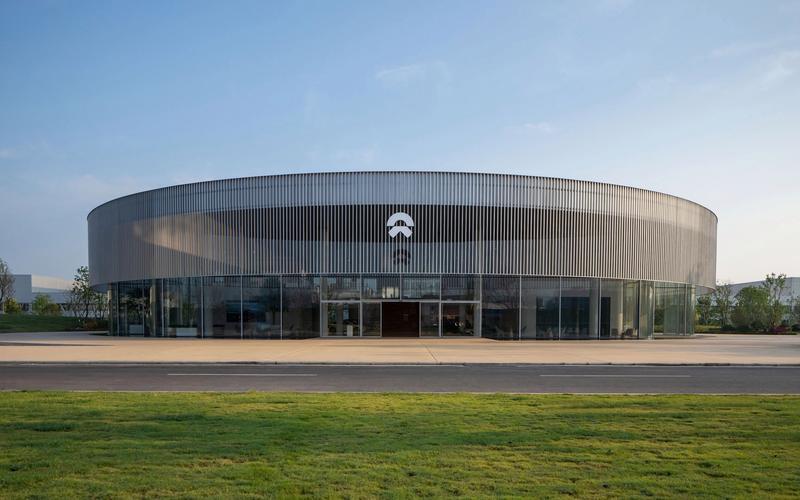
NIO built its reputation on an unlikely idea: that a Chinese car company could sell at a premium and still be chosen over established European rivals. What makes that credible to a visiting team is not the showroom but the industrial estate north of central Hefei, where one campus holds stamping, body, paint, final assembly and electric drive under a single roof – a plant recognised by the World Economic Forum as a Lighthouse Factory.
A NIO visit in Hefei is not a marketing tour. It is a look at how a company with a decade of history turned vertical integration into a manufacturing advantage, and how it built one of the world's largest battery-swap networks.
This article sets out what the campus contains, what to look at during the walkthrough, what a day covers and how to arrange access, for manufacturing, supply chain, engineering and investment visitors.
Key takeaways
- The Qiao F2 plant holds World Economic Forum Lighthouse Factory status, a designation for the adoption of Fourth Industrial Revolution technology at scale.
- The industrial park covers 11.3 square kilometres, with planned annual capacity of one million vehicles and 100 GWh of battery production.
- Cumulative vehicle production passed one million units in early January 2026, eleven years after the company was founded.
- Full-stack self-development covers the vehicle platform, electric drive, battery pack, the 5-nanometre Shenji NX9031 assisted-driving chip, the vehicle operating system and the TianGong manufacturing system.
- Battery swapping takes about three minutes, and the global network reached 3,737 swap stations and 4,877 charging stations by the end of 2025.
Why visit NIO in Hefei?
Most factory tours show a single process; a NIO visit shows a stack. The group sees the product in a brand space, then the body shop and final assembly areas behind it, then spends the afternoon on the in-house chips, operating system, electric drive platform and manufacturing software NIO chose to build rather than buy. The sequence matters: the argument about premium positioning holds together only when a visitor can trace it from component to vehicle.
The Lighthouse Factory designation is the second reason. The plant was recognised for a digital twin platform that links development, procurement, manufacturing and quality control into a closed loop. What visitors can discuss with the host is how a line supporting more than 3.6 million configuration combinations still runs at volume, and what that demands of scheduling, logistics and quality.
The third reason is the energy network. NIO built battery swapping at commercial scale rather than treating charging as a third-party problem, and cumulative swaps have passed 100 million, on 18 billion yuan of infrastructure investment. Whether or not a visitor's own market can support swap stations, the model changes how a car company thinks about customer relationships and asset ownership.
Hefei itself is the fourth reason. The city has assembled an unusually dense cluster of electric vehicle, battery, display and solar manufacturers within a short drive of one another. A two- or three-day programme that adds a battery maker and a power electronics maker is more valuable than a single visit, because the comparison is where the insight comes from.
Company background
A premium group listed in three venues
NIO is a premium electric vehicle company listed in three venues: the New York Stock Exchange, the Hong Kong Stock Exchange and the Singapore Exchange. Its China headquarters sits in the New Qiao smart electric vehicle industrial park in Hefei, known as NeoPark.
Three brands and the one-million mark
The portfolio covers three brands: NIO remains the premium line, ONVO (Ledao in Chinese) addresses the family market and Firefly covers the compact urban segment. Cumulative vehicle production passed one million units in early January 2026, eleven years after the company began. In 2025 NIO delivered 326,028 vehicles, up 46.9 per cent, on revenue of 87.49 billion yuan, up 33.1 per cent. Cumulative research and development spending has exceeded 65 billion yuan, and the patent portfolio stands at more than 9,600 filings.
The park as an operating system
The industrial park covers 11.3 square kilometres, with planned annual capacity of one million vehicles and 100 GWh of battery production. NIO describes it as a jointly developed cluster rather than a single factory, bringing vehicle assembly, core component suppliers and energy infrastructure into one geography.
Inside Qiao F2: what to look for
Five processes under one roof
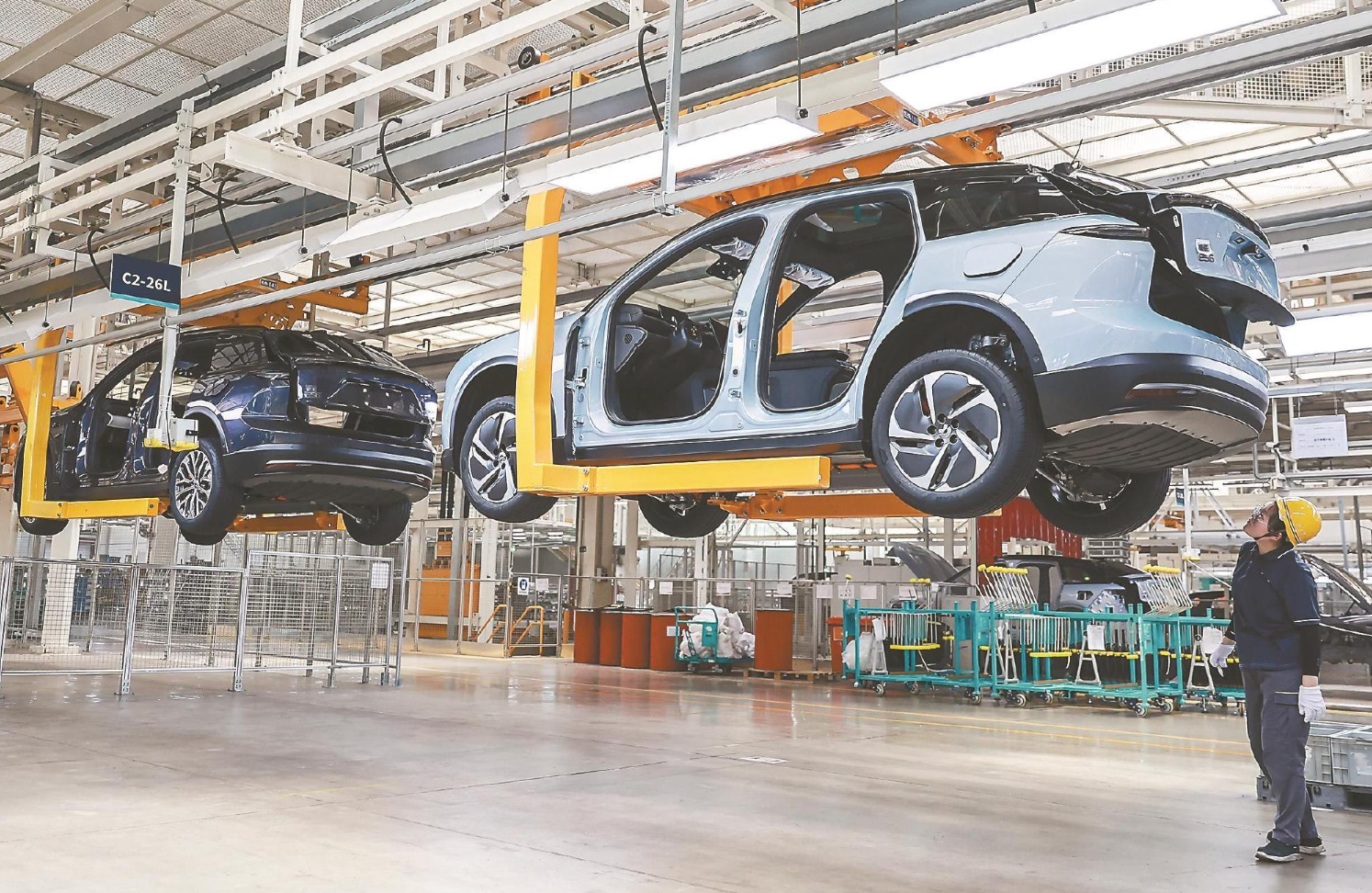
The plant integrates stamping, body, paint, final assembly and electric drive production into a single site. The body shop alone runs close to a thousand robots, and the line reaches 98 per cent automation, enough to support unlit production for extended periods. What to look for is not the robot count but the hand-offs that are no longer there: every process brought under one roof removes a transfer, and with it variability, buffer inventory and delay. Watch how material moves between stamping, body and assembly, and where the flow is deliberately buffered.
A mixed-model line at volume
The line supports more than 3.6 million combinations of individual configuration options, and variety normally fragments batch sizes and multiplies the parts needed at each station. Two platform concepts show how the plant answers that: a vehicle storage and retrieval platform that buffers and sequences bodies between stages, and a flexible assembly island that handles different variants without a dedicated line for each. Look at where bodies wait, in what order they are released, and whether a station can take variants without a long changeover.
Judging the digital twin
NIO's own TianGong system sits over these processes, connecting development, procurement, manufacturing and quality control in one closed loop, so a design or supply change appears in production planning rather than on the line. The question worth asking is not whether the software is impressive but which decisions it makes on its own, and which still require a person. Ask who sees an exception first, and how long it takes to become a decision.
What a visit covers
| Time | What happens |
|---|---|
| 09:00–09:30 | Meet the host, receive a pre-visit briefing and set the objectives for the day. |
| 09:30–10:30 | Tour the NIO House brand space, then a guided walkthrough of the body shop and final assembly areas. |
| 10:30–12:00 | Themed session on NIO's energy technology roadmap, covering the twelve in-house technology areas and the production model. |
| 12:00–13:30 | Break for lunch and informal discussion with the host team. |
| 13:30–15:00 | Deep-dive session on the TianGong system, the vehicle storage platform and the flexible assembly island. |
| 15:00–15:30 | Closing questions and departure. |
The sequence reflects a full-day programme that can be compressed into a half day or extended, depending on how much time a group wants on the manufacturing or the energy network side. The scope is agreed in advance, and the areas the host opens may vary with production schedules, so we confirm the final outline during planning.
What the sessions add to the walkthrough
The morning session covers NIO's stated technology pillars: in-house development as a route to control over underlying technology, the Lighthouse Factory as flexible digital manufacturing, and the battery-swap network as a commercial model that departs from selling cars alone. The afternoon deep dive is more operational, looking at how the TianGong system connects planning and quality, and how the assembly island and storage platform hold a mixed-model line together.
What different teams take away
Manufacturing and operations leaders get a concrete benchmark: a body shop at 98 per cent automation supporting more than 3.6 million configuration combinations. It is a useful reference when debating the limits of mixed-model production, and the digital twin discussion gives the team a vocabulary for linking engineering change to planning.
Supply chain and procurement teams get the park model. Concentrating component suppliers around the assembly plant is a structural choice with direct consequences for lead times, inventory and quality escalation, and comparing it with their own supplier footprint tends to be uncomfortable in a productive way.
Product and engineering teams get the case for vertical integration in specific layers. NIO's decision to own the assisted-driving chip, the vehicle operating system and the electric drive platform is not a claim that everything should be built in-house, but a claim about which layers determine differentiation and upgrade cadence.
Strategy, investment and policy visitors get a view of how industrial policy and corporate strategy interact. The Hefei park exists because a city decided to concentrate an industry and a company decided to build inside it, and knowing what each side contributed helps when assessing similar clusters.
Teams from non-automotive industries still find the day useful. The recurring themes are personalisation at volume, the boundary between what software decides and what people decide, and the trade-off between owning critical infrastructure and renting it – questions that recur across advanced manufacturing.
How to arrange a NIO visit
NIO receives group bookings rather than individual visitors, so a visit is arranged for a team rather than for one person. We assemble the group, agree the objectives, and put a request to the host with a proposed date and a short description of who is coming and what they want to focus on. The narrower that description, the more useful the day tends to be.
Because the programme mixes a walkthrough with two hosted sessions, it works best with a management team or a department. We handle the introductions, the schedule and the interpretation, and agree the final outline in writing before anything is confirmed.
Combine with other Hefei visits
Hefei rewards a two-day programme. Pairing NIO with a Gotion High-Tech visit in Hefei is the most natural combination, because the two sit on opposite sides of the same supply chain: one assembles vehicles and owns an energy network, the other makes the cells and packs that go into them. A BOE Hefei visit shows the display and electronics side of the same industrial base, and a Sungrow visit in Hefei adds the power electronics and energy storage perspective. Groups with a wider interest often extend the trip with an iFlytek visit in Hefei.
Practical notes
- Group size and lead time: The programme is best suited to groups of 10–20 participants. We charge per group, so larger groups usually offer better value per person. Individuals and smaller groups are welcome to enquire at a higher per-person rate. Please allow at least 30 days before the requested date.
- Language: the hosted sessions run in Chinese, with consecutive interpretation into English throughout.
- Photography: brand and display areas can normally be photographed, while the areas the host opens are usually restricted.
- Dress and safety: comfortable closed shoes are advisable, and the host may require protective clothing and shoe covers in certain areas.
- Access: NIO receives group bookings only, so we coordinate the request and the attendee list.
Questions before a NIO visit
What does a NIO visit in Hefei include? It combines a briefing, a guided walkthrough of the brand space and manufacturing areas, and hosted sessions on NIO's technology and production model.
Where exactly does the visit take place? It takes place at NIO's China headquarters in the New Qiao smart electric vehicle industrial park in Hefei, where the F2 plant stands.
How large is the company today? Cumulative vehicle production passed one million units in early January 2026, and NIO delivered 326,028 vehicles in 2025 on revenue of 87.49 billion yuan. Research and development spending has exceeded 65 billion yuan, with more than 9,600 patent filings.
Why does the Lighthouse Factory status matter? The World Economic Forum designation reflects large-scale adoption of advanced manufacturing technology, including a digital twin platform and a body shop running at 98 per cent automation.
What is battery swapping and why does it matter? NIO operates stations that exchange a depleted battery for a charged one in around three minutes, and cumulative swaps have passed 100 million, with 3,737 stations by the end of 2025.
How many people can join the programme? The format works best with a management group or department of 10–20 people. We charge per group, so larger groups usually offer better value per person. Individuals and smaller groups are welcome to enquire at a higher per-person rate.
How far in advance should we plan? At least 30 days' notice is required under our public terms, and longer is better for groups with fixed dates.
Is interpretation available if our team does not speak Chinese? Yes, we provide English interpretation throughout the hosted sessions and the walkthrough.
Is the visit suitable for people without an engineering background? Yes. The day is structured for mixed audiences, and the manufacturing and business model sessions are accessible to non-specialists.
How much does the programme cost and how long does it last? Cost depends on group size, the number of days and the sessions you choose, and the standard format runs for half a day or a full day, so we quote once we understand the requirements.
Does the programme always run as described? It is built around the elements above. Facilities and areas opened on the day are subject to what the site opens, and we confirm the final scope in writing during planning, before you commit.
Arrange your NIO visit
Tell us your preferred dates, how many people are travelling, and which parts of NIO's operation your team most wants to understand – the Lighthouse Factory, the battery-swap network or the in-house technology stack. We will come back with a proposed outline and confirm it with the host. Contact China Innovation Visits and we will arrange the whole programme.