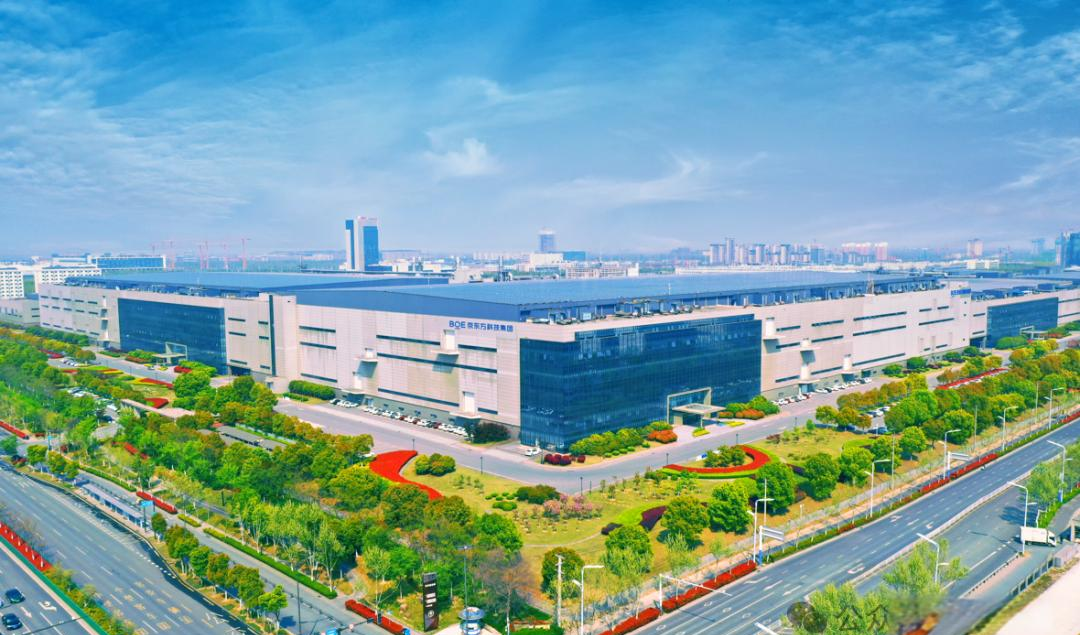
A television, a car cockpit, a laptop and a hospital monitor all begin life as a sheet of glass. In Hefei, one of the world's largest display complexes turns that glass into the screens inside those devices, and the scale becomes real only when you stand above the line that does it.
The BOE Hefei base is the anchor of the city's electronics cluster and one of the company's most important manufacturing sites. It has built Generation 6, Generation 8.5 and Generation 10.5 TFT-LCD lines, with cumulative investment in Hefei above 100 billion yuan.
This article explains what a visitor can see, what a half-day programme covers and how to plan one. It also corrects a point that circulates widely in itinerary descriptions: which BOE site holds the World Economic Forum Lighthouse Factory designation.
Key takeaways
- The Hefei base sits in the Xinzhan High-tech Zone and has built Generation 6, Generation 8.5 and Generation 10.5 TFT-LCD lines.
- The Generation 10.5 line carries investment of 45.8 billion yuan, 120,000 glass substrates a month, and panels for screens of 65 inches and above.
- BOE's LCD panels rank first worldwide in shipment volume and shipment area, and about one display screen in four worldwide comes from the company.
- A visit combines the innovation exhibition hall, the factory viewing gallery above a high-generation line, and a themed briefing.
- BOE's World Economic Forum Lighthouse Factory designation belongs to the Generation 8.5 site in Fuzhou, Fujian, and has never extended to the lines in Anhui.
Why visit BOE in Hefei?
Display manufacturing is the least visible and most pervasive part of modern industry. Screens sit inside phones, tablets, notebooks, monitors, televisions, car dashboards, medical equipment and retail signage, yet few outside the sector have seen how one is made, or why the plants that make them are among the most capital-intensive buildings on earth.
Hefei is the right place to see it because of generational scale: the higher the generation, the larger the glass sheet and the more efficient the cutting for big screens. The Generation 10.5 line in Hefei was the first of its generation anywhere in the world to reach volume, which makes it the reference point for how large-format displays moved from an imported product to a domestically produced one.
The visit is structured as learning rather than sightseeing. The exhibition hall establishes what the technology does, the viewing gallery shows the manufacturing reality behind those claims, and the discussion lets the group interrogate strategy and investment logic with people who work inside it.
Hefei itself is part of the argument. The city has gathered more than 200 companies across the display supply chain and has ranked first among China's top ten cities for high-quality new display industry development three years running. The cluster holds three TFT-LCD lines in mass production, one printed OLED pilot line, one silicon-based OLED line for small sizes and one flexible AMOLED Generation 6 line: mature LCD capacity funds the operation while OLED carries growth in premium phones, wearables and automotive interiors.
Company background
From a follower to a global display leader
BOE began as a component maker and became a display maker at a time when large panels were almost entirely imported. The Hefei base is where much of that transition happened: the company built its Generation 6 line, then Generation 8.5, then the Generation 10.5 line, each step raising the size of the glass substrate. Its LCD panels hold first place worldwide in shipment volume and area across phones, tablets, notebooks, monitors and televisions.
The 1+4+N+ecosystem chain architecture
The company describes its structure as "1+4+N+ecosystem chain". The "1" is semiconductor display, the core business. The "4" are the growth directions built on it: internet of things innovation, sensors, MLED and smart healthcare engineering. The "N" covers the application scenarios that follow, and the ecosystem chain refers to the partners and suppliers that grow around the core.
The anchor of a Hefei cluster
An anchor plant of this size creates demand for glass, polarisers, backlights, driver chips, precision equipment, cleanroom engineering and logistics. Display is the earliest and largest of the four sectors the city groups together as chips, displays, automobiles and home appliances, and it supplied the engineering workforce that later supported electric vehicles in the same city.
Inside the display complex: what to look for
Reading scale from the viewing gallery
The gallery runs above the process areas of the Generation 10.5 line, and it is where the numbers stop being abstract. Generation refers to the glass substrate size a plant can handle: this line processes sheets of 3,370 by 2,940 millimetres, roughly 10 square metres at about 0.5 millimetres thick, and one substrate yields eight 65-inch panels. The path to a finished panel runs through more than a hundred process steps, and what to watch from the glass is the movement rather than the machinery: glass passing between process areas without human handling, with defect data feeding back into the process rather than being reviewed after the fact.
What the construction timeline tells you
Ground was broken in December 2015, the first product came off the line in December 2017, mass production began in March 2018, and the line reached full capacity in March 2019, with yield running at 96 to 97 per cent. More than two years passed between the start of construction and the first product, and another fifteen months before the plant was genuinely full. For anyone planning capital projects, the sequence is the benchmark worth studying on site: equipment installation, process tuning, customer qualification and yield stabilisation are separate phases with separate failure modes.
A note on the Lighthouse Factory listing
Only one BOE site holds the World Economic Forum Lighthouse Factory designation: the Generation 8.5 site in Fuzhou, Fujian, selected in March 2022. That listing has never covered the lines in Anhui, and it is not the basis on which Hefei should be described. What Hefei can claim is different and arguably harder: it was the first place in the world to run a Generation 10.5 TFT-LCD line at volume, while localising a supply chain that had depended on imports for large-format panels.
What a visit covers
| Time | What happens |
|---|---|
| 09:00–09:15 | Gather and sign in, then cover the safety briefing and the aims of the visit. |
| 09:15–09:45 | Tour the innovation exhibition hall with a host guide, taking in 8K ultra-high-definition screens, integrated automotive displays, glasses-free 3D, Mini-LED and folding and rollable formats. |
| 09:45–10:15 | Walk the factory viewing gallery and observe automated production on a high-generation line through the glass. |
| 10:15–11:30 | Join a themed briefing and an open discussion on independent innovation, industry trends and management practice. |
| 11:30 | Departure. |
The blocks above are the standard shape of a half-day visit. Timings can move by fifteen minutes or so depending on group size and any operational restrictions on the day, and the group stays in the areas the host opens.
How the day flexes around your group
The briefing changes most between audiences. A manufacturing group tends to push on yield management, equipment reliability and how a plant of this class is staffed. A strategy or investment group pushes on capital intensity, the timing of a generation step, and how demand for larger screens is assessed years ahead. A mixed group usually wants the management story: how a long-horizon technology bet is protected inside a large organisation.
What different teams take away
Operations and manufacturing leaders take away a view of process discipline at a precision most plants never need. The question is not the technology but the management system around it: how process parameters, defect data and equipment condition become decisions, and how a continuously running plant stays stable when one stoppage is expensive.
Strategy and investment teams take away a clearer sense of timing risk in capital-intensive industries. The gap between groundbreaking in December 2015 and full capacity in March 2019 shows how long money stays committed before a line performs, and how far the return depends on yield reaching the high nineties.
Engineering groups take away an understanding of how a technology roadmap is executed in generations rather than in products. Each generation step requires new handling, new process control and new supplier capability, and the cluster around the plant has to move at the same time.
General management audiences take away the organisational question: how a company sustains long-horizon research spending while its customers compete on price and speed. The 1+4+N+ecosystem chain structure is a concrete answer, and the exhibition hall shows it as products rather than as a diagram.
Mixed and non-technical delegations take away the same story told differently. The exhibition hall works visually, the viewing gallery is watched from behind glass, and the briefing is delivered in plain language, so groups without a display background can still follow how a long-horizon bet is protected and brought to volume.
How to arrange a BOE Hefei visit
We plan the day around your group rather than fitting it into a fixed tour. Tell us the size of the party, the roles represented and what the group most wants to understand, and we build the morning accordingly.
The programme is best suited to groups of 10–20 participants. We charge per group, so larger groups usually offer better value per person. Individuals and smaller groups are welcome to enquire at a higher per-person rate. Please allow at least 30 days for the host to confirm arrangements. Within that window we agree the outline, the emphasis of the briefing and the practical arrangements, and we send a written programme before you commit.
Combine with other Hefei visits
Hefei is one of the few cities where a single trip can show four advanced manufacturing models. Alongside the display base, it hosts the notebook computer plant of Lianbao Technology, which makes one in every eight laptops sold worldwide, the vehicle plant of NIO, which pairs electric vehicle assembly with battery swapping, and a visit to iFLYTEK in Hefei. Groups familiar with BOE's work in the north often ask about the capital: the BOE factory tour in Beijing covers a different operation from the display base in Hefei.
Practical notes
- Recommended group size is 10–20 people. We charge per group, so larger groups usually offer better value per person; individuals and smaller groups are welcome to enquire at a higher per-person rate. Please allow at least 30 days before the intended date.
- The standard format is a half-day morning programme, typically starting at 09:00 and finishing by 11:30.
- The viewing gallery follows a fixed route above the process areas, so the group stays with the host guide on the marked walkway.
- Photography is generally possible in the exhibition hall. In the areas the host opens, follow the host's instructions, as some process areas and equipment are commercially confidential.
- Flat, closed shoes are advisable, and groups should expect to stand for extended periods.
Questions before a BOE visit
What does a BOE Hefei visit include? A half-day programme built around three blocks: the innovation exhibition hall, the factory viewing gallery above a high-generation line, and a themed briefing with company specialists.
Where exactly is the BOE Hefei base? It sits in the Hefei Xinzhan High-tech Zone in Anhui province, inside the cluster the city describes as chips, displays, automobiles and home appliances.
How large is BOE as a company? Its LCD panels rank first worldwide in shipment volume and area across phones, tablets, notebooks, monitors and televisions, and about one screen in four worldwide comes from the company.
What are the headline numbers for the Hefei base? Cumulative investment in the city is above 100 billion yuan, and the Generation 10.5 line alone represents 45.8 billion yuan with a designed capacity of 120,000 glass substrates a month.
How many people can take part in one visit? The programme works best with 10–20 participants; larger parties are split into smaller groups during the walkthrough so the host guide can be heard. We charge per group, so larger groups usually offer better value per person. Individuals and smaller groups are welcome to enquire at a higher per-person rate.
How far ahead should we get in touch? At least 30 days before the date you have in mind, which gives the host side time to confirm arrangements and us time to agree the briefing emphasis.
Do you arrange interpretation? Yes. Consecutive interpretation into English is arranged on request, and other languages can be arranged with enough notice.
Is the visit suitable for teams without a technical background? Yes. The exhibition hall is a visual experience and the briefing is delivered in plain language, with technical depth available for those who want it.
How long does the visit run and how is the fee set? The standard morning runs from 09:00 to 11:30. The fee depends on group size, programme length and interpretation, and we set it out as a single figure in the written proposal.
Can we take photographs? Photography is generally possible in the exhibition hall. In the manufacturing areas the host's instructions govern, as some process areas and equipment are commercially sensitive.
Does the programme always run as described? It is built around the elements above. Facilities and areas opened on the day are subject to what the site opens, and we confirm the final scope in writing during planning, before you commit.
Arrange your BOE visit
If you are planning a group visit to the Hefei display base, send us the date you have in mind, the number of people travelling and what the group most wants to understand. We handle the host side, the programme design, the interpretation and the logistics. Contact China Innovation Visits and we will come back with an outline programme for your dates.