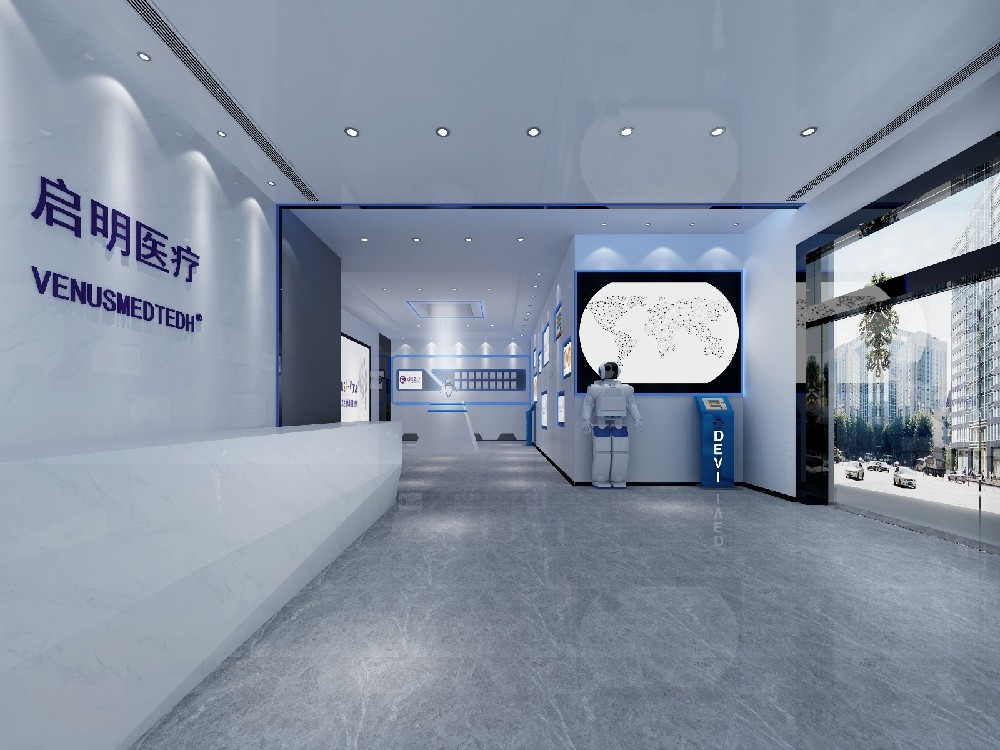
A Venus Medtech(启明医疗) visit in Hangzhou takes a delegation to the company that created China's transcatheter heart valve industry. Venus Medtech (Hangzhou) was founded in 2009, is headquartered in the Binjiang district of Hangzhou, and has been listed on the main board of the Hong Kong Stock Exchange under 02500 since December 2019. Its VenusA-Valve was the first transcatheter aortic valve replacement product approved in China, in April 2017.
The reason to go in 2026 is the portfolio. The company no longer sells one valve; it runs what it calls a four-valve pipeline, with six aortic valve products, a pulmonary valve product approved in close to seventy countries and regions, and a single device platform being developed for both mitral and tricuspid replacement. Very few companies anywhere — and no other Chinese one — cover all four heart valves with transcatheter devices.
The second reason is how international the business already is. Overseas revenue was 98.3 million yuan in 2025, about 32 per cent of the total, growing at a compound rate of roughly 23.7 per cent a year since 2022. The pulmonary valve product is approved in Europe and covered by reimbursement in major European markets, and it was the first Chinese-made heart valve to receive an investigational device exemption from the United States FDA. For a delegation studying how a Chinese high-risk device company clears Western regulators, this is the reference case.
China Innovation Visits coordinates the Hangzhou programme, including the company reception, scheduling, local transport and English interpretation.
Key takeaways
- See the four-valve portfolio: aortic, pulmonary, mitral and tricuspid, plus the delivery and access products around them.
- Understand how China's first approved TAVR product was designed around Chinese pathology — heavy calcification and a high rate of bicuspid valve disease.
- Examine VenusP-Valve, approved in close to seventy countries and regions and reimbursed in major European markets.
- Discuss the regulatory route: European CE marking, United States FDA investigational device exemption, and parallel clinical programmes.
- Ask how a company running a large clinical programme at roughly 87 per cent of revenue in research spending plans its route to profitability.
- Compare with a Mindray overview on how Chinese medical devices internationalise, or a BGI Genomics visit on the diagnostics side of Chinese life science.
Why visit Venus Medtech in Hangzhou?
Transcatheter heart valves are among the hardest products in medical devices to bring to market. The clinical evidence takes years, the regulators are cautious, the implanters need training, and the competitors — Edwards Lifesciences and Medtronic globally — are formidable. A Chinese company that reached approval first at home and then took its products into Europe and into the United States regulatory system has solved problems that transfer directly to any high-risk device business.
It is also a good place to study portfolio design. The four valves are different clinical problems with different anatomies, different patient populations and different competitive landscapes, and the company has chosen to address all four rather than defend one. The visit is where you can ask how that choice is funded and sequenced.
Hangzhou is the right setting. The company sits in the Binjiang national high-tech development zone, part of one of China's densest medical technology clusters. Delegations building a wider health technology programme in the city often pair it with a BrainCo visit on the neurotechnology side.
Company background
2009 to a listed valve company
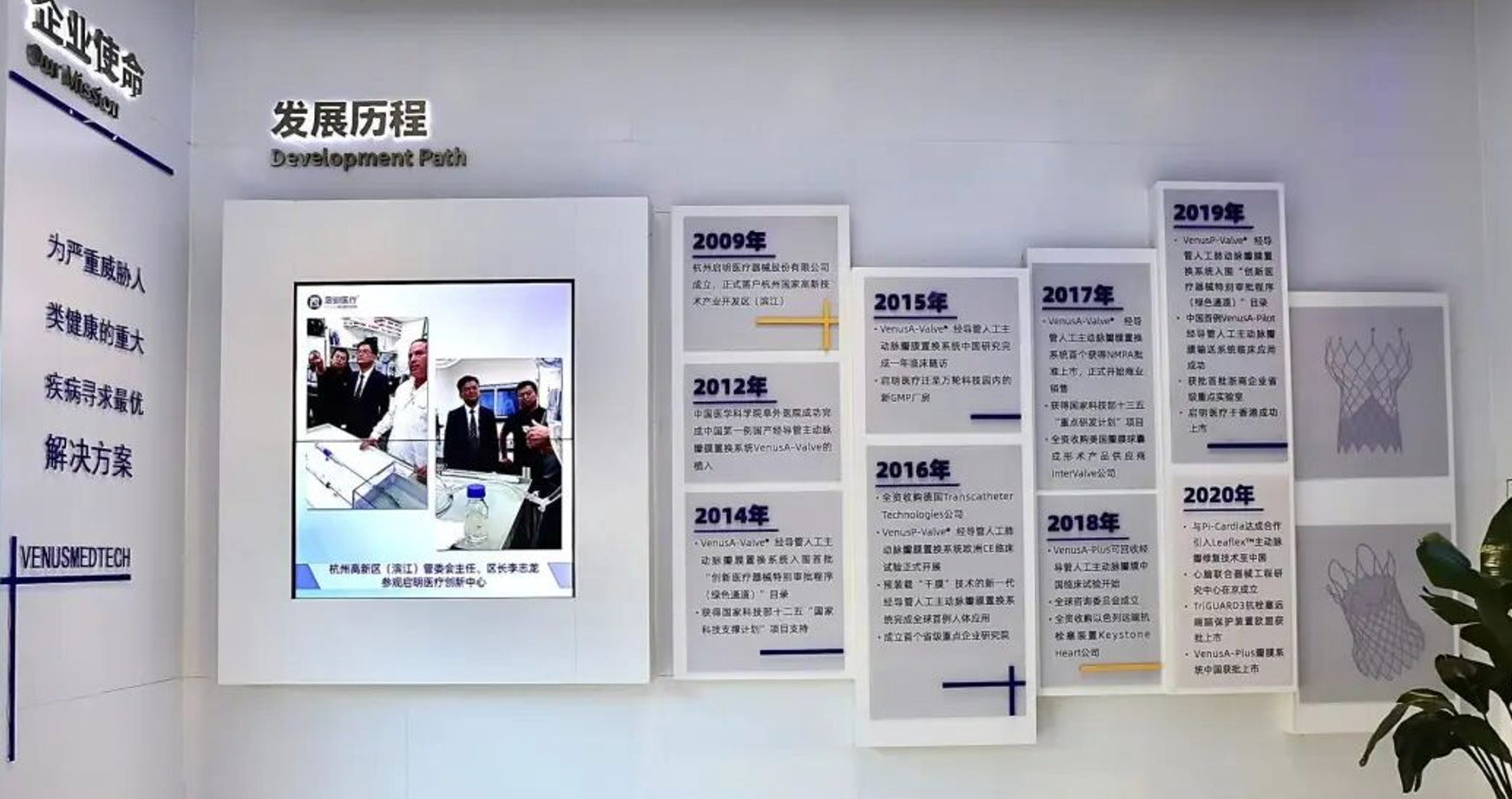
The company was founded in July 2009 by Zi Zhenjun and Zhang Qiming. Zi had previously been a co-founder and director of Lifetech Scientific and a research and development manager at MicroPort, and he is also a founding partner of Denovo Capital. The company started with a team of about twenty people and now employs close to 700 people from nearly ten countries.
It won a national biomedicine industry competition in 2014 for its biological aortic valve project, listed in Hong Kong in December 2019, and now runs research and development centres in China, the United States and Israel.
By 2018 implant volume, Frost & Sullivan put the company's share of the Chinese TAVR market at 79.3 per cent — the base from which the current portfolio was built.
The four-valve portfolio
The company describes its portfolio as four valves in one system. There are six aortic valve replacement products: VenusA-Valve, VenusA-Plus, VenusA-Pro, VenusA-Deluxe, Venus Vitae and Venus-PowerX. There is one pulmonary valve product, VenusP-Valve. There are two procedure accessories, the G Sheath expandable introducer sheath and the TAVO balloon dilation catheter. And there is Cardiovalve, a single device platform being developed for both mitral and tricuspid replacement.
Its products have reached more than sixty countries and regions across Asia, Europe, Oceania, Africa, South America and North America.
What it makes
Aortic valve: TAVR
VenusA-Valve was approved in China in April 2017, the first transcatheter aortic valve replacement product to be approved in the country, and it opened the category in China. It is a self-expanding device: a nitinol frame with a trileaflet valve and skirt made from porcine pericardium, delivered through a catheter system rather than through open surgery.
The design was built around Chinese pathology, which differs from Western populations in two ways that matter — a higher degree of calcification and a higher incidence of bicuspid valve disease. The valve uses specific anti-calcification treatment for that reason.
VenusA-Valve and VenusA-Pro are approved in close to fifteen countries including China, Brazil, Russia and Thailand. VenusA-Plus is approved in four countries, and VenusA-Deluxe in China. The newer generation, Venus-PowerX, is a fully retrievable self-expanding dry-tissue aortic valve already approved in Argentina, Chile and Venezuela, with pivotal clinical work running in China and internationally.
Pulmonary valve: VenusP-Valve
This is the strongest product internationally. VenusP-Valve is approved in close to seventy countries and regions across Europe, North America, Asia-Pacific, Latin America and the Middle East, and the company describes it as the first and only self-expanding transcatheter pulmonary valve approved in both China and Europe. It received European CE marking under the Medical Device Regulation in April 2022 and Chinese approval in July 2022, and it is covered by reimbursement in major European countries.
In 2023 it became the first Chinese-made heart valve to receive an investigational device exemption from the United States FDA, and the pivotal United States trial is enrolling. This is the clearest single example of a Chinese implantable device entering the American regulatory system on its own evidence.
Mitral and tricuspid: Cardiovalve
Cardiovalve is being developed for both mitral and tricuspid replacement from one platform. On the tricuspid side, the European confirmatory study completed enrolment of 150 patients and the CE application has been submitted, with approval expected around mid-2027. On the mitral side, the pivotal study is ready to start.
Mitral and tricuspid disease are much larger patient populations than aortic stenosis and much less well served by existing devices, which is why this programme matters more to the company's long-term shape than its current revenue suggests.
Accessories
The G Sheath expandable introducer sheath and the TAVO balloon dilation catheter are approved in China. Accessories look minor and are not: delivery and vascular access are where much of the complication risk in a transcatheter procedure sits, and companies that control them control the procedure.
Overseas: about a third of revenue
Overseas revenue was 98.3 million yuan in 2025, about 32 per cent of total revenue, with a compound annual growth rate of roughly 23.7 per cent from 2022 to 2025. The overseas share has risen substantially over that period.
The growth is not one product in one market. The aortic valve line is approved in close to fifteen countries. The pulmonary valve line is approved in close to seventy and reimbursed in Europe. Cardiovalve is heading for European approval in 2027.
For a delegation, the interesting question is what the next phase looks like: the company describes its strategy as structured global operation rather than opportunistic export, and the visit is where that distinction gets tested in detail.
The clinical programme
What is running now
Venus-PowerX and Venus Vitae are both in pivotal clinical studies, with Venus-PowerX expected to complete Chinese enrolment in the second quarter of 2026. The United States pivotal trial for VenusP-Valve is enrolling, with the full sixty-patient enrolment expected to complete in 2026 and approval anticipated around the end of 2028. Cardiovalve's tricuspid study is in follow-up after submitting its European application.
The company expects four or more additional products to be approved before the end of 2028.
What comes next
The stated roadmap runs through 2028: introduce a significant strategic shareholder in 2026, continue global clinical work and registrations, commercialise the tricuspid product in 2027, and bring a new-generation aortic valve to market in 2028, with the group reaching profitability in that year.
That is a long runway and it is worth being clear about it. A company at this stage is judged on clinical execution and cash discipline rather than on current earnings, and the discussion session is where delegations get the most from asking how the sequence is financed.
Research and the global network
Research and development costs were 267 million yuan in 2025, which for a company of this revenue is an unusually high intensity of spend — the reflection of a programme running pivotal trials on several continents at once.
The work is distributed. The company runs research and development centres in China, the United States and Israel, and its products are developed for Chinese and Western anatomies in parallel rather than sequentially. It holds several hundred patents and patent applications across China, the United States, Europe, Japan, Canada, Russia, India, Brazil, South Korea and South Africa.
Money and the path to profit
Revenue was 306.8 million yuan in 2025, with gross profit of 211.8 million yuan — a gross margin of about 69 per cent, which is what a high-value implantable device business should produce.
The loss for the year narrowed sharply, to 407.7 million yuan from 717.4 million yuan a year earlier, a reduction of 43.2 per cent, and loss per share narrowed from 1.63 yuan to 0.93 yuan. Adjusted earnings before interest, tax, depreciation and amortisation were broadly flat year on year.
That improvement came from both directions. Selling and distribution expenses fell from 245.1 million yuan to 195.5 million yuan and administrative expenses from 146.0 million yuan to 96.8 million yuan, while the company moved to a platform sales model, localised component sourcing to reduce cost, and completed the disposal of its industrial park. It also raised 150 million yuan through a convertible bond for working capital, and restored normal trading of its shares in Hong Kong after completing a governance restructuring.
The company's own target is profitability in 2028, on the combination of new product approvals, overseas growth and the operating cost base it has now reset.
What a visit covers
The standard programme
| Time | What happens |
|---|---|
| First 30 minutes | Reception and exhibition hall: the company's history and the four-valve portfolio |
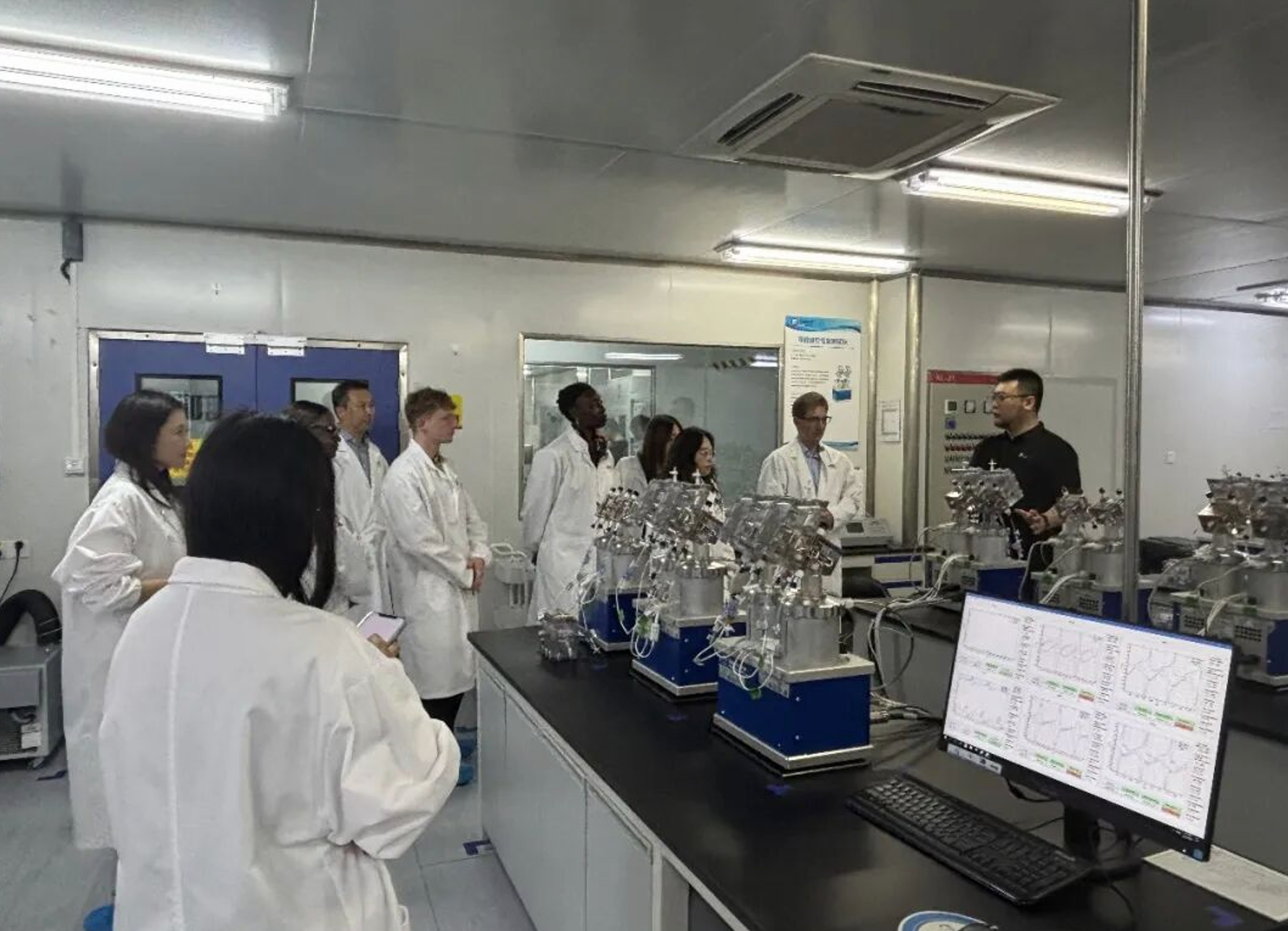
| 30–70 minutes | Simulated procedure demonstration showing how a transcatheter valve is delivered and deployed, plus manufacturing or laboratory areas |
| 70–120 minutes | Discussion with research or international business staff |
The standard visit runs about 120 minutes: 30 minutes in the exhibition hall, 40 minutes in the demonstration and manufacturing areas and 50 minutes in discussion, with the start time set with the host.
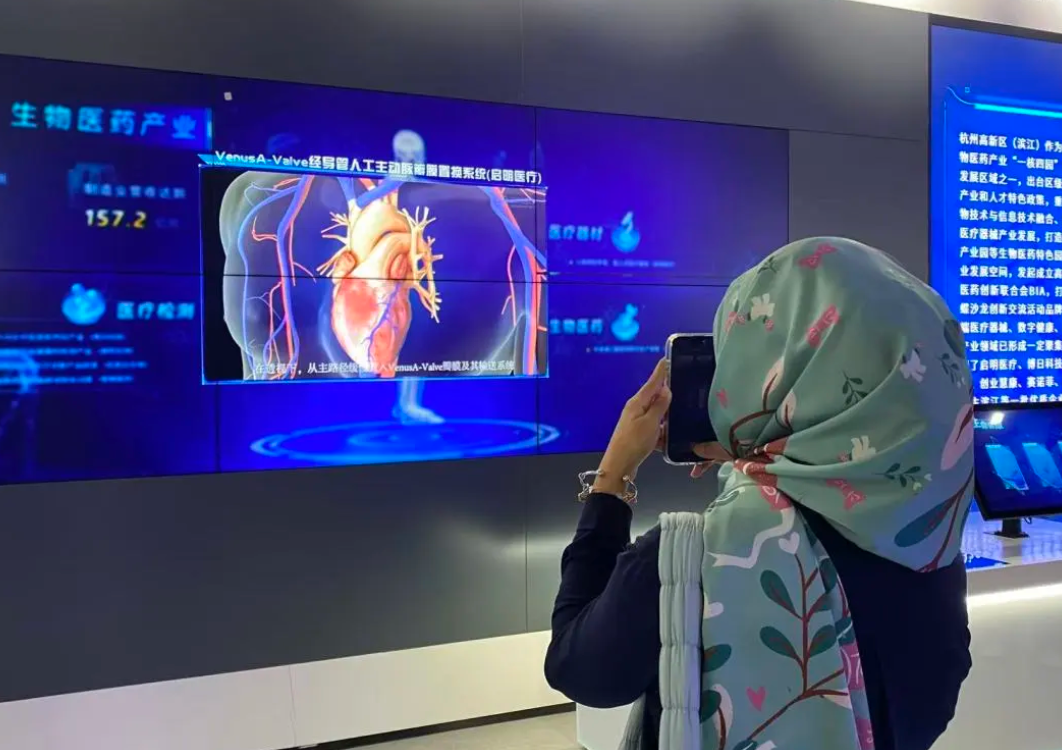
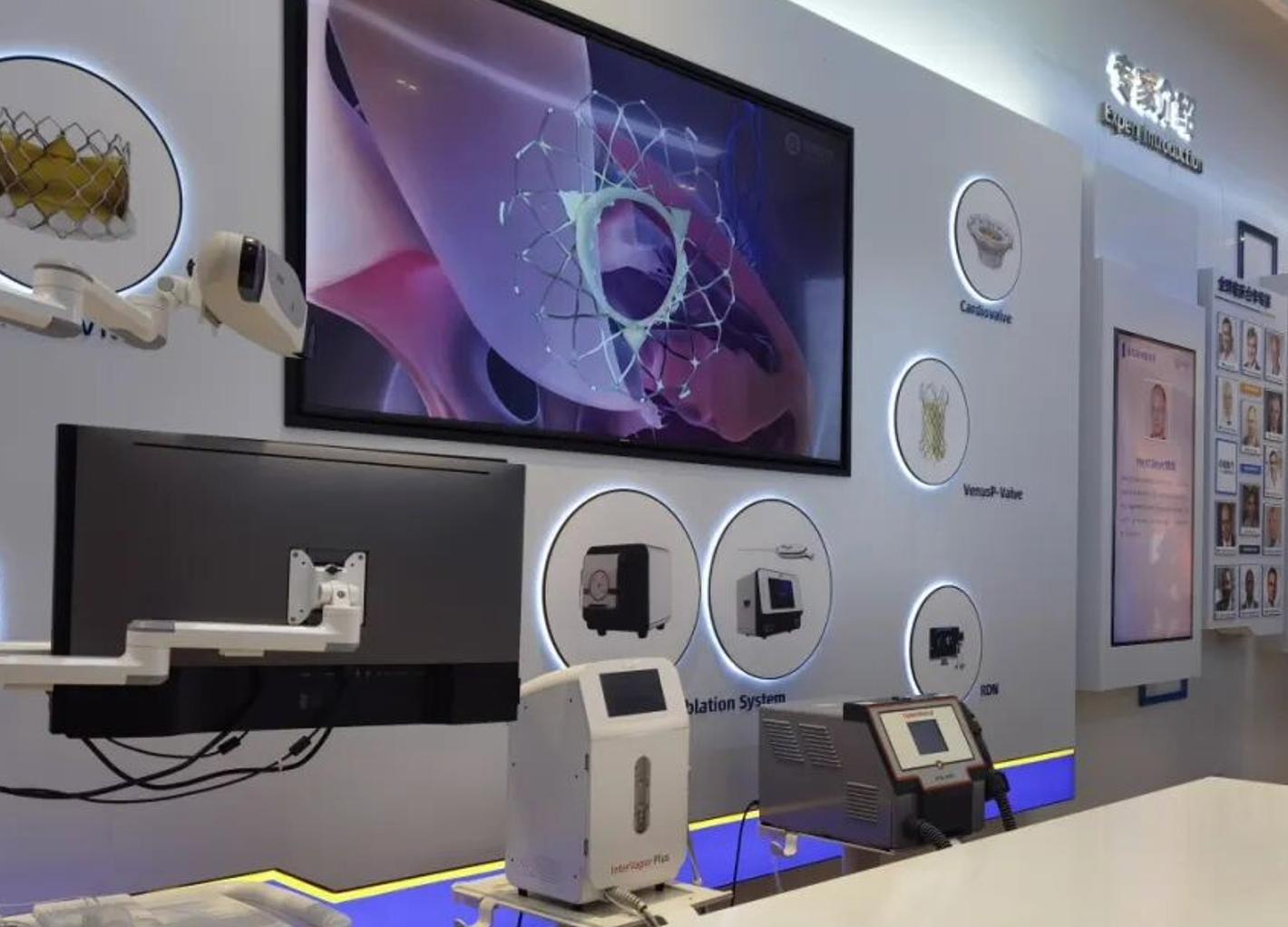
The exhibition hall and the procedure demonstration are where the technology becomes concrete — the scale of the device, the delivery system and the deployment sequence are difficult to convey in words. The discussion session is where regulatory, clinical and commercial questions are handled, and it is the part most professional visitors value most.
Who it suits
The visit suits medical device and pharmaceutical companies, cardiologists and clinical teams, hospital groups and procurement organisations, investors and analysts, and life science delegations. It is also used by university and hospital management groups working on innovation systems, and the company is experienced in receiving professional visitors.
Practical notes
- The visit is a business programme. Delegations are received as professional visitors and follow the host's rules.
- Booking requires approval in advance. Foreign participants normally need to be registered with the host ahead of time, and that process is longer than for domestic visitors; allow additional working days for the paperwork.
- Provide the participant list, nationalities and professional focus early; the technical depth of the briefing is adjusted to suit.
- Photography rules are confirmed in advance; some areas carry confidentiality requirements. Tell us during planning if you need images for internal reporting.
- Smart casual is appropriate. The programme involves walking through exhibition and technical areas.
- English interpretation can be arranged, including specialist preparation on cardiology and device regulatory terminology. Bilingual materials and an English summary can be prepared on request.
Questions before a Venus Medtech visit in Hangzhou
Is the visit open to international business delegations? Yes, subject to advance arrangements and confirmation by the host. Registration of foreign participants takes extra time, so we recommend planning at least 30 days ahead.
What is the group size? Visits are normally arranged for groups of 10 or more. We confirm the practical maximum with the host for your date.
How long does the visit take? The standard programme runs about two hours, covering the exhibition hall, a procedure demonstration, a technical briefing and a discussion. Longer programmes can include a deeper research session.
Where is the visit held? At the company's headquarters in Hangzhou, in the Binjiang national high-tech development zone. We confirm the meeting point in writing after the host approves the booking.
Do participants need a medical background? No. The visit can be approached through medical devices, clinical practice, regulatory affairs, investment or research management, and terminology is handled through interpretation.
Is English interpretation provided? Yes, including preparation on cardiology and regulatory terminology, and bilingual handouts can be arranged.
How large is the company? Revenue was 306.8 million yuan in 2025 with close to 700 employees from nearly ten countries, listed in Hong Kong under 02500 since December 2019.
What is the company known for? VenusA-Valve, approved in April 2017, was the first transcatheter aortic valve replacement product approved in China. Its products now reach more than sixty countries and regions.
How international is the business? Overseas revenue was 98.3 million yuan in 2025, about 32 per cent of the total, growing at a compound rate of roughly 23.7 per cent a year since 2022.
Which product has gone furthest abroad? VenusP-Valve, the pulmonary valve, approved in close to seventy countries and regions, reimbursed in major European markets, and the first Chinese-made heart valve to receive a United States FDA investigational device exemption.
What is in the pipeline? Venus-PowerX and Venus Vitae in pivotal studies, a United States pivotal trial for VenusP-Valve, and Cardiovalve for mitral and tricuspid replacement with European tricuspid approval expected around mid-2027.
What documentation is needed in advance? A participant list with passport details for foreign visitors, submitted to the host for registration, plus the delegation's professional focus. We tell you the lead time for your specific group.
Does the programme always run as described? It is built around the elements above. Facilities and areas opened on the day are subject to what the site opens, and we confirm the final scope in writing during planning, before you commit.
Arrange your Venus Medtech visit
Tell us your dates, group size and what your team wants to understand: how China's first approved transcatheter aortic valve was designed and commercialised, how a Chinese implantable device reaches European reimbursement and United States clinical trials, how one platform is being developed for both mitral and tricuspid replacement, or how a company funds a multi-continental clinical programme to profitability. China Innovation Visits will coordinate the company reception, discussion priorities, transport and English interpretation.
Contact China Innovation Visits to arrange your Venus Medtech visit in Hangzhou.