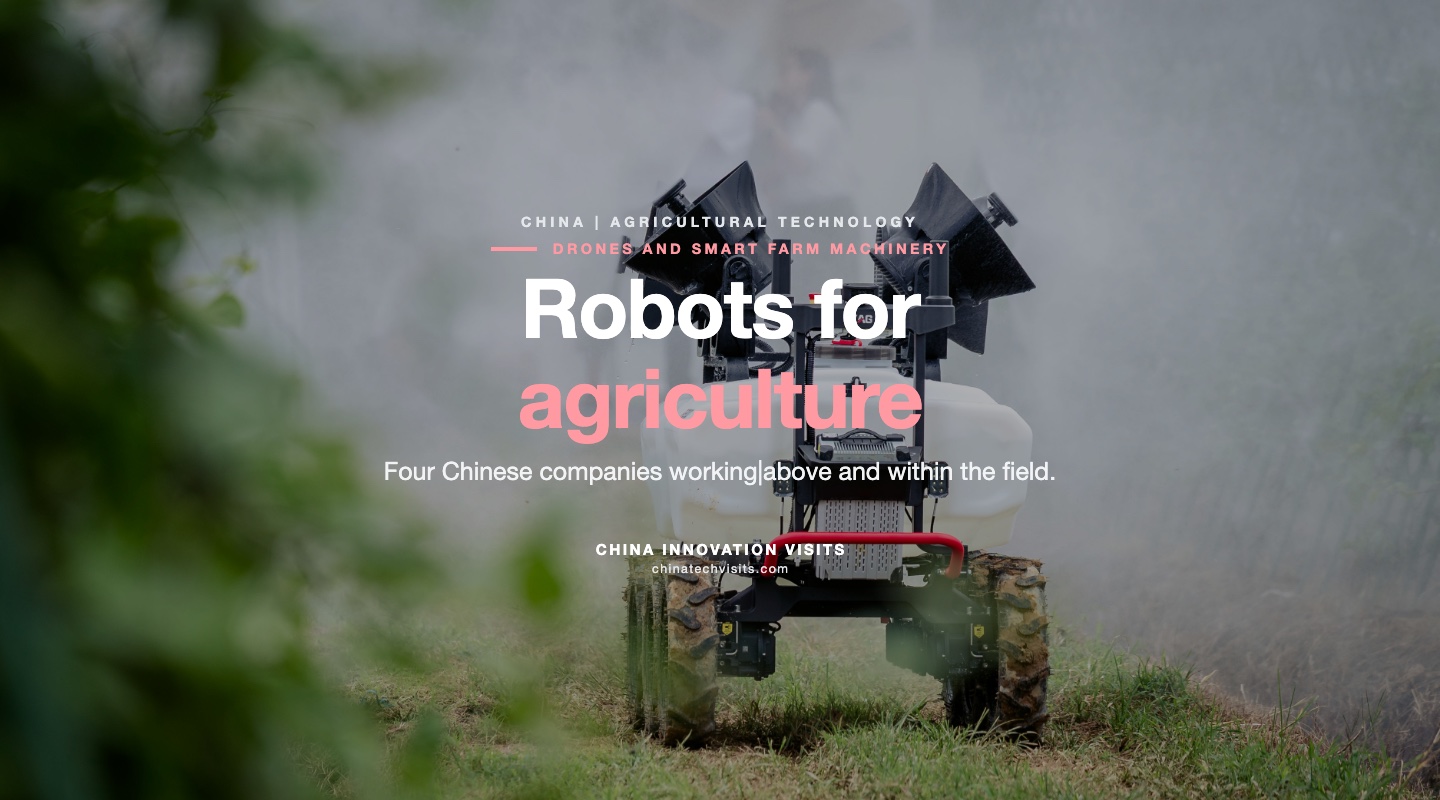
Agricultural robotics starts with the job in the field
Agricultural robots already carry out specific jobs: spraying grapevines, spreading seed, moving between orchard rows and controlling machinery across a field. The equipment changes with the crop, terrain and task. A spraying drone works above the canopy; a ground rover travels between plants; an autonomous tractor system must coordinate vehicle movement with an implement working in the soil.
Four Chinese companies provide different ways into this industry. DJI brings agricultural drones and a large international operating base. XAG combines drones, ground rovers and tractor steering equipment. EAVISION specialises in perception and spraying for complex crop environments. AIForceTech develops ground machinery, autonomous-operation systems and electric tractors.
For overseas growers, agricultural contractors, equipment distributors and food companies planning a technology visit to China, the comparison starts with an operating question: which field job needs to change, and what would a successful working season look like?
Four Chinese agricultural robotics companies to understand
| Company | China headquarters | Main equipment and technology | Application discussed here |
|---|---|---|---|
| DJI 大疆 | Shenzhen | Agras spraying and spreading drones; mapping and farm-management tools | T50 vineyard spraying in Romania during the 2024 season |
| XAG 极飞 | Guangzhou | Agricultural drones, R-series ground rovers and APC2 tractor steering | P100 drone spraying at Bilancia Vineyard, New Zealand |
| EAVISION 极目 | Suzhou | J-series drones for agricultural and forestry crop protection, C-series heavy-lift drones and ES-series unmanned operation platforms. Visit venue: Hangzhou showroom. | Crop protection in Guangxi citrus orchards |
| AIForceTech 中科原动力 | Beijing | Autonomous machinery controls, intelligent farm machines and electric tractors | A commercial electric-tractor lease supporting PepsiCo China's potato supply chain |
These are equipment and technology developers. Their strengths come from different combinations of flight control, perception, spraying, vehicle control and agricultural engineering. The examples below explain what each business contributes.
DJI: agricultural drones supported by a global operating base
DJI was founded in 2006 and is headquartered in Shenzhen. Alongside its camera and industrial drones, its agricultural business develops Agras aircraft for spraying and spreading, with mapping and farm-management tools supporting the work. This is a farm-equipment business built around flight control, sensing and application systems.
By the end of 2025, more than 600,000 DJI agricultural drones were in use worldwide. Its April 2026 industry update also identified a network of 3,500 service and repair centres. Those figures show the scale of the installed equipment and the support infrastructure behind it. For a distributor or agricultural contractor, repair capability and operator support are part of the product's commercial value.
A Romanian vineyard illustrates a specific operating problem. During the 2024 spraying season, vineyard owner Vladimir Potiuc used Drone Box's services with a DJI Agras T50. Sloping ground softened by rain had made tractor access difficult. The application combined terrain following, obstacle sensing and adjustable droplet size to carry out spraying over the vines.
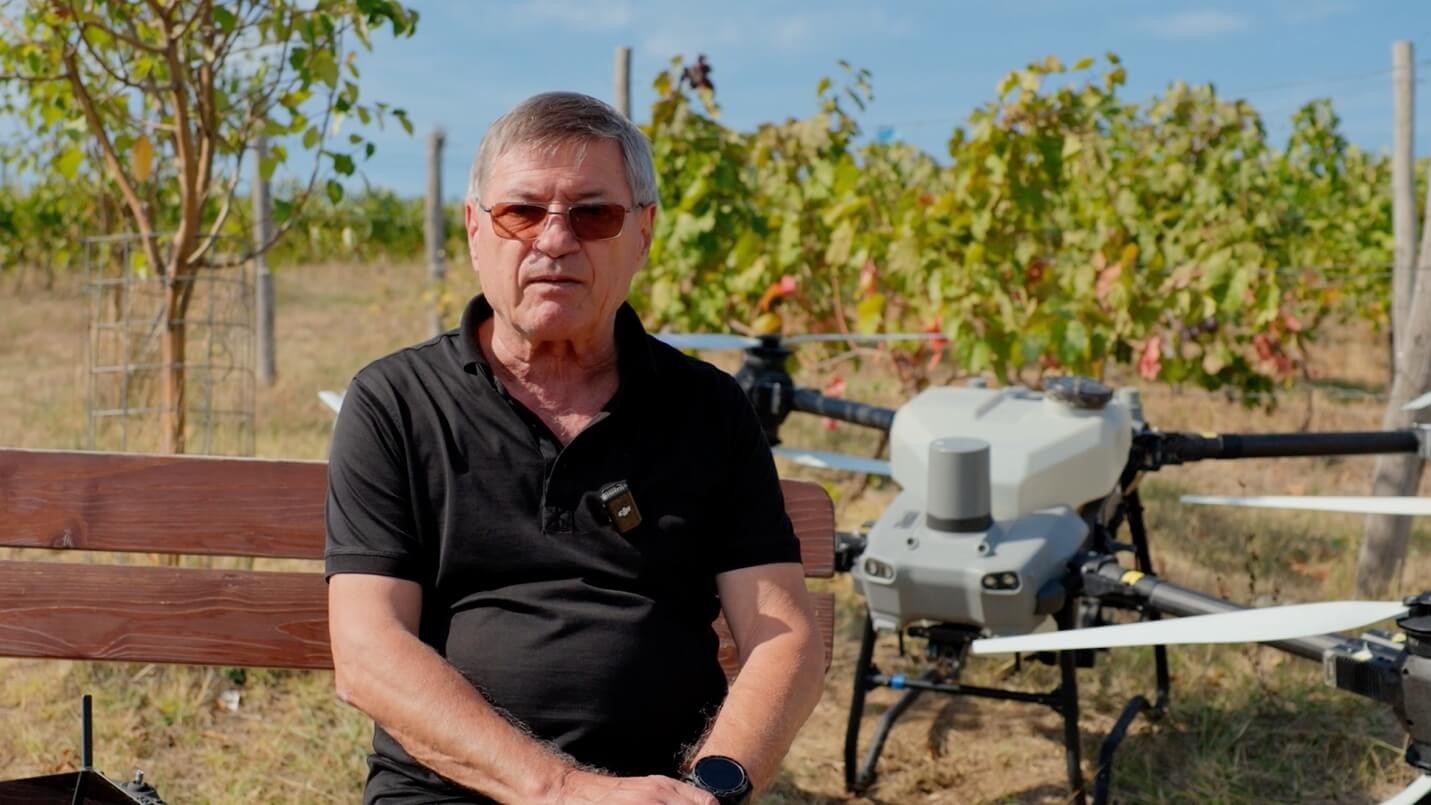
Vladimir Potiuc with DJI Agras equipment at the Romanian vineyard. Photo: DJI Agriculture.
A technical exchange can follow the entire spraying cycle: defining a field boundary, setting a route, selecting application settings, refilling, changing batteries and recording completed work. That exposes the practical relationship between an aircraft's specifications and the hectares a team can treat in a working day.
XAG: drones, ground rovers and tractor steering in one portfolio
Founded in 2007 and headquartered in Guangzhou, XAG develops agricultural drones, electric ground rovers, autopilot consoles and farm-monitoring equipment. Its portfolio spans work above crops, movement between crop rows and steering assistance for conventional machinery. This makes it relevant to agricultural operators evaluating several tasks across one farm.
The R100 and R200 ground rovers bring spraying into greenhouses, orchards and vineyards. Their operating modes include path tracking and repeat operation, with mapping and remote supervision supporting the task. The working width between rows, available turning space and refill arrangements become central design questions.
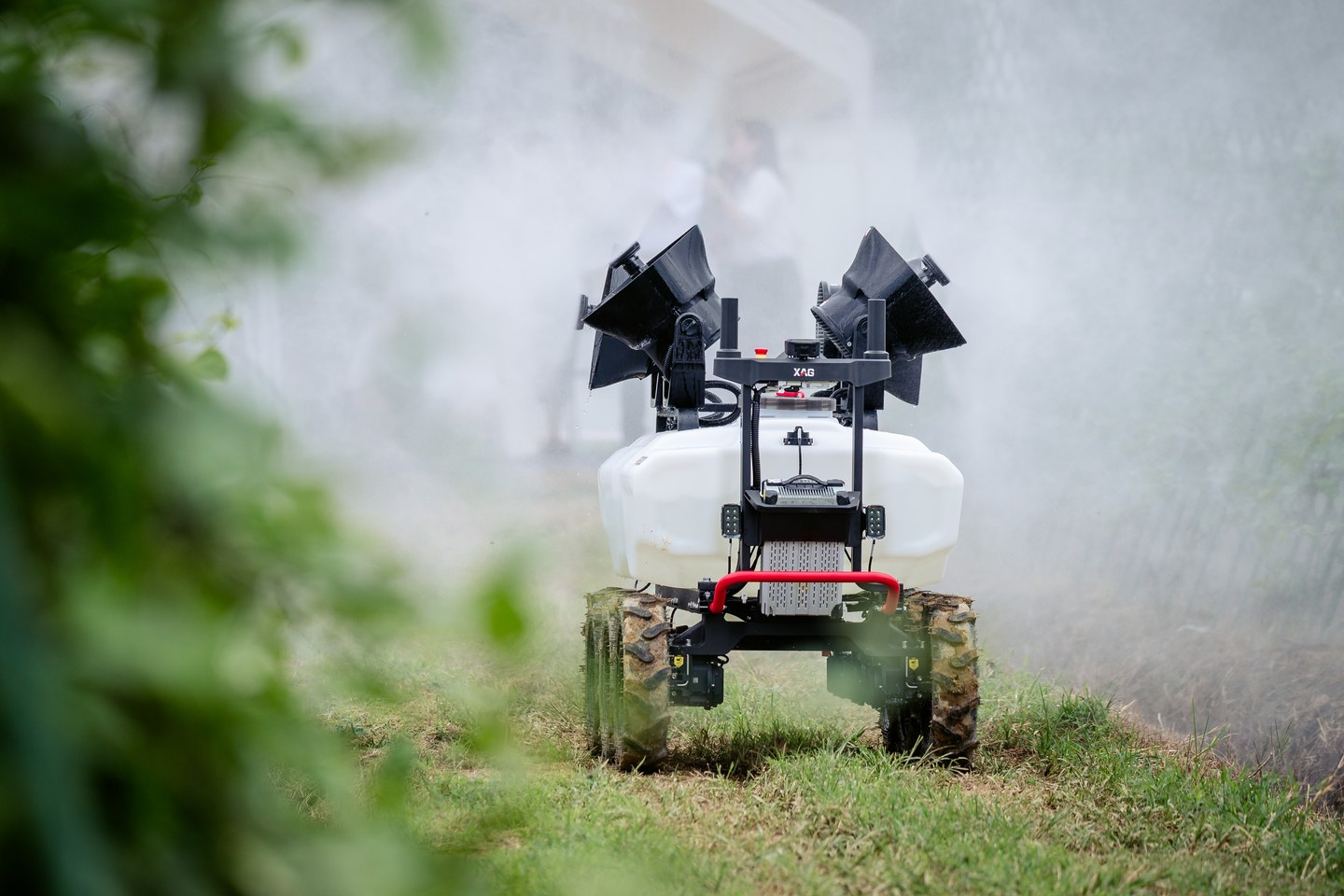
An XAG R-series rover in a crop-row spraying application. Photo: XAG.
XAG's drone work has a separate example at Bilancia Vineyard in Hawke's Bay, New Zealand. In the application documented in February 2023, local partner Airborne Solutions used an M500 remote-sensing drone to create a three-dimensional terrain map, followed by P100 spraying over the hillside vines. The workflow connected surveying, route planning and crop treatment on a site previously sprayed from a four-wheel motorbike.
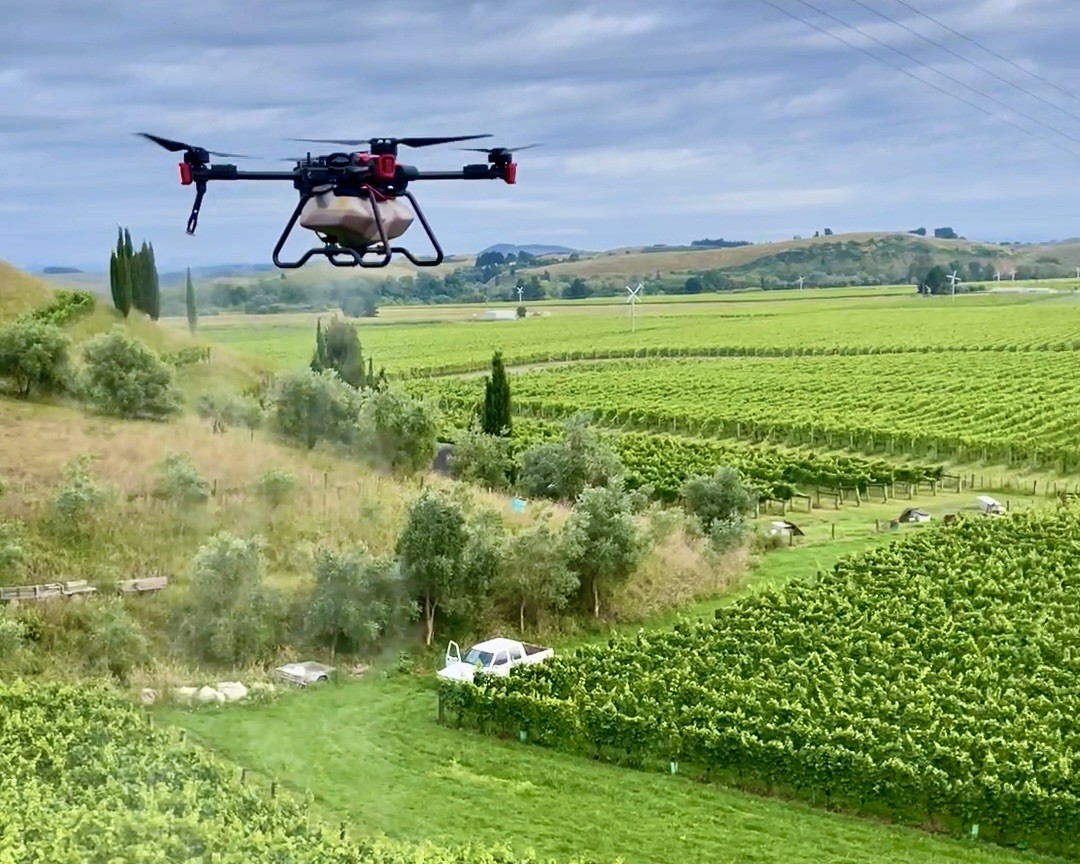
XAG P100 equipment in the Bilancia Vineyard application. Photo: XAG.
XAG also opened a service centre with Chia Tai in Thailand in May 2025, supporting repair, maintenance and training around agricultural drones and smart farming equipment. This adds another topic for an overseas business discussion: how equipment sales are supported through local service partners during the farming season.
For a China visit, XAG offers a comparison between aerial application, ground spraying and tractor steering. Each has its own operator role and working conditions; the useful discussion follows those differences through an actual farm task.
EAVISION: perception and spraying for complex orchards
EAVISION was established in Suzhou Industrial Park in June 2016. Its engineering combines visual perception, autonomous control and spraying technology for agricultural work in complex outdoor environments. Its current product range includes J160, J110 and S40 agricultural drones, supported by R&D centres in Suzhou, Nanjing and Hainan and manufacturing facilities in Zhejiang and Guangxi.
At its Hangzhou showroom, EAVISION presents its full product range, including J-series drones for agricultural and forestry crop protection, C-series heavy-lift drones and ES-series unmanned operation platforms. Physical exhibits, models and multimedia presentations explain stereo vision sensing and autonomous obstacle avoidance, and introduce precision operations in mountainous terrain and orchards.
Its technical focus is particularly relevant to fruit trees and uneven terrain. Stereo vision and other sensing systems help the aircraft interpret its surroundings, while the spraying system controls how liquid is atomised and delivered towards the crop. Understanding that combination requires examining the aircraft's distance from the canopy, the shape of the trees and the distribution of droplets.
A 2021 application in Guangxi citrus orchards included crop protection against spider mites. The engineering task was treating fruit trees where terrain and canopy structure complicate access and coverage. Guangxi citrus application
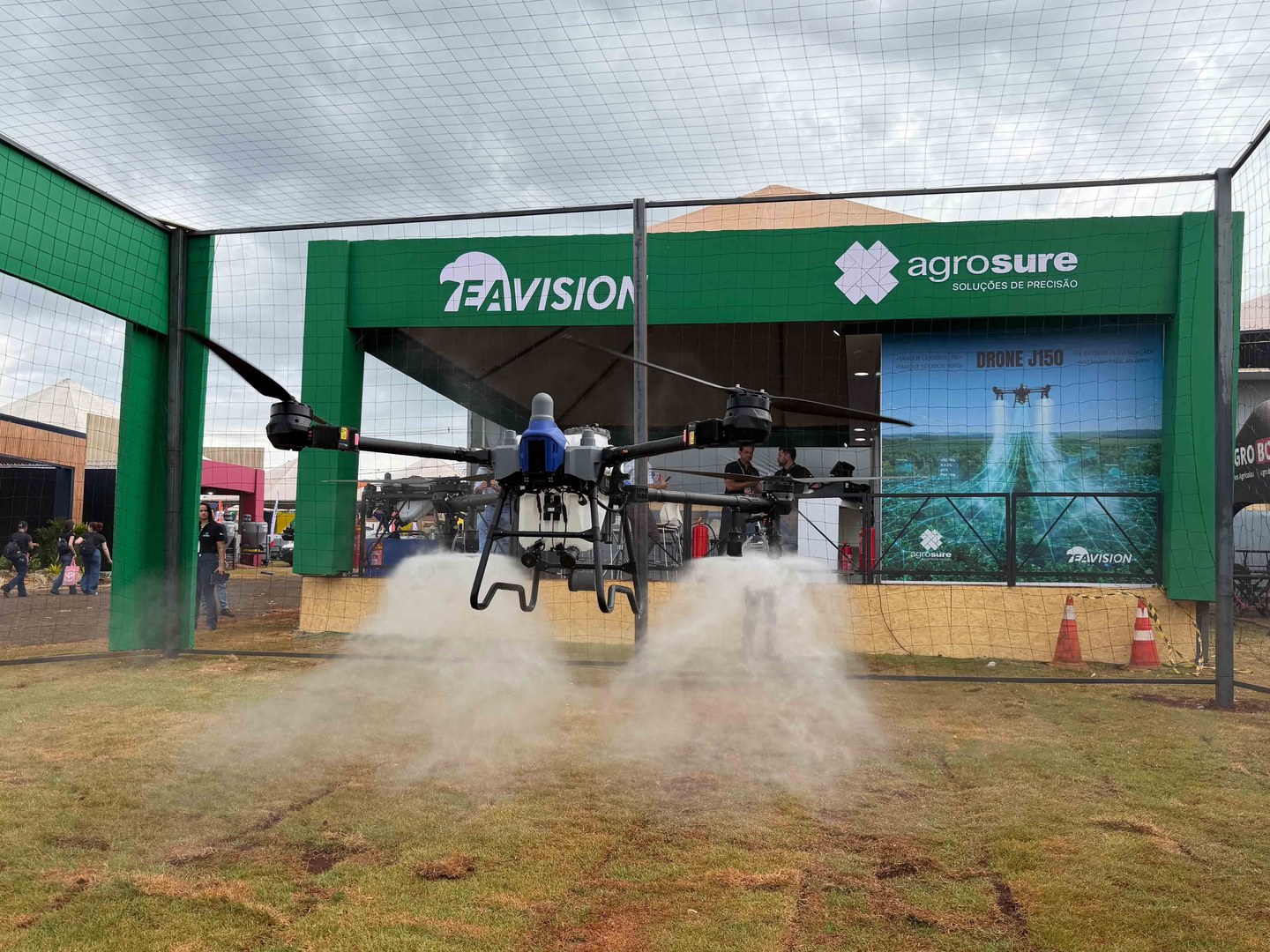
EAVISION agricultural equipment during an outdoor spraying demonstration. Photo: EAVISION.
For orchard operators and crop-protection businesses, this creates a focused engineering discussion. How does the system respond when tree heights change? Where is deposition measured within the canopy? Which settings are adjusted as foliage develops? These questions help connect the showroom's technical displays with the practical demands of orchard work.
AIForceTech: autonomous machinery controls and electric tractors
AIForceTech, known in Chinese as Zhongke Yuandongli, is headquartered in Beijing. Incubated by the Institute of Microelectronics of the Chinese Academy of Sciences, it began operating in 2019. Its product families cover autonomous-operation retrofit systems, intelligent farm machines, electric tractors and agricultural robots. The technical platform brings together perception, positioning, planning and vehicle control for agricultural machinery.
This puts the tractor and its implement at the centre of the discussion. Following a route is one function; controlling the work also involves coordinating the machine's movement with cultivation, planting or another implement task. The appropriate configuration depends on the machinery, crop and field conditions.
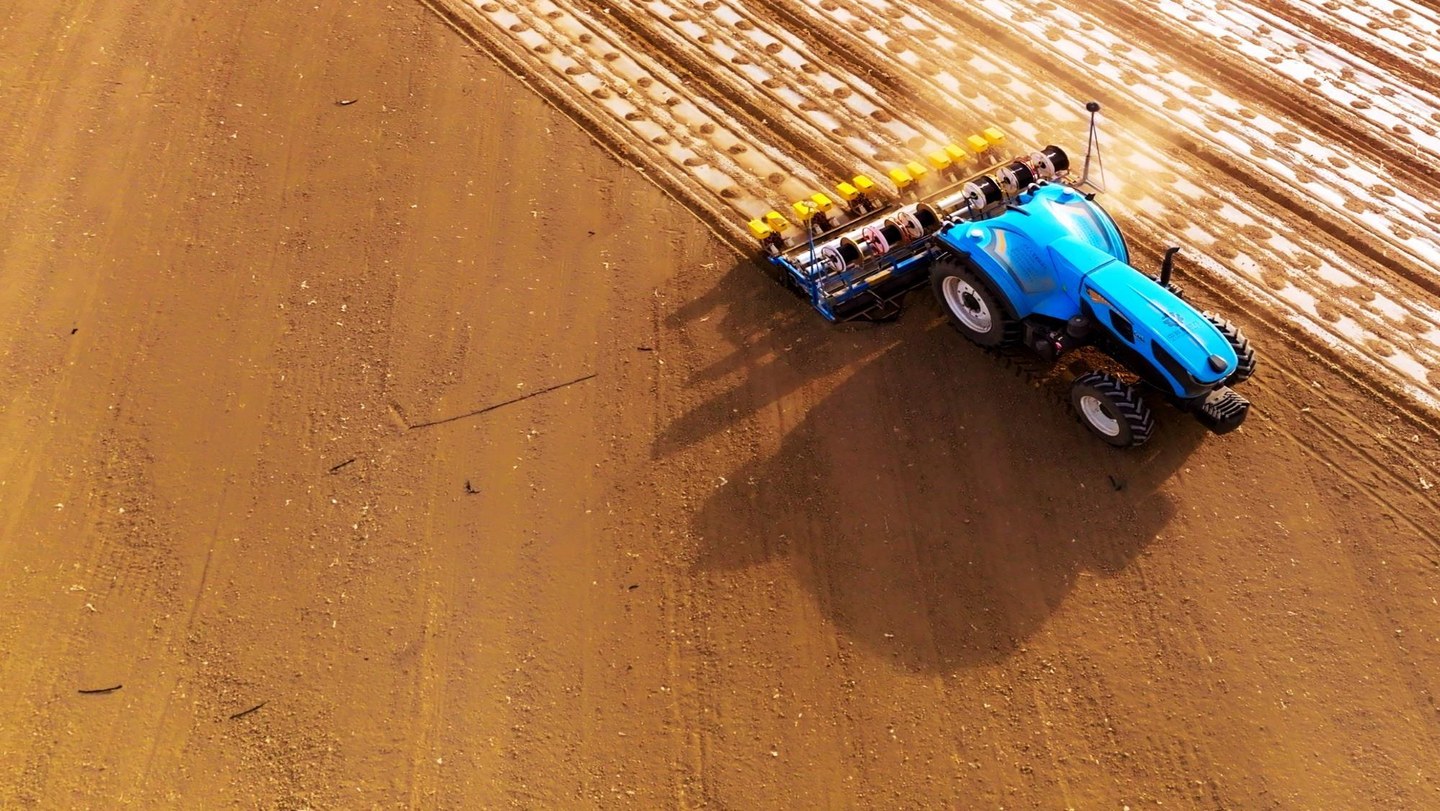
AIForceTech field machinery with an attached implement. Photo: AIForceTech.
Its electric-tractor business has a commercial example in PepsiCo China's agricultural supply chain. As of October 2026, a 140-horsepower AIForceTech electric tractor operated under a five-year commercial lease, supporting potato farming at selected grower farms. A larger 180-horsepower tractor was undergoing testing scheduled to conclude by the end of 2026. The lease and the larger model's testing are distinct stages of adoption. PepsiCo commercial-use update
For food companies and large farm operators, the commercial lease opens questions about charging, maintenance, machine availability and seasonal workloads. A technical meeting can then establish which steering, implement-control and supervision functions are included in each configuration. The commercial case demonstrates electric machinery in use; the degree of autonomy must be examined for the selected system.
What agricultural operators should compare
Begin with the crop and the job. Broadacre spraying, orchard protection, greenhouse treatment and soil cultivation place different demands on equipment. Field dimensions, row spacing, slopes, crop height and the availability of water or charging all affect the operating plan.
For spraying, examine the application result as well as the machine's movement. Flight or driving speed, droplet characteristics, canopy structure and weather influence where material is deposited. A useful trial compares coverage and crop-protection results under the conditions in which the equipment will actually work. Tank capacity alone provides an incomplete comparison.
For ground machinery, review the connection between navigation and implement control. Ask how boundaries, headland turns, obstacles and interrupted work are handled. Establish what the operator supervises, how an intervention is made and which tasks can be resumed automatically.
A technical exchange can examine maintenance, battery or charging routines, operator training and how teams respond to equipment interruptions during a busy farming season.
Planning an agricultural technology visit to China
The four companies support different learning objectives. DJI is relevant to agricultural drone operations and service networks. XAG offers an air-and-ground equipment comparison. EAVISION's Hangzhou showroom offers a closer look at its product range, stereo vision and autonomous obstacle avoidance, with applications in mountainous terrain and orchards. AIForceTech provides a route into intelligent ground machinery and electrification.
A delegation can prepare around one crop and one operating problem, bringing a field layout, equipment list or short account of seasonal work. This gives engineers something concrete to discuss and helps turn a demonstration into an assessment of operating fit.
China Innovation Visits can coordinate a tailored agricultural technology programme, including company arrangements, interpretation and China-side logistics. Request an agricultural robotics visit with your organisation, preferred dates, group size and crop or machinery priorities. Our XAG Guangzhou visit guide provides a company-specific starting point. For the underlying perception and control technologies, see our machine vision and robot software guide.
Sample visit programme
This sequence is an example for a selected company. The equipment, venue and session lengths are agreed during planning.
| Segment | Time | What to expect |
|---|---|---|
| Farm and crop briefing | Opening session | Discuss the crop, terrain, current work process and a documented application relevant to the delegation. |
| Equipment and task demonstration | Main session | Examine a selected spraying, steering or machinery-control task, including the operator's role. |
| Data and application review | Technical discussion | Follow route preparation, task settings, operation records and responses to an interrupted task. |
| Technical takeaways | Closing session | Discuss maintenance, training, local support and the operational questions raised during the exchange. |
Questions about agricultural robotics visits
Does agricultural robotics include drones and tractors? Yes. Agricultural drones are aerial robots; ground rovers and autonomous machinery systems perform different field tasks. Tractor autosteering, autonomous implement operation and electric propulsion are separate capabilities. Tell us which function you want to examine so the programme can address it precisely.
Which company is most relevant to our business? Start with the work you manage. Drone service providers may prioritise application workflows and support networks. Orchard growers may focus on terrain, canopy treatment and crop-row access. Large farm and food-company teams may prioritise machinery controls, electrification and seasonal operating requirements. We use those priorities to propose suitable company exchanges.
Can a visit include a working-field demonstration? The proposal identifies the demonstration setting and equipment. Field work depends on the crop calendar, weather and local operating conditions, while an equipment or software demonstration can have a different setting. Share your preferred dates and target crop early so that the programme can be planned around them.
Can we visit the overseas farms or PepsiCo grower sites described here? These examples explain the technologies and their applications. Access to customer farms, research sites or supply-chain facilities requires separate arrangements. A China company exchange does not include access to those sites unless it is specifically confirmed.
How are group size, language and planning time handled? Visits are priced by group; 10–20 participants generally provide better per-person economics. Individuals and smaller teams can request a tailored quotation. Tell us your working language and interpretation requirements. We recommend at least 30 days for coordination; shorter lead times require an availability check.
What information is needed for a proposal? Send your organisation, participant roles and number, dates, city preferences, target crops and technical objectives. A short description of field size, terrain, current machinery and the task you want to improve helps define the exchange. The quotation specifies company arrangements, interpretation, transport and any other included services.
Final host locations, equipment, demonstrations, meeting participants and field access are confirmed during programme planning.