Machine vision and robot software companies in China
A robot arm can repeat a movement. A factory also needs software to choose the next job, vision to locate a displaced part, and inspection to decide whether the result is acceptable. These functions sit in different parts of China's industrial automation supply chain.
The five companies below connect these functions with factory production. SEER Robotics coordinates 27 robots in a battery-recycling logistics project; Standard Robots connects warehousing and production for electronics manufacturer OPPO; Mech-Mind uses 3D vision to handle reflective, oily automotive axles. Aqrose and OPT address the inspection problems that remain when a part is difficult to image or a defect varies in appearance.
China Innovation Visits arranges company exchanges around your technical priorities: host coordination, local transport and English interpretation. Request a robot software and machine vision visit programme with your preferred dates, group size and the manufacturing problem you want to understand.
Five companies, and what each one sells
Robot software covers separate jobs. Fleet software coordinates transport across a factory. Vision guidance helps a robot locate and handle an object. Inspection software judges an image or measurement against a quality requirement. Each depends on its own hardware, its own data and its own connections to the production system.
| Company | What it supplies | A concrete reason to pay attention |
|---|---|---|
| SEER Robotics | Robot controllers, dispatch software and logistics management systems | A GEM project connects 27 robots of different types with battery disassembly and warehousing |
| Standard Robots | Industrial mobile robots and factory collaboration software | Its OPPO case links several robot types to material flow from storage to production |
| Mech-Mind | Industrial 3D cameras, vision processing and robot programming software | Its axle-handling case tackles overlapping metal parts with reflective, oily surfaces |
| Aqrose Technology | Industrial AI inspection software and vision systems | Its bolt inspection case addresses missing and discontinuous adhesive; AIDI provides model training and deployment tools |
| OPT | Machine vision optics, cameras, software and related components | Its phone-frame inspection case combines imaging hardware and algorithms to handle reflections and vibration |
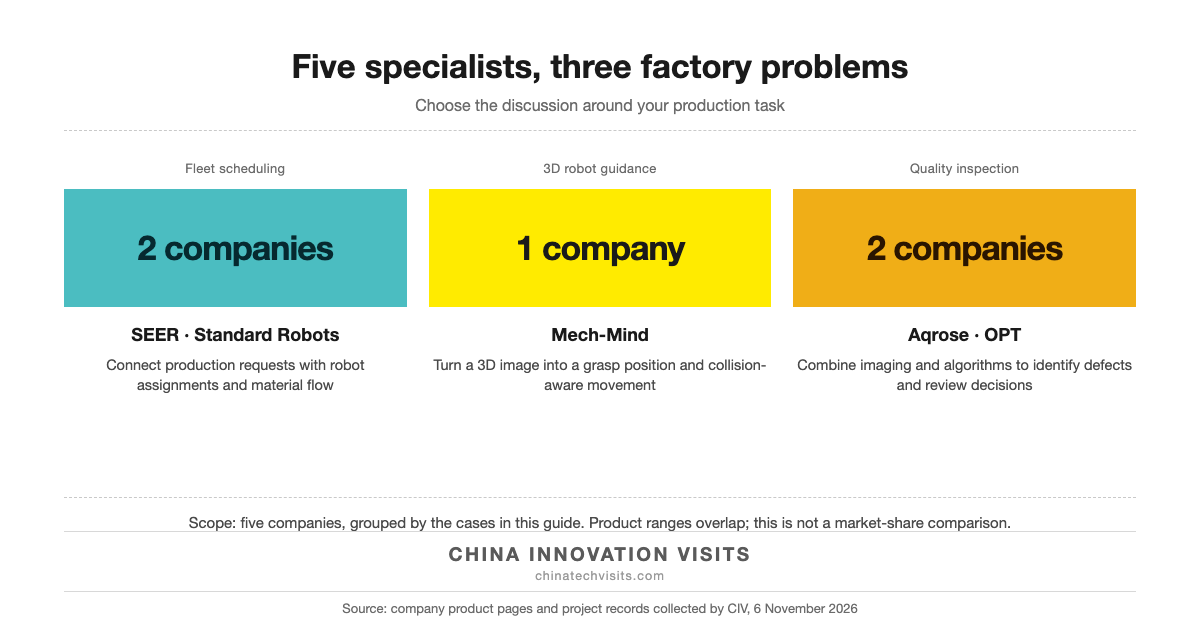
Application focus of the five companies in this guide. Product portfolios overlap.
These companies develop different parts of an automation system. Their software ranges from task scheduling to image analysis and robot motion planning.
Where these five sit in China's robotics chain
Our 21-segment robotics framework covers upstream components, midstream manufacturing and downstream integration. The five companies work across four of those segments.
| Segment | What it covers | Companies here |
|---|---|---|
| 12. Mobile robots and intelligent warehousing | AGV and AMR fleets for warehouses, factories and e-commerce sorting | SEER Robotics, Standard Robots |
| 14. Machine vision and perception | Cameras, lighting, 3D vision and AI inspection | Mech-Mind, Aqrose, OPT |
| 15. Robot operating systems and software | Multi-robot scheduling, motion planning and cloud-edge coordination | SEER Robotics, Standard Robots, Mech-Mind |
| 4. Sensors and encoders | Sensing components upstream of the vision and control stack | OPT |
Each company's portfolio extends beyond a single category, and the table shows only the product areas discussed here. Explore the wider industry chain in our China robotics industry chain map.
The segment structure explains why one company rarely covers a whole problem.
Fleet software connecting robots to production
SEER Robotics and battery recycling logistics
Shanghai-headquartered SEER Robotics (仙工智能) develops robot controllers, software and intelligent robots. Its business spans the control inside a machine and the coordination of multiple machines. SEER serves more than 2,500 customers across 43 countries and regions; that customer base gives its factory software a commercial context beyond any single demonstration.
At GEM (Wuxi), 27 robots support a used power-battery disassembly line and warehouse operations. GEM works in battery materials and recycling. The deployed mix includes rotating lift robots and stacking forklifts, with separate material-transfer and pallet-handling duties.
The system connects three elements: SRC controllers on the robots, RDS for resource scheduling, and M4 for logistics management. M4 connects to GEM's manufacturing execution system, the factory software that coordinates production information. Weighing data from the forklifts also return to that system.
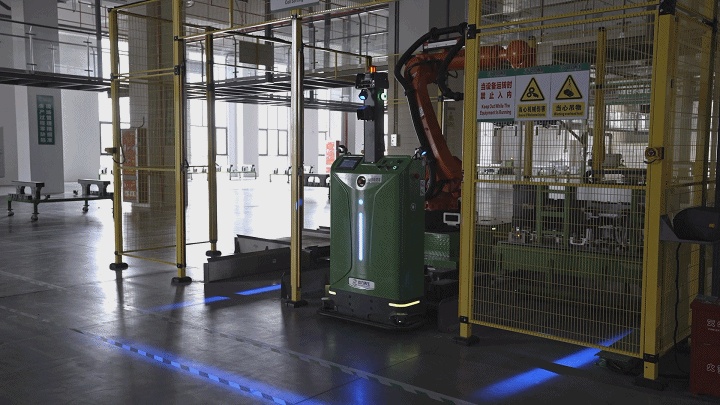
A mobile robot at GEM (Wuxi). Project video frame. Image: SEER Robotics.
The engineering issue to follow sits at that connection. A transport request has to leave the production system and become a robot assignment, and completion has to be written back. An occupied destination or an unavailable robot is where that chain gets tested, because some system has to decide what happens next. SEER's RDS unifies the scheduling of robots and automated logistics equipment with a low-code workflow engine.
SEER's Pudong headquarters holds the controller and fleet-software operations described here; our SEER Robotics guide covers the site.
Standard Robots and OPPO's factory material flow
Standard Robots (斯坦德机器人) develops industrial mobile robots alongside control and collaboration software. The company was registered in Shenzhen in 2016, exported to Japan in 2019 and expanded sales to 15 countries and regions by 2024.
Its OPPO case gives a specific example of that relationship. Material moves between incoming storage, line-side storage, production and finished-goods storage. Customised scheduling lets OPPO's system dispatch mobile robots directly. The equipment includes 27 lift-equipped robots, 17 conveyor robots and two unmanned forklifts, alongside RoboVerse software.
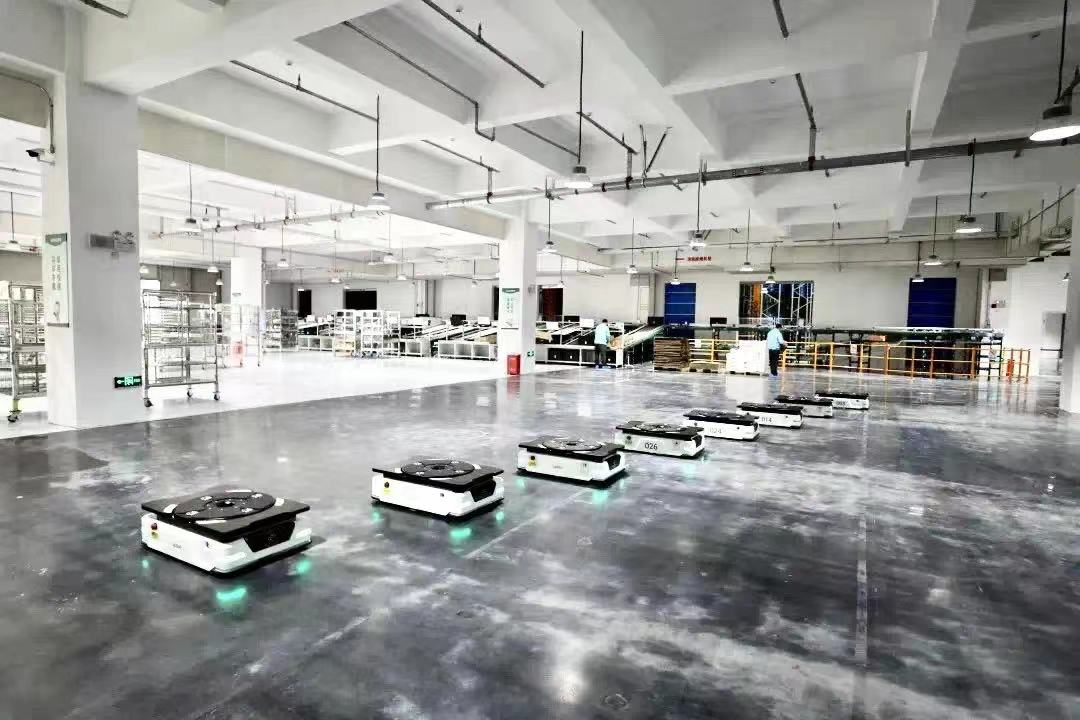
Mobile robots shown in Standard Robots' OPPO case. Image: Standard Robots.
Coordinating unlike machines with the factory's material requests is where the technical value sits. Three things decide how well that coordination works: who issues a job, how a robot obtains access to a shared transfer point, and what happens when a conveyor or workstation stops accepting material.
Standard's current RoboVerse product range also covers digital factory simulation, task configuration and collaboration between robots. Those functions give software teams specific subjects to examine alongside the transport equipment.
3D vision turning a parts pile into a robot task
Mech-Mind and reflective automotive axles
Mech-Mind (梅卡曼德) develops industrial 3D vision and robotics software in China. Its portfolio combines cameras with vision processing, robot programming, deep learning and measurement software. Its systems operate in nearly 50 countries, across machine tending, assembly, inspection and logistics. Mech-Mind is listed on the Hong Kong Stock Exchange under stock code 09615.HK.
At a large automotive parts factory, Mech-Mind's system handles axles for machine tending. The parts are large, reflective and affected by oil residue. A Mech-Eye DEEP-GL camera captures 3D data; vision software locates the axles and guides a robot to pick them and place them in a V-shaped groove. Collision detection and path planning support the robot's movements.
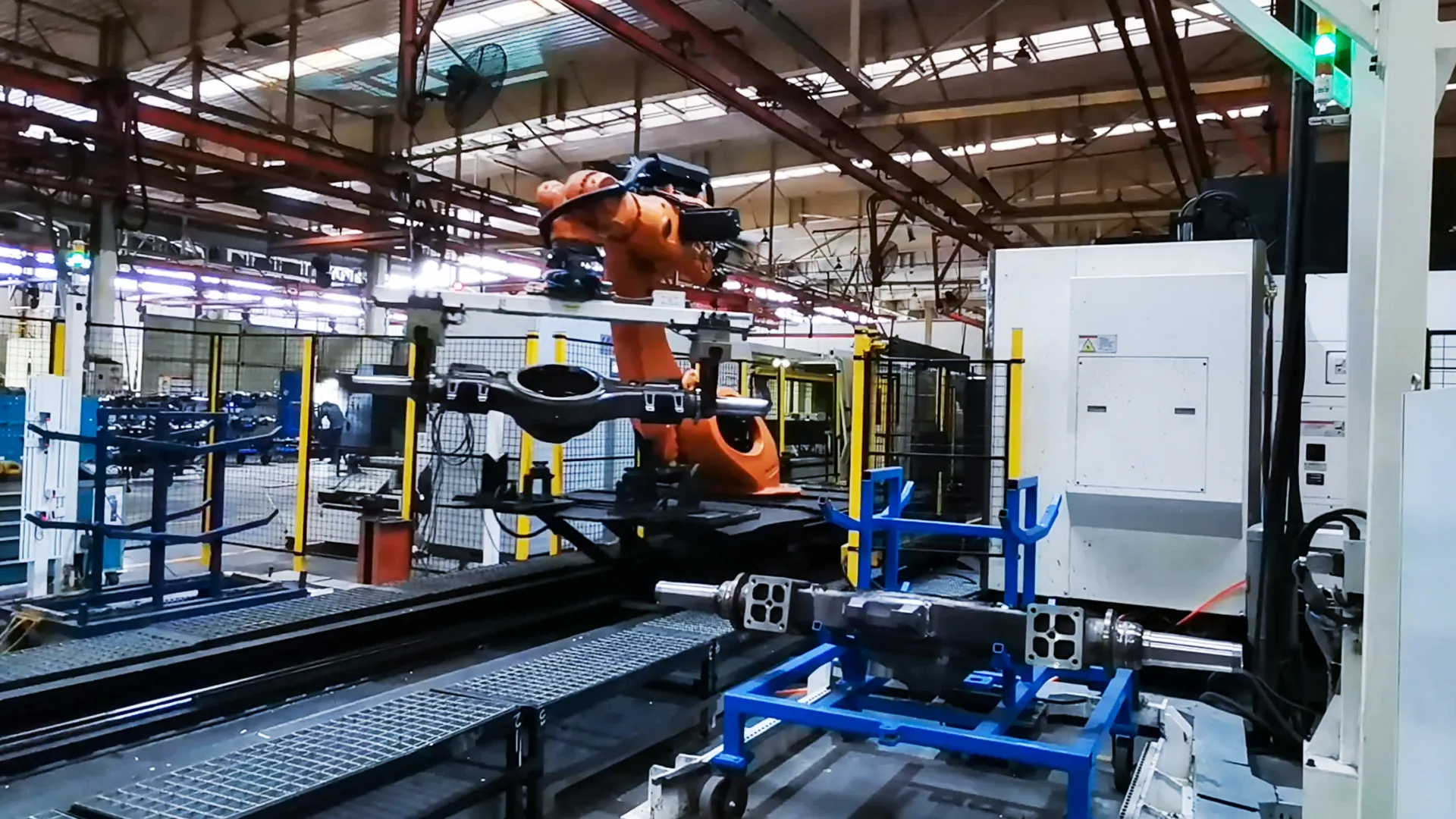
The robot cell shown in Mech-Mind's axle-handling case. Mech-Mind supplies the vision and guidance technology; the pictured arm is one component of the installation. Image: Mech-Mind.
The difficult step is turning an imperfect view of overlapping metal parts into a usable grasp and movement. The chain runs: captured image, 3D point cloud, part position, selected grasp, movement plan and response when a part cannot be picked. A failure anywhere in that sequence shows up as a missed pick, which is why vision and motion planning are usually discussed together.
Mech-Mind's Mech-Vision software builds vision applications, while Mech-Viz handles robot programming and motion planning. The handover between the two is what an engineering team assesses when a part, gripper or robot model changes.
Mech-Mind's Beijing and Shanghai sites are covered in our Mech-Mind guide.
Inspection software and the optics that feed it
Aqrose and AI inspection of adhesive on bolts
Aqrose Technology (阿丘科技) develops industrial AI tools and inspection systems. It has dual headquarters in Beijing and Singapore. A China-focused exchange can concentrate on its Chinese engineering teams and industrial applications. It serves more than 1,200 clients, with over 20,000 AI systems deployed across several industries.
Its differential-bolt case explains a quality-control problem: adhesive can be missing or discontinuous, while conventional threshold-based vision can struggle where the adhesive breaks. The customer is unnamed.
Aqrose's AIDI platform covers image input, labelling, model training, validation and deployment. It supports both supervised and anomaly learning, and includes tools for examining wrong predictions and for monitoring changes in image quality or model performance.
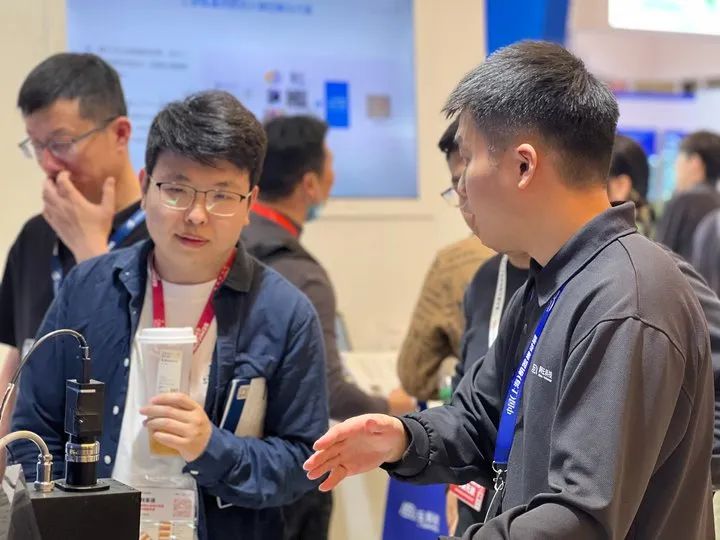
Imaging equipment demonstrated at Aqrose's VisionChina 2025 booth. Photo: Aqrose Technology.
For a quality team, the important thing to see is the decision boundary. Which acceptable variations trigger a false rejection, and which defects are missed, are the two numbers that decide whether an AI model is usable on a line. Comparing training images against a separate test set is how that boundary gets located before a new surface finish or part variant moves it.
OPT and imaging reflective phone frames
OPT (奥普特) is a Dongguan machine vision company listed on the Shanghai Stock Exchange (688686.SH), whose range spans lighting, lenses, industrial cameras, 3D cameras and vision software. Its software products include SciVision, SmartWorks and DeepVision3. Its products are used in more than 20 countries and regions, serving more than 40,000 customers. Optics and algorithms sit in the same company, so their interaction is central to a visit.
OPT's LPF2-018-01 line-laser 3D camera is used for phone-frame inspection. The technical problems include mixed metal and plastic reflectivity, stray reflections around steps and holes, and vibration on a fast-moving line. The solution combines imaging hardware with exposure processing, reflection filtering and vibration-related algorithms.
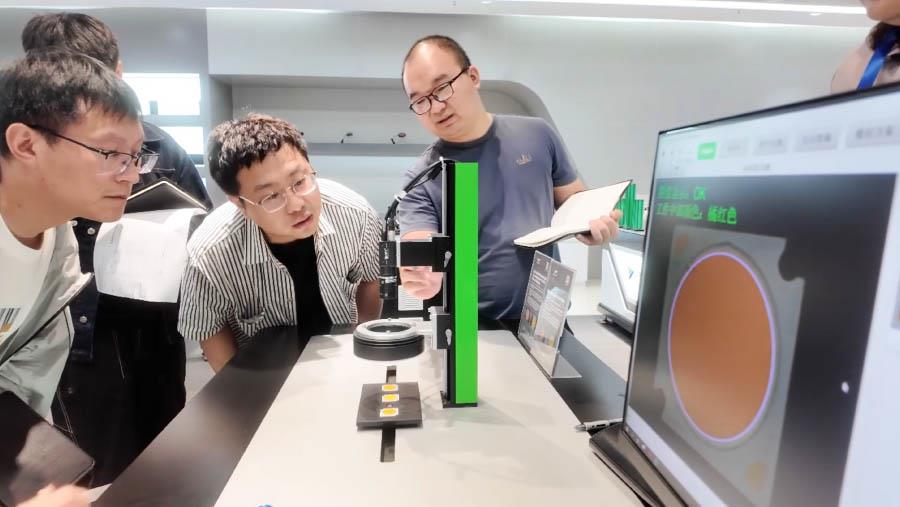
Participants examine an imaging station during OPT's 2026 hands-on training. Photo: OPT, 1 June 2026.
For engineers evaluating inspection software, the input image deserves as close an examination as the model. Much of the improvement in a case like the phone frame comes from lighting, exposure, optics and mechanical stability rather than from the algorithm alone. Measurements on representative parts, under the proposed line conditions and on difficult surfaces and edge features, are what separate a demonstration from a production line.
How to judge which of the five matters to you
Start from one problem your team already has. For factory logistics, that might be coordinating forklifts and lift robots with production orders. For robot guidance, it might be a bin of reflective parts. For quality inspection, it might be a defect whose appearance changes across batches.
That problem determines which of the five is relevant. Shanghai is a starting point for SEER's controller and fleet-software business. Mech-Mind has operations in Beijing and Shanghai, while Aqrose has a Beijing headquarters alongside its Singapore headquarters. Standard Robots was registered in Shenzhen and OPT is based in Dongguan, which puts two of the five in southern China. Locations and technical themes should guide the shortlist before dates are fixed.
A related industrial-AI company is covered in our SmartMore showroom visit in Shenzhen. Comparisons of factory logistics, 3D vision and inspection also run through our China robotics factory tour guide.
Send your institution, preferred cities, dates, participant numbers and learning goals through our programme enquiry form. We will check host arrangements and prepare a proposed programme and quotation. Where your company permits it, a short description of the part, defect or material flow helps us prepare a more specific technical discussion. Companies beyond this sector are listed in our company visits in China directory.
Sample visit programme
The following sequence illustrates a technical exchange with one selected host company. It can be adapted to fleet software, robot guidance or inspection. Session lengths are agreed during planning.
| Segment | Time | What to expect |
|---|---|---|
| Application briefing | Opening session | Review a material-flow, part-handling or inspection problem and the host company's comparable case. |
| Working demonstration | Main session | Follow a transport request, a vision-guided pick or an inspection decision through the relevant software and equipment. |
| Engineering discussion | After the demonstration | Discuss blocked destinations, difficult part poses or false inspection decisions; examine changeover and integration requirements. |
| Technical takeaways | Closing session | Review interfaces, operating trade-offs and questions for follow-up discussion. |
A demonstration is at its best when your team gets a process to follow. For SEER or Standard Robots, follow a job from the factory system to a robot and back. For Mech-Mind, follow an image through localisation and motion planning. For Aqrose or OPT, follow an image or measurement through the quality decision and its review.
Questions about machine vision and robot software companies in China
Which companies can our group visit? SEER Robotics, Standard Robots, Mech-Mind, Aqrose and OPT each provide a different technical starting point for planning. We check the relevant China location, host availability and discussion scope before confirming a programme. Our existing SmartMore programme is an additional industrial-AI showroom option in Shenzhen.
Can we see software working with robots or inspection equipment? Tell us whether your priority is fleet scheduling, 3D robot guidance or AI inspection. We use that to request a suitable demonstration and technical briefing. The agreed programme specifies the equipment and activities included.
Does a published customer case mean we can visit that customer's factory? A company meeting and access to its customer's production site require separate arrangements. We confirm the actual host location and activities during planning. Customer data, source code and proprietary process details are subject to the host's disclosure rules.
How far ahead should we plan? We recommend allowing at least 30 days. Share your proposed dates, participant backgrounds and nationalities early so we can coordinate host scheduling and any registration requirements.
What group size and pricing format apply? Programmes are best suited to groups of 10–20 and are priced by group. Individuals and smaller teams, including two or three people, can inquire; their per-person rate is higher. A tailored quotation sets out the services included, usually covering company arrangements, speaker or briefing fees where applicable, interpretation and on-site support.
How do we request a programme with English interpretation? Submit your institution, group size, dates, preferred cities and technical objectives through our programme enquiry form. China Innovation Visits coordinates company reception, scheduling, discussion preparation, local transport and English interpretation, then provides the proposed programme and quotation.
What should we prepare for the technical discussion? Send a short description of the material flow, part or defect you are evaluating, together with your existing systems and target outcome. Photos, sample parts or anonymised images can help shape the agenda when both sides agree what can be shared.
Final host locations, facilities, demonstrations and meeting participants are confirmed for each programme during planning.