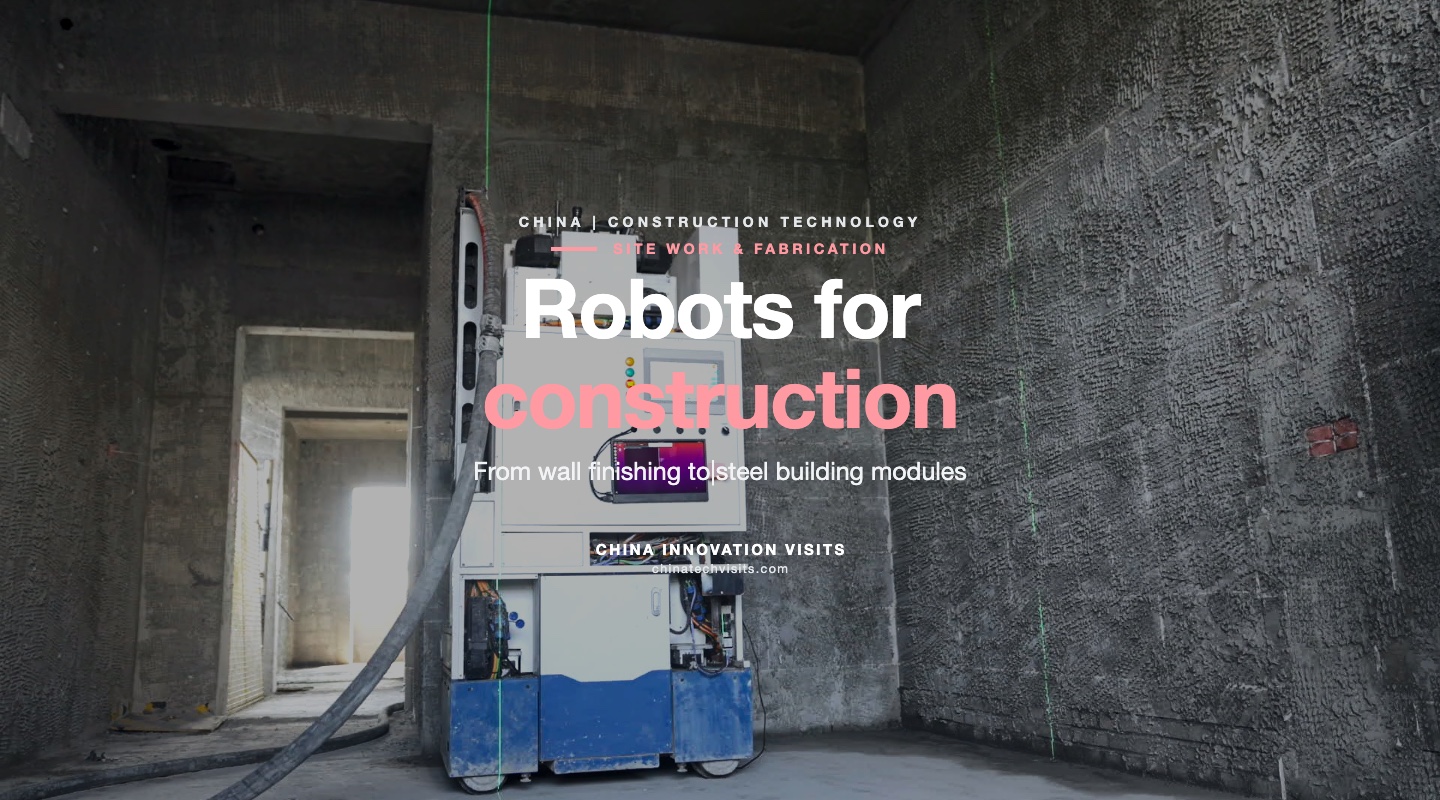
Where construction robots fit on a real project
For a contractor exploring construction robotics in China, the useful starting point is a work package: levelling a concrete floor, plastering an interior wall or welding a steel building module. Each task has different requirements for access, materials, quality control and supervision. A robot that succeeds in a fabrication workshop faces different conditions from one moving through an unfinished building.
Three Chinese companies provide practical entry points. Bright Dream Robotics develops robots for multiple construction stages. WEIBUILD focuses on wall finishing and related site workflows. ROBOTICPLUS connects building models with robotic fabrication in factories. Their projects make it possible to discuss what the machine does, what the crew still handles and how the resulting work is accepted.
For an overseas delegation planning a construction robotics company visit, those distinctions help shape the exchange. The aim is to understand a transferable operating method, including its site requirements and operating arrangements.
Three construction robotics companies to understand
| Company | Headquarters | Main capabilities | Project to examine |
|---|---|---|---|
| Bright Dream Robotics / Bozhilin | Foshan, Guangdong | Concrete placement and finishing, interior finishing and construction workflow coordination | Robots used through different phases of Guangzhou Baiyun railway station construction |
| WEIBUILD | Shanghai | Robotic plastering, paint and putty spraying, room modelling | Plastering subcontract at Shanghai Jiao Tong University School of Medicine's Pudong campus |
| ROBOTICPLUS | Shanghai | RoBIM software and robotic welding, grinding and assembly | Steel modular-building fabrication at CSCEC Hailong's Zhuhai factory |
The first two examples concern work on construction sites. The third concerns off-site production of building components. These are complementary parts of construction automation, with different equipment, work environments and acceptance processes.
Bright Dream Robotics: linking robots to construction stages
Bright Dream Robotics, known in Chinese as Bozhilin, was founded in July 2018 and is based in Shunde, Foshan. Its business combines construction robots, building information modelling (BIM) and industrialised building methods. Its equipment portfolio spans concrete work and interior finishing, giving contractors a way to examine several trades within one technology organisation.
The technical attraction is the connection between the robot and the surrounding construction process. A floor-finishing machine needs a workable surface, material supplied at the right time and a crew able to handle interruptions. A wall-finishing robot has a different operating envelope. Bright Dream's range makes the transition between work packages a useful subject for an engineering discussion.
At Guangzhou Baiyun railway station, robots were used during construction between March 2021 and October 2023. Concrete placement, levelling and floor-finishing equipment supported structural-stage work, followed by coating and wallpaper-related applications during fit-out. This was a sequence of task-specific deployments across project stages.
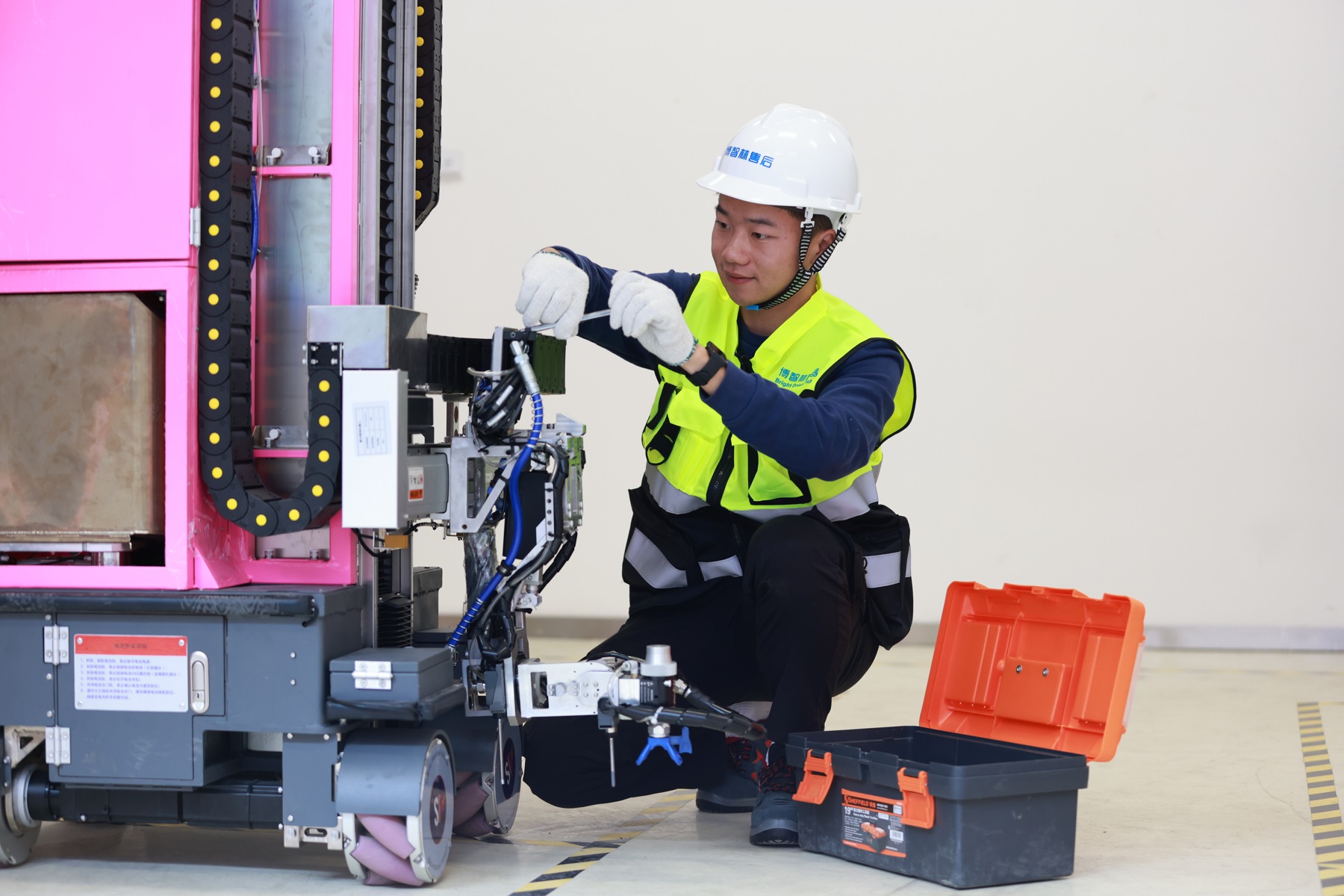
Bright Dream Robotics equipment and technician. Photograph: Bright Dream Robotics. This is an equipment illustration from the company's project article; it is not identified as a photograph of Baiyun station.
A valuable visit would follow one operation from preparation to handover: how the working area is checked, how material reaches the machine, where an operator intervenes and how completed work is inspected. For a general contractor, the broader question is how several robot-supported trades can fit into the project schedule. For a specialist subcontractor, one well-defined task may be the better focus.
WEIBUILD: making robotic plastering part of a subcontract
WEIBUILD, founded in 2020 and headquartered in Shanghai's Baoshan district, develops plastering robots, paint and putty spraying robots, room-modelling equipment and intelligent rebar-processing systems. For a live-site visit, its interior-finishing equipment is the most direct focus. Rebar machinery belongs to a separate fabrication discussion.
Its plastering technology brings together spatial perception, task planning, robot movement and wall treatment. The Hong Kong Construction Industry Council's innovation centre lists WEIBUILD's plastering robots among its construction technology exhibits. This provides a useful technical reference for a contractor comparing wall-finishing systems.
At Shanghai Jiao Tong University School of Medicine's Pudong campus, WEIBUILD worked with a Shanghai unit of China Construction Eighth Engineering Division. The work progressed from an initial trial to a plastering subcontract covering four dormitory buildings. The significance is the delivery responsibility: the discussion can extend beyond machine operation to how a robot-supported crew organises a defined package of wall-finishing work.
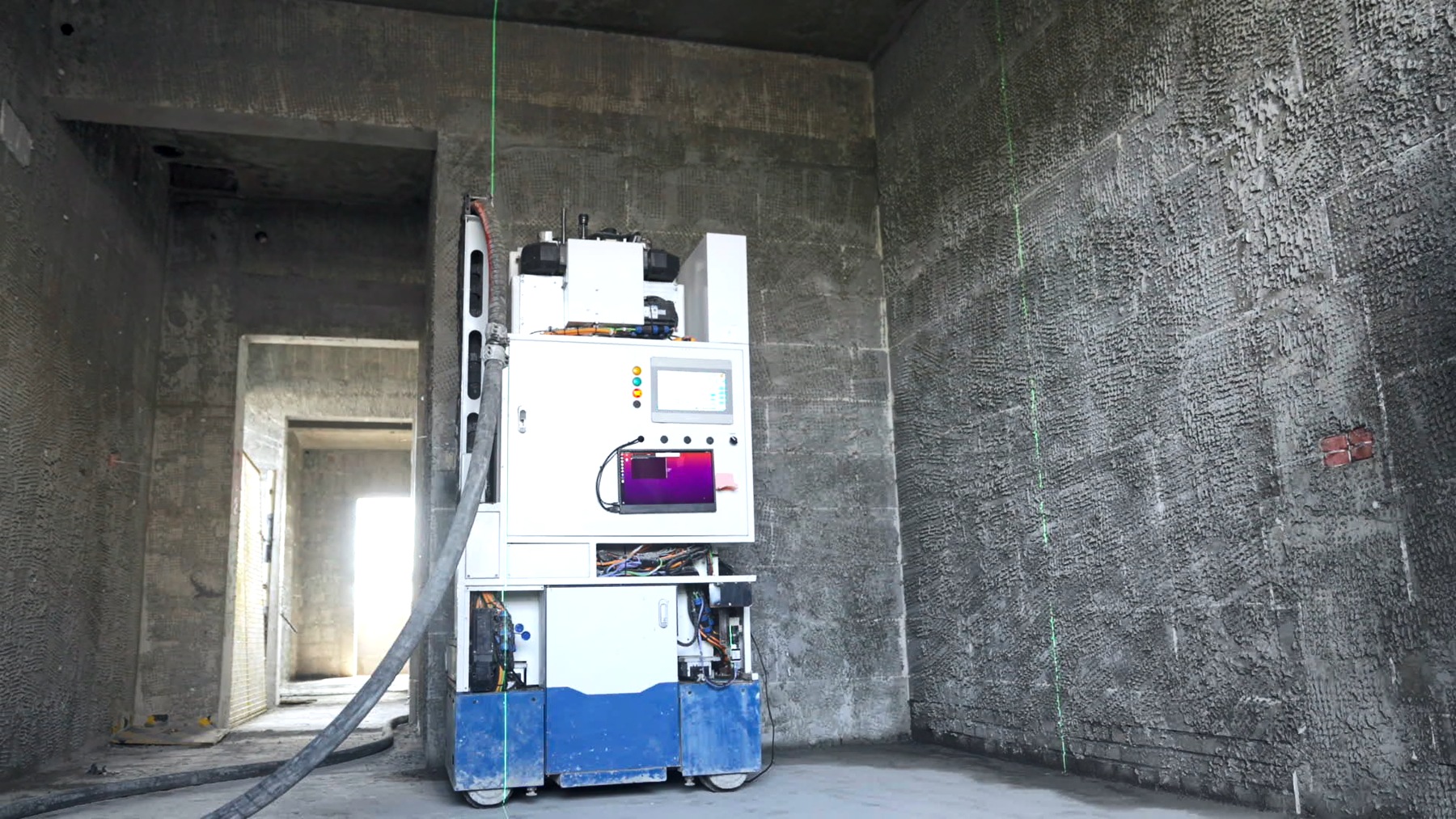
WEIBUILD plastering equipment in a site-testing setting. Photograph: WEIBUILD. The image accompanies the company's development history and is not identified as the Pudong campus project.
For overseas contractors, the practical questions are mortar preparation, room geometry, movement between work areas, treatment around openings and responsibility for final finish quality. Ask the technical team to trace a complete wall cycle, including setup, replenishment, edge work, cleaning and inspection. That is a stronger basis for evaluating labour requirements than the robot's application speed alone.
During a technical exchange, delegations can discuss how such solutions are deployed across markets, whether through equipment delivery, a robot-supported subcontract or local technical partnerships. Each model places training, maintenance and workmanship responsibility with different parties.
ROBOTICPLUS: turning building models into fabrication work
ROBOTICPLUS, also known as Dajie, is a Shanghai-based robotics company whose RoBIM software connects digital models with industrial robot operations. Its construction relevance lies in robotic fabrication, including cutting, welding, grinding and assembly. The company addresses the programming and process-planning problem that arises when building components vary between projects.
In steel modular construction, a robot must work from the component design, the fixture arrangement and the required joining process. ROBOTICPLUS combines model-based planning with robotic cells so the discussion can cover both software preparation and the physical production sequence.
At CSCEC Hailong's Zhuhai factory, ROBOTICPLUS implemented a robotic line for steel modular integrated construction (MiC). The published case connects the work to the Light Public Housing project at Olympic Avenue, Kai Tak, Hong Kong. The line includes floor and roof frame handling, clamping, scanning, welding and grinding, together with column-welding operations.
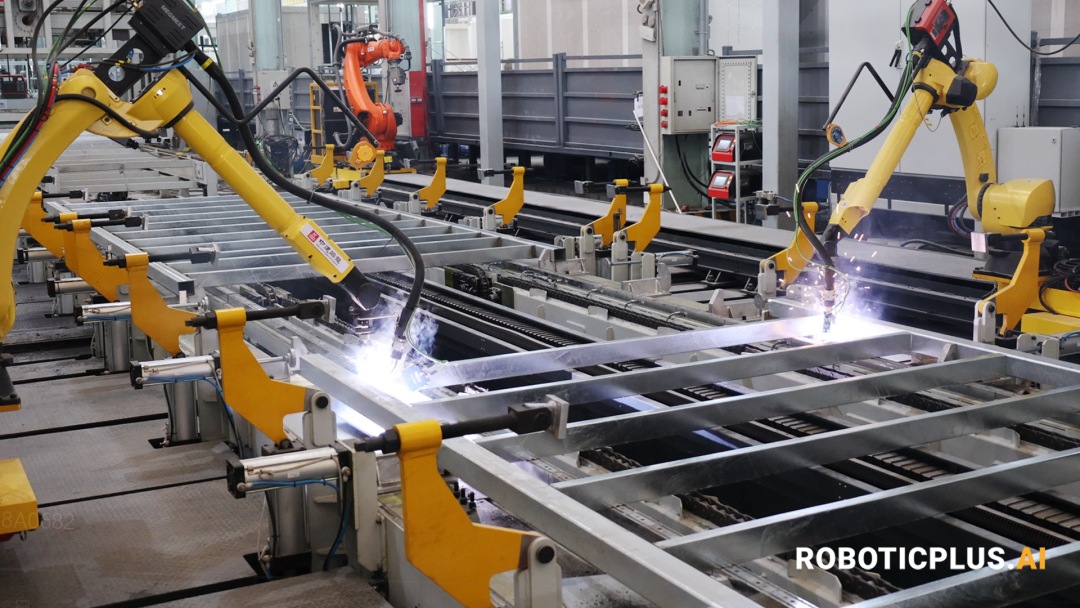
Robotic welding of steel building frames at the Hailong fabrication line. Photograph: ROBOTICPLUS. This is off-site factory production of construction modules.
For a delegation, the most useful demonstration would follow a design change into robot programming, path simulation, fixturing and weld inspection. The site question then becomes how a completed module is transported and assembled. This case does not establish that the welding cell can operate on an open construction site; its value is understanding the factory route to construction automation.
Key operational trade-offs in construction robotics
On a construction site, floor work and plastering depend on the working surface, materials and required finish. Factory fabrication of modular steel components involves a different sequence of fixtures, joining processes and production steps. Each task has its own work boundaries and inspection requirements.
An exchange can trace the full work cycle: survey and setup, material supply, robot movement, human finishing, cleaning and inspection. A demonstration can explain the mechanism, while a project record can show how the machine and crew worked together.
Local materials, site practices and maintenance arrangements also shape how the work is organised. Sharing the work process and setting your group wants to understand in advance can help the host prepare a focused technical exchange.
Planning a construction robotics visit to China
Foshan is the starting point for Bright Dream Robotics. Shanghai supports discussions with WEIBUILD and ROBOTICPLUS. The Hailong application described above is in Zhuhai; ROBOTICPLUS's Shanghai base and that customer factory are separate locations. A programme focused on wall finishing may therefore look very different from one centred on modular-building production.
China Innovation Visits can coordinate a tailored company exchange, technical interpretation and China-side travel arrangements. We build the proposal around the task your team wants to examine, the host's available equipment and the level of engineering discussion required. Request a construction robotics visit with your organisation, dates, participant roles and target work package. For the underlying perception and programming technologies, see our machine vision and robot software guide.
Sample visit programme
This example is for a selected company. A final proposal identifies the venue, equipment, meeting participants and session lengths.
| Segment | Time | What to expect |
|---|---|---|
| Project and work-package briefing | Opening session | Review the delegation's construction task and a relevant deployment, including the contractor and operator roles. |
| Equipment and process demonstration | Main session | Follow one plastering, floor-work or fabrication operation, including setup and human intervention. |
| Engineering review | Technical discussion | Examine materials, geometry, process data, quality inspection and workflow constraints. |
| Operations and exchange wrap-up | Closing session | Review workflow boundaries, crew coordination, maintenance considerations and open questions for follow-up. |
Questions about construction robotics visits
Can these robots work on a live construction site? Bright Dream Robotics and WEIBUILD have site-work examples, including concrete and interior-finishing tasks. ROBOTICPLUS's Hailong example is a factory production line. The proposal should specify the task and setting so your team can judge relevance to its own projects.
Does a company visit include access to the named customer projects? The cases explain the technology and its delivery context. Customer-site or factory access requires a separate arrangement with the relevant host and operator. A company meeting can still cover equipment, workflow and project experience when a customer site is unavailable.
Which company should our delegation prioritise? Bright Dream Robotics is relevant to a broader construction-stage discussion. WEIBUILD is particularly relevant to wall-finishing work packages. ROBOTICPLUS suits teams studying model-driven fabrication and steel modular construction. Your target task and current delivery method should guide the choice.
Can we discuss how these technologies apply to our own projects? Yes. Sharing your target work package, site conditions or technical questions in advance helps the host prepare a focused engineering discussion. Any subsequent commercial evaluation is handled separately.
How do we arrange a visit and receive a quotation? Send your preferred dates, group size, participant roles, city preferences and technical objectives through the enquiry form. The proposal sets out company arrangements, interpretation, local transport and any other included services. Timing is agreed around host availability and the required demonstration setting.
Final host locations, equipment, demonstrations, meeting participants and customer-site access are confirmed during programme planning.