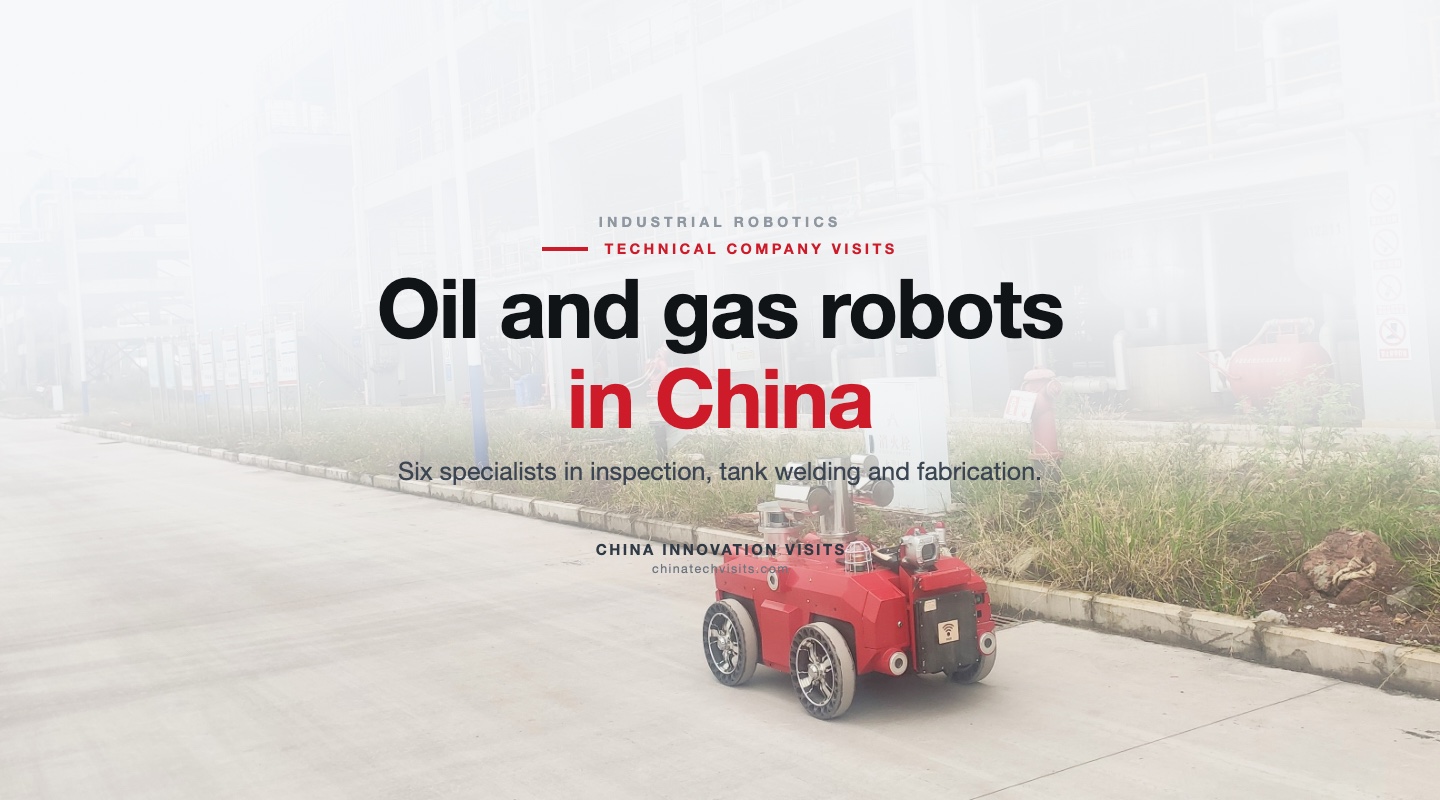
Oil and gas robotics for industrial teams
China's robotics specialists offer practical technologies for inspecting chemical facilities, monitoring oil and gas stations, welding storage tanks and fabricating industrial equipment. For overseas refinery operators, engineering contractors and digitalization teams, a focused company visit can connect these technologies with the tasks they are evaluating at home.
This guide introduces six Chinese companies: SEVNCE Robotics, Elitenect Technologies, ANCN, BOTSING Technology, Guochen Robot and Xingjian Robotics. Their capabilities span mobile inspection, tank welding and automated fabrication. Each offers a different technical conversation, from detecting equipment abnormalities to following a weld seam across a steel structure.
Request a tailored oil and gas robotics visit with your organisation, preferred dates, group size and priority applications. China Innovation Visits can help develop the company shortlist, technical agenda and travel arrangements around those objectives.
Six Chinese companies and their engineering strengths
| Company | China base | Technology focus | Useful technical discussion |
|---|---|---|---|
| SEVNCE Robotics | Chongqing | Explosion-proof inspection platforms and equipment sensing | Matching a mobile platform and sensor package to a chemical unit |
| Elitenect Technologies | Beijing | Inspection robots, positioning, navigation and industrial vision | Reliable patrol routes and usable inspection data in complex plants |
| ANCN | Xi'an | Oil and gas instrumentation and inspection robots | Combining instrument knowledge, mobile sensing and remote operations |
| BOTSING Technology | Beijing | Trackless crawling welding robots | Seam following and welding automation on large tanks and steel structures |
| Guochen Robot | Hangzhou | Wheeled and rail-mounted inspection systems | Selecting ground or overhead patrol routes and integrating monitoring |
| Xingjian Robotics | Wuhu and Harbin operations | Robotic cutting, welding and fabrication equipment | Automating the production of pipes, pressure vessels and industrial structures |
SEVNCE, Elitenect, ANCN and Guochen supply inspection technology. BOTSING addresses welding on large structures, while Xingjian brings a workshop and equipment-manufacturing perspective. In practice the programme follows the engineering task, not the company list.
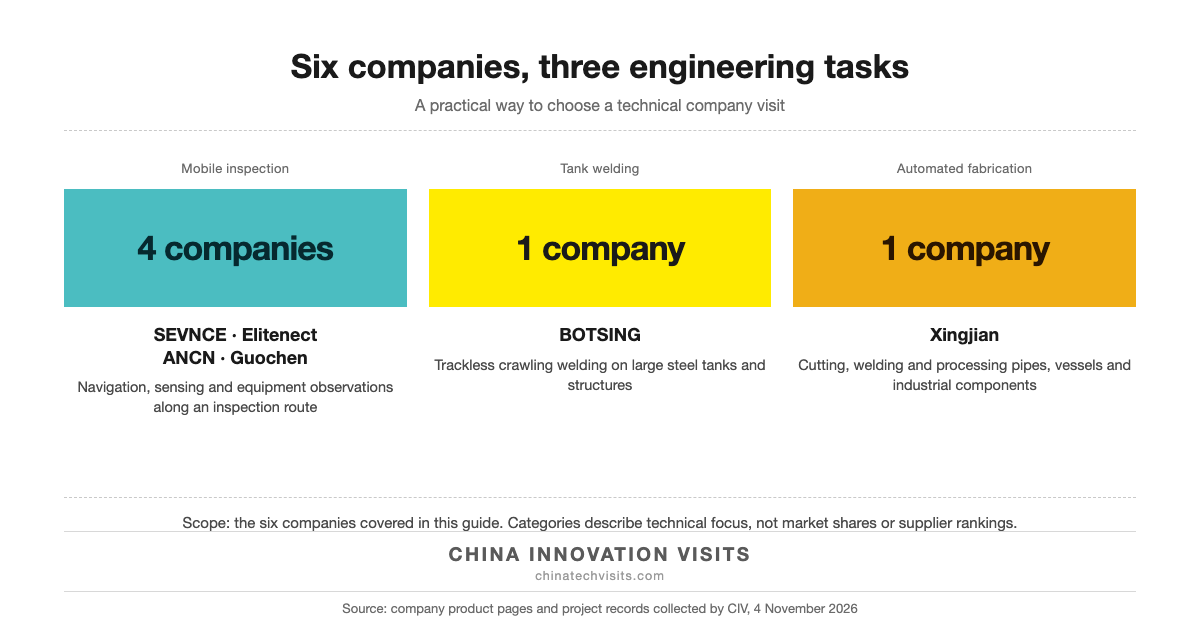
The six companies in this guide cover three engineering tasks. The grouping describes their focus in this article; it is not a market-share comparison. Source: company product information and the project records linked below.
SEVNCE Robotics for inspection in hazardous industrial areas
SEVNCE Robotics (七腾机器人) develops inspection robots for industrial environments where operators need to monitor equipment while limiting routine exposure to hazardous areas. Based in Chongqing, SEVNCE develops wheeled, quadruped and rail-mounted robots for industrial inspection. Its platforms combine mobility with sensors selected for different operating environments.
Its engineering strength is the combination of mobility, industrial sensing and application-specific inspection. A robot has to reach the inspection point and hold its sensors steady enough to produce a reading. After that, the abnormality has to reach plant staff in a form they can act on.
A Beijing municipal equipment case file describes SEVNCE's solution for the phosgene process area at Chongqing Changfeng Chemical. The application combines gas detection, thermal imaging and monitoring of acoustic and vibration abnormalities. A separate 2024 government application list records its wheeled robot inspecting equipment in an unnamed EVA production unit.
Both cases give a delegation something concrete to press on. Platform choice comes first, then where the sensors sit and how a route repeats day after day. What happens when an alarm fires is worth asking about too. Better still, ask the engineering team to walk you through how an inspection requirement turns into a configured robot and a daily routine.
SEVNCE's April 2026 memorandum with BASF adds a relevant partnership topic: the companies agreed to explore inspection applications and materials innovation. The announcement concerns cooperation and future applications.
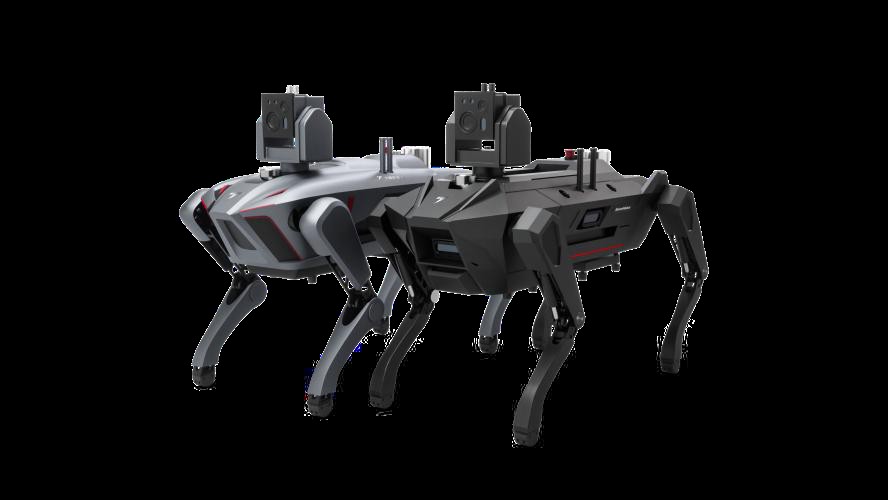
SEVNCE quadruped product illustrations in Beijing's equipment catalogue. The Changfeng application described above concerns wheeled inspection. Source: Beijing Municipal Bureau of Economy and Information Technology, 2025.
Elitenect Technologies for navigation and inspection in complex plants
Beijing Elitenect Technologies Co., Ltd. (北京眸视科技有限公司) develops inspection robots and software for energy and chemical facilities. Its capabilities include mapping, positioning, navigation, obstacle avoidance and industrial image analysis.
These capabilities matter because inspection is a repeatable measurement task. Reaching a valve or instrument is only part of the job. The robot also needs a viewing position it can hold, a route that stays workable as the plant changes, and some way to tie each observation back to the right asset.
A Workers' Daily report published on 19 November 2025 describes a pipe-corridor robot system at Guangdong Petrochemical using Elitenect's positioning and navigation system. It had been in trial operation for more than a month when reported. This provides a specific refinery application for discussing navigation; the report does not identify the full system's contractual supply scope.
Elitenect also won a pump-house robot inspection system procurement on China Coal's official platform in November 2023. That award concerns a separate industrial setting.
Digitalization and reliability teams tend to want the same thing: to see a patrol route turn into an asset record. That means mapping the environment, recognising inspection points and passing exceptions to an operator. Ask for one observation to be traced through the software, from capture to the person who acts on it.
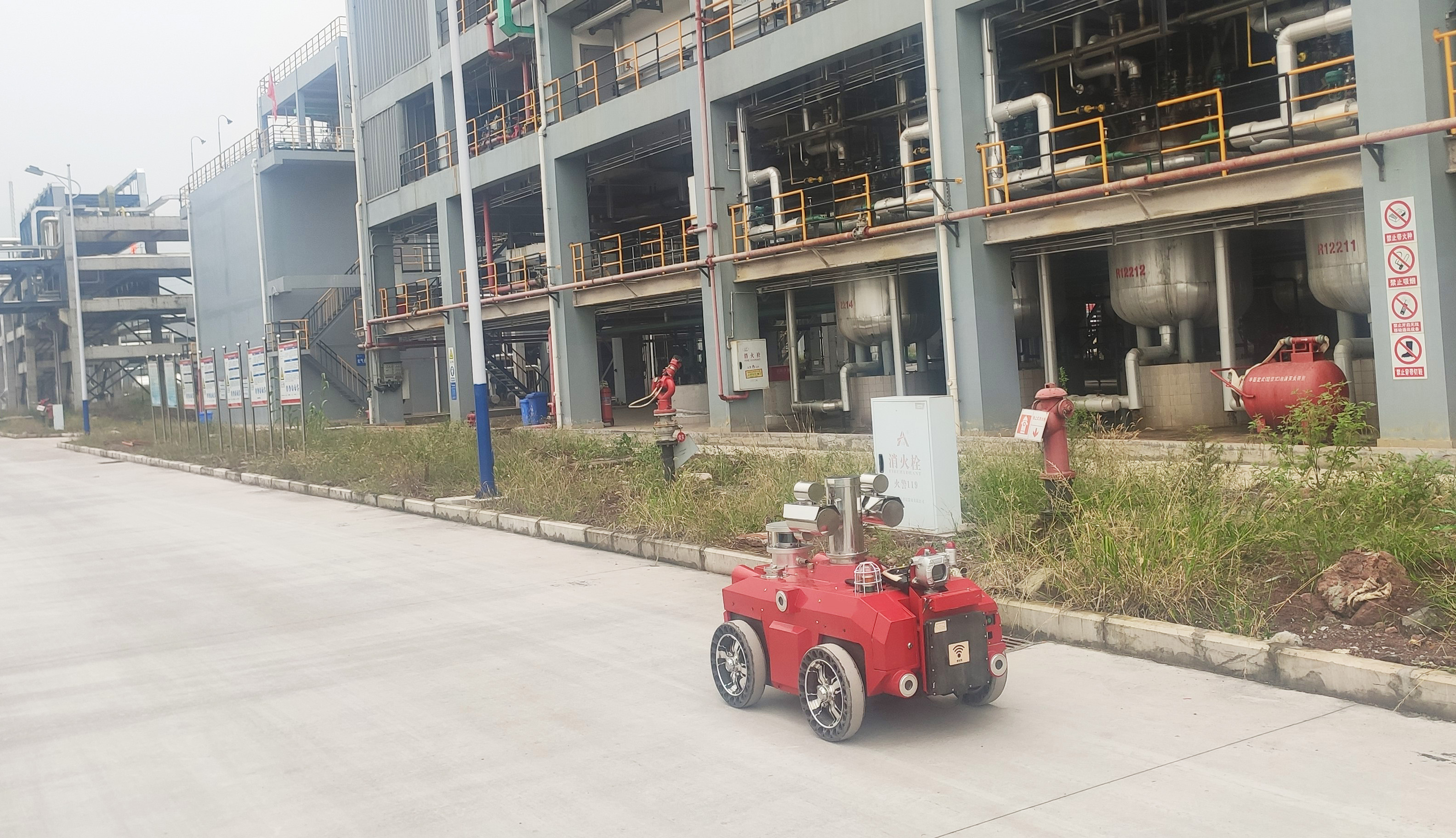
An Elitenect wheeled inspection robot beside industrial process equipment, shown on the supplier's website. The photograph is not attributed to the Guangdong Petrochemical project. Source: Elitenect Technologies.
ANCN for oil and gas instrumentation and robotic inspection
ANCN (西安安森智能仪器股份有限公司) combines oil and gas instrumentation, field digitalization and inspection robots. For an overseas team, that combination is the interesting part: how a mobile robot reads the instruments a station already has.
Its ACR-3 wheeled inspection platform uses lidar and inertial navigation, a suspension system and multiple sensing devices. The product description covers autonomous inspection and the detection of equipment or environmental abnormalities. Its wider range also includes rail-mounted inspection equipment.
There is a documented history of field application. A supplier project account from November 2019 records the ACR-1B in use at a Sulige gas-field gathering station, reading instruments and reporting abnormalities. A 2019 China National Radio interview also describes application at gathering stations, a natural gas processing plant and product oil depots. These are historical oil and gas references; Sulige is an upstream gas application.
Teams weighing how instruments, patrol routes and remote operations fit together will find the most to discuss here. Where it gets specific: reading different instrument types, telling a real change from a poor observation, and keeping the robot's sensors serviceable in field conditions. The answers are what let a refinery team judge the fit with its own equipment and operating environment.
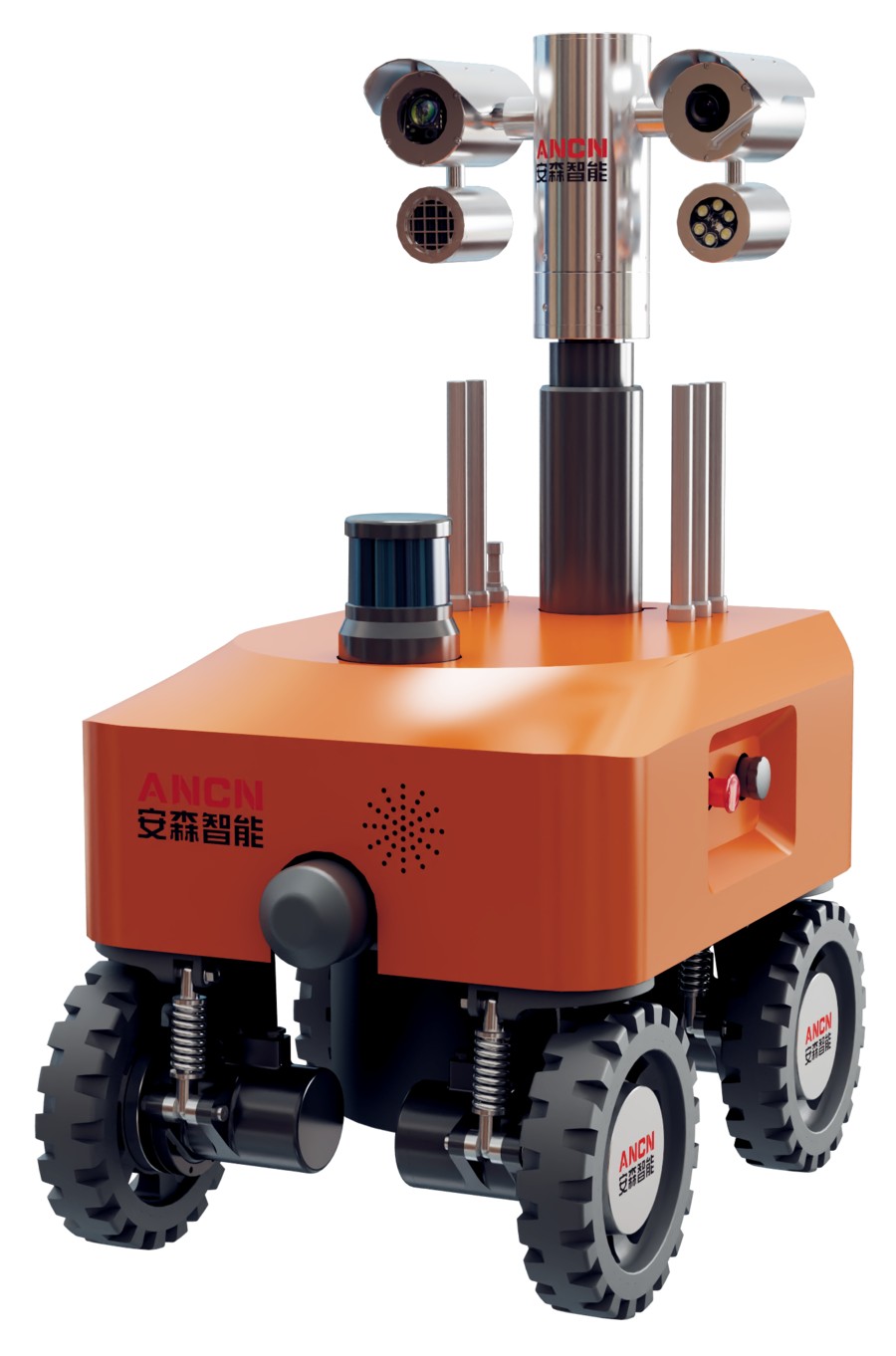
The ACR-3 wheeled inspection robot shown on ANCN's product page. This is a product illustration, not a photograph of the 2019 Sulige installation. Source: ANCN.
BOTSING Technology for tank welding and large steel structures
BOTSING Technology (北京博清科技有限公司) develops trackless crawling welding robots. Its technology addresses a physical production task: moving along a steel structure and following a weld seam without installing a guide track along the welding path.
Tank builders and engineering contractors meet a different automation problem here than inspectors do. Welding position and seam geometry set the constraints. Process consistency then depends on how operators set up and supervise the equipment on a structure that large.
A 2021 project account describes BOTSING's joint application appraisal with Sinopec Fifth Construction and tank-welding work at the Zhanjiang Zhongke refinery and petrochemical integration project dating back to 2018. In August 2026, Beijing E-Town reported the joint release of a robot for welding storage-tank floating-roof pontoons with a Xinjiang petroleum engineering company, following a research project begun in 2022.
Its overseas work is where implementation gets concrete. A 2023 government report records delivery and on-site welding verification for a project with Japan's OKAYA & CO., LTD. BOTSING separately describes commissioning and operator training on an overseas China 15th Metallurgical construction project.
Seam tracking and setup procedures are the substance of a technical visit; welding-process control and operator training decide whether the equipment earns its place on site. A refinery delegation should treat this as a tank-construction topic rather than an inspection one.
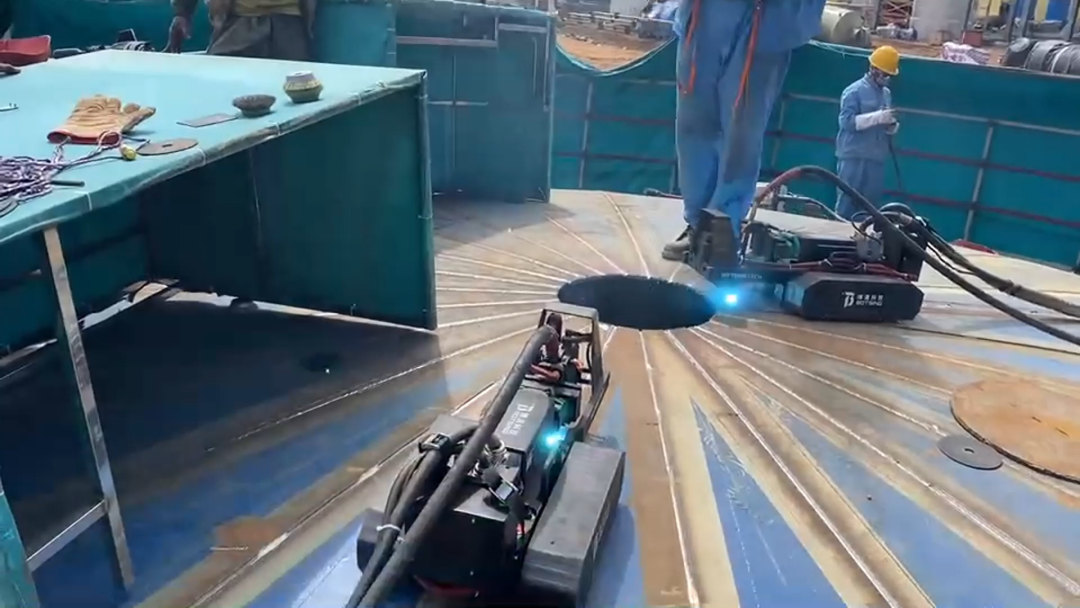
Two BOTSING robots welding a tank roof in the supplier's account of an overseas China 15th Metallurgical construction project. Source: BOTSING Technology. The image is separate from the Zhongke refinery reference.
Guochen Robot for wheeled and rail-mounted inspection
Guochen Robot (杭州国辰机器人科技有限公司) offers two inspection approaches worth comparing: a wheeled platform travelling at ground level and a robot moving along an installed overhead rail.
Its rail-mounted product lists patrol, leak and environmental monitoring, automatic charging and transmission to a monitoring platform. Its wheeled inspection product offers another configuration for collecting readings along a selected route. Together, they create an engineering discussion about how the robot and the facility layout should work together.
For a pipe corridor, equipment room or chemical production area, the questions are practical. Where can a ground robot travel? Which equipment can an overhead sensor reach? What installation work does a rail route require? How are observations linked to the monitoring system?
Guochen's 2023 petrochemical article describes its inspection approach and industry applications without naming individual clients. So pair the product demonstration with a request for a comparable project reference. What your team gains is a comparison of two kinds of mobility against a plant layout you already know: ground travel, and an overhead rail with the installation work it brings.
Xingjian Robotics for industrial cutting and welding automation
Xingjian Robotics (行健机器人) brings an equipment-manufacturing perspective to this guide. Its equipment range covers robotic cutting, welding, pipe processing and tube-sheet fabrication, with operations in Wuhu, Anhui, and Harbin.
This direction is relevant to companies making or sourcing pressure vessels, pipework and industrial steel structures. A technical discussion can connect part geometry, welding access, tooling and production flow with the choice of automation.
Engineering and equipment teams get the most from two questions: how a workpiece is positioned, and how the cutting or welding path is prepared for it. How operators cope with different part sizes usually follows. Ask to follow one component through the manufacturing process, then discuss the process boundaries and operating questions. Choose the host site around the fabrication process and workshop that match.
Connecting robots with industrial AI and maintenance
Inspection robots collect instrument readings, images, temperatures and other observations. Their value to a refinery depends on how those observations support an operating or maintenance decision.
An industrial AI team should follow the data path, not the hardware. Identify the asset, capture the observation, detect the abnormal condition, let someone review it, then connect the result to the plant's maintenance workflow. Interfaces, asset naming, data quality and human review end up mattering as much to the visit as the robot's mobility.
For predictive maintenance or digital-twin projects, bring a specific use case to the meeting. Explain which equipment is involved, what data already exist and what decision the team wants to improve. Ask the technical team to show the relevant functions and explain the integration points.
For welding and fabrication, a technical discussion can cover the workpiece, process requirements, quality inspection and operator training.
Sample visit programme
What follows is a starting point for a technical company visit. Session lengths get agreed when the programme is prepared.
| Segment | Time | What to expect |
|---|---|---|
| Application briefing | Opening session | Explain the plant task, equipment and current workflow; review the host company's relevant products and project experience. |
| Product demonstration | Main session | Examine the selected inspection, welding or fabrication equipment and discuss how it performs the task. |
| Engineering discussion | Following the demonstration | Work through navigation and sensing, data interfaces or welding setup, according to the selected technology. |
| Technical takeaways | Closing session | Review operating constraints, integration points and questions for follow-up discussion. |
Inspection teams have four starting points here: SEVNCE, Elitenect, ANCN and Guochen. Tank-construction teams will get further with BOTSING's welding focus, and equipment manufacturers should add Xingjian for cutting and fabrication automation.
China Innovation Visits helps turn the chosen technical focus into a company-visit brief and proposed programme. Our power robotics guide covers related inspection and maintenance technologies, while our robotics industry chain map explains the wider industry chain.
Questions about oil and gas robotics company visits
Which of these companies is most relevant to a refinery team? Start with the task. Mobile inspection points towards SEVNCE, Elitenect, ANCN or Guochen; storage-tank welding towards BOTSING; equipment fabrication towards Xingjian. Bring the equipment type, operating environment and expected outcome so that the shortlist reflects the team's technical objective.
Can a programme include an operating refinery or chemical plant? An operating-site visit requires the plant owner's approval and a separately confirmed scope. A company workshop, a product demonstration or an engineering discussion can provide another way to explore the technology. We establish the agreed facilities and activities with each host before the programme is confirmed.
Can these visits cover industrial AI and predictive maintenance? They can provide a focused discussion of inspection data, equipment abnormalities and maintenance workflows. The agenda can also address interfaces with existing plant systems. The proposed programme should identify the specific software functions and integration topics to be demonstrated or discussed.
Can we request meetings with engineers or technical leaders? Yes. Tell us the technical roles and topics that matter to your team. We use those requirements in the host brief and confirm the proposed meeting format and participants during planning.
Can a small executive or technical delegation enquire? Yes. Programmes are priced for groups, with 10–20 participants generally offering better per-person economics. Smaller delegations, including teams of three, can request a tailored quotation; their per-person cost is usually higher. Accommodation, transport and interpretation are included according to the agreed scope.
How far in advance should we plan? We recommend allowing at least 30 days for company coordination and travel planning. For shorter lead times, send the intended dates and priority topics so that availability can be checked before travel arrangements are committed.
What information should we send for a proposal? Include your organisation, participant roles, group size, dates, city preferences and two or three priority applications. A short description of the relevant assets, existing systems and technical questions helps the host prepare the discussion.
Public project references are dated in the relevant sections. Final meeting participants, facilities and activities are confirmed for each programme.
Plan a technical robotics visit to China
Choose the questions you want your team to answer: how a robot inspects a process area, how observations support maintenance, how a welding robot follows a tank seam, or how fabrication equipment fits a production workflow.
Request your customised company-visit programme. Share your preferred dates, delegation size and priority applications, and China Innovation Visits will prepare a proposed shortlist and programme for discussion.