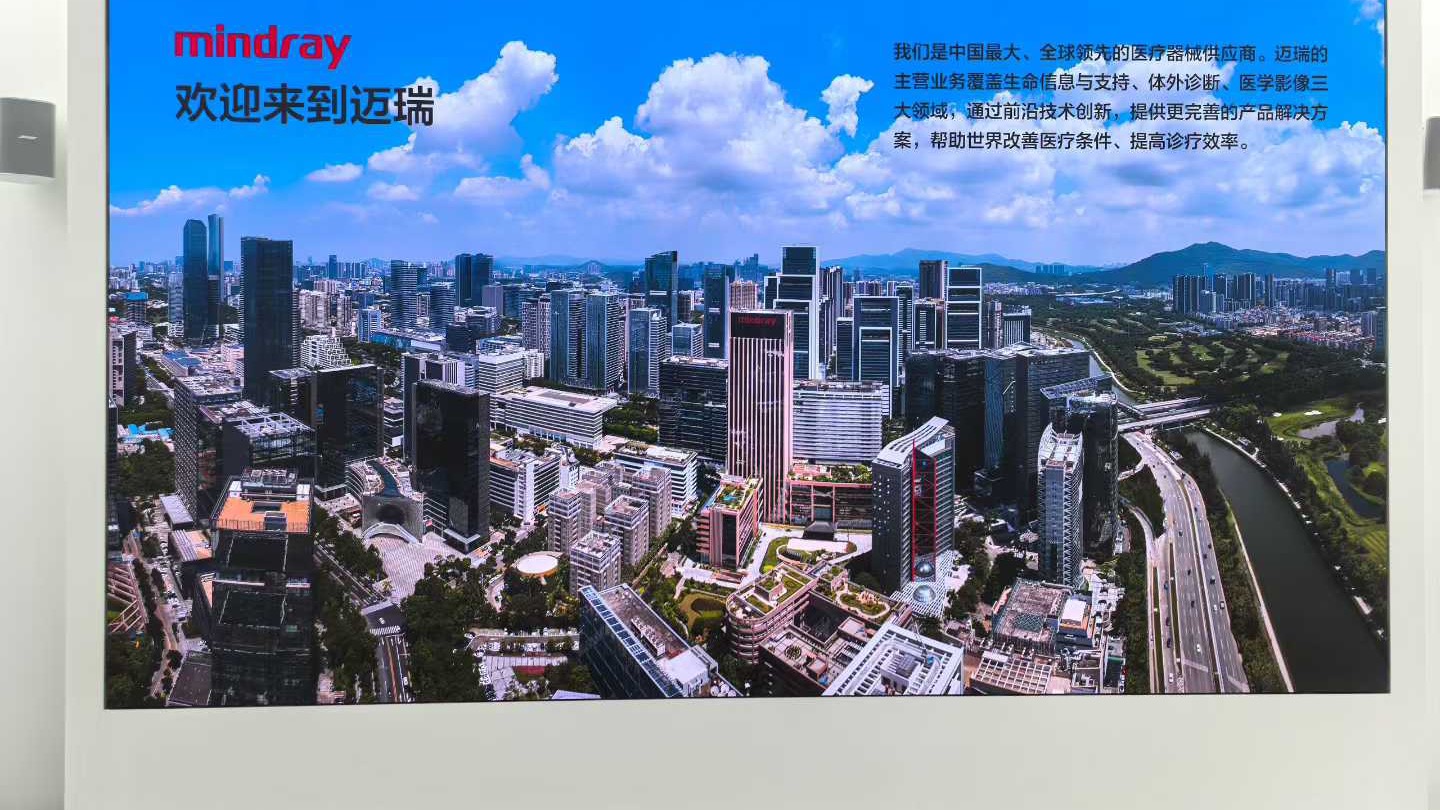
Mindray medical visit in Shenzhen at a glance
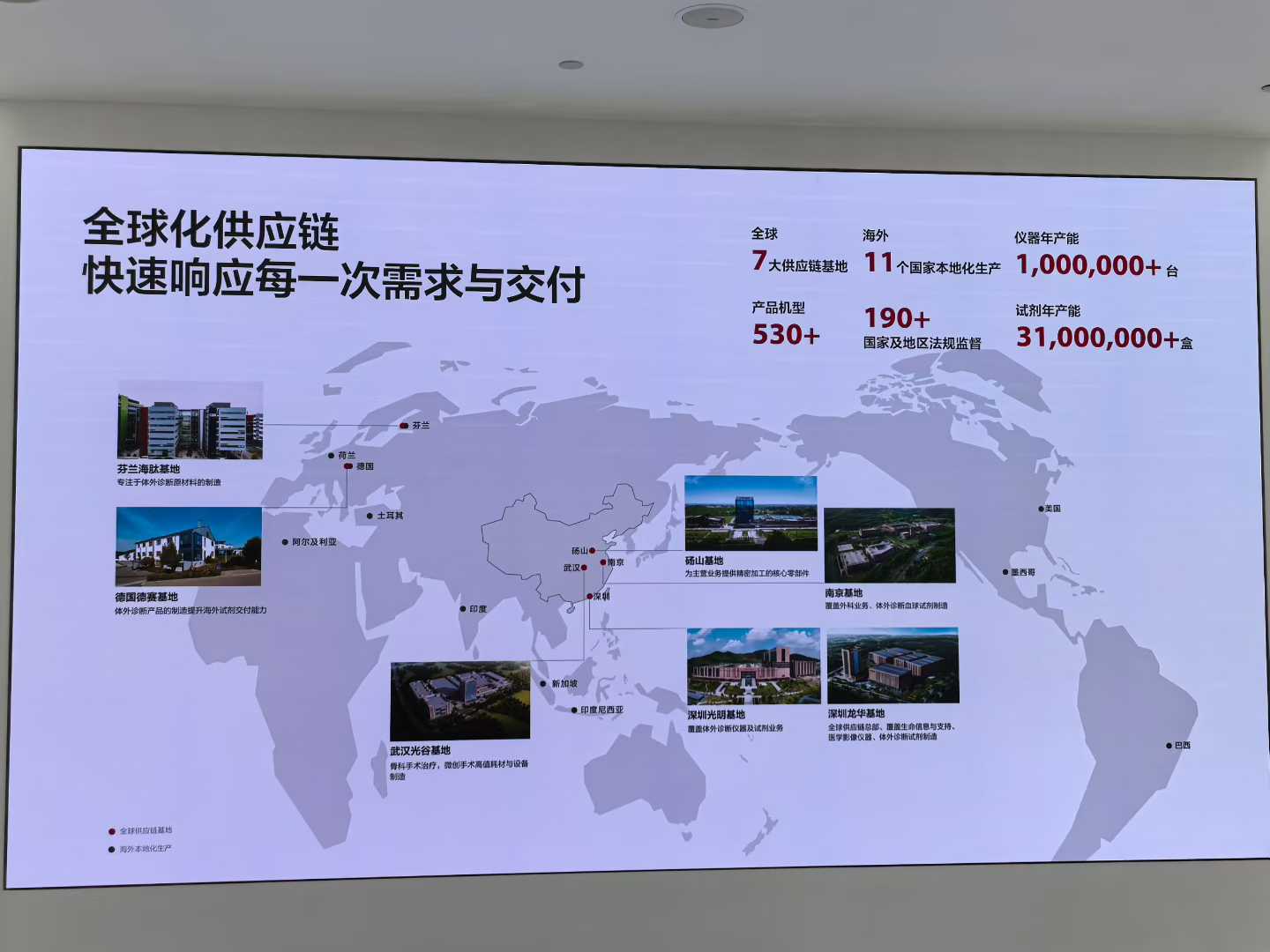
Mindray is China's largest medical-device maker and one of the few that sells into the most demanding hospital markets in the world. Its equipment reaches more than 190 countries and regions from a base in Shenzhen, with seven manufacturing centres, localised production in ten countries, 12 R&D centres and more than 530 product types. The company also spends over 10% of annual revenue on research and development — a number that shows up on the exhibition floor rather than in a slogan.
A visit here is a half day, built around four stages: the exhibition hall, a research or manufacturing area, a session with the company's R&D and overseas teams, and open discussion. It suits healthcare, medical-device, manufacturing and outbound-expansion groups, and it works as one stop inside a longer Shenzhen itinerary.
The export side of Mindray's business — how it turned overseas markets into its largest revenue source — is covered separately in our Mindray overseas analysis.
What you see on the visit
The exhibition hall: three business lines under one roof
The hall is organised around the three businesses Mindray runs: patient monitoring and life support, in-vitro diagnostics, and medical imaging. In practice that means monitors, ventilators, anaesthesia machines and infusion pumps on one side; blood cell analysers, biochemistry and chemiluminescence systems on the other; and ultrasound systems alongside them.
What makes the arrangement useful is that the equipment is displayed in clinical context rather than as isolated boxes — a monitor shown with the ventilator and anaesthesia machine it works beside in an operating theatre, a laboratory line shown as a sequence from sample loading to reported result. For a delegation, this is where the level of Chinese medical equipment becomes concrete instead of abstract.
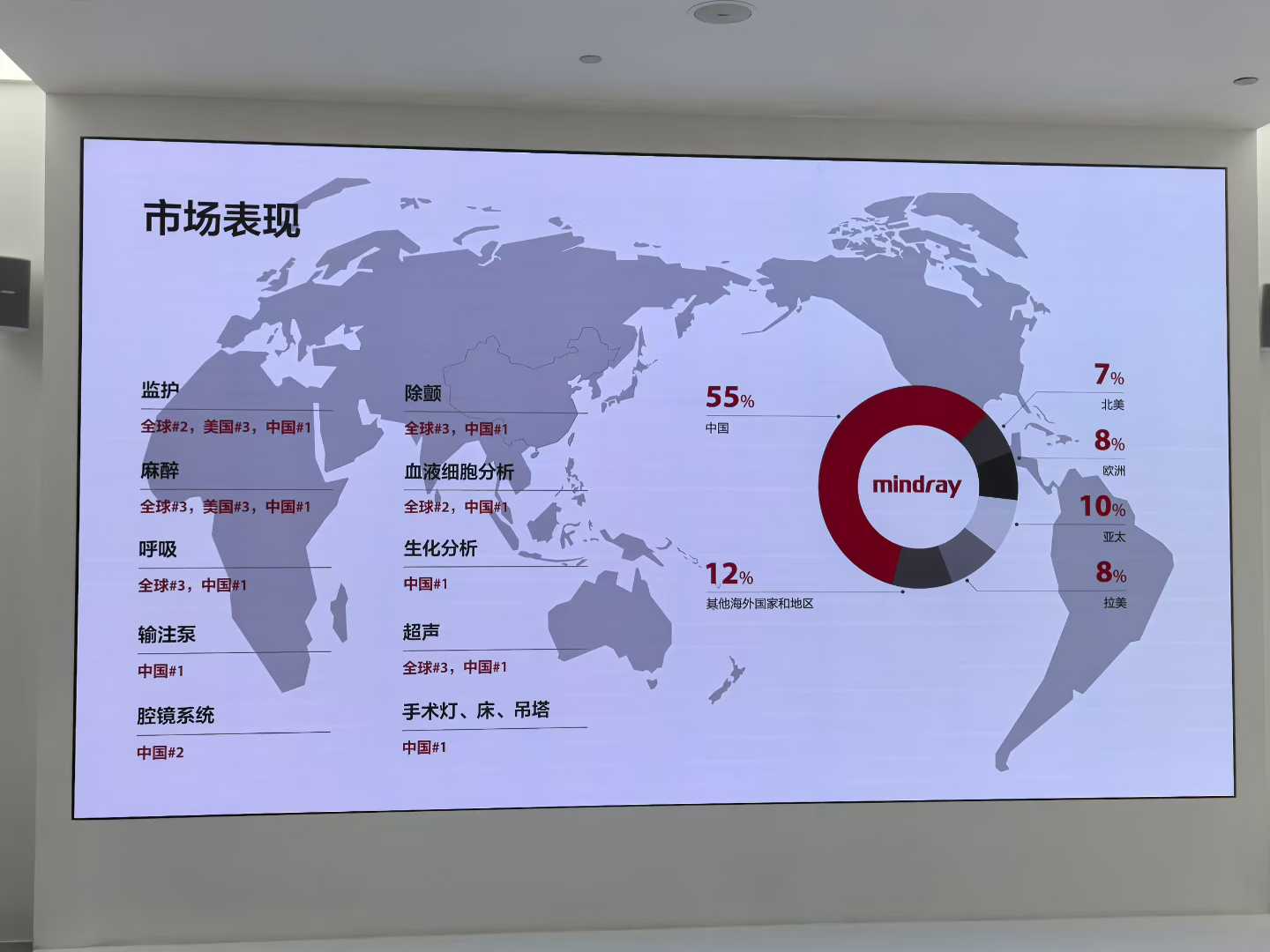
A second display covers the supply chain and market picture: seven manufacturing centres, localised production in ten countries, and the position each product line holds in its market — patient monitoring ranked second globally and first in China, ultrasound and anaesthesia in the global top three, blood cell analysis second globally. For visitors trying to judge where Chinese medtech actually stands, this wall answers the question faster than any brochure.
The digital ecosystem
The more interesting half of the hall is not hardware. Mindray presents three digital systems as a set: a hospital-wide device network that connects monitors, ventilators and other equipment into one managed system; a laboratory automation system covering the workflow from sample handling to report generation; and an imaging platform for remote and collaborative diagnosis. Alongside them sits the company's medical AI work, which now spans several clinical models rather than a single product.
For hospital administrators, IT leads and healthcare investors this is usually the most valuable stop, because the equipment itself is internationally comparable while the digital layer is where the local operating model differs.
Research, manufacturing and quality
The second stage moves into a research laboratory or a smart manufacturing area, depending on the day's arrangement. The subject here is not scale but control: how core modules and algorithms are developed in-house, how a medical-grade quality system is built and audited, and how automation is deployed in an environment where a defect is a clinical risk rather than a returns problem.
Photography and access in this area are restricted by the host, so the visit is guided rather than free-roaming.
Sample visit programme
| Segment | Time | What to expect |
|---|---|---|
| Exhibition hall | 30 min | The three business lines — life support and monitoring, in-vitro diagnostics, medical imaging — presented in clinical context, plus the supply-chain and market-position displays |
| Research laboratory or smart manufacturing area | 45 min | In-house module and algorithm development, medical-grade quality control and automation on the production side; access and photography follow the host's rules |
| Session with R&D and overseas teams | 55 min | A discussion with the company's research and international business leads, with time reserved for questions from the group |
| Open discussion and follow-up | 50 min | Further questions, topic-specific discussion for your sector, and planning of any follow-on meetings |
The half day runs around three hours in total.
What you can learn
The first lesson is what medical-grade quality actually demands. In consumer electronics, a defect is a cost. In medical devices it is a clinical event, and the systems built around that difference — traceability, verification, documentation, change control — are visible on this visit in a way that a product catalogue cannot convey.
The second is how a Chinese manufacturer moved upmarket. Mindray competes in hospitals in Europe and North America, not only on price but on the quality systems and certifications those markets require. For manufacturing teams, the question worth carrying away is which of their own processes would fail if the customer audited them the way a hospital does.
The third is the shift from selling equipment to running an installed base. The digital systems on display are an attempt to stay in the customer's workflow after the hardware is delivered — a pattern that repeats across Chinese industrial companies, and one that healthcare and service businesses can examine here in detail.
Questions and answers
How long is the visit? Half a day, around three hours, following the four stages above.
Where does it take place? At Mindray's Shenzhen headquarters and exhibition facilities. Specific buildings and areas depend on the host's arrangement for the day.
How far in advance should we book, and how large can the group be? We ask for at least 30 days' notice and a minimum group of 10. Large groups are split for parts of the programme, including any production area. For tighter timelines, ask and we will check availability with the host.
Can we take photographs? In the exhibition hall and public areas, normally yes. Production lines and laboratories are restricted, and photographing equipment details or products in progress is not permitted. The host confirms the boundaries on the day.
Is the session with management guaranteed? The programme includes a session with R&D and overseas business leads. The seniority of participants is confirmed with the host when the visit is scheduled.
Is this visit suitable for a hospital or healthcare-management group? Yes. Clinical engineering, hospital operations, procurement and healthcare investment groups each take a different thread. Tell us your focus and the discussion time is directed accordingly.
Can it be combined with other Shenzhen companies? Yes — that is the usual way to run it. Shenzhen pairs medical devices with genomics, robotics, AI and consumer electronics, and a two-day itinerary covering two or three of them is realistic. See our BGI genomics visit and Huawei headquarters visit for two common pairings.
Is English interpretation provided? Yes, technical interpretation is arranged as part of the programme.
Every visit is confirmed with the host before it is scheduled, so the programme above runs as described in normal circumstances but remains subject to final confirmation with the host.
Arranging your Mindray visit
We arrange the visit end to end — the introduction to the host, scheduling on the Chinese side, transfers, and on-site English interpretation — and build the rest of the Shenzhen itinerary around it. Tell us your preferred dates, group size and what your team needs to compare, and we will come back with a programme and a quotation. Start with your requirements.