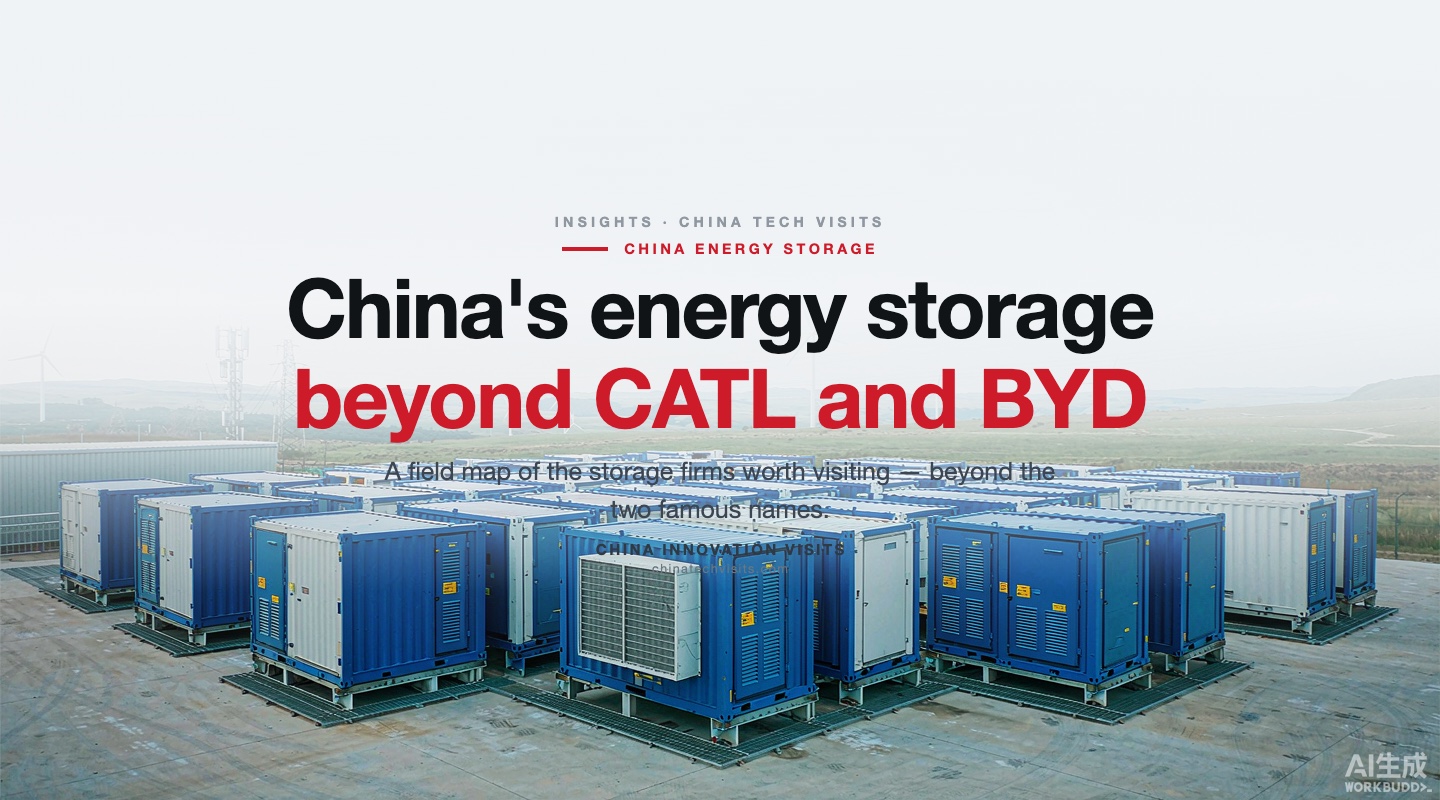
When overseas business owners, technical teams or delegation groups come to China looking for energy storage, they usually arrive with a specification, not a brand preference. The deciding question is whose capability actually matches what you need to build, and that is where the two most famous names stop being the obvious answer. China's energy storage companies run far deeper than those two. CATL and BYD are real giants, and they have earned it, but they are not the whole industry, not even close. Across Guangdong, Zhejiang, Jiangsu, Anhui, Fujian and beyond sits a deep bench of storage battery manufacturers with real engineering, real production lines and real export records. Most overseas buyers have never heard of them, not because they are second-rate, but because the giants absorb almost all of the attention. For a buyer with a specification to meet, that is a costly blind spot.
This field map is built from the Qianzhan Industry Research Institute's 2026 comparison of China's listed storage-battery companies. It is organised the way a buyer actually works: start from the application, narrow to a shortlist, decide what to verify, then go and verify it in person.
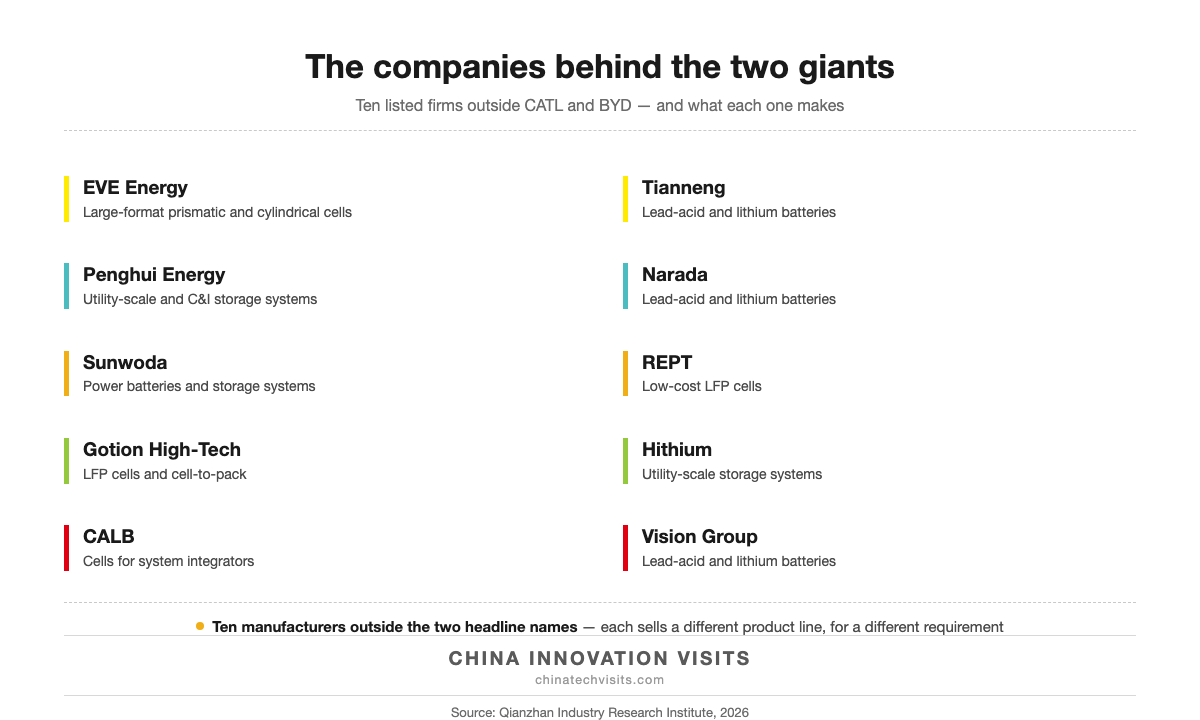
The companies behind the two giants: ten listed firms outside CATL and BYD, and what each one makes. Source: Qianzhan Industry Research Institute, 2026.
Start with the application, not a brand
Mature buyers rarely shop for "storage" in the abstract. They arrive with a project type: a grid-scale solar-plus-storage farm, a factory that needs peak shaving, a telecom backup requirement, or a plan to build packs from cells. Each of those narrows the field very differently.
The table below is a preliminary map from application to companies worth researching, and to the capabilities that decide whether a supplier genuinely fits. It is drawn from the Qianzhan company data and public product information. It does not mean any listed company has passed project certification, holds a specific certificate for your market, or will accept a given cooperation model. Each line still has to be verified case by case.
| Your requirement | Companies worth researching | What to verify |
|---|---|---|
| Utility-scale grid storage, solar-plus-storage | Hithium, EVE, Gotion, REPT | MWh-scale system integration, safety, grid-connection, reference projects |
| Commercial and industrial (C&I) storage | Penghui, Gotion, EVE | Modular system design, economics, O&M, local certification |
| Cells and packs for your own assembly | EVE, CALB, REPT, Gotion | Cell consistency, cycle life, volume delivery, OEM terms |
| Telecom and backup power | Vision Group, Narada, Tianneng, EVE | Reliability, environmental tolerance, maintenance cycles |
| International sourcing and channel partnership | Hithium, Sunwoda and others | Overseas service, sales territories, agent policy, delivery record |
For a first pass, this is usually enough to decide which two or three regions and which handful of companies deserve a closer look. Some of the firms publish their own evidence, and that material is more useful for judging fit than a revenue chart. EVE, for example, publicly lists grid, telecom and residential storage solutions, and Hithium has documented a series of international project cases. What those documents do not tell you is how the company behaves when your specification is unusual. That is a conversation, not a download.
What to verify before you shortlist
For an engineering team evaluating energy storage manufacturers in China, five dimensions usually decide whether a supplier is a real candidate rather than a brochure.
- Technical capability. Product parameters, cycle life, thermal management, BMS and system integration. How a 314 Ah cell is actually stacked, or how a 5 MWh enclosure is laid out, is not trivia: it sets cycle life, thermal behaviour and safety margin, which is what your project is really buying.
- Certification and compliance. The safety and grid-compliance certifications your target market requires, plus the supporting test reports. Ask which certificate covers which product and which destination.
- Manufacturing capability. Capacity, quality control, cell-to-cell consistency and the ability to customise without losing yield.
- International delivery experience. Actual overseas projects, delivery cycles and after-sales support, not just an export licence.
- Commercial fit. Order scale, cooperation model, technical support and commercial terms.
Certification deserves particular care, because it is the easiest thing to blur in a first meeting. It differs by destination and by product type, and a cell certificate is not a system certificate. A system-level safety standard such as UL 9540 applies to the complete storage system and cannot be satisfied by a cell-level approval alone. Asking a supplier which certificates they hold, for which product and for which market, is one of the fastest ways to separate a serious exporter from a deck of slides.
Pearl River Delta (Guangdong): breadth, not just scale
Guangdong hosts more listed storage-battery firms than any other province, concentrated around Shenzhen, Huizhou and Guangzhou. The interesting thing is not the headcount but the variety packed into a few hundred kilometres: a pure-play storage maker, a fast-growing challenger and a dual-use cell producer, all within reach of one itinerary.
- EVE Energy (Huizhou) — its product range covers both large-format prismatic cells for utility-scale storage and cylindrical cells for smaller packs, with dedicated energy-storage lines. A visit shows electrode coating, stacking and module assembly under one roof, which is where questions about consistency and form-factor trade-offs actually get answered.
- Penghui Energy (Guangzhou) — its storage business spans both utility-scale projects and smaller commercial-and-industrial (C&I) installations, so one site shows how production lines are split between very different customers. For a C&I project, that split is worth seeing before you commit to a specification.
- Sunwoda (Shenzhen) and Vision Group (Shenzhen) — Sunwoda's range covers power batteries and stationary storage systems; Vision Group makes lead-acid and lithium batteries for storage and backup power. Both extended a core battery line into stationary storage without rebuilding from scratch, which tells you something about how they handle a new requirement.
What you learn here: China's storage supply chain is not monolithic. Within a single delta you can compare a pure-play storage maker, a fast-growing challenger and a dual-use cell producer in adjacent cities, and watch the same chemistry solve three different problems.
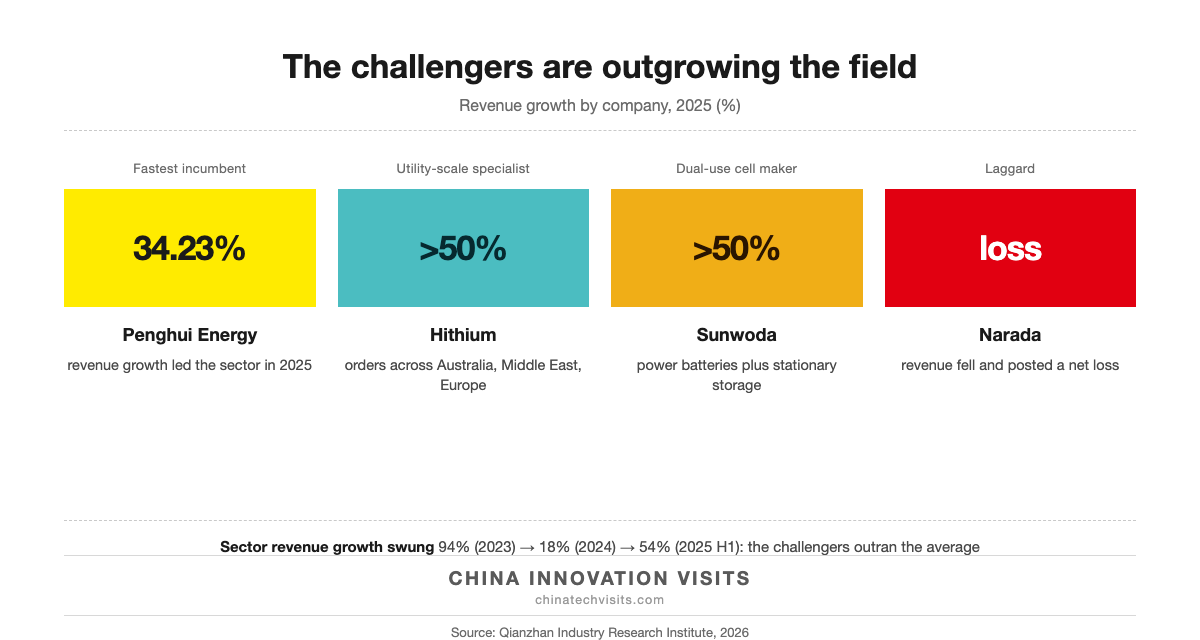
Revenue growth by company, 2025: the challengers are expanding fastest, Penghui leads the incumbents at 34.23% while Hithium and Sunwoda grow above 50%. Fast growth is a rough proxy for how hard a company is pushing capacity and export sales. Source: Qianzhan Industry Research Institute, 2026.
Yangtze River Delta: the second wave
The Yangtze River Delta, covering Zhejiang, Jiangsu and Anhui, is where the challenger tier concentrates: companies with national scale but far less Western name recognition.
- Gotion High-Tech (Hefei, Anhui) — its core line is LFP cells and cell-to-pack (CTP) modules for vehicles and stationary storage. The Hefei visit shows electrode processing and pack assembly end to end, which makes the cost-and-safety logic of LFP concrete rather than theoretical.
- CALB / China Lithium Battery Technology (Changzhou, Jiangsu) — its cells are specified to work inside system integrators' products rather than sold as a standalone brand. That makes it a strong stop for understanding how a cell becomes a deployable system, which is the part most supply-chain reports skip.
- Tianneng (Huzhou, Zhejiang) and Narada (Hangzhou, Zhejiang) — both span lead-acid and lithium batteries for storage and backup power, backed by a mature recycling loop. For circularity and total cost of ownership, these sites show the material-recovery and "battery passport" side that a pure cell tour will not.
- REPT (Wenzhou, Zhejiang) — its capability comes from upstream material integration: it controls more of the cell's material chain than a pure assembler, a different technical route to competitiveness than brand or scale. On the floor, that shows up as a tightly squeezed process rather than headline volume.
What you learn here: the Delta is where process engineering and chemistry specialisation live. If your real question is how a supplier holds a specification at volume, this is the cluster to walk through, because the answers are in the process, not the press release. For the inverter and system side of the same Hefei cluster, Sungrow's operations are the adjacent reference.
Fujian: the giant's backyard, and more
Fujian is globally synonymous with CATL (Ningde), and rightfully so. CATL posted roughly 283 billion yuan in revenue across the first three quarters of 2025 with a gross margin above 25%, the clearest proof of scale plus margin discipline in the sector. Yet look one city south and you find Hithium (Xiamen), whose range is containerized utility-scale storage systems, with a documented overseas-order book across Australia, the Middle East and Europe. It is the useful counterpoint to CATL: the same utility-scale ambition, built by a company most overseas buyers have never encountered, and one that publishes project references you can actually check.
What you learn here: even inside the province everyone associates with one giant, a second, sharper player is building dedicated energy-storage capacity. The "beyond the giants" story is not abstract. It is geographic, and it is visible from the same regional base.
Inland expansion: the next cluster forming
Production capacity is no longer confined to the coast. The Qianzhan report, drawing on the Volta Foundation's 2025 battery report, points to combined planned capacity of about 6,401 GWh across Chinese storage-battery firms, with bases extending from the Yangtze and Pearl River Deltas toward the Chengdu and Chongqing inland hub. For a buyer, that means a future route may pair a coastal cell tour with an inland gigafactory stop, which matters if you are tracking where the next wave of capacity is actually being built rather than where it is advertised.
The numbers, briefly
Two figures from the 2026 Qianzhan comparison are worth keeping in view, and neither is about price.
- Sector average gross margin rose from about 14.6% in 2022 to about 20.3% in the first half of 2025, which suggests the industry is moving from a volume race into a process-and-technology race.
- Overseas demand concentrates in Australia, the Middle East, North America and Europe, with South America and Africa drawing selective entries. That is the map your own export destination sits on.
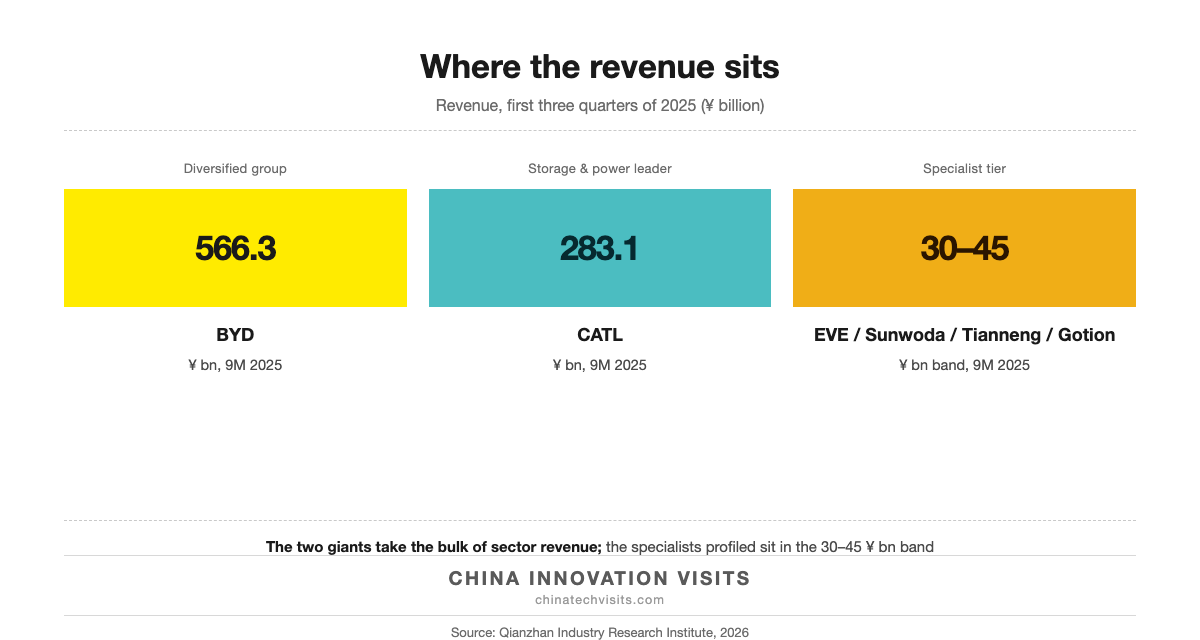
Revenue by company, first three quarters of 2025 (¥ billion). BYD and CATL dominate the headline numbers; the specialists profiled still sit in the 30–45 ¥ bn band, substantial businesses in their own right. Source: Qianzhan Industry Research Institute, 2026.
None of those numbers tell you which factory floor is worth standing on. That is the point.
How a visit turns a shortlist into a decision
A shortlist is not a decision. Three things usually close the gap, and all three happen on site.
Technical discussion. A visit is the point where your engineering team sits with the supplier's engineers and works through specifications, thermal design, BMS architecture and integration questions in person. That is a different conversation from a sales meeting, and it usually surfaces constraints that no brochure mentions.
Certification verification. Instead of accepting a list of certificates, you can see which document covers which product and which market, and ask how a system-level approval was actually obtained.
Manufacturing and engineering capability. Seeing the line running, the quality gates and the test benches tells you more about consistency than any capacity figure. Where a site opens a dedicated energy-storage line rather than a showroom, that difference alone is informative.
For a delegation, the same visit opens the partnership conversation: whether the company is open to OEM work, dedicated lines, joint development or a regional arrangement, and under what conditions. None of this replaces due diligence, but it shortens the path from "interesting" to "worth a second meeting".
Questions about visiting China's storage firms
Can overseas executives actually visit these battery companies, or only read about them? Most are open to organised business and institutional delegations through arranged programmes, though what you see varies by site: R&D centres, dedicated energy-storage lines, recycling loops, or in some cases a showroom rather than a live production line. We confirm the exact scope with each host before you commit, so you know what is real rather than assumed.
Which cluster should a first-time visitor prioritise? It depends on your requirement. The Pearl River Delta shows breadth: a pure-play storage maker, a fast-growing challenger and a dual-use cell producer in one region. The Yangtze River Delta shows process engineering and the challenger tier. Fujian shows the giant beside a sharp utility-scale specialist. A multi-city route can cover two or three without losing days to domestic flights.
How far ahead should we plan, and what group size works? Plan at least 30 days ahead; host scheduling is confirmed case by case. Programmes are often built around groups of about 10, which is the size many corporate hosts are set up to receive. Smaller teams, including a two- or three-person owner or engineering group, can often be accommodated. Tell us your numbers and we will confirm what is possible.
The programmes above are built around each host's availability, and the facilities and areas open on the day are subject to what the site opens. We confirm the final scope in writing during planning, before you commit.
Finding the Right Energy Storage Partner in China
The best energy storage supplier is not necessarily the largest or the lowest-priced. It is the one whose technology, manufacturing capability, certifications and delivery experience align with your project's requirements.
China offers far more options than the brands most international buyers already know. The challenge is identifying which companies are genuinely capable of meeting your specific needs, and finding the right people to speak with.
At China Innovation Visits, we help international business leaders, engineering teams and industry delegations explore China's energy storage supply chain through tailored company visits and technical exchanges.
Whether you are evaluating battery cell manufacturers, exploring utility-scale storage solutions, looking for an OEM partner, planning a China battery factory tour, or assessing potential suppliers for an upcoming project, we can help you identify relevant companies, arrange professional discussions and explore opportunities for on-site visits.
Tell us what you are looking to build, source or evaluate in China. We can help you find the companies worth meeting.