Warehouse automation starts with the order
A warehouse has to receive goods, store them, find the right stock and dispatch the right order. Robotics changes how those jobs are organised: a rack can move to a picker, a robot can retrieve a tote from high shelving, or a shuttle can bring a pallet out of dense storage.
China's warehouse robotics companies build different parts of that operation. Geekplus connects mobile robots with goods-to-person picking. Hai Robotics specialises in automated case-handling systems. Quicktron combines storage and transport technologies around warehouse layouts. Guozi brings robotic picking together with conveyors and control software.
The distinction matters when comparing companies. A warehouse holding individual retail items needs a different design from one storing full pallets. The following four companies illustrate those choices through healthcare, department-store, electronics and retail warehousing applications.
Meet four Chinese warehouse robotics companies
| Company | China headquarters | Main products | Application in this guide |
|---|---|---|---|
| Geekplus 极智嘉 | Beijing | Mobile robots, warehouse software and goods-to-person systems | DHL healthcare logistics in Auckland |
| Hai Robotics 海柔创新 | Shenzhen | Case-handling robots, workstations and HaiPick storage systems | John Lewis' Fenny Lock distribution centre |
| Quicktron 快仓 | Shanghai | Shelf, bin and pallet systems, mobile robots and shuttles | A TCL electronics warehouse with an irregular layout |
| Guozi 国自机器人 | Hangzhou | PICKING robots, robotic forklifts and warehouse control | Lotte retail distribution |
These companies work at the point where storage equipment, robots and software meet. Their engineering strength lies in making the whole warehouse process work: receiving and replenishing stock, retrieving it in the right sequence, and keeping picking and dispatch supplied.
Geekplus: mobile robots and complete warehouse systems
Geekplus was founded in 2015 and is headquartered in Beijing. It supplies autonomous mobile robots, warehouse software and goods-to-person systems for retailers, e-commerce businesses and logistics operators. The company listed on the Hong Kong Stock Exchange in July 2025.
Its warehouse systems operate in over 40 countries, with more than 1,000 projects worldwide. The product range covers moving shelves, retrieving totes and handling pallets, supported by software that coordinates the equipment. That breadth makes Geekplus relevant to operators comparing several ways to automate one warehouse.
RoboShuttle, used in the application below, retrieves totes from storage so that goods can be presented for picking. It moves part of the travel inside the warehouse from people to machines.
At DHL Supply Chain's Te Kapua facility in Auckland, 41 Geekplus robots form part of the healthcare logistics operation. The installation involves local automation integrator Automate-X, whose work includes installation, testing and on-site training. That division of responsibilities matters: robots are one part of a warehouse system that also needs commissioning, interfaces and operating procedures.
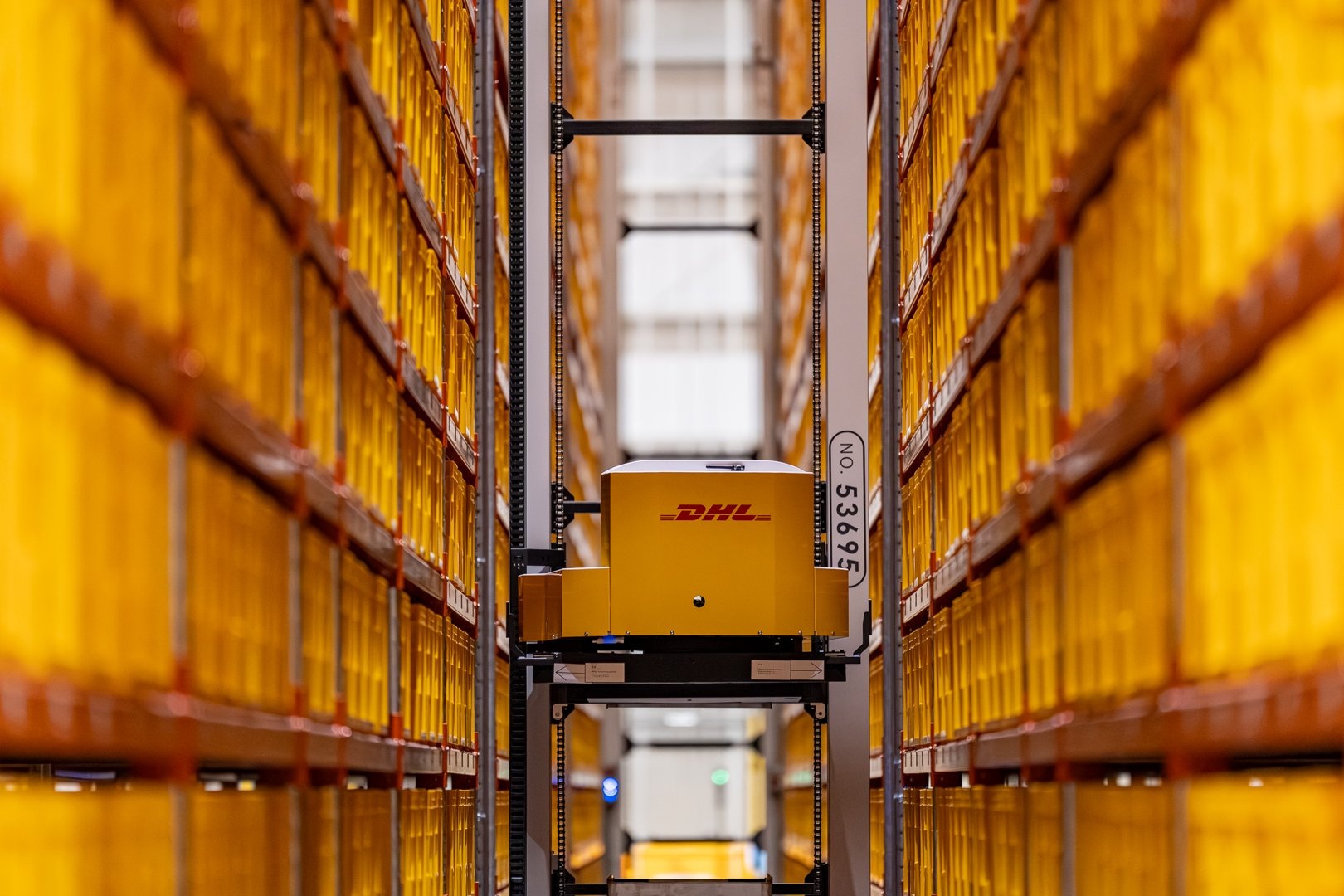
Geekplus RoboShuttle warehouse equipment. Photo: Geekplus.
Healthcare warehousing makes the relationship between physical movement and inventory records particularly useful to examine. Retrieving a container is only one step; the operation also has to preserve the connection between that container, its contents and the order being fulfilled. A technical discussion can follow one tote from its storage location to the picking process and back.
Hai Robotics: a specialist in automated case storage
Founded in 2016 and headquartered in Shenzhen, Hai Robotics specialises in automated case-handling and storage systems. Its HaiPick range combines robots, racking, workstations and software into a modular automated storage and retrieval system. Customers include retailers, e-commerce businesses and third-party logistics operators.
More than 1,700 HaiPick systems operate across over 40 countries and regions. Its technical focus is retrieving individual cases from shelving and connecting them with picking and replenishment, while allowing the system to be expanded or reconfigured. This is particularly relevant to warehouses with many product lines and a need to use vertical space more effectively.
At John Lewis' Fenny Lock distribution centre in the UK, the system includes 60 HaiPick A42T robots and 10-metre shelving. Logistex integrates the wider warehouse solution. HaiQ's execution software connects with Logistex's warehouse management system, linking robotic work with warehouse instructions.
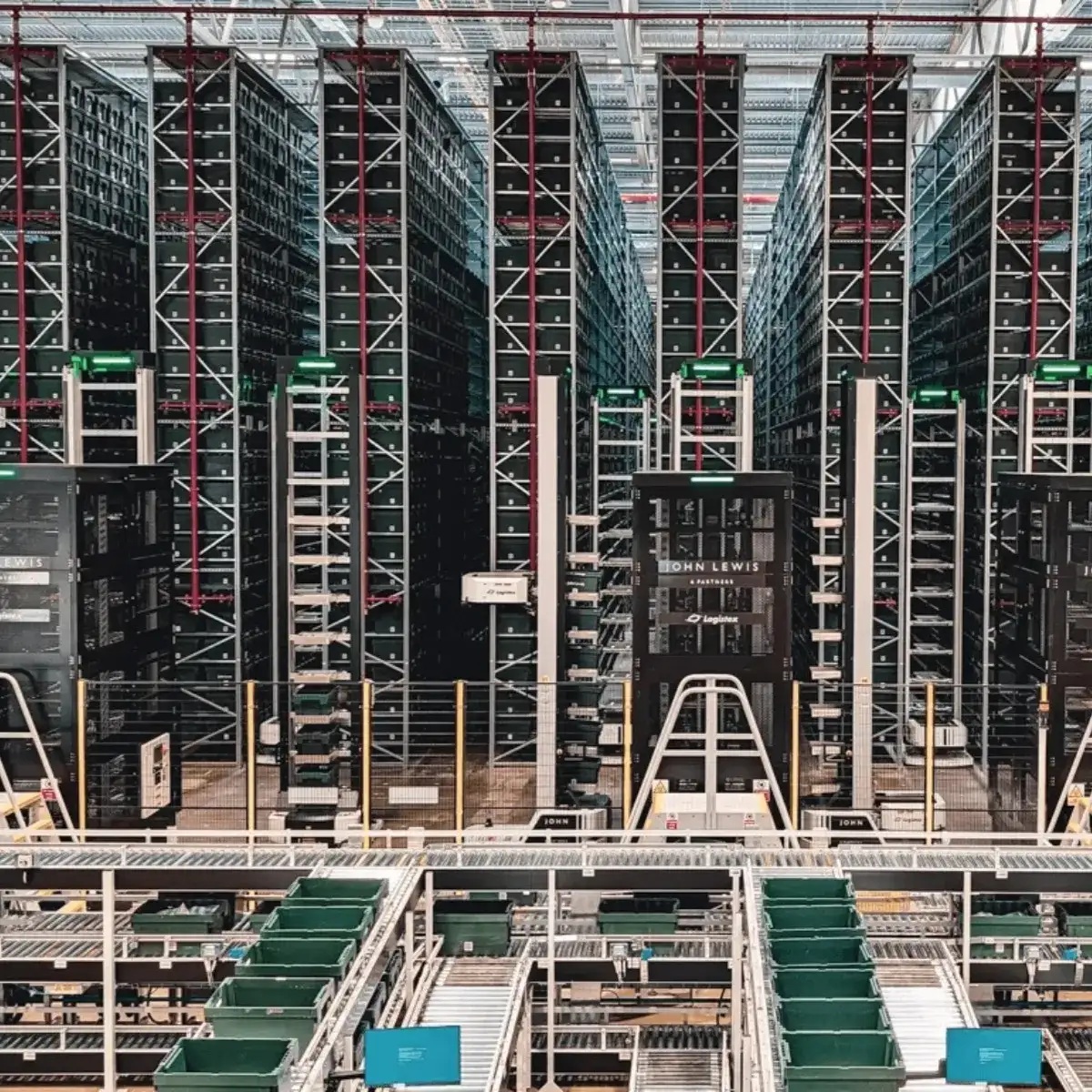
Case-handling robots, storage racks and conveyors at Fenny Lock. Photo: Hai Robotics.
Height alone does not determine capacity. Stock also has to get into storage, reach a workstation and return after a partial pick. The engineering comparison therefore includes tote dimensions, replenishment, buffers and workstation loading. A tall storage system can still be constrained by a busy handover point at floor level.
Quicktron: combining shelf, bin and pallet automation
Quicktron was founded in 2014 and is headquartered in Shanghai. It develops mobile robots, warehouse software and shelf-to-person, bin-to-person and pallet-to-person solutions. Its systems serve more than 1,000 customers across over 20 countries.
Its strength is combining different handling and storage methods around the goods and building. A warehouse may need dense pallet storage in one zone and flexible robot movement in another; Quicktron's range provides several modules for that design. The TCL warehouse application below illustrates how shuttles and mobile robots work together.
That project combines four-way shuttles with mobile robots in an irregularly shaped building of approximately 3,100 square metres. Beams, floor layouts and movement between storage areas all affect the design.
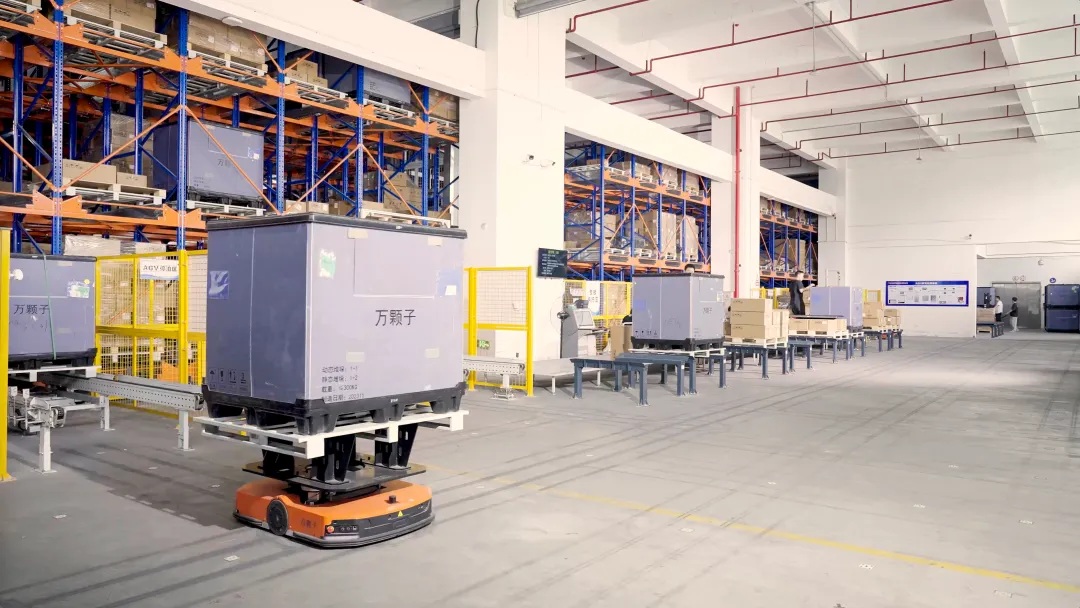
Mobile handling equipment in the Quicktron TCL warehouse application. Photo: Quicktron.
This is an electronics manufacturer's warehouse, and the relevant work here is storage and retrieval. Four-way shuttles move within the storage structure; mobile robots connect handling points outside it. Their work has to be coordinated with lifts and the building's available clearances.
The case is useful for operators adapting existing premises. The starting question is not how many robots will fit, but which storage positions can be reached and how goods will leave them. A layout review should locate the constraints before equipment is selected: columns, beam heights, lifts, shared transfer points and access for maintenance.
Guozi: picking robots backed by a broader robotics platform
Guozi was founded in 2011 and is headquartered in Hangzhou. It develops mobile robots for logistics, inspection and intelligent manufacturing, serving more than 1,000 customer organisations across its broader robotics business. Its technology base includes navigation, multi-robot scheduling and coordinated operation.
For warehousing, the range includes PICKING robots, robotic forklifts, mobile handling equipment and control software. Its relevance is the ability to connect carton retrieval with the next handling step, rather than considering the robot in isolation. The Lotte project shows that combination in retail distribution.
In that application, PICKING robots operate with conveyors and warehouse, equipment and robot control software. The system handles cartons of different widths and coordinates several robots within an aisle. It also addresses low-temperature warehouse conditions.
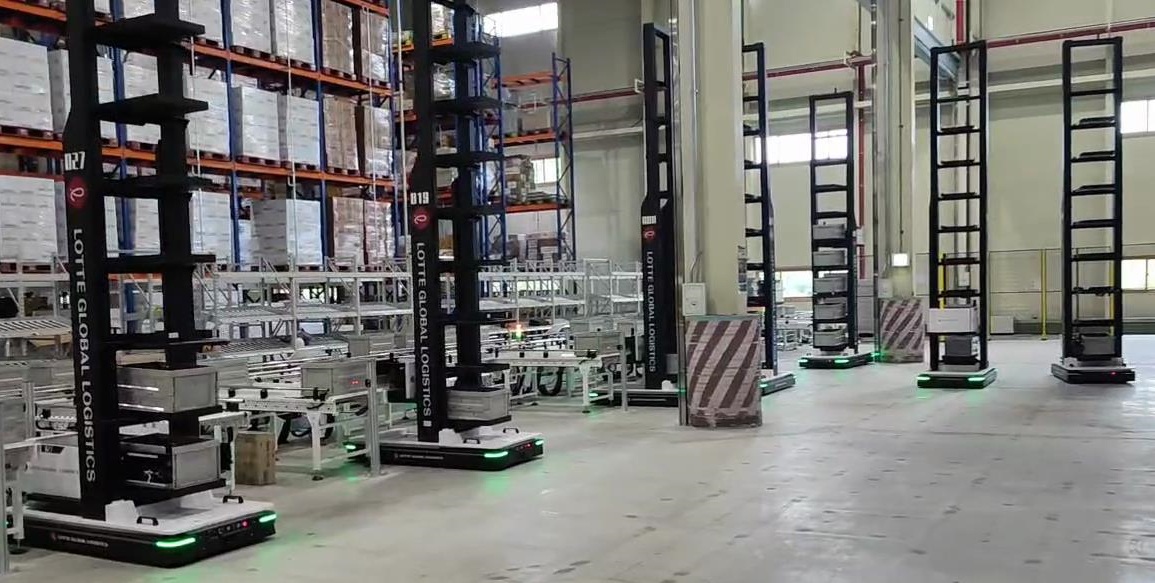
Guozi PICKING robots in the Lotte retail warehouse application. Photo: Guozi.
The technical interest is the combination of physical carton handling and system coordination. A robot needs to retrieve a carton, obtain access to the next transfer point and hand it over in a sequence that the downstream process can use. Different carton sizes make that task more demanding than repeatedly moving an identical container.
For retail distribution, this connects storage decisions with the preparation of goods for different destinations. The useful questions concern compatibility, sequencing and recovery: which cartons can the equipment handle, how are requests prioritised, and how does an operator resolve a blocked or incomplete transfer?
The decisions behind a warehouse design
The first decision is the handling unit. A pallet, a movable shelf, a tote and an original shipping carton impose different requirements on storage equipment and picking. Product dimensions, weight and packaging need to be understood before comparing robot specifications.
The second is the order profile. Total daily orders tell only part of the story. Lines per order, units per line, stock turnover, returns and replenishment all change the workload. A system designed around an average hour may face a different problem during a peak dispatch window.
The third is the connection between systems. A warehouse management system tracks stock and orders. Execution and control software turn those requirements into work for robots, conveyors, lifts and stations. Product names differ by developer; the important issue is which system owns each decision and how it responds when equipment or stock is unavailable.
These operating details help explain why warehouse projects differ in practice. Storage density, picking throughput, software integration and maintenance workflows all shape how a system performs.
Exploring warehouse robotics in China
For overseas warehouse operators, retailers, e-commerce businesses and logistics integrators, these companies offer different engineering conversations. Geekplus brings a goods-to-person warehouse application; Hai Robotics provides a high-storage case-handling perspective; Quicktron illustrates a hybrid layout; Guozi connects carton picking with warehouse control.
A useful technical exchange follows a complete warehouse task, from an inventory or order instruction through equipment movement to the recorded result. A blocked location, a missing item or a replenishment request can reveal how the system behaves beyond a straightforward demonstration.
China Innovation Visits can prepare a company exchange around your warehouse type, handling units and operating questions. Request a warehouse automation programme with your organisation, preferred dates, group size and technical priorities. For a related software perspective, read our machine vision and robot software guide. For an operator-level perspective, explore our JD Logistics warehouse programme in Dongguan.
Sample visit programme
The following sequence is an example for one selected host company. The agenda and session lengths are agreed during planning.
| Segment | Time | What to expect |
|---|---|---|
| Warehouse requirements | Opening session | Review handling units, order profile, building constraints and a relevant application. |
| Equipment demonstration | Main session | Follow a tote, carton, shelf or pallet through storage retrieval and a workstation handover. |
| Software and exceptions | Technical discussion | Examine task allocation, inventory updates, replenishment and recovery from an interrupted transfer. |
| Key takeaways | Closing session | Review the technical trade-offs, system integration boundaries and operational lessons discussed during the exchange. |
Questions about warehouse robotics company visits
Does this programme cover factory production-line delivery? This guide focuses on warehouse receiving, storage, picking and dispatch. Production-line supply and transfers between manufacturing processes are a separate subject. Tell us which operation you want to examine so that the company and agenda match it.
Can we visit the DHL, John Lewis, TCL or Lotte sites described here? Those examples explain the companies' technologies. A company exchange and access to a customer's warehouse require separate arrangements. We confirm the host location, facilities and activities for each programme.
Can a visit include robot and software demonstrations? Tell us whether you work with pallets, shelves, totes or cartons, and which warehouse process matters most. We use that information to request an appropriate demonstration and technical discussion. The agreed programme identifies the equipment and activities included.
What group size and planning time should we allow? Groups of 10–20 generally offer better per-person economics, with pricing by group. Individuals and smaller teams can enquire for a tailored quotation. We recommend allowing at least 30 days for coordination; shorter lead times require an availability check.
What should we send for a proposal? Include your organisation, participant roles, group size, dates, preferred cities and warehouse objectives. Where your company permits it, a short description of handling units, stock and order patterns, existing systems and building constraints helps us prepare the discussion. Company arrangements, interpretation, local transport and other services are specified in the quotation.
Final host locations, demonstrations, meeting participants and access arrangements are confirmed during programme planning.